

If you’re asking, “can I get a second opinion on my tax debt,” yes. A qualified tax professional can review the records and reasoning behind the reported balance. A second opinion doesn’t mean the first assessment was wrong. It can help you understand how the balance was reached and whether it matches the available tax history.
It’s understandable to feel uncertain when a balance is difficult to trace or earlier returns or records may contain errors. A careful review can examine IRS transcripts, filed returns, notices, payment records, and the strategy already proposed. This article explains what a second opinion can establish, which documents and questions can make the review more useful, and how to choose a next step based on the findings.
Key Takeaways
- If you’re asking “can I get a second opinion on my tax debt,” a review can assess the evidence without presuming the original assessment is wrong.
- Gather IRS notices, filed returns, payment records, and tax-related correspondence to give the reviewer useful context.
- Transcript analysis can clarify IRS account history. Comparing it with your own records may identify questions that need further review.
- A review may support the current assessment, raise questions, or identify missing information. Any next-step strategy should reflect the facts and IRS guidelines.
Can I Get a Second Opinion on My Tax Debt, and What Can It Tell Me?
Yes. You can ask another qualified tax professional to review a tax-debt assessment without assuming the first assessment was wrong. A second opinion examines the available facts, filed returns, IRS records, and advice you’ve already received. The goal is to determine whether the explanation and proposed next steps are supported by the records, not simply to get a different answer.
Disagreement alone doesn’t establish an error. A reviewer needs records showing what was filed, what the IRS recorded, and how the balance was assessed. Comparing those details can help establish whether the assessment is consistent with the documented history, whether an issue needs clarification, or whether important information is missing.
When does a second opinion on tax debt make sense?
A review may be useful if the balance changes without a clear explanation, a tax period you expected to see is missing, or the advice you received doesn’t address the notices and account records you have. For example, if you have proof of a payment but aren’t sure how it was applied, a reviewer can compare the payment record with the available IRS account history.
An unexpected balance can have several explanations, including account activity or information that isn’t reflected in the records you’re reviewing. The documents are needed to determine what explains a particular balance. Transcript analysis can help examine IRS account history, while filed returns, notices, payment records, and correspondence provide context. Compare the tax periods and amounts across these records, and note any dates or entries that don’t seem to match.
Asking “can I get a second opinion on my tax debt” is different from requesting representation or choosing a resolution strategy. The review first examines the assessment and prior advice. If you want help addressing the matter afterward, a tax professional can assess the facts and discuss a tailored strategy subject to IRS guidelines. Let the findings guide that next step.
How to Prepare for a Tax-Debt Second Opinion
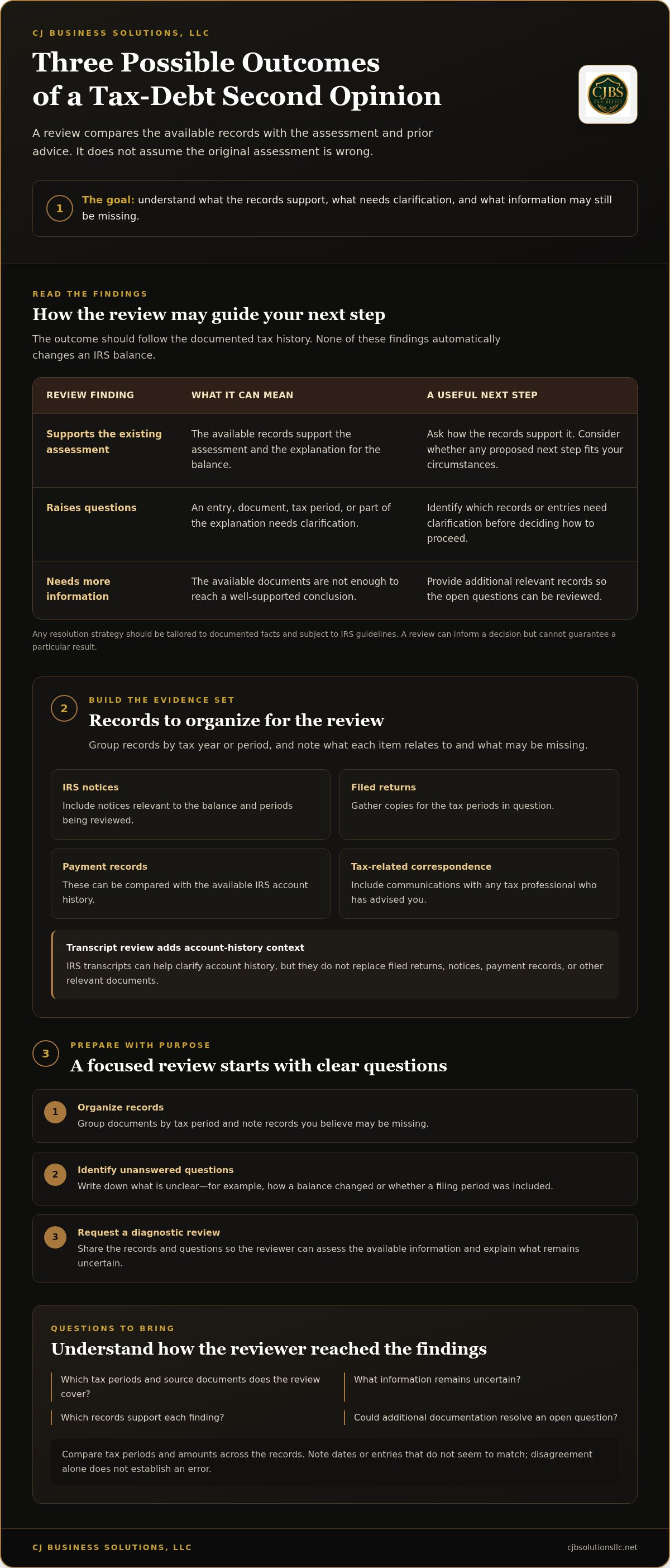
Organized records make a second opinion more focused. Collect IRS notices, copies of filed returns for the periods in question, payment records, and correspondence with any tax professional who has advised you. Group documents by tax year or period, and make a note of what each one relates to. Transcript review can clarify IRS account history, but it doesn’t replace your returns, notices, payment records, or other relevant documents.
Use this sequence to prepare:
- Organize records. Group documents by tax period and note any records you believe may be missing.
- Identify unanswered questions. Write down what you don’t understand, such as how a balance changed or whether a particular filing period was included.
- Request a diagnostic review. Share the records and questions so the reviewer can assess the available information and explain what remains uncertain.
What should I ask during an independent tax-debt review?
Ask which tax periods and source documents the review covers, what information remains uncertain, and how the reviewer reached their assessment. Find out which records support each finding and whether additional documentation could resolve an open question. These details can help you understand the reasoning, even if the review supports the advice you already received.
CJ Business Solutions, LLC provides transcript review and diagnostic investigation for tax matters. Organizing your records and preparing specific questions can help focus the review on your documented tax history and the issues you want addressed.
What Happens After a Second Opinion on Your Tax Debt?
A review should give you a clearer picture of what the records support and what remains unresolved. The findings may point in one of three directions:
- The review supports the existing assessment. Ask for an explanation of how the records support it, then consider whether any proposed next step fits your circumstances.
- The review raises questions. The reviewer can identify which entries or documents need clarification before you decide how to proceed.
- More information is needed. You may need to provide additional records before anyone can draw a well-supported conclusion.
None of these outcomes automatically changes an IRS balance. If a resolution strategy is appropriate, it should be tailored to the documented facts and subject to IRS guidelines. A review can inform that decision, but it can’t guarantee a particular result. Use the findings to decide whether to gather more information, seek clarification, or discuss representation.
When might professional IRS representation be the next step?
If you want help addressing the matter after the review, IRS authorization can allow a representative to access relevant account information and act within the authority granted. Transcript review can clarify IRS account history, and ongoing representation can support follow-through as the matter is addressed. These steps are separate from the second opinion, so you can weigh them against the review’s findings.
Crystal Johnson is an Enrolled Agent authorized to represent eligible taxpayers before the IRS. If you’re considering representation, you can discuss a confidential tax-resolution review and the records relevant to your next step.
Choose Your Next Step With Care
A second opinion can give you a clearer basis for deciding what to do next. If you’re still asking, “can I get a second opinion on my tax debt,” consider what would help you move forward with confidence, such as clarifying a discrepancy, understanding how a balance was calculated, or discussing representation.
Crystal Johnson is an Enrolled Agent, CPA, and Audit Defender with More Than 25 Years of Accounting Experience. For a confidential review of your tax situation, discuss a confidential tax-resolution review with CJ Business Solutions. Any next steps can be tailored to your circumstances and records, subject to IRS guidelines. The review can help you understand the available information and consider a practical path forward.
Frequently Asked Questions
Can I get a second opinion on my tax debt if I already have a tax professional?
Yes. You can seek another review without assuming your current professional made a mistake or deciding to change representatives. For a useful comparison, ask the reviewer to explain which records they considered and how those records support their conclusions. Clarify whether the review covers only the assessment or also includes advice on potential next steps.
Can a second opinion show whether my IRS tax balance is incorrect?
A second opinion may identify discrepancies or questions for further investigation, but a different conclusion alone doesn’t prove the balance is wrong. The reviewer needs supporting details, such as the relevant filings, IRS records, and payment information. For example, a payment receipt may help explain a difference between your records and the account history, but the full context still matters.
Should I seek a second opinion after receiving an IRS notice?
A review may help you understand the issue, but don’t set the notice aside while arranging one. Read it carefully, note any response instructions and deadlines, and share the complete notice with the tax professional. The notice may identify a particular tax period or issue, helping focus the review. Keep a copy with related records and correspondence.
Can an Enrolled Agent represent me before the IRS after a second opinion?
Yes. An Enrolled Agent may represent eligible taxpayers before the IRS, and you can consider representation after reviewing your circumstances. At CJ Business Solutions, a diagnostic review informs a personalized resolution strategy. Any proposed solution is subject to IRS guidelines, and no result is guaranteed. Whether ongoing representation is appropriate depends on the review findings and the support you need.

Article by
Crystal R. Johnson, MBA EA
Crystal Johnson founded CJ Business Solutions to give individuals and small-business owners something often missing from the tax and accounting process: clear explanations, practical solutions, and trusted support.
With more than 27 years of accounting and financial experience, Crystal helps clients understand complicated tax matters, restore compliance, respond to IRS concerns, and make stronger business decisions. As an Enrolled Agent, she is federally authorized to represent taxpayers before the Internal Revenue Service.


