

What if the amount withheld from your paycheck depends partly on details you can clarify? An IRS wage levy can reduce each paycheck, making rent, groceries, and other household expenses harder to manage. If you’re looking for IRS wage garnishment assistance, it’s understandable to feel unsure which notice matters or how quickly you need to act. The levy’s effect on take-home pay depends in part on your filing status, dependents, and pay schedule.
A focused review can help you move from uncertainty to informed next steps. Start by identifying the tax periods and deadlines in your notices, then compare them with your account and payment records. This article explains what a wage levy means and which tax and financial records to gather for a case review.
An Enrolled Agent can use IRS transcript analysis and representation to clarify account history, review hardship information, and evaluate possible resolution paths. The right approach depends on your circumstances, so begin with the details of your account and the effect of the withholding on your household.
Key Takeaways
- An IRS wage levy is a collection action. Review the notice, tax periods, and account status before deciding how to respond.
- Gather tax returns, IRS correspondence, income records, household expense details, and prior payment information for a clearer case review.
- IRS wage garnishment assistance can help you understand your account history and consider a resolution path suited to your circumstances.
- An Enrolled Agent can review notices and financial information, while transcript analysis can help identify relevant account issues.
IRS Wage Garnishment Assistance: What a Wage Levy Means
An IRS wage levy is a collection action that directs an employer to withhold part of an employee’s wages and send it toward unpaid federal tax debt. Unlike ordinary deductions for taxes, insurance, or retirement contributions, a levy is imposed through IRS collection procedures. The IRS Tax Levy overview provides general background, but the notice you received is the practical starting point for understanding your own case.
How an IRS wage levy affects a paycheck and collection account
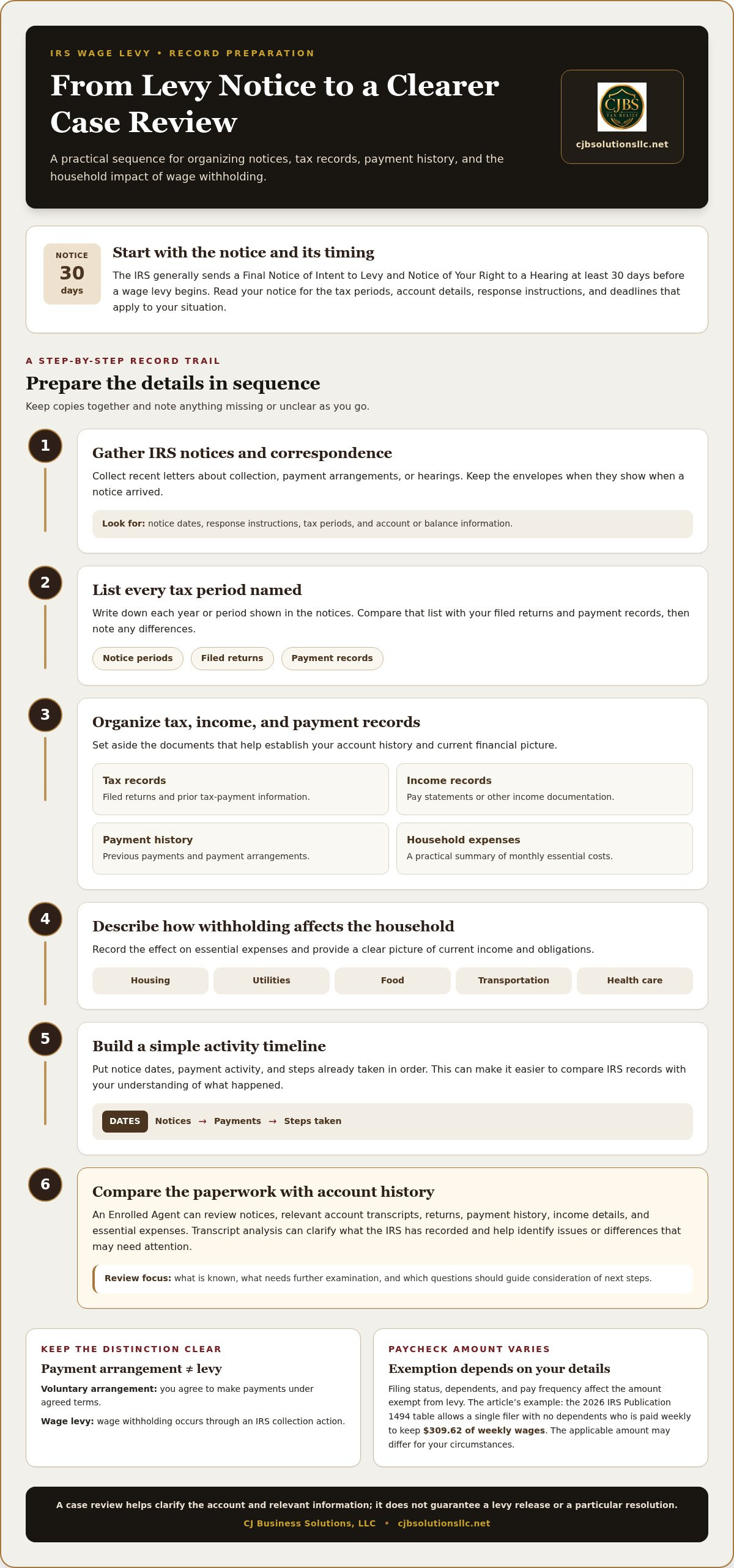
A wage levy generally continues across paychecks until the debt is paid, the levy is released, or collection ends under applicable rules. The amount exempt from levy depends on factors such as filing status, dependents, and pay frequency. For example, the 2026 IRS Publication 1494 table allows a single filer with no dependents who is paid weekly to keep $309.62 of weekly wages. The applicable amount may differ for your circumstances.
Read the notice closely and note the tax periods involved, the balance or account information, and any response instructions or deadlines. The IRS generally sends a Final Notice of Intent to Levy and Notice of Your Right to a Hearing at least 30 days before a wage levy begins. Compare the periods in the notice with your tax and payment records. A payment option that addresses one part of an account may not address every period or issue.
A voluntary payment arrangement is different from a levy: you agree to make payments under agreed terms, while a levy results in wage withholding through a collection action. IRS wage garnishment assistance means reviewing levy notices, account details, and financial circumstances to help evaluate an appropriate response, without guaranteeing a particular outcome. Understanding these details makes it easier to assess what needs attention and what information is still missing.
Prepare for IRS Wage Garnishment Assistance: Records and Questions
Organizing your records can make a case review more focused. Start with the paperwork you have, then list any gaps or questions. The IRS’s IRS Wage Levy Information page explains the process generally. Your notices and financial records help establish the details of your account and how the levy affects you.
- Gather notices. Collect recent IRS letters and correspondence about collection, payment arrangements, or hearings. Keep envelopes if they show when a notice arrived.
- Identify tax periods. Write down each year or period named in the notices. Compare the list with your own returns and payment records, and note any differences.
- Organize records. Set aside filed tax returns, income documentation, and information about previous payments or arrangements.
- Summarize immediate concerns. Record how the wage withholding affects essential household expenses, such as housing, utilities, food, transportation, and health care.
Which financial and tax documents help clarify your situation?
Include pay statements or other income records, a practical summary of monthly household expenses, and proof of prior tax payments when available. Keep copies together and make a simple timeline of notice dates, payment activity, and steps you’ve already taken. This makes it easier to compare what the IRS has recorded with your understanding of what happened.
Transcript analysis can clarify account history and identify tax issues that may affect the review. Complete records help a representative compare IRS account information with your financial circumstances and assess which resolution paths may merit consideration. An Enrolled Agent at CJ Business Solutions, LLC can review these details as part of tax resolution and representation. Learn more about tax resolution and representation as you consider your next steps.
How Professional IRS Wage Garnishment Assistance Supports Next Steps
Once you’ve gathered your records, an Enrolled Agent can interpret them in the context of your IRS account. Professional IRS wage garnishment assistance from CJ Business Solutions, LLC includes reviewing the levy notice and related correspondence, comparing the tax periods in those documents with account details, and discussing how withholding affects your household finances. This organized review helps clarify what is known, what needs further examination, and which questions should guide the next step.
What to expect from a tax-resolution case review
A case review brings together IRS correspondence, relevant account transcripts, filed returns, payment history, income details, and essential household expenses. Transcript analysis can clarify what the IRS has recorded, including account activity or tax issues that may shape the assessment. Comparing transcripts with your notices and records can also highlight differences that deserve attention before you consider a response.
The review does not promise that a levy will be released or that a particular resolution will be available. Instead, it provides a basis for evaluating the account and considering tax-resolution paths in light of your financial circumstances. Appropriate next steps depend on the facts, current IRS procedures, and your ability to meet relevant requirements. If the withholding is creating immediate strain, explain which expenses are affected and provide a clear picture of your current income and obligations.
With representation from an Enrolled Agent, you can discuss your account details and understand how they inform possible next steps. CJ Business Solutions, LLC provides tax resolution and audit defense, including transcript analysis to identify tax issues and develop resolution paths. A careful review can replace guesswork with a more complete understanding of your situation. To discuss your circumstances, Discuss your IRS tax-resolution needs.
Take a Clearer Step Toward Resolving Your Tax Account
A wage levy can make it difficult to plan for everyday expenses, but decisions don’t have to be based on guesswork. Reviewing your notices, account details, and financial circumstances can help identify what needs attention and which resolution paths to consider. IRS wage garnishment assistance helps you make informed decisions based on your own situation rather than assuming one solution fits everyone.
CJ Business Solutions, LLC provides tax resolution and representation nationwide through an Enrolled Agent-led firm. Its services include IRS transcript analysis to identify tax issues and inform possible next steps. While no particular outcome can be guaranteed, clear information supports a more considered assessment of your options.
To discuss your circumstances with CJ Business Solutions, LLC, discuss your IRS tax-resolution needs. A focused review is a practical first step toward understanding your account and considering what to do next.
Frequently Asked Questions
Can the IRS garnish wages without warning?
Generally, the IRS sends notices before taking levy action, including a final notice explaining appeal rights. Notice histories and exceptions can vary, so don’t assume your case followed a standard sequence. Check the dates and response instructions on every letter, including older correspondence. If you’re unsure whether a deadline is still open, seek qualified tax guidance promptly.
What should I do if an IRS wage levy is causing financial hardship?
Review the levy or related correspondence and organize information about how the withholding affects your finances. Before discussing the situation, note your current take-home income, essential bills, and any immediate shortfall, such as difficulty covering rent or utilities. IRS wage garnishment assistance can include reviewing account information and organizing these facts to help evaluate possible next steps.
How much of my paycheck can the IRS take through a wage levy?
The levy doesn’t necessarily take your entire paycheck. IRS rules allow an exempt amount, and the calculation can depend on factors such as filing status and dependents. Your pay frequency and the information provided for the calculation can also matter. For an accurate estimate, compare your withholding with the current IRS guidance that applies to your circumstances rather than relying on a general online figure.
How long does an IRS wage levy stay in place?
A wage levy may remain in place until the IRS releases it or another applicable condition ends it. The timing depends on your account and circumstances. Don’t assume a phone call or payment alone ends the withholding. Keep any IRS response or account update with your records, and clarify the levy’s current status and next steps before relying on a change to your paycheck.

Article by
Crystal R. Johnson, MBA EA
Crystal Johnson founded CJ Business Solutions to give individuals and small-business owners something often missing from the tax and accounting process: clear explanations, practical solutions, and trusted support.
With more than 27 years of accounting and financial experience, Crystal helps clients understand complicated tax matters, restore compliance, respond to IRS concerns, and make stronger business decisions. As an Enrolled Agent, she is federally authorized to represent taxpayers before the Internal Revenue Service.


