

What if an accurate tax return still leaves important decisions until next year? Tax planning and compliance work best together: planning helps you consider tax obligations throughout the year, while compliance supports complete, accurate reporting when it’s time to file. It’s understandable to focus on filing requirements, especially when records are spread across the year, but filing readiness can begin well before tax season.
This guide explains how planning and compliance differ, where they connect, and how a manageable routine for organizing records and reviewing decisions can help you prepare. You’ll also learn when professional support can help connect ongoing records with reporting or clarify a tax issue. CJ Business Solutions, LLC provides tax and accounting services for individuals and businesses. Led by an Enrolled Agent, the firm also offers IRS audit defense and transcript analysis to help identify tax issues and inform next steps.
Key Takeaways
- Use year-round records to connect tax decisions with accurate reporting and filing readiness.
- Tax planning and compliance serve different purposes, but reviewing them together can help you anticipate obligations and avoid reactive decisions.
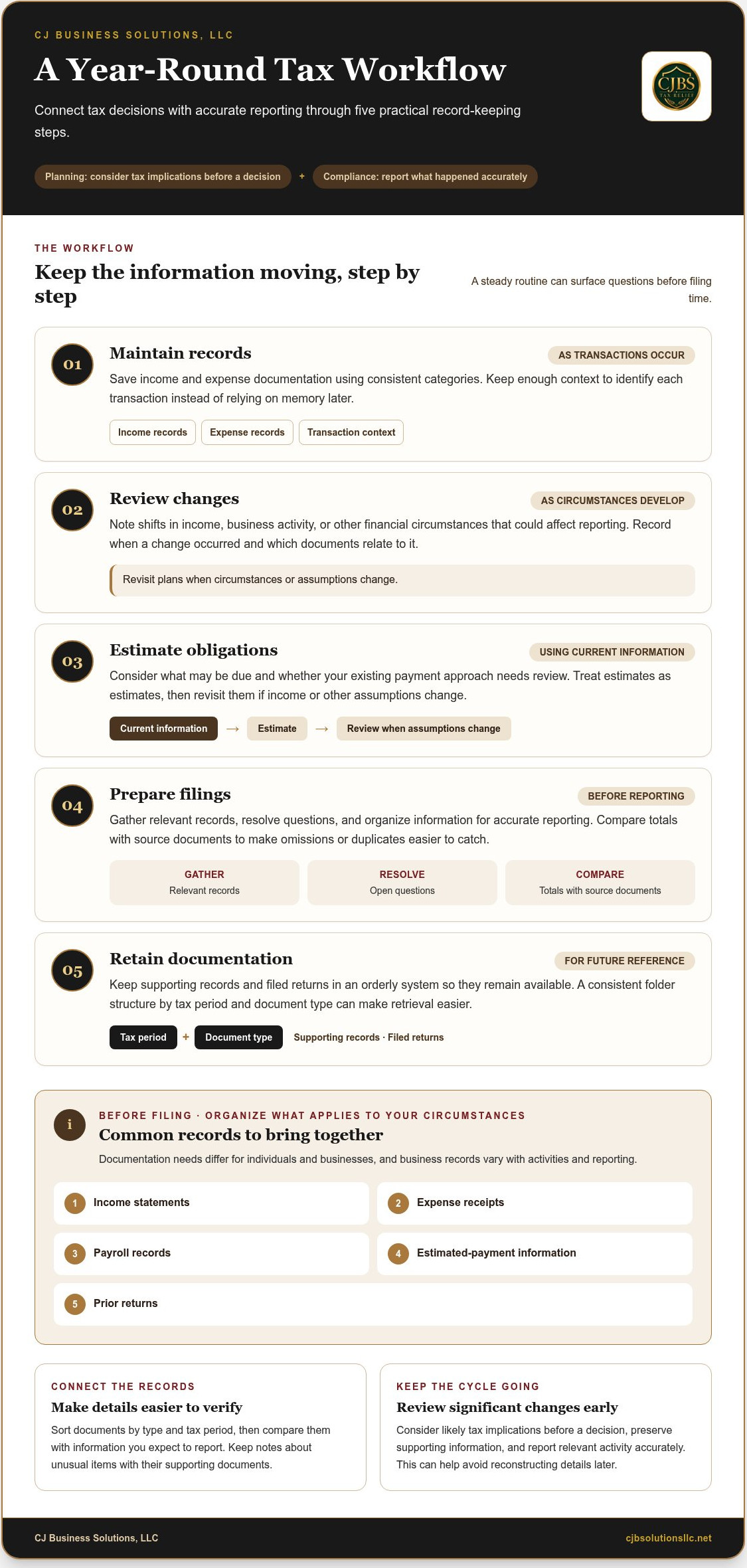
- Build a simple workflow: maintain records, review changes, estimate obligations, prepare filings, and retain documentation.
- When finances change, records are incomplete, or reporting becomes complex, professional guidance can help clarify relevant information and practical next steps.
Tax Planning and Compliance: How They Work Together
Tax planning means considering the possible tax consequences of a decision before acting. Tax compliance means accurately reporting relevant financial activity and completing required filings. The two rely on much of the same information: current records of income, expenses, transactions, and other relevant events. Understanding What is Tax Compliance? helps clarify why accurate reporting matters, while planning considers what a choice may mean before it appears in a return.
Planning is proactive: it considers tax implications before a decision; compliance is the responsibility of reporting what happened accurately and meeting filing requirements. Organized records connect the two. For example, recording business income and expenses as transactions happen gives you a clearer basis for reviewing decisions during the year and preparing complete reporting later. Keep receipts, invoices, payment confirmations, and notes that explain unusual transactions together with the relevant records. Waiting until filing time can make it harder to find missing documents or understand how an earlier choice relates to reported figures.
Does tax planning stop when a return is filed?
No. A filed return documents a particular reporting period; it does not account for decisions or changes that occur afterward. Suppose a business is considering expanding or an individual expects a substantial change in income. Reviewing likely tax considerations before proceeding can help identify which records to keep and which questions to resolve. For example, note the date of a major transaction, its purpose, and the documents that support it instead of trying to reconstruct those details later.
The tax effect of a change depends on the specific facts and applicable rules, and those rules can change. Keep records current and revisit plans as circumstances develop. This makes tax planning and compliance an ongoing cycle: consider decisions, preserve supporting information, then report relevant activity accurately. A useful review asks whether your assumptions still match your circumstances and whether the records needed to support them are available.
A Year-Round Tax Planning and Compliance Workflow
A steady routine can make tax preparation more manageable and surface questions before filing time. The steps below are a starting point, not a universal checklist: individuals and businesses may have different records to maintain and filing responsibilities to meet. For background on planning within the rules, see Cornell Law School’s Legal Definition of Tax Planning.
- Maintain records. Save income and expense documentation as transactions occur. Use consistent categories and keep documents with enough context to identify the transaction, rather than relying on memory later.
- Review changes. Note shifts in income, business activity, or other financial circumstances that could affect reporting. Keep a brief record of when a change occurred and what documents relate to it.
- Estimate obligations. Use current information to consider what may be due and whether your existing payment approach needs review. Treat estimates as estimates, and revisit them when income or other assumptions change.
- Prepare filings. Gather relevant records, resolve questions, and organize information for accurate reporting. Compare totals with source documents so omissions or duplicates are easier to catch.
- Retain documentation. Keep supporting records and filed returns in an orderly system so they are available for future reference. A consistent folder structure by tax period and document type can make retrieval easier.
What information should you organize before filing?
Depending on your circumstances, gather income statements, expense receipts, payroll records, estimated-payment information, and prior returns. Individuals may have different documentation needs from businesses, and business records vary according to activities and reporting. Sort documents by type and tax period, then compare them with the information you expect to report. This can make missing statements, unclear transactions, and possible duplicate entries easier to spot before filing. Keep notes about unusual items with the supporting documents so their context is not lost. Filing requirements depend on your situation, and a tax professional can help you identify the records relevant to your reporting.
Review a significant financial change before it affects your reporting or filing, not after the details become difficult to reconstruct. If you would benefit from help organizing records and connecting them to reporting, tax and accounting support can help bring relevant information into focus.
When Professional Tax Planning and Compliance Support Can Help
Professional guidance can be valuable when your financial circumstances are harder to assess on your own. A change in income, new business activity, incomplete records, or reporting that involves several types of transactions can raise questions about what information matters and how it should be reported. Support can also help when you’re unsure how past tax information relates to a current concern. Before seeking help, gather relevant returns, notices, financial records, and a short description of the question. This gives the review a clear starting point.
A useful process starts with understanding your circumstances, then reviewing relevant records and tax information before outlining practical next steps. For businesses, that may include identifying upcoming filing responsibilities; the IRS Tax Calendar for Businesses is one reference for tracking dates. The appropriate steps depend on the taxpayer’s situation and applicable requirements, so keep the source documents and dates that inform your decisions.
How an Enrolled Agent can support tax matters
CJ Business Solutions, LLC is led by an Enrolled Agent and provides tax and accounting services for individuals and businesses. The firm provides IRS representation and audit defense, helping clients review relevant tax information and develop a strategy for federal tax examinations. If you receive an audit notice, gather the notice, the return in question, and records that support the reported items. If you’re trying to understand your tax history or identify an issue, CJ Business Solutions, LLC's transcript analysis can help clarify what the records show and inform a resolution path.
Tax planning and compliance support should connect the facts in your records with clear reporting and considered decisions, without promising a particular tax result or IRS outcome. When a change or unresolved question makes your next step uncertain, reviewing the relevant information with a tax professional can help you understand the issue and options. You can explore tax and accounting support and learn how the firm’s services can address your circumstances.
Bring More Clarity to Your Next Tax Decision
A useful next step can be simple: choose a regular time to review upcoming financial decisions, gather the information that explains them, and write down tax questions before acting. This habit can make tax planning and compliance feel less like a filing-season scramble and more like part of steady financial administration. During each review, check whether your records are current, whether a recent change affects your assumptions, and what questions need an answer before you proceed.
CJ Business Solutions provides tax and accounting services for individuals and businesses. Led by an Enrolled Agent, the firm also offers IRS audit strategy defense and transcript analysis to help clients understand tax information and consider practical next steps.
Explore tax and accounting support from CJ Business Solutions to bring greater clarity to your next tax decision.
Frequently Asked Questions
Is tax planning only for businesses?
No. Individuals can also consider tax effects before making personal financial choices, such as changing jobs, selling an asset, or taking on a major expense. The purpose isn’t to make every decision around taxes; it’s to understand relevant consequences alongside other priorities. When a choice has several tax implications, professional guidance can help clarify the questions to consider.
Can tax planning and tax compliance be handled together?
Yes. Tax planning and compliance can be coordinated so decisions and the records supporting them remain connected. For example, a business reviewing a new compensation arrangement can consider tax treatment before setting it up, then ensure records and reporting reflect what actually occurred. Keeping planning notes with supporting documents can help clarify the reasoning and evidence when the return is prepared.
Does tax planning guarantee a lower tax bill?
No. Planning can help identify questions and compare possible approaches, but it can’t guarantee a lower bill or a particular result. The outcome depends on financial facts and applicable rules, which may change. Treat projections as estimates, not promises, and revisit them when assumptions such as income or timing shift. A qualified professional can explain potential trade-offs without guaranteeing a specific tax outcome.
What should I do if I discover a mistake on a filed tax return?
Keep a copy of the filed return and its supporting records, then identify the item that appears incorrect and gather documents that clarify it, such as a corrected income statement or payment confirmation. Avoid changing figures informally or assuming the error has no effect. A tax professional can assess whether an amended return or another response may be appropriate and explain possible next steps for your circumstances.

Article by
Crystal R. Johnson, MBA EA
Crystal Johnson founded CJ Business Solutions to give individuals and small-business owners something often missing from the tax and accounting process: clear explanations, practical solutions, and trusted support.
With more than 27 years of accounting and financial experience, Crystal helps clients understand complicated tax matters, restore compliance, respond to IRS concerns, and make stronger business decisions. As an Enrolled Agent, she is federally authorized to represent taxpayers before the Internal Revenue Service.


