

An Enrolled Agent’s authority before the IRS is broader than many taxpayers expect. The Enrolled Agent tax representation scope includes the right to represent any taxpayer, handle any type of tax matter, and appear before any IRS office, according to the Internal Revenue Service. That authority can be useful when an IRS audit or collection issue calls for informed representation.
It’s reasonable to want a clear picture of what an EA can do before deciding whom to involve in a tax matter. This guide explains what an Enrolled Agent is, how the role differs from those of CPAs and tax attorneys, and when each professional’s expertise may be relevant.
You’ll also learn how EAs can represent taxpayers in audits, appeals, and collection actions, and how CJ Business Solutions’ IRS audit strategy defense, transcript analysis, and tax resolution services can help with these concerns.
Key Takeaways
- Enrolled Agents can represent taxpayers before the IRS across a broad range of tax matters, and must complete 72 hours of continuing education every three years, according to the Internal Revenue Service.
- Compare an EA’s federal IRS practice authority with a CPA’s state-based accounting license and a tax attorney’s role in criminal tax matters or formal Tax Court litigation.
- An EA may represent you in IRS audits, appeals, and collection matters, including discussions of payment arrangements and levy defense.
- Identify the kind of help your situation calls for: audit strategy, collection resolution, or analysis of IRS tax transcripts.
What is an Enrolled Agent?
An Enrolled Agent (EA) is a federally credentialed tax professional authorized to represent taxpayers before the IRS. The credential can be earned through the Special Enrollment Examination or qualifying former IRS experience.
IRS Examination Experience
Former IRS employees may qualify through five years of relevant IRS work experience instead of passing the examination. That background can bring familiarity with IRS examination processes, which matters when a taxpayer needs help responding to an audit. EAs with relevant expertise may also handle estate and gift tax examinations and estate tax returns, including Form 706.
Rules for EA Practice and Representation
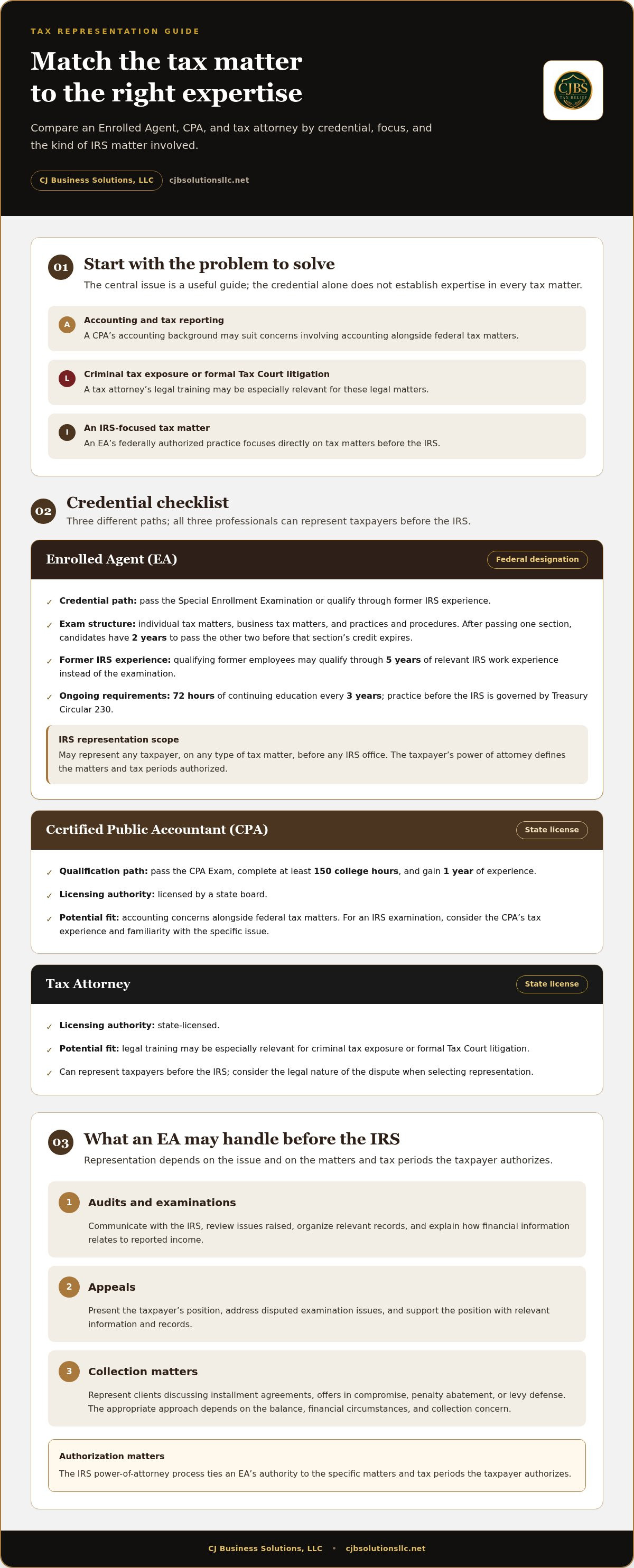
The Special Enrollment Examination has three sections: individual tax matters, business tax matters, and practices and procedures. Candidates who pass one section have two years to pass the other two before that section’s credit expires, and the IRS conducts a background check. According to the Internal Revenue Service, EAs must complete 72 hours of continuing education every three years. Treasury Circular 230 governs their practice before the IRS. These requirements help taxpayers understand the education and conduct standards behind the credential.
The Enrolled Agent tax representation scope covers any taxpayer, any type of tax matter, and any IRS office, according to the Internal Revenue Service. To authorize representation, a taxpayer grants an EA authority for the relevant IRS matters and tax periods through the IRS power-of-attorney process. Defining that scope helps direct IRS communications appropriately.
Fees and Authorization for Representation
What an EA charges depends on the case, and fees are provided after a quote request. The work involved, tax periods at issue, available records, and whether the matter involves an examination or collection can shape the engagement. To authorize an EA, provide the IRS power-of-attorney authorization for the matters and periods they will handle. This ties the representative’s authority to your specific IRS issue.
EA comparison with CPAs and tax attorneys
Enrolled Agents, certified public accountants, and tax attorneys can represent taxpayers before the IRS, but they earn their credentials through different paths. An EA’s credential comes from the U.S. Department of the Treasury and is a federal designation. CPAs and attorneys hold state-based licenses, so their professional licensing authority differs.
CPA qualification requires passing the CPA Exam, completing at least 150 college hours, and gaining one year of experience. A CPA is licensed by a state board. This path can suit taxpayers whose concerns involve accounting as well as federal tax matters. For an IRS examination, compare the professional’s tax experience and familiarity with the specific issue, not only the credential.
Tax attorneys are also state-licensed, but their legal training may be especially relevant when a matter involves criminal tax exposure or formal Tax Court litigation. These situations call for legal representation, rather than treating every IRS disagreement as an ordinary tax adjustment. For a routine examination or collection concern, an EA’s federally authorized practice focuses directly on tax matters before the IRS.
In practical terms, consider the central problem: accounting and tax reporting may point toward a CPA; a tax dispute with criminal exposure or Tax Court litigation may call for an attorney; and an IRS-focused tax matter may fit an EA. Credentials alone don’t establish expertise in every issue, so the nature of the case matters. For IRS-centered tax questions, Enrolled Agent representation is one relevant option to explore.
EA representation during audits and collection actions
An Enrolled Agent may represent taxpayers in IRS audits, appeals, and collection matters. The work depends on the issue, such as disputed tax returns or unpaid balances.
Audit Representation
Audit representation means an EA communicates with the IRS and supports a taxpayer during an examination. The EA can review the issues raised, organize relevant records, and explain how the taxpayer’s financial information relates to reported income. Clear, consistent responses help keep the examination focused on the questions the IRS is reviewing. An EA’s tax knowledge can help taxpayers understand correspondence and prepare a considered response.
Appeals Representation
Appeals representation allows an EA to present a taxpayer’s position through the IRS appeals process. If a taxpayer disagrees with an examination outcome, the representative can address the disputed issues and relevant information with the appeals function. This gives taxpayers a way to pursue administrative review without treating the initial examination decision as the end of the process. The EA’s role is to explain the tax position and support it with relevant records and reasoning.
Collection Action Representation
In collection matters, an EA can represent clients discussing installment agreements, offers in compromise, penalty abatement, or levy defense with the IRS. The appropriate approach depends on the taxpayer’s balance, financial circumstances, and collection concern. Representation can clarify what information the IRS needs and keep communications focused on a proposed resolution. An EA’s unlimited practice rights before the IRS cover these federal tax matters, while the specific authority applies to the matters authorized by the taxpayer.
For support with an IRS examination, explore IRS audit strategy defense.
CJ Business Solutions: Tax Resolution Services
CJ Business Solutions, LLC can help when an IRS notice, examination, or unresolved tax balance needs focused attention. Its Tax Resolution Services address tax issues, while transcript analysis can identify specific concerns and clarify possible resolution paths.
For an IRS examination, its Enrolled Agent provides IRS audit strategy defense. Transcript analysis can also help make sense of account records before deciding how to address an outstanding issue. These services are useful when you need a clearer view of your IRS tax situation and the next steps it may call for.
You’re welcome to visit CJ Business Solutions to learn more.
Choose a Clear Next Step for Your IRS Matter
The most useful next step is to define the decision you need help with: responding to an IRS notice, addressing an examination, or resolving a tax balance. Understanding how the Enrolled Agent tax representation scope applies to your situation can help you prepare relevant records and identify the support you need.
CJ Business Solutions offers Tax Resolution Services, Enrolled Agent support, and IRS audit strategy defense for taxpayers facing these concerns. If you’re ready to discuss your circumstances and consider a practical path forward, contact CJ Business Solutions. A thoughtful conversation can help you approach the next step with greater clarity.
Frequently Asked Questions
How can an EA help me out?
An EA can help you understand an IRS notice, organize supporting records, and respond to tax questions. For example, if a notice reports income that differs from your filed return, comparing the notice with your return and IRS account transcript can help identify the issue. EAs also prepare returns and assist with tax resolution when balances or filing concerns need attention.
What are the differences between an EA and other tax professionals?
An EA’s federal credential focuses on taxation and IRS practice, while a CPA’s state license also covers accounting work. Attorneys are licensed by states and can address legal matters, including criminal tax exposure and formal Tax Court litigation. To decide which background fits, distinguish an accounting need from IRS representation or a legal dispute, then consider the professional’s experience with that issue.
What is an EA?
An Enrolled Agent is a tax professional credentialed to practice before the IRS. The U.S. Department of the Treasury issues this federal designation. Candidates may qualify by passing the Special Enrollment Examination or through qualifying experience as a former IRS employee. EAs may also prepare tax returns for individuals and entities, so their work can include both return preparation and IRS representation.
What is representation?
Representation means a taxpayer authorizes a qualified representative to communicate and act on the taxpayer’s behalf in specified dealings with the IRS. In practice, an EA may address questions, present records, and discuss the tax issue covered by the authorization. The taxpayer still needs to provide accurate information and make decisions about proposed resolutions.
What tax matters can an Enrolled Agent represent clients before the IRS?
An EA may represent clients in IRS examinations, appeals, and collection matters, including installment agreements, offers in compromise, penalty abatement, and levy defense. The tax issue can also involve payroll or employment taxes, self-employment tax obligations, or an assessment under IRC § 6672. This range helps taxpayers identify whether a dispute concerns an assessment, a collection arrangement, or a levy.

Article by
Crystal R. Johnson, MBA EA
Crystal Johnson founded CJ Business Solutions to give individuals and small-business owners something often missing from the tax and accounting process: clear explanations, practical solutions, and trusted support.
With more than 27 years of accounting and financial experience, Crystal helps clients understand complicated tax matters, restore compliance, respond to IRS concerns, and make stronger business decisions. As an Enrolled Agent, she is federally authorized to represent taxpayers before the Internal Revenue Service.


