

An IRS payment plan can spread a tax balance over time, but interest and failure-to-pay penalties may continue until it’s paid in full. For individuals seeking IRS tax payment plan assistance, the Internal Revenue Service says a short-term plan may be available when combined tax, penalties, and interest are below $100,000, with repayment within 180 days. The right option also depends on whether the debt is personal or business-related.
If you’re concerned that a payment plan will make your balance grow, that’s a reasonable concern. This guide explains what an IRS payment plan does, how interest and penalties apply, and which thresholds matter for business plans, including the $25,000 limit that can affect eligibility. You’ll have a clearer view of the rules and the factors to consider when deciding how to address an outstanding IRS balance.
Key Takeaways
- Compare short-term and installment options by your balance and how quickly you can pay it down.
- Understand how filing on time affects the late-payment penalty while an installment agreement is active.
- For a business plan, review the balance threshold, tax periods involved, and whether direct debit is required.
- Use transcript analysis and tax resolution support to clarify the IRS balance and consider a path forward.
What is a payment plan?
An IRS payment plan lets an eligible taxpayer repay federal tax debt over time through an agreement with the Internal Revenue Service. For IRS tax payment plan assistance, first compare your total balance and filing status with the available options.
Individual Installment Agreement Eligibility
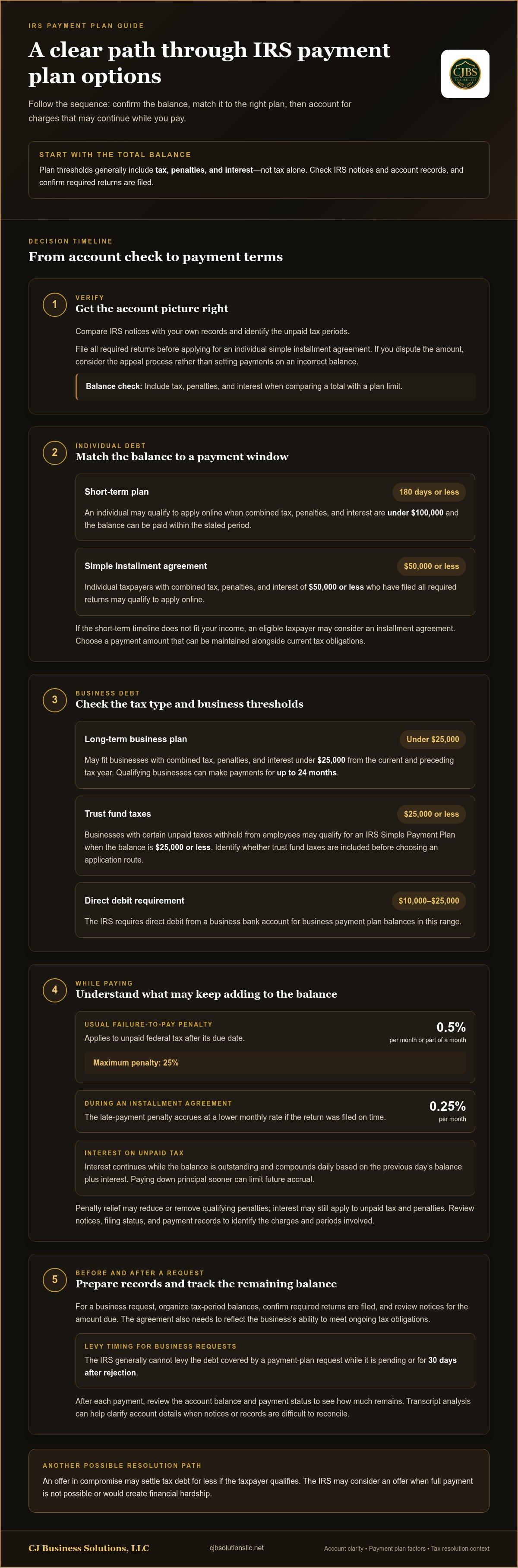
An individual installment agreement allows a taxpayer to pay an IRS balance over time. According to the Internal Revenue Service, individual taxpayers with $50,000 or less in combined tax, penalties, and interest who have filed all required returns may qualify to apply online for a simple installment agreement. Filing compliance matters, so identify and file required returns before applying. Compare IRS notices with your records; if you dispute the amount, consider the appeal process rather than arranging payments on an incorrect balance.
Payment Options and Eligibility
An IRS short-term plan gives an individual a set period to pay a balance. According to the Internal Revenue Service, an individual may qualify to apply online for an IRS short-term payment plan if they owe less than $100,000 in combined tax, penalties, and interest. The Internal Revenue Service says the balance must be paid within 180 days or less. If that timeline does not fit your income, an eligible taxpayer may consider an installment agreement. Choose a payment amount you can maintain alongside current tax obligations.
Tax Balance Limits
Tax-balance limits help determine which agreement an individual may request. The total generally includes tax, penalties, and interest, so review the balance shown on IRS notices rather than looking at tax alone. IRS tax payment plan assistance can help clarify account records and filing steps. Taxpayers who cannot pay in full may also consider an offer in compromise, which may settle tax debt for less if they qualify. The IRS may consider an offer when full payment is not possible or would create financial hardship. To address an IRS problem, use the online payment agreement tool or seek assistance from the Taxpayer Advocate Service.
Interest and failure-to-pay penalties
A failure-to-pay penalty is a charge applied to unpaid federal tax after its due date. According to the Internal Revenue Service, the usual penalty is 0.5% of unpaid tax for each month or part of a month, subject to a 25% maximum. For an IRS installment agreement, the late-payment penalty accrues at 0.25% per month while the agreement is in effect, if the taxpayer filed the return on time. The Internal Revenue Service says that, under an installment agreement, the late-payment penalty accrues at 0.25% per month while the agreement is in effect if the taxpayer filed the return on time.
Interest is charged on unpaid federal tax and grows while the balance remains outstanding. It compounds daily, based on the previous day’s balance plus interest, so paying down the principal sooner can limit future accrual. Review your account balance and payment status after each payment to see how much remains.
Penalty relief reduces or removes qualifying IRS penalties. You may request relief if you qualify, but interest may still apply to unpaid tax and penalties. Start by reviewing IRS notices, filing status, and payment records to identify the tax periods and charges involved. Paying what you can toward the federal balance may help limit the amount that continues to accrue.
If IRS notices or account records make it difficult to understand the charges, tax resolution assistance can help clarify the issue and possible next steps.
Business payment plan thresholds
A business installment agreement lets an eligible business repay federal tax debt over time. For business taxpayers, the balance and tax periods determine which payment plans may be available. A long-term payment plan may fit businesses with combined tax, penalties, and interest under $25,000 from the current and preceding tax year. Qualifying businesses can make payments for up to 24 months.
A trust fund tax payment plan is an arrangement for certain unpaid business taxes withheld from employees. Businesses with trust fund taxes may qualify for an IRS Simple Payment Plan when the balance is $25,000 or less. This limit differs from the long-term plan threshold, so identify whether the debt includes trust fund taxes before choosing an application route. Include penalties and interest when assessing the total amount.
Direct debit is an automatic withdrawal from a business bank account for scheduled payments. The IRS requires direct debit for business payment plan balances between $10,000 and $25,000. A workable agreement must also reflect the business’s ability to meet ongoing tax obligations.
Application status matters while the IRS reviews a request. The IRS generally cannot levy the debt covered by a payment-plan request while it is pending or for 30 days after rejection. Before applying, organize the relevant tax-period balances, confirm required returns are filed, and review notices for the amount due. If you need help interpreting business transcripts and identifying a resolution path, request business tax resolution assistance.
CJ Business Solutions: Tax Resolution Services
CJ Business Solutions, LLC helps taxpayers address IRS debt through Tax Resolution Services, including reviewing account records and considering resolution paths. If notices show conflicting balances or you’re unsure which tax periods remain unpaid, transcript analysis can clarify the account details. An Enrolled Agent can help explain the tax issue and relevant next steps. For business owners facing an IRS examination, IRS audit strategy defense provides focused support during the examination process.
Consider seeking help when the amount owed, filing history, or IRS notices make it difficult to choose a payment approach. Clear account information can help you understand the issue before deciding how to proceed. You’re welcome to contact CJ Business Solutions, LLC to discuss your tax resolution needs.
Choose a Clear Next Step
Once you understand the available paths, decide what needs attention first: account accuracy, a practical resolution approach, or an IRS examination. Keeping notices and tax records together can make the discussion more focused. IRS tax payment plan assistance can help you understand how your circumstances affect the options ahead.
CJ Business Solutions offers Tax Resolution Services, Enrolled Agent representation for eligible taxpayers, and IRS audit strategy defense. These services can help taxpayers address an IRS tax issue or prepare for an examination. You remain in control of the decisions, with professional guidance to clarify the issues and possible next steps.
Contact CJ Business Solutions for assistance when you’re ready to discuss your situation. Taking one informed step at a time can make a complex tax matter easier to approach.
Frequently Asked Questions
What are IRS payment plans?
IRS payment plans are agreements that let taxpayers resolve an outstanding federal tax balance through scheduled payments rather than paying it all at once. A balance may include more than one tax period, so compare each notice with your account records before choosing a payment amount. An agreement addresses collection of the debt; it does not replace required tax filings.
Why do I owe interest and penalties?
Interest and penalties can accrue when tax remains unpaid after its due date, and separate charges can apply when a return is filed late. The failure-to-file penalty is usually 5% of the tax owed for each month or part of a month, up to 25%. Filing a return and paying its balance are separate obligations, so address both.
How do I manage my plan to avoid default?
Make each scheduled payment on time and keep required returns filed, including returns due after your agreement begins. If your income changes and the scheduled amount becomes difficult to manage, use the IRS Online Payment Agreement tool to request an eligible change to payment dates, amounts, or direct-debit bank information. Review notices and account activity so you do not miss a payment or overlook a new balance.
If I set up an IRS installment agreement form, can I change or stop it?
If eligible, you can request changes to an existing agreement through the IRS Online Payment Agreement tool, including changes to the payment date, amount, or direct-debit bank information. Stopping payments without arranging a change can leave the debt unresolved and affect the agreement. Before changing your payment method or ending payments, review the current balance and any IRS notices.
What happens if the 10-year collection deadline arrives before I finish paying?
The IRS collection statute for proposed payment plans is usually 10 years, but the applicable period depends on the account’s collection history. If that period expires before the balance is paid, the remaining amount may no longer be collectible. Check account transcripts and notices to understand the relevant dates and any events affecting the collection period before relying on a deadline.

Article by
Crystal R. Johnson, MBA EA
Crystal Johnson founded CJ Business Solutions to give individuals and small-business owners something often missing from the tax and accounting process: clear explanations, practical solutions, and trusted support.
With more than 27 years of accounting and financial experience, Crystal helps clients understand complicated tax matters, restore compliance, respond to IRS concerns, and make stronger business decisions. As an Enrolled Agent, she is federally authorized to represent taxpayers before the Internal Revenue Service.


