

Tax audit risk assessment services help identify potential exposure by reviewing federal income tax, state and local nexus, sales and use tax, employment taxes, deductions, credits, and supporting records. A practical review compares tax filings with financial data, tests internal controls, and ranks risks by potential impact and the strength of available documentation. This helps clarify where attention is needed before an examination begins.
Tax risk can involve more than the tax department: finance, payroll, procurement, and everyday business decisions may all play a part. This article explains how to assess federal, state, and indirect tax exposure, review controls, and evaluate risks without treating every issue as equally serious. Organized records and consistent review procedures can support a more prepared, measured approach.
Key Takeaways
- Map exposure across federal, state, and indirect taxes, paying particular attention to nexus, worker classification, and sales tax records.
- Compare tax filings with financial records and use reconciliations, approval steps, and clear responsibilities to strengthen controls.
- Rank risks by potential impact, likelihood of detection, and documentation quality rather than treating every issue as equally urgent.
- Organize supporting records and address inconsistencies early so you can approach an examination with a clearer picture of your tax position.
Federal, state, and indirect tax exposure
Review federal income tax, state and local nexus, and indirect taxes. Include employment, sales and use, excise, and information reporting. Map where employees, inventory, customers, and transactions connect to each state. After the U.S. Supreme Court’s Wayfair decision in 2018, economic nexus can create sales tax collection duties. A state’s transaction-count or sales-amount threshold determines when those duties apply. Compare sales records with applicable thresholds before reporting.
The standard IRS assessment period is 3 years from the later filing date or return due date. It extends to 6 years if more than 25% of gross income is omitted. It also extends if more than $5,000 of foreign-account income is omitted. In most states, sales tax audit statutes of limitations are three years from the later return due date or filing date. Fraud, evasion, or gross negligence can remove that limit in most states.
For financial statement audits, align confidence in uncertain tax positions with the strength of their documentation. An examination can require staff time and coordination across departments. Assessments, penalties, and interest can also affect financial statements. Match tax accounts to ledger balances and retain support for significant positions.
CPAs, tax attorneys, and enrolled agents may provide assessments. Choose a professional based on the relevant state obligations and tax types, and their ability to review filings and supporting records. An IRS audit risk assessment identifies and evaluates exposure before or during tax preparation; audit defense addresses strategy and responses during an examination. An enrolled agent may also provide IRS audit strategy defense.
In the United States, assessment fees depend on the case and are discussed after a quote request. Factors include the jurisdictions and tax types involved, record volume, and complexity. Gather filed returns, general ledgers, sales records, payroll reports, exemption certificates, invoices, and prior audit correspondence for review.
2. Internal controls and mitigation measures
Separate three types of risk before choosing a response. Inherent risk exists before controls, such as the complexity of transactions across several states. Control risk is the chance that a control fails to prevent or detect an error. Detection risk is the chance that a review misses an error that remains. These distinctions help identify whether exposure comes from business activities, procedures, or the review process.
Map internal controls from source records through to filed tax returns. For example, reconcile sales tax accounts to sales ledgers, then document who reviews differences and approves corrections. Where practical, separate preparation, payment, and approval functions. An approval hierarchy for significant tax decisions clarifies responsibility and preserves the purpose of each review. Keep contracts, invoices, calculations, and approval records together.
Internal tax controls should reflect how each department handles tax-sensitive activity. Accounts payable can review vendor classifications and reporting details. Procurement can flag purchases that require sales or use tax treatment. Human resources can retain support for compensation and employee benefits. A tax review can then test whether these records match the organization’s returns and accounting entries.
Can an assessment reduce penalties or prevent an IRS audit? A self-review can uncover errors or weak controls, helping an organization correct future reporting or consider an applicable voluntary disclosure program. It cannot prevent the IRS from selecting a return for examination.
If an examination has begun, IRS audit strategy defense can help organize a response and address examination issues.
3. Tax risk identification and evaluation
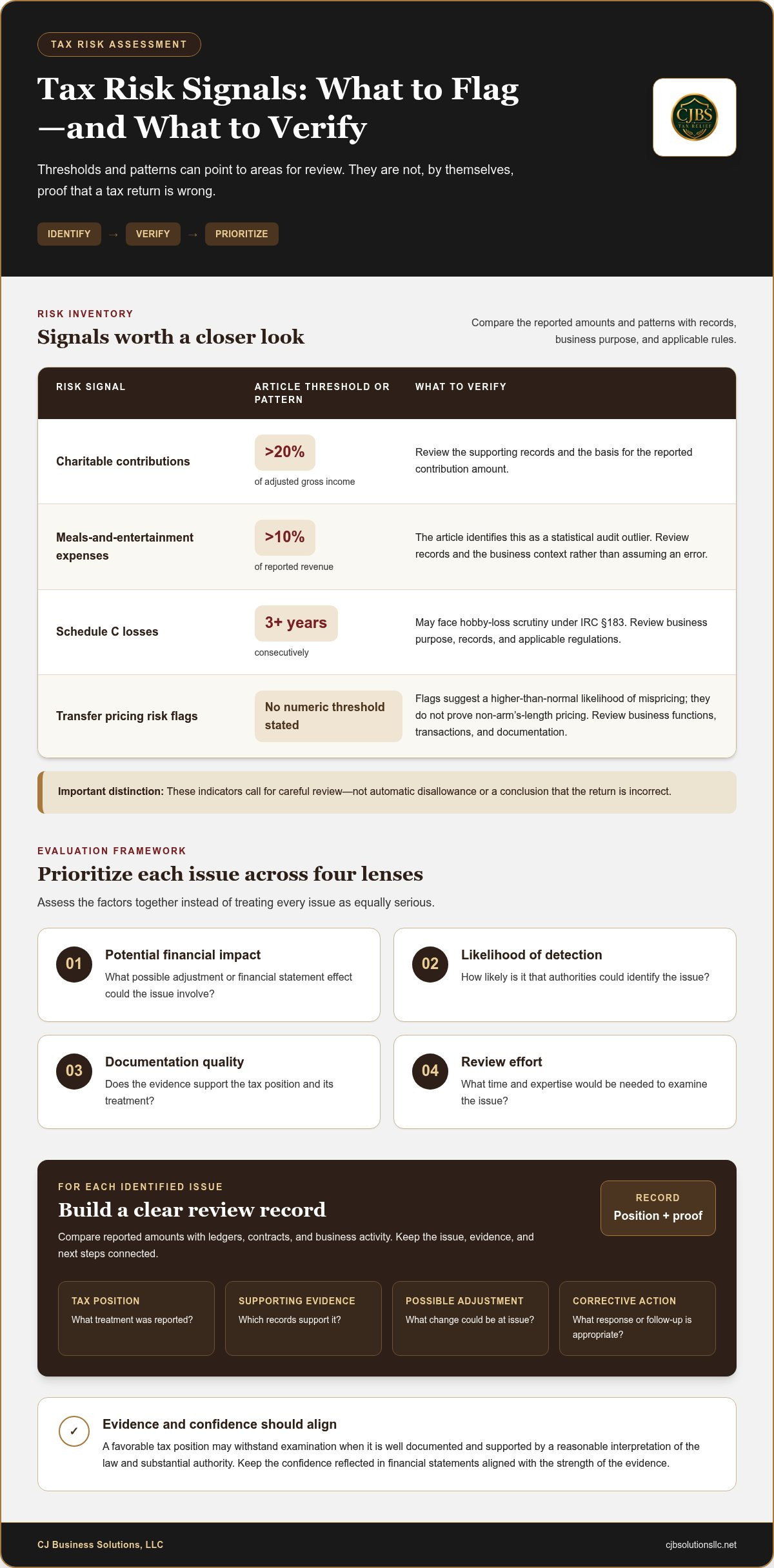
Start with a risk inventory covering tax returns, income recognition, deductions, credits, and revenue allocation. Compare reported amounts with ledgers, contracts, and business activity. For example, charitable contributions exceeding 20% of adjusted gross income can be an audit risk factor. That indicator calls for careful review, not an assumption that the return is wrong.
Look for patterns that may need explanation. Meals-and-entertainment expenses exceeding 10% of reported revenue are identified as a statistical audit outlier. A business reporting Schedule C losses for three or more consecutive years may face hobby-loss scrutiny under IRC §183. These signals should prompt a review of business purpose, records, and the applicable regulations, rather than automatic disallowance.
For each issue, record the tax position, supporting evidence, possible adjustment, and corrective action. Assess the likelihood that authorities could detect the issue, its potential financial impact, and the time and expertise needed to examine it. Transfer pricing risk flags, for instance, suggest a higher-than-normal likelihood of mispricing, but do not prove that non-arm’s-length pricing occurred. Review business functions, transactions, and available documentation before setting priorities.
A favorable tax position may withstand examination when it is well documented and supported by a reasonable interpretation of the law and substantial authority. Keep the confidence reflected in financial statements aligned with the strength of the evidence. This helps decision-makers distinguish a documentation gap from a substantive reporting concern.
Use a structured review to turn identified risks into practical next steps. Discuss your tax risk findings and how they may inform your response.
CJ Business Solutions: Tax Resolution Services
CJ Business Solutions, LLC provides Tax Resolution Services for taxpayers addressing tax problems, as well as transcript analysis to clarify account activity and identify specific issues. Led by an Enrolled Agent, the firm also provides IRS audit strategy defense for eligible taxpayers facing a federal examination. Its services can help when an identified issue needs careful review or an examination calls for a considered response.
If an assessment reveals a discrepancy, unresolved balance, or IRS notice, organized account information can help clarify next steps. Transcript analysis can help identify the issue, while audit strategy defense focuses on responding to an examination. These services are relevant when you need help understanding your tax position or preparing a response, rather than simply reviewing controls for future filings.
Contact CJ Business Solutions, LLC to discuss your tax concerns and possible next steps.
Make tax risk review part of ongoing decisions
Treat tax risk review as an ongoing business practice, not a task reserved for filing season. As operations, transactions, or reporting positions change, document who owns each decision and what evidence supports it. This creates a clearer record for future reviews and helps teams address emerging issues before they become harder to resolve. Tax audit risk assessment services can organize that work around your specific concerns.
CJ Business Solutions offers Tax Resolution Services, with an Enrolled Agent and IRS audit strategy defense for taxpayers who need support addressing tax matters or responding to an examination. If you’re ready to discuss your situation, contact CJ Business Solutions. A considered next step can help you approach your tax concerns with greater clarity.
Frequently Asked Questions
How do you deal with tax risk?
Manage tax risk by assigning each issue an owner, priority, and documented next step. For example, a finance lead can track an unresolved reporting difference while a tax professional reviews its treatment and supporting records. Revisit open items when business activity changes, such as with a new product or transaction, so decisions remain connected to current operations.
What do tax audit risk assessment services include?
Tax audit risk assessment services typically involve reviewing filed returns, comparing reported figures with accounting records, identifying uncertain positions, and evaluating documentation. The review may also consider whether tax procedures match the organization’s actual operations. A useful result is an issue list describing each concern, the available evidence, and questions that need further analysis.
How do tax professionals assess IRS audit risk for a business or individual?
Tax professionals assess risk by comparing return entries with supporting documents and examining whether reported amounts fit the taxpayer’s activity. For example, the IRS identifies multiple large, rounded amounts as a possible audit concern. For a business, reviewers may also compare income patterns with sales records and contracts, distinguishing a documentation weakness from a possible reporting error.
What IRS audit selection methods and red flags should taxpayers know about?
Statistical outliers and inconsistencies can indicate areas for closer review, but a red flag alone doesn’t establish an error. Examples include a Schedule C expense ratio more than two standard deviations from industry norms or vehicle mileage claims above 35,000 miles annual for a single business. Sales tax audits may also be random or statistically selected, so not every audit follows a specific trigger.
What are the steps in a tax audit risk assessment and how long does it take?
Review filed returns against ledgers and other business records, map tax exposure, test controls, and document the evidence, potential adjustment, and corrective action for each issue. Then prioritize risks by likelihood of detection, potential impact, and documentation quality.

Article by
Crystal R. Johnson, MBA EA
Crystal Johnson founded CJ Business Solutions to give individuals and small-business owners something often missing from the tax and accounting process: clear explanations, practical solutions, and trusted support.
With more than 27 years of accounting and financial experience, Crystal helps clients understand complicated tax matters, restore compliance, respond to IRS concerns, and make stronger business decisions. As an Enrolled Agent, she is federally authorized to represent taxpayers before the Internal Revenue Service.


