

A penalty notice doesn't always mean the charge is final. Several IRS tax penalty abatement strategies may apply, including first-time abatement for taxpayers with a timely compliance history over the prior three years, or reasonable-cause relief when circumstances beyond their control prevented compliance. You may request some relief by phone, while other cases call for a written request.
It’s understandable to ask whether you can reduce a penalty without overlooking the tax you still owe. Penalty relief may remove or reduce eligible penalties, but it generally does not erase the underlying tax debt. The grounds for relief matter.
This article explains how first-time abatement and reasonable cause work, what can support a request, and when to contact the IRS by phone or submit Form 843. It also clarifies what penalty relief does and does not change, so you can understand the available paths before deciding what to do next.
Key Takeaways
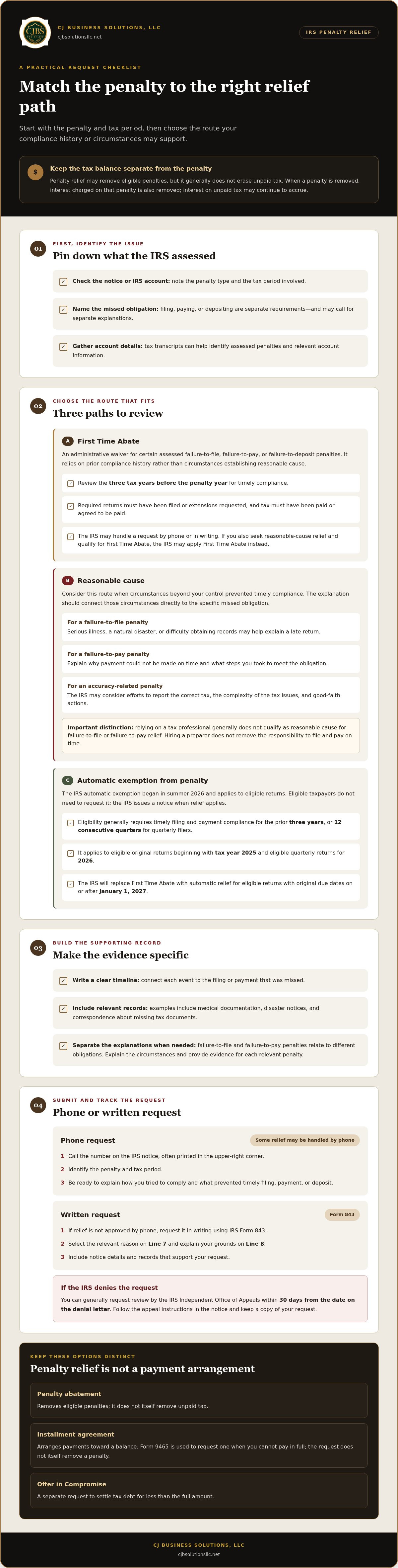
- Use the phone number on your IRS notice to ask whether phone-based relief may apply; if relief isn’t approved by phone, the Internal Revenue Service allows a written request using Form 843.
- For reasonable-cause relief, connect the circumstances that prevented compliance to the missed filing or payment, and support your explanation with relevant records.
- Review your filing and payment history before seeking first-time abatement, since prior compliance can affect eligibility.
- Penalty relief may reduce eligible charges, but it doesn’t erase the underlying tax debt; transcript analysis and tax resolution support can help clarify the issues and possible next steps.
Can I request penalty relief by phone?
Yes. The IRS may handle some penalty relief requests, including First Time Abate requests, by phone. Call the number on your IRS notice, often printed in the upper-right corner, and identify the penalty and tax period. Before calling, review the notice and your records so you can explain how you tried to comply and what prevented timely filing, payment, or deposit.
First Time Abate generally depends on a timely compliance history for the prior three years. You must have filed required returns or requested extensions, and paid or agreed to pay the tax due. If the IRS doesn’t approve relief by phone, the Internal Revenue Service allows taxpayers to request it in writing with IRS Form 843. On the form, select the relevant reason on Line 7 and explain your grounds on Line 8. Include the notice details and records supporting your request. You can prepare the request independently; professional help from firms such as Timothy Roberts & Associates, LLC may assist with organizing the facts and explaining the basis for relief.
Penalty abatement removes eligible penalties, while an installment agreement arranges payments toward a balance. An Offer in Compromise is a separate request to settle tax debt for less than the full amount. If you can’t pay in full, Form 9465 is used to request an installment agreement; that request doesn’t itself remove a penalty.
After a denial, you can generally request review by the IRS Independent Office of Appeals within 30 days from the date on the denial letter. Follow the appeal instructions in the notice and keep a copy of your request.
When the IRS removes a penalty, it also removes interest charged on that penalty. Interest on unpaid tax may continue to accrue until you pay the tax balance.
Reasonable cause relief
Reasonable cause is one of the IRS tax penalty abatement strategies to consider when circumstances beyond your control prevented timely compliance. The penalty type and supporting evidence matter, so link the events directly to the missed obligation.
Reasonable Cause for Different Penalties
For failure-to-file penalties, serious illness, a natural disaster, or difficulty obtaining records may help explain a late return. For failure-to-pay penalties, explain why you couldn’t pay on time and what steps you took to meet the obligation. Accuracy-related cases are different: the IRS may consider your efforts to report the correct tax and the complexity of the tax issues. Good-faith actions are relevant to that review.
Support your written explanation with records, such as medical documentation, disaster notices, or correspondence about missing tax documents. A clear timeline should connect each circumstance to the specific filing or payment failure.
Reasons That Do Not Qualify
Reliance on a tax professional generally doesn’t qualify as reasonable cause for failure-to-file or failure-to-pay relief. Hiring someone to prepare your return doesn’t remove your responsibility to file and pay on time. Explain what actually prevented compliance and include supporting records. This keeps your request focused on grounds that may qualify for relief.
Separate Abatement of Filing and Payment Penalties
Yes. You can seek abatement of failure-to-file and failure-to-pay penalties separately. Each penalty relates to a different obligation, so explain the circumstances behind each and provide evidence for both when relevant. For example, illness may explain a late return, while separate financial circumstances may explain delayed payment. Addressing each penalty separately helps the IRS assess the evidence for that specific failure.
Penalties Eligible for Abatement
Relief may apply to information-return, failure-to-file, failure-to-pay, accuracy-related, failure-to-deposit, dishonored-check, and certain estimated-tax penalties. Eligibility depends on the penalty and relief basis; reasonable cause generally doesn’t apply to estimated-tax penalties. As you compare IRS tax penalty abatement strategies, organize records by penalty and show how events affected compliance. Tax transcript analysis can help identify assessed penalties and relevant account details.
First time penalty abate and administrative waiver
First Time Abate is an administrative waiver for certain assessed failure-to-file, failure-to-pay, or failure-to-deposit penalties. It may suit taxpayers with a clean compliance history, rather than those relying on circumstances to establish reasonable cause. Eligibility generally considers the three tax years before the penalty year. You must have filed required returns or requested extensions, and paid or agreed to pay the tax owed.
You can request First Time Abate by phone or in writing. If submitting a written claim, use Form 843 and explain the request clearly. A penalty waiver removes eligible penalties, but it doesn’t remove unpaid tax. Check the IRS account or notice to identify the penalty assessed and tax period before making the request. If you qualify for First Time Abate while seeking reasonable-cause relief, the IRS may apply First Time Abate instead.
The IRS’s Automatic Exemption from Penalty began in summer 2026. According to the Internal Revenue Service, eligible taxpayers generally need timely filing and payment compliance for the prior three years, or 12 consecutive quarters for quarterly filers. This automatic administrative waiver applies to eligible original returns beginning with tax year 2025 and eligible quarterly returns for 2026. Eligible taxpayers don’t need to request it; the IRS issues a notice when relief applies.
These pathways are changing: the IRS will replace First Time Abate with automatic relief for eligible returns with original due dates on or after Jan. 1, 2027. Compare the notice’s penalty type and due date with your filing history to identify the relevant route. For help interpreting assessed penalties and account records, request help reviewing your IRS penalty history.
CJ Business Solutions: Tax Resolution Services
CJ Business Solutions, LLC provides Tax Resolution Services to taxpayers dealing with penalty notices, unresolved balances, or possible relief options. When the penalty type, tax period, or account history is unclear, transcript analysis can help identify what the IRS assessed and the account details relevant to a resolution strategy.
An Enrolled Agent can help interpret tax issues and organize the information needed to consider next steps. This can be useful when weighing First Time Abate against reasonable-cause relief, or when a penalty notice seems inconsistent with your filing or payment records. Penalty relief does not remove unpaid tax, so understanding your full account balance remains important.
If you’d like help reviewing your tax situation, contact CJ Business Solutions, LLC for a confidential consultation.
Choose a Clear Next Step for Your Tax Account
Use your notice and account records to decide what needs attention first: the penalty assessment, the remaining balance, or a related tax issue. A focused review can help you choose a next step based on the facts, rather than treating every IRS letter as the same problem. The right IRS tax penalty abatement strategies depend on the specific issue and the records supporting your position.
CJ Business Solutions offers Tax Resolution Services, support from an Enrolled Agent, and IRS audit strategy defense. If you would like help assessing your tax situation and planning a practical response, you’re welcome to contact CJ Business Solutions. A measured next step can make a complex tax matter easier to approach.
Frequently Asked Questions
IRS Penalty Abatement | What is a Penalty Abatement?
Penalty abatement is IRS relief that removes or reduces an assessed penalty when an eligible basis applies. It may concern charges for late filing, payment, or other tax compliance failures. The underlying tax remains due, and any charges not covered by the approved relief stay on the account. Review your notice to identify the assessment the IRS is addressing.
What if I don’t qualify for the relief?
If one relief option doesn’t fit, consider whether another basis applies, such as reasonable cause or a statutory exception. If the IRS denies your request, review the denial letter for its stated reasons and appeal instructions. Taxpayers can generally request review by the IRS Independent Office of Appeals within 30 days from the date on the denial letter.
How long does it take to find out if you’re approved for penalty relief?
Timing depends on the request method and relief basis. After granting a First Time Abate request made by phone, the IRS sends a confirmation letter within 30 days. A written reasonable-cause request may take several months to process. Keep the notice and a copy of any written submission together so you can track the request and respond to related correspondence.
What doesn’t qualify as reasonable cause for the failure to file or pay?
Relying on a tax professional generally doesn’t qualify as reasonable cause for failure-to-file or failure-to-pay relief. By contrast, serious illness, a natural disaster, or inability to obtain necessary records may support a request if it prevented timely compliance. Explain what happened, how it affected the deadline, and what steps you took to meet your tax obligations.
What are the IRS rules for first-time penalty abatement?
First Time Abate generally requires a compliant filing history for the three tax years before the year the penalty was incurred. You must have filed required returns or requested extensions, and paid or arranged to pay the tax due. The relief may apply to failure-to-file, failure-to-pay, or failure-to-deposit penalties, subject to the IRS’s eligibility review.

Article by
Crystal R. Johnson, MBA EA
Crystal Johnson founded CJ Business Solutions to give individuals and small-business owners something often missing from the tax and accounting process: clear explanations, practical solutions, and trusted support.
With more than 27 years of accounting and financial experience, Crystal helps clients understand complicated tax matters, restore compliance, respond to IRS concerns, and make stronger business decisions. As an Enrolled Agent, she is federally authorized to represent taxpayers before the Internal Revenue Service.


