

You might naturally assume that hiring a high-priced lawyer is the only way to protect yourself from the IRS, but for many taxpayers, the specialized expertise of a federal tax specialist is actually the more strategic path. Receiving a notice from the IRS is an inherently stressful experience that often leaves you feeling overwhelmed by complex regulations and the fear of collection actions. It's completely understandable to feel confused when comparing an Enrolled Agent vs tax attorney, especially when your financial security feels like it's on the line. You deserve a clear, cost-effective path toward resolution that prioritizes your peace of mind and technical accuracy. This guide explores the distinct roles of these professionals, helping you determine which representative possesses the specific authority and transcript analysis skills needed to resolve your tax debt with confidence.
Key Takeaways
- Understand that Enrolled Agents are the only federally licensed tax practitioners with unlimited rights to represent taxpayers before the IRS across all 50 states.
- Evaluate the strategic differences in an Enrolled Agent vs tax attorney to determine if your situation requires administrative resolution or legal litigation in a courtroom.
- Discover how specialized transcript analysis acts as a powerful resource for decoding IRS data and identifying the precise issues within your tax history.
- Learn to select a representative based on their expertise in audit strategy defense, ensuring a methodical and cost-effective approach to resolving complex tax matters.
Understanding the Scope of Professional IRS Representation
Choosing between an Enrolled Agent vs tax attorney often begins with understanding who has the authority to speak on your behalf. An Enrolled Agent is the only tax professional who earns their license directly from the federal government rather than a state board. This distinction is significant. It grants them unlimited representation rights before the IRS. While attorneys and CPAs are state-licensed, an Enrolled Agent's authority is recognized nationwide for federal tax matters. This allows them to assist clients in any state without needing local bar admission.
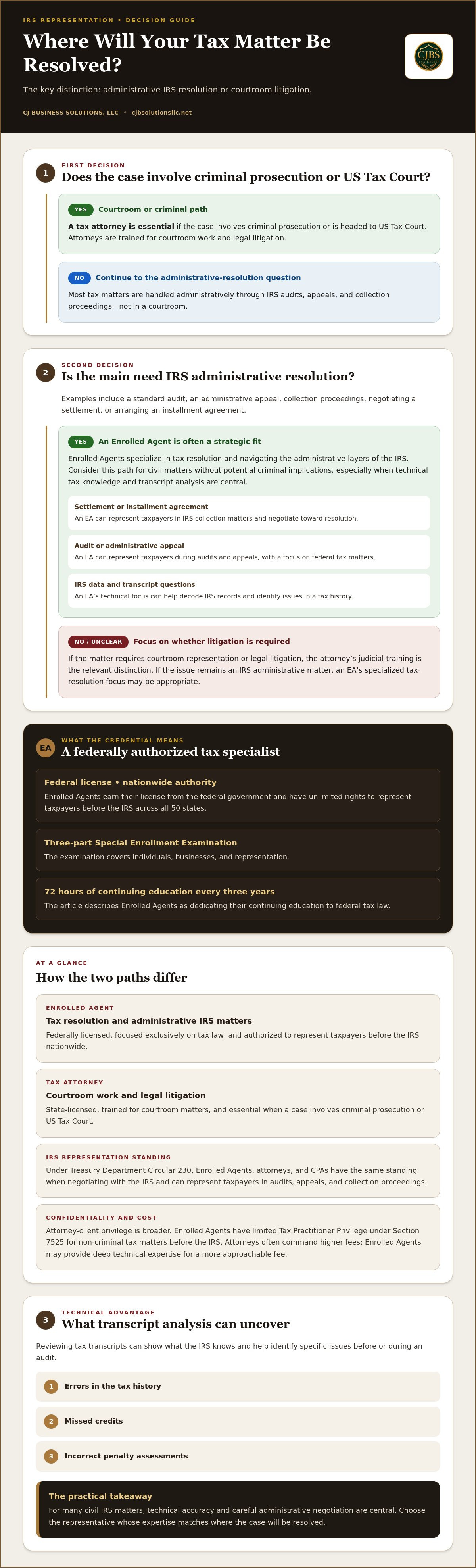
It's helpful to understand that under the Treasury Department's Circular 230 regulations, Enrolled Agents, attorneys, and CPAs are granted the same standing when negotiating with the IRS. They can represent you during audits, appeals, and collection proceedings with equal legal weight. Most tax resolutions occur at the administrative level, where these specialists negotiate directly with IRS officers rather than in a courtroom. Unlike a general lawyer, an Enrolled Agent focuses exclusively on tax law. Their expertise isn't diluted by general litigation, making them highly specialized allies for IRS resolution.
The Enrolled Agent: A Federally-Authorized Tax Specialist
Earning this designation requires passing a rigorous three-part Special Enrollment Examination covering individuals, businesses, and representation. Many professionals in this field are former IRS employees who bring an intimate understanding of internal agency procedures to your case. These specialists also complete 72 hours of continuing education every three years. When evaluating an Enrolled Agent vs tax attorney, this dedicated focus provides a stable foundation for a methodical audit defense.
Comparing Strategic Advantages: EA vs. Tax Attorney
When you evaluate an Enrolled Agent vs tax attorney, the decision often rests on where your case will be heard. Attorneys are trained for the courtroom and legal litigation. In contrast, Enrolled Agents specialize in tax resolution. They spend their time navigating the administrative layers of the IRS. It's a common misconception that only attorneys offer confidentiality. While attorney-client privilege is broader, Enrolled Agents possess a limited Tax Practitioner Privilege under Section 7525. This applies to non-criminal tax matters before the IRS. For most resolution cases, this protection is sufficient.
Cost is another practical factor. Attorneys often command higher fees due to their broad legal training. Enrolled Agents dedicate 100% of their continuing education to federal tax law. This allows them to provide deep technical expertise for an approachable fee. The IRS offers official guidance on choosing a tax professional to help you weigh these options with confidence.
When Technical Expertise Outweighs Legal Litigation
Most tax issues are settled at the administrative level. This includes audits, appeals, and collections. An attorney is essential if your case involves criminal prosecution or is headed to US Tax Court. However, for identifying specific errors through specialized transcript analysis services, the technical focus of an EA is often superior. You might consider an Enrolled Agent if:
- Your primary goal is to negotiate a settlement or installment agreement.
- You're facing a standard IRS audit or administrative appeal.
- Your case is purely civil and lacks potential criminal implications.
- You need a representative who understands the nuances of IRS data decoding.
Selecting the Right Professional for Your Tax Resolution Path
Choosing the right ally requires a methodical look at your tax history. If you're facing standard audits or need to negotiate a settlement, the administrative focus of an Enrolled Agent is often the most strategic fit. However, if your case involves litigating specific legal interpretations in court, a Tax attorney provides necessary judicial representation. When weighing an Enrolled Agent vs tax attorney, remember most IRS matters are resolved through technical accuracy. They're settled through careful negotiation rather than courtroom litigation.
This partnership is built on protecting your interests through every examination phase. Our approach to IRS audit strategy defense focuses on establishing a stable foundation for your future compliance. When you compare an Enrolled Agent vs tax attorney for administrative defense, you'll find that a specialized focus often yields the most precise results. By choosing a representative who prioritizes a composed methodology, you can lower your stress and approach the resolution process with quiet confidence. Entering a consultation should feel like a steady conversation with a seasoned mentor rather than a high-pressure sales pitch.
The Role of Transcript Analysis in Audit Defense
A key advantage in modern tax resolution is the use of data-driven insights. Specialized tax transcript analysis services allow an Enrolled Agent to see exactly what the IRS knows before an audit begins. By decoding these transcripts, we can identify errors, missed credits, or incorrect penalty assessments. At CJ Business Solutions, LLC, we utilize this data to develop a defense strategy that is both proactive and precise. This ensures your representative isn't just reacting to the IRS but is leading the conversation toward a favorable outcome.
Moving Toward a Clear Resolution Path
Deciding on the right representative is a significant step toward reclaiming your financial peace of mind. Choosing the right ally helps ensure your case is handled with the precision it deserves. By evaluating the strategic differences between an Enrolled Agent vs tax attorney, you can select a representative who aligns with your specific technical and financial needs. Our firm provides expert IRS audit strategy defense and specialized transcript analysis to identify errors and build a precise case on your behalf. Led by an Enrolled Agent with full federal authority, we're here to act as your reliable guide through complex tax challenges. We invite you to request a professional consultation for your tax resolution needs and take the first step toward stability. You don't have to face the IRS alone; a methodical path to resolution is within your reach.
Frequently Asked Questions
Can an Enrolled Agent represent me in an IRS audit just like an attorney?
Yes, an Enrolled Agent has the same unlimited representation rights as an attorney when dealing with IRS audits and administrative proceedings. These professionals are federally authorized to speak on your behalf, sign documents, and negotiate settlements. While a tax attorney handles court litigation, an Enrolled Agent focuses on resolving the audit through technical accuracy and direct communication with IRS officers.
Is a Tax Attorney more expensive than an Enrolled Agent for tax resolution?
While fees vary based on the complexity of the case, tax attorneys often command higher rates due to their broad legal background and courtroom training. Enrolled Agents typically offer a more cost-effective path for administrative resolution. When comparing an Enrolled Agent vs tax attorney, you'll find that the EA's specialized focus on federal tax law provides high-level expertise without the overhead of a general legal practice.
What is the difference between tax practitioner privilege and attorney-client privilege?
Attorney-client privilege is a broad legal protection that covers communications regarding both civil and criminal matters. In contrast, the tax practitioner privilege under Section 7525 is more specific. It protects confidential communications between you and an Enrolled Agent for non-criminal tax matters before the IRS. For the majority of civil audits and resolution cases, this protection provides the necessary confidentiality for a secure defense.
Do I need a Tax Attorney if I want to file an appeal with the IRS?
You don't need a tax attorney to file an administrative appeal with the IRS. Enrolled Agents are fully authorized to represent you during the appeals process to contest audit findings or collection actions. An attorney is typically required only if you decide to take your case beyond the IRS administrative level and into the US Tax Court for judicial litigation.
What happens during an IRS transcript analysis service?
During a transcript analysis service, we decode the raw data and transaction codes within your official IRS records. This methodical review allows us to identify specific issues such as misapplied payments, missed credits, or incorrect penalty assessments. By understanding exactly what the IRS knows before an audit begins, CJ Business Solutions, LLC builds a precise strategy that addresses the root cause of your tax challenges.
Can an Enrolled Agent help me with back taxes and IRS collections?
Yes, Enrolled Agents are highly effective at resolving back taxes and managing IRS collection actions. They can negotiate installment agreements, Offers in Compromise, and the release of tax liens or levies on your behalf. When evaluating an Enrolled Agent vs tax attorney for collections, the EA’s deep knowledge of IRS administrative manuals often provides a steady and predictable path to financial recovery.

Article by
Crystal R. Johnson, MBA EA
Crystal Johnson founded CJ Business Solutions to give individuals and small-business owners something often missing from the tax and accounting process: clear explanations, practical solutions, and trusted support.
With more than 27 years of accounting and financial experience, Crystal helps clients understand complicated tax matters, restore compliance, respond to IRS concerns, and make stronger business decisions. As an Enrolled Agent, she is federally authorized to represent taxpayers before the Internal Revenue Service.


