
There are two routes to becoming an IRS Enrolled Agent: pass the Special Enrollment Examination or qualify through relevant IRS employment. According to the Internal Revenue Service, candidates must pass all three exam parts within three years. The Enrolled Agent qualifications for tax help lead to a credential that authorizes tax professionals to represent taxpayers before the IRS across all 50 states.
If you assumed this career requires a college degree, it doesn’t. Enrolled Agent qualifications for tax help center on demonstrating tax knowledge through an exam or qualifying IRS experience, then meeting enrollment requirements. This guide explains what an Enrolled Agent does, how the qualification paths differ, and the practical steps involved in applying. You’ll see which route may fit your background and what the credential means for people seeking help with federal tax matters.
Key Takeaways
- Compare the Special Enrollment Examination route with qualifying IRS experience to identify which path best fits your background.
- Plan exam preparation around three sections that must be passed within three years.
- Prepare for the enrollment process by understanding the PTIN, application, and suitability review requirements.
- Include continuing education in your long-term plan: the Internal Revenue Service requires 72 hours during each three-year renewal cycle, including taxation and ethics education.
What Is an IRS Enrolled Agent?
An IRS Enrolled Agent (EA) is a federally credentialed tax professional authorized to represent taxpayers before the IRS. Candidates don’t need a college degree, but they must meet enrollment requirements and maintain their knowledge through continuing education.
Education Requirements and Recommended Coursework
- Choose tax-focused preparation. No college degree is required for EA status. A course in federal taxation or accounting can help candidates build knowledge for the enrolled agent exam, but coursework is preparation, not a credential requirement.
- Understand the scope of representation. An EA credential authorizes representation before the IRS nationwide. Compared with CPAs and tax attorneys, enrolled agents hold a tax-focused federal credential; each profession has a distinct background and professional scope.
- Consider the cost question separately. Hiring costs depend on the work involved, such as tax preparation complexity, records, and whether IRS representation is needed. Fees depend on the case and are provided after a quote request.
Continuing Education and EA Renewal
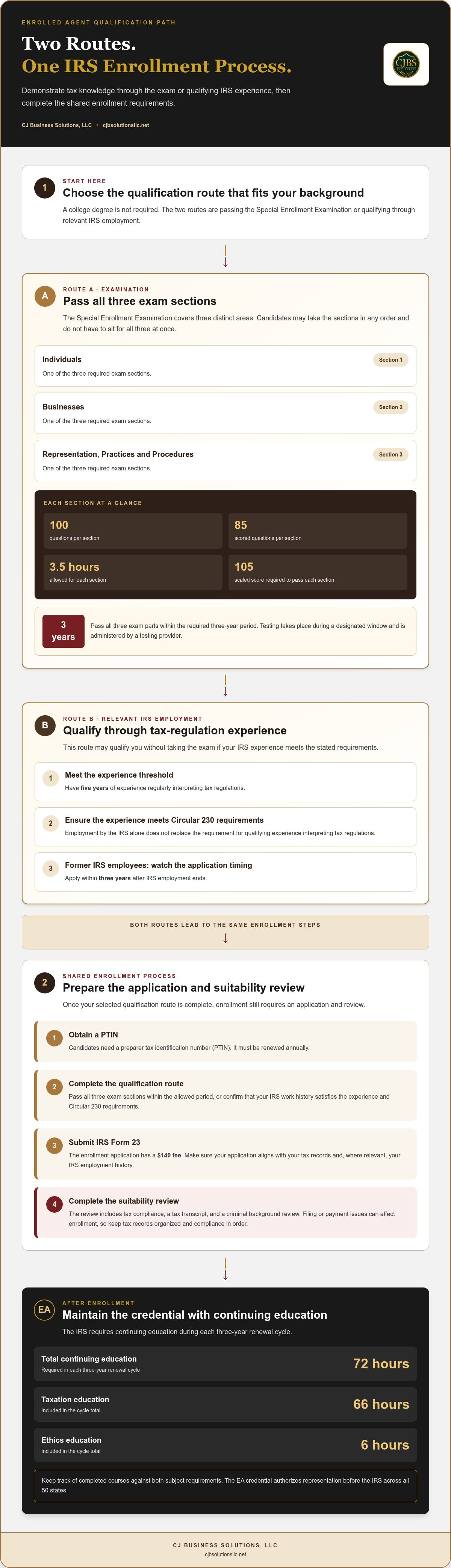
- Plan for renewal and education. According to the Internal Revenue Service, enrolled agents must complete 72 continuing education hours during each three-year renewal cycle, including 66 hours of taxation education and six hours of ethics. Track completed courses against both subject requirements.
- Maintain the required identification and verify status. Candidates need a preparer tax identification number (PTIN), which must be renewed annually. To assess an EA, verify enrollment status and review available disciplinary history through official IRS information; before hiring, ask about relevant experience, services, and fees.
EA qualification routes: the Special Enrollment Examination or relevant IRS employment
Choose between passing the Special Enrollment Examination and qualifying through relevant IRS experience. Both routes require an enrollment application and a suitability review.
-
Review Exam Sections and Format
Start by mapping the three Special Enrollment Examination sections: Individuals; Businesses; and Representation, Practices and Procedures. Each section has 100 questions, with 85 scored, and allows 3.5 hours. A scaled score of 105 is required to pass each section. The exam tests different areas of tax knowledge, so plan study time around each section rather than treating it as one subject.
-
Schedule and Take the Examination
Schedule each section during the available testing window. Testing is available during a designated window, with exam administration handled by a testing provider. Candidates may take the sections in any order and need not sit for all three at once. According to the Internal Revenue Service, candidates must pass all three parts within three years.
- Consider the IRS experience route. Relevant IRS employment may qualify you without the exam if you have five years of experience regularly interpreting tax regulations. The experience must meet Circular 230 requirements. Former IRS employees must apply within three years after their employment ends.
- Prepare for the suitability review. Applicants undergo a review of tax compliance and criminal background, including a review of their tax transcript. Keep tax filings and payments in order as you prepare to become an Enrolled Agent, because compliance issues can affect enrollment.
For help understanding an IRS tax issue while considering your next steps, explore tax resolution guidance.
Ways to qualify as an Enrolled Agent
Use these steps to understand the Enrolled Agent qualifications for tax help and prepare an enrollment application. The main decision is whether to demonstrate tax knowledge through testing or qualifying IRS experience.
- Select the route that matches your background. If you don’t have qualifying IRS experience, plan to pass all three Special Enrollment Examination parts. The alternative is five years of IRS experience regularly interpreting tax regulations, with experience meeting Circular 230 requirements. A preparer background alone does not replace either qualification route.
- Obtain a preparer tax identification number. Candidates need a PTIN to become an enrolled agent. Keep your tax records organized, because enrollment includes a review of tax compliance and criminal background. The IRS also reviews a tax transcript, so unresolved filing or payment issues can affect an application.
- Complete the relevant qualification before applying. Exam candidates must pass all three sections within the allowed period. Former IRS employees using the experience route must apply within three years after their employment ends. Check that your work history reflects regular interpretation of tax regulations, not simply employment by the Internal Revenue Service.
- Submit the enrollment application. Apply using IRS Form 23 and pay the $140 enrollment fee. Allow time for the suitability review, and make sure your application aligns with your tax records and, where applicable, IRS employment history. If you’re assessing the Enrolled Agent qualifications for tax help as a career step, remember that the credential doesn’t require a college education.
If you’re weighing how an enrolled agent’s tax knowledge applies to your situation, discuss your tax needs with an enrolled agent.
CJ Business Solutions: Tax Resolution Services
CJ Business Solutions, LLC provides Tax Resolution Services for taxpayers seeking help with IRS issues. If you’ve received an IRS notice or are facing an audit, transcript analysis can help identify the tax information involved, while IRS audit strategy defense can support you during a federal tax examination. The firm is led by Crystal Johnson, an Enrolled Agent authorized to represent eligible taxpayers before the IRS.
The right next step depends on the issue. Tax Resolution Services can help you understand a tax problem and consider a practical path forward; audit defense is relevant when the IRS is examining your return. These services address specific tax concerns, rather than questions about qualifying for the Enrolled Agent credential.
For assistance with a tax matter, contact CJ Business Solutions, LLC at your convenience.
Choose the Right Support for Your Next Tax Step
Understanding the Enrolled Agent qualifications for tax help can guide your career plans, but an IRS tax issue may call for a different next step. Identify what you need help with, such as a tax resolution matter or an examination, and gather the related notices and records. Clear documentation helps frame the questions you want answered.
CJ Business Solutions offers Tax Resolution Services and IRS audit strategy defense, with an Enrolled Agent leading the firm. If you’re ready to discuss your tax situation, contact CJ Business Solutions. A thoughtful conversation can help you consider an appropriate direction for your circumstances.
Frequently Asked Questions
What Does the Special Enrollment Exam Cover?
The exam assesses tax knowledge across individual returns, business taxation, and representation practices. Its three parts are Individuals; Businesses; and Representation, Practices and Procedures. That final section focuses on the practices and procedures involved in representing taxpayers. Reviewing the subject areas separately can help you identify which topics need more attention before your testing appointment.
What Happens When I Pass the EA Exam?
Passing all exam sections is one step, but you must also apply for enrollment and complete the IRS suitability review. Submit Form 23, keep your tax records ready for review, and ensure your preparer tax identification number is in order. Enrollment follows review of your tax compliance and background, including your tax transcript.
Why Get Certified as an EA?
The EA credential can suit tax professionals seeking a federal tax focus and authority to represent eligible taxpayers before the IRS. That scope is useful when a client needs help addressing an IRS matter, not just tax preparation. Consider how representation work fits your interests, experience, and longer-term career plans before committing to exam preparation.
How Can You Prepare for the EA Exam?
Build a study schedule around each exam part, then use practice questions to identify topics that need further review. The National Society of Accountants recommends at least 50 study hours for each section and 10-15 hours per week. The IRS provides sample questions and answers covering 20 questions per section, which can help you target review.
How Do You Qualify for the EA Credential?
Qualify by passing all three Special Enrollment Examination parts or by meeting the IRS experience route. That alternative requires five years of IRS experience regularly interpreting tax regulations, with experience outlined in Circular 230. Then obtain a PTIN and apply using Form 23. The IRS reviews tax compliance and criminal background as part of enrollment.

Article by
Crystal R. Johnson, MBA EA
Crystal Johnson founded CJ Business Solutions to give individuals and small-business owners something often missing from the tax and accounting process: clear explanations, practical solutions, and trusted support.
With more than 27 years of accounting and financial experience, Crystal helps clients understand complicated tax matters, restore compliance, respond to IRS concerns, and make stronger business decisions. As an Enrolled Agent, she is federally authorized to represent taxpayers before the Internal Revenue Service.


