

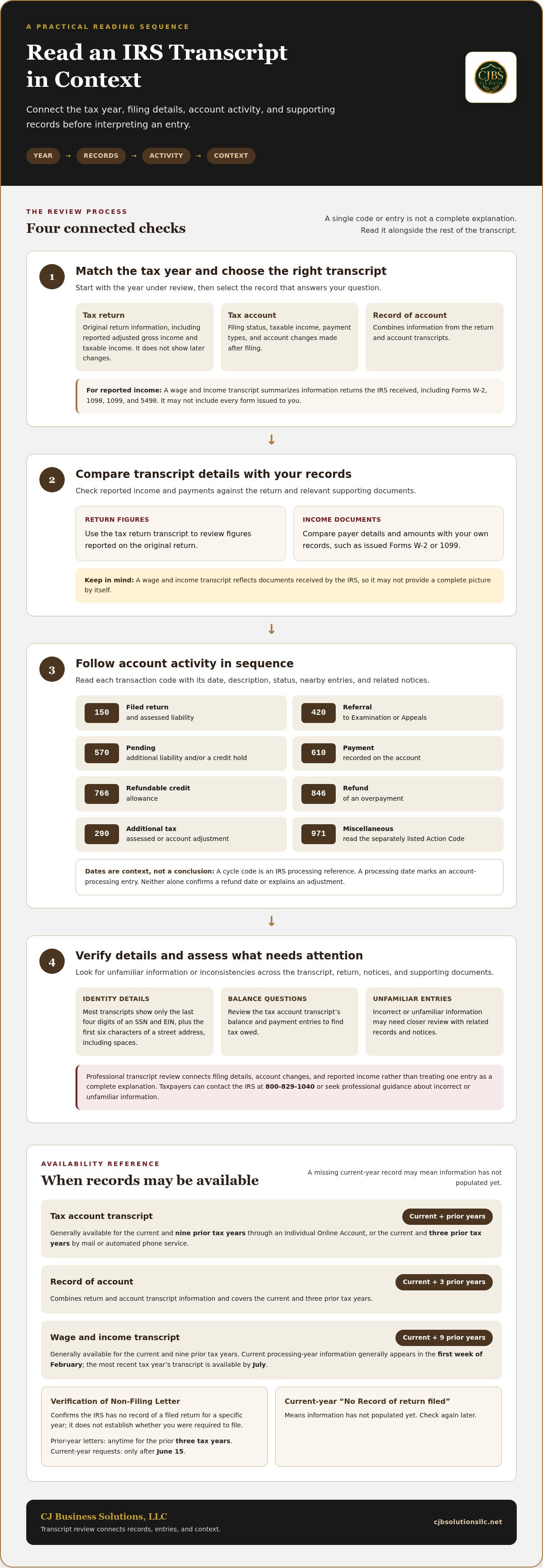
A tax transcript can reveal more than whether you filed a return. IRS tax transcript interpretation starts with identifying the transcript type: a tax return transcript reflects the original filing, while a tax account transcript shows account activity and changes made after filing. A record of account combines information from both, and a wage and income transcript shows information returns the IRS received. Each code or entry makes sense only in the context of the rest of the transcript.
These records can be difficult to read, especially when a code appears without an obvious explanation. This article explains what each transcript shows, when it becomes available, and how to distinguish common entries from issues that may need closer attention. It also covers how a professional review connects filing details, account changes, and reported income to clarify what may be happening.
Key Takeaways
- Choose the transcript that matches the question you need answered, such as checking a filed return, account activity, or reported income.
- Read transaction codes alongside their descriptions and surrounding entries before drawing conclusions about a balance, refund, or review.
- Use transcript availability dates to distinguish missing information from records that may still be populating.
- Compare transcript details across records to spot unfamiliar entries or inconsistencies that may benefit from professional review.
Tax return, tax account, and record of account transcripts
Transcripts show the original return, later account activity, or both. Identifying the right type helps answer questions about income, adjustments, and balances.
Tax Return Transcript
A tax return transcript summarizes information from the original tax return, not changes made after processing. Use it to review reported adjusted gross income and taxable income for a tax year. Individuals can get transcripts online through the IRS website, by mail, or by phone at 800-908-9946. Form 4506-T requests a transcript; Form 4506 requests an actual copy of an old return.
Tax Account Transcript Details
A tax account transcript shows details such as filing status, taxable income, payment types, and changes made after the original return was filed. It can help you follow account adjustments and notices. Read each entry alongside its date and description. This transcript is generally available for the current and nine prior tax years through an Individual Online Account, or the current and three prior tax years by mail or automated phone service. A record of account combines return and account transcript information and covers the current and three prior tax years.
Account Transcript Transaction Codes
Transaction codes identify events posted to a tax account, but their meaning depends on the entry’s context. Code 150 indicates a filed return and assessed liability; 420 indicates referral to Examination or Appeals. Code 570 means additional liability is pending and/or a credit hold; 610 records a payment. Code 766 indicates a refundable credit allowance, while 846 indicates a refund of an overpayment. Code 290 can mean additional tax assessed or an account adjustment. Code 971 is miscellaneous, so read its separately listed Action Code.
Cycle Codes and Processing Dates
A cycle code is an IRS processing reference, while the processing date marks an account-processing entry. Neither, on its own, confirms a refund date or explains an adjustment. Compare the date and code with nearby transactions and notices to understand the sequence. To find tax owed, review the tax account transcript’s balance and payment entries. The return transcript shows the figures reported on the original return.
Wage and income transcript contents and availability
A wage and income transcript reports information returns received by the IRS. A non-filing letter indicates whether the IRS has a return on record for a particular year.
Wage and Income Transcript Details
A wage and income transcript summarizes information from documents filed with the IRS. It can include Forms W-2, 1098, 1099, and 5498. Because it shows only documents the IRS received, it may not include every form issued to you. The transcript is generally available for the current and nine prior tax years. Current processing-year information generally appears in the first week of February; the most recent tax year’s transcript is available by July.
Unmasked Wage and Income Transcripts
An unmasked wage and income transcript displays information needed to prepare and file a tax return. The IRS provides unmasked transcripts for that purpose, which can help when the available record does not show enough detail for return preparation. A Verification of Non-Filing Letter confirms that the IRS has no record of a filed return for a specific year, but it doesn’t establish whether you were required to file. Prior-year letters are available anytime for the prior three tax years; current-year requests are available only after June 15. For the current tax year, “No Record of return filed” means information hasn’t populated yet, so check again later.
Transcripts as Proof of Income
A wage and income transcript can support an income review by showing information returns received by the IRS. Compare listed payer details and amounts with your own tax records, such as issued Forms W-2 or 1099. Since documents can be missing from the transcript, it may not provide a complete picture by itself. For help connecting transcript entries with reported income, transcript analysis services can help clarify what the records show.
Professional transcript review
Professional transcript review compares IRS records with a taxpayer’s own documents. Careful IRS tax transcript interpretation considers the tax year, transcript type, and surrounding account activity together, rather than treating one entry as a complete explanation.
Start by downloading the transcript for the year in question and matching its filing details against the return and supporting records. Then compare account entries with related notices and documents. This step-by-step review distinguishes information from the original filing from later account activity and helps identify details that need further attention.
- Match the year: Confirm the transcript covers the tax year under review before comparing figures.
- Compare records: Check reported income and payments against the return and relevant documents.
- Follow account activity: Read transaction descriptions, dates, and status together to understand the sequence.
Verification also means checking identifying details and looking for inconsistencies. Most IRS transcripts display only the last four digits of a taxpayer’s Social Security number and Employer Identification Number. They also show the first six characters of a street address, including spaces. Use these shortened details alongside the tax-year entries, not instead of reviewing them.
If a transcript contains incorrect or unfamiliar information, taxpayers can contact the IRS at 800-829-1040 or seek professional guidance. A detailed IRS tax transcript interpretation can connect separate entries and clarify discrepancies. For a closer review of IRS records alongside your tax documents, request transcript analysis services.
CJ Business Solutions: Tax Resolution Services
CJ Business Solutions provides transcript analysis services to help interpret IRS transcript entries. If account activity, an unfamiliar code, or a mismatch with your records raises questions, a review can clarify how the entries relate and what issue may need attention.
When transcript findings point to a broader tax matter, CJ Business Solutions also provides Tax Resolution Services. Its Enrolled Agent offers IRS audit strategy defense for taxpayers facing a federal tax examination. The appropriate next step depends on what the transcripts show: a record discrepancy calls for careful analysis, while an examination may require a considered defense strategy.
To get help understanding your IRS transcripts, contact CJ Business Solutions to discuss your records and concerns.
Use Your Transcript to Choose a Clear Next Step
IRS tax transcript interpretation is most useful when it supports a practical decision: whether an unfamiliar entry needs clarification, records need reconciliation, or an IRS matter calls for a response. Rather than treating one code as the whole story, keep the transcript with the related return and notices, and identify the specific question you need answered. This gives a professional review a clear starting point.
CJ Business Solutions connects transcript questions with Tax Resolution Services. Its Enrolled Agent provides IRS audit strategy defense for eligible taxpayers, placing transcript details in the broader context of an IRS examination or unresolved tax concern. Understanding what the record reflects can help you consider a measured next step.
For guidance on your situation, contact CJ Business Solutions. A careful review can help you move forward with greater clarity and confidence.
Frequently Asked Questions
What's on a tax transcript?
A tax transcript contains tax-year information, with details depending on its type. A return transcript reflects information from the original filing, while an account transcript records account activity. A wage and income transcript gathers information returns reported to the IRS. Before relying on a document, confirm that its tax year and type match the question you’re trying to resolve.
Can I Request Transcripts for Multiple Years at Once?
Yes, individuals can request transcripts covering multiple tax years, subject to the available years for each transcript type. A tax return transcript can be requested for up to three tax years. Availability varies by type and access method, so identify the specific years and transcript types you need before making a request. This helps ensure you obtain records suited to your review.
Does my transcript contain information about when I’ll get my refund?
A transcript may show refund-related account activity, but it doesn’t necessarily give you a reliable delivery date. For instance, code 846 indicates a refund of an overpayment; that entry describes an account transaction, not a guaranteed arrival date. Read it alongside surrounding entries and any IRS notice. A processing date alone shouldn’t be treated as the date funds will reach your account.
Masked vs Unmasked IRS Transcripts: What’s the Difference?
A masked transcript hides some identifying information, while an unmasked version displays additional details needed for a specific task. Most IRS transcripts show only the last four digits of a Social Security number. The IRS provides unmasked Wage and Income transcripts when needed to prepare and file tax returns. Use the version appropriate to the task, and handle documents containing more complete identifying details carefully.
What do the transaction codes mean on account transcripts?
Transaction codes identify activity recorded on an IRS account, but the code and nearby entries should be read together. For example, code 150 indicates a filed return and assessed liability, while code 570 indicates additional liability pending and/or a credit hold. Code 971 is a miscellaneous transaction; its action depends on the separately listed Action Code. Check the description and sequence before interpreting an entry.

Article by
Crystal R. Johnson, MBA EA
Crystal Johnson founded CJ Business Solutions to give individuals and small-business owners something often missing from the tax and accounting process: clear explanations, practical solutions, and trusted support.
With more than 27 years of accounting and financial experience, Crystal helps clients understand complicated tax matters, restore compliance, respond to IRS concerns, and make stronger business decisions. As an Enrolled Agent, she is federally authorized to represent taxpayers before the Internal Revenue Service.


