

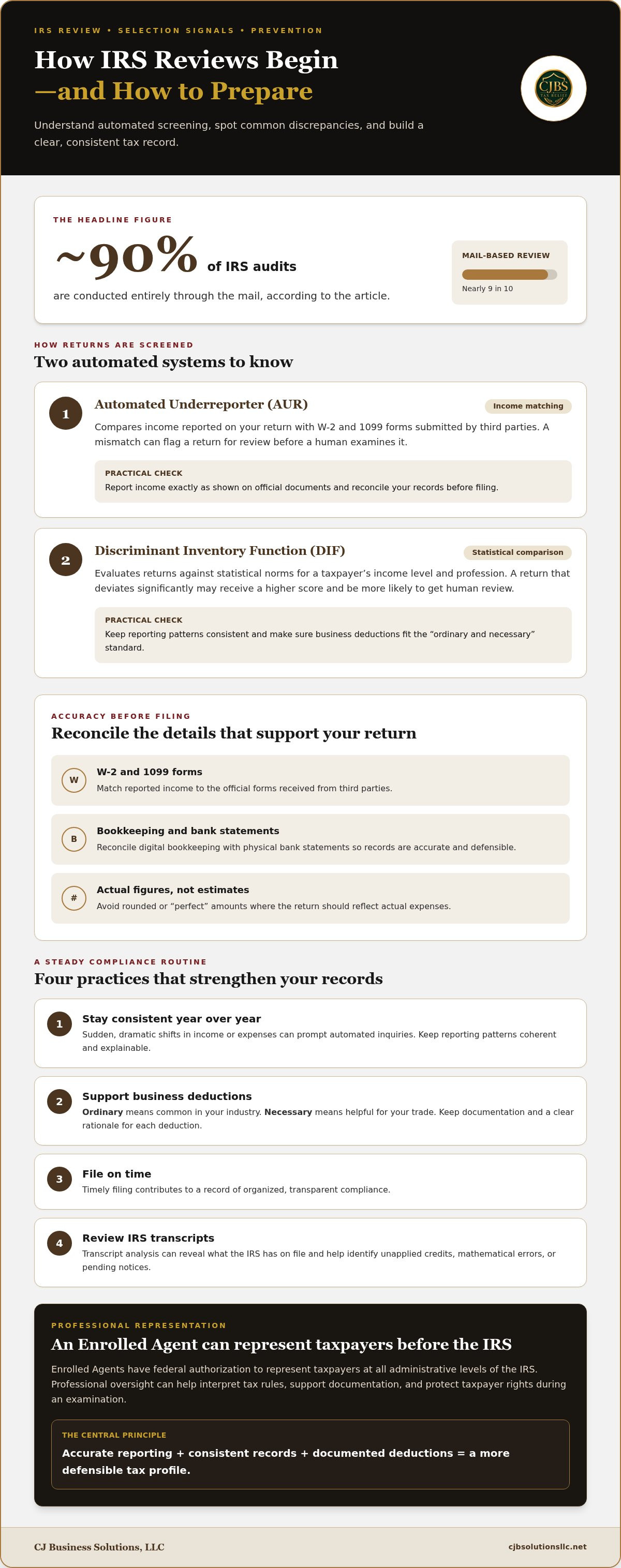
Did you know that nearly 90 percent of IRS audits are now conducted entirely through the mail, often triggered by simple automated discrepancies? It's natural to feel a sense of unease when a letter from the IRS arrives, especially when tax regulations seem to shift every year. Many taxpayers share your concern that a minor oversight or a misunderstood deduction rule could lead to an intrusive and stressful examination of their past filings.
The good news is that you don't have to leave your financial peace of mind to chance. By implementing strategic tax planning to avoid audits, you can transform your approach from reactive worry to proactive preparation. This article explains how professional transcript analysis and methodical planning can minimize IRS scrutiny while ensuring your long-term stability. You'll gain a clear roadmap for record-keeping and understand how expert representation protects your interests in 2026 and beyond.
Key Takeaways
- Gain an understanding of how the IRS utilizes automated systems and statistical scoring to select returns for review, allowing you to address common red flags proactively.
- Implementing strategic tax planning to avoid audits helps you maintain a consistent financial profile that aligns with the "ordinary and necessary" standards for business deductions.
- Learn how professional transcript analysis serves as a vital preventative measure by identifying discrepancies in your IRS records before they escalate into formal inquiries.
- Discover the value of working with an Enrolled Agent to establish a professional buffer and ensure your tax strategy remains fully compliant with evolving federal guidelines.
Understanding the IRS Selection Process and Common Audit Triggers
The prospect of an income tax audit often brings a sense of unease, yet understanding how the IRS selects returns can significantly lower that anxiety. Most examinations aren't random; they're the result of sophisticated automated systems designed to ensure accuracy. The Automated Underreporter (AUR) system acts as the first line of defense, comparing your reported income against W-2 and 1099 forms submitted by third parties. If a mismatch exists, the system flags the return for review without a human ever looking at it.
Beyond simple matching, the IRS employs the Discriminant Inventory Function (DIF) score. This algorithm evaluates every return against statistical norms for your specific income level and profession. When a return deviates too far from these benchmarks, it receives a higher score, increasing the likelihood of human review. Emphasizing strategic tax planning to avoid audits allows you to align your reporting with these expected norms, providing a sense of stability and confidence in your filings. Knowing that selection is often a matter of mathematics rather than a personal judgment helps you approach your taxes with a calm, methodical mindset.
Identifying Data Mismatches and Mathematical Discrepancies
Precision is your best ally when filing. Reporting income exactly as it appears on your official documents prevents the AUR system from triggering a flag. It's also wise to avoid using rounded numbers or "perfect" figures. While it might seem simpler to estimate a $500 deduction, the IRS often views these rounded amounts as estimates rather than actual expenses, which can invite closer scrutiny. Reconciling your digital bookkeeping with physical bank statements before you file ensures your data is both accurate and defensible. This methodical approach is a cornerstone of strategic tax planning to avoid audits, turning a complex process into a manageable routine.
Proactive Strategies for Maintaining Long-Term Tax Compliance
Building a stable tax profile involves more than just annual accuracy; it requires a commitment to the consistency principle. The IRS monitors year-over-year reporting patterns, and sudden, dramatic shifts in income or expenses can trigger automated inquiries. For example, maintaining a steady approach to business deductions ensures they meet the "ordinary and necessary" standard. An expense is considered ordinary if it's common in your industry and necessary if it's helpful for your trade. Adhering to these benchmarks is a central pillar of strategic tax planning to avoid audits, as it prevents your return from standing out as a statistical outlier.
Filing your returns on time also serves as a vital signal of good-faith compliance. While the IRS audit selection process relies heavily on algorithms, a history of timely filings suggests a taxpayer who is organized and transparent. This reliability builds a narrative of compliance that's beneficial if your return is ever selected for a closer look. It's about creating a record of dependability that speaks for itself over the long term.
The Role of Transcript Analysis in Identifying Potential Issues
An often overlooked tool in a proactive defense is IRS transcript analysis. This process involves reviewing the internal records the IRS maintains for your account to see exactly what data they have on file. By examining specific transaction codes, it's possible to identify unapplied credits, mathematical errors, or even pending notices before they escalate. This clarity is essential for strategic tax planning to avoid audits, as it allows you to resolve discrepancies quietly. If you're looking for a foundational step in your annual preparation, exploring transcript analysis services can provide the transparency you need to move forward with confidence.
Navigating Complex Deductions with Professional Representation
Effective tax management is often a matter of perspective. While aggressive tax avoidance focuses on short-term gains at the risk of crossing legal boundaries, strategic tax planning to avoid audits prioritizes long-term compliance through established federal guidelines. By engaging a professional, you create a necessary buffer between yourself and the IRS. This representative acts as a seasoned mentor, interpreting shifting tax laws to keep your business within a safe harbor. Staying informed about common tax audit triggers, such as disproportionate expense ratios or unverified cash transactions, is much easier when you have an expert reviewing your strategy.
This methodical approach to strategic tax planning to avoid audits ensures that every deduction is backed by the proper documentation and legal rationale. A seasoned mentor doesn't just fill out forms; they anticipate how new legislation might impact your specific industry. This foresight allows you to adjust your records and reporting methods well before the filing deadline, maintaining a consistent and low-risk profile. It's a way of working that values substance over flash, ensuring your financial health remains secure year after year.
Why Enrolled Agent Representation Strengthens Your Audit Defense
An Enrolled Agent holds a unique federal authorization to represent taxpayers before all administrative levels of the IRS. Unlike other preparers, their status is granted directly by the Department of the Treasury, ensuring they have the specialized knowledge required for complex challenges. Investing in an IRS audit strategy defense is not just about responding to a notice; it's about protecting your rights and ensuring fair treatment throughout any examination. This professional oversight provides the quiet confidence needed to manage your finances without the fear of unexpected correspondence. A long-term partnership with a firm that prioritizes stability transforms the tax season into a routine exercise in financial stewardship.
Securing Your Financial Peace of Mind for 2026
Achieving long-term tax stability begins with understanding that the IRS selection process is largely driven by data consistency and statistical norms. By focusing on accurate reporting and utilizing proactive tools like transcript analysis, you can address potential discrepancies before they lead to an inquiry. This methodical approach transforms tax season from a period of uncertainty into a routine part of your financial growth. Implementing strategic tax planning to avoid audits ensures that your records remain transparent and your deductions stay within the safe harbor of federal guidelines.
Explore how our IRS audit strategy defense and resolution services can protect your financial future. With expert representation by a licensed Enrolled Agent and detailed transcript analysis, we provide the steady guidance needed to navigate complex regulations. You deserve the confidence that comes from a professional partnership rooted in quality and care.
Frequently Asked Questions
What is the most common reason for an IRS audit selection?
The most frequent reason for selection is a data mismatch between your tax return and third-party forms like 1099s or W-2s. The IRS Automated Underreporter system flags these discrepancies instantly when figures don't align. Additionally, returns with high statistical scores that deviate from industry norms are often prioritized for review. This is why strategic tax planning to avoid audits focuses so heavily on reporting accuracy.
How far back can the IRS audit my tax returns for errors?
Generally, the IRS can audit your returns for up to three years after the filing date or the due date, whichever is later. However, this statute of limitations extends to six years if you omit more than 25 percent of your gross income. In cases involving fraudulent returns or a failure to file, there's no time limit for the IRS to assess tax or initiate an examination.
Does filing a tax extension increase my risk of being audited?
Filing a tax extension does not increase your risk of being audited by the IRS. In fact, taking the extra time often allows you to gather all necessary third-party documents and ensure your figures are precise. Providing a complete and accurate return is a core part of strategic tax planning to avoid audits, as it reduces the likelihood of automated flags caused by rushed reporting errors.
How can transcript analysis help me avoid a future tax audit?
Transcript analysis allows you to see exactly what information the IRS has on file for your account before a notice is even issued. By reviewing specific transaction codes, a professional can identify unapplied payments, mathematical errors, or mismatched 1099 data. Resolving these issues proactively prevents them from escalating into a formal audit, providing a clear path toward long-term compliance and greater financial stability.

Article by
Crystal R. Johnson, MBA EA
Crystal Johnson founded CJ Business Solutions to give individuals and small-business owners something often missing from the tax and accounting process: clear explanations, practical solutions, and trusted support.
With more than 27 years of accounting and financial experience, Crystal helps clients understand complicated tax matters, restore compliance, respond to IRS concerns, and make stronger business decisions. As an Enrolled Agent, she is federally authorized to represent taxpayers before the Internal Revenue Service.


