

Could a thorough analysis of your IRS transcripts be the quiet turning point in your financial recovery? For many, the weight of federal debt feels like a storm that never ends, especially when seeking a reliable path toward back taxes resolution. It's natural to feel overwhelmed by technical terminology or the fear of a sudden bank levy. You aren't alone in seeking a way out that protects your livelihood and your family's future.
This guide offers a clear roadmap to compliance, providing the professional strategies and procedural steps required to regain your standing with the IRS. We'll examine how to evaluate your eligibility for federal programs in 2026, manage 7% interest rates, and utilize transcript analysis to build a methodical defense. By understanding the options available under the latest legislation, you can move toward a future defined by stability rather than uncertainty.
Key Takeaways
- Gaining clarity on the progression of the IRS collection cycle helps you anticipate how unpaid liabilities eventually lead to formal actions like liens or levies.
- You can identify specific federal relief options, such as Installment Agreements and Currently Not Collectible status, to help stabilize your financial situation.
- Reviewing the eligibility requirements for an Offer in Compromise helps you determine if you qualify to settle your debt for less than the full amount.
- An Enrolled Agent facilitates a thorough back taxes resolution by managing all direct IRS communications and performing detailed transcript reviews on your behalf.
Understanding the IRS Collection Cycle and Back Tax Liabilities
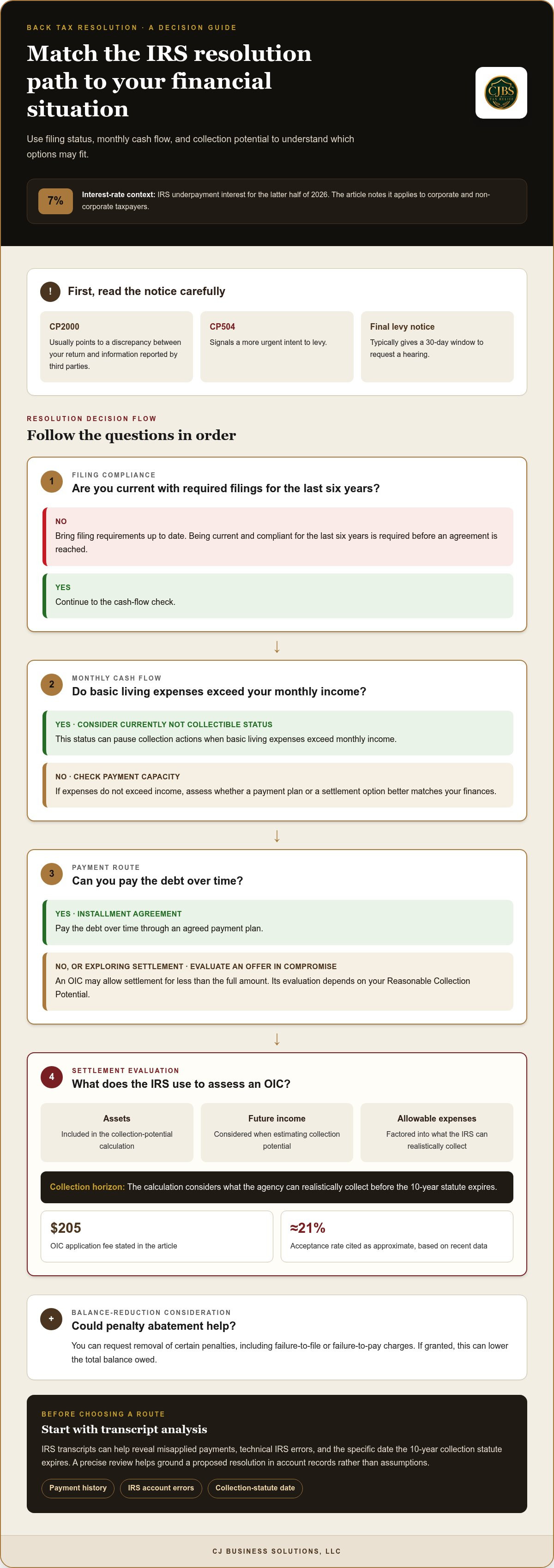
Understanding the full scope of your liability is the first step toward regaining your peace of mind. When we ask What are back taxes? we're looking at a combination of unpaid liabilities, unfiled returns, and accrued interest. For the latter half of 2026, the IRS interest rate for underpayments sits at 7%, applying to both corporate and non-corporate taxpayers. This steady accumulation means that waiting often complicates your financial options. The collection cycle follows a set progression, starting with initial notices of balance due and eventually escalating to formal actions such as federal tax liens or bank levies. Responding promptly is vital. It keeps the door open for various resolution programs that might be restricted once formal collection begins.
Identifying Your Specific Tax Issues and IRS Notices
IRS envelopes often contain specific codes that act as markers for your account status. A CP2000 notice usually indicates a discrepancy between your return and information reported by third parties, while a CP504 signals a more urgent intent to levy. It's helpful to distinguish between a simple balance due notice and a final notice of intent to levy, which typically grants you a 30-day window to request a hearing. Rather than viewing these letters as a final demand, consider them a formal invitation to start your back taxes resolution. Each piece of mail provides a specific opportunity to use transcript analysis to clarify your standing. This methodical approach helps you identify the exact nature of your debt. It allows you to move forward with a clear, professional strategy instead of reacting out of fear.
Proven Strategies for Strategic Back Taxes Resolution
Choosing the right path requires a calm evaluation of your unique financial profile. Several federal programs exist to provide relief, ranging from long-term payment plans to temporary hardship deferments. An Installment Agreement allows you to pay your debt over time; conversely, Currently Not Collectible status pauses collection actions if your basic living expenses exceed your monthly income. Penalty abatement also plays a significant role in a successful back taxes resolution. By requesting the removal of certain penalties, such as the failure-to-file or failure-to-pay charges, you can effectively lower the total balance owed to a more manageable level. These IRS tax debt solutions are designed to help taxpayers return to good standing without sacrificing their essential needs.
Evaluating Settlement Options: OIC vs. Installment Agreements
Deciding between a lump-sum settlement and a long-term plan involves understanding how the IRS calculates your "Reasonable Collection Potential." This formula considers your assets, future income, and allowable expenses to determine what the agency can realistically collect before the 10-year statute expires. The Offer in Compromise (OIC) program is a sought-after option for settling for less than the full amount, though it requires a $205 application fee and carries an acceptance rate of approximately 21% as of recent data. Before any agreement is reached, you must be current and compliant with all filing requirements for the last six years. This foundational step ensures you're eligible for negotiation. If you're unsure which path fits your situation, exploring professional tax resolution services can offer the steady guidance needed for navigating back taxes resolution with confidence.
The Role of Professional Representation and Transcript Analysis
Having a qualified representative acts as a vital shield between you and the IRS when you're managing federal debt. An Enrolled Agent possesses unique federal practice rights, allowing them to represent you across all administrative levels of the agency. This professional representation creates a necessary buffer, ensuring that you don't have to engage in direct, stressful negotiations with revenue officers. Instead, your representative manages all correspondence and inquiries, advocating for your rights while you focus on your daily life. For those seeking a comprehensive guide to back tax relief, understanding this level of advocacy is often the first step toward a successful outcome.
Why Transcript Analysis is the Foundation of a Successful Resolution
Effective back taxes resolution doesn't begin with a guess; it starts with a precise diagnostic review called transcript analysis. This process involves decoding the internal IRS records that track every action on your account. By examining these transcripts, we can uncover critical data points that aren't always obvious in standard notices. This includes identifying misapplied payments, technical IRS errors, or the specific date when the ten-year collection statute expires. It's a methodical way to ensure your history is accurately reflected before any resolution is proposed.
At CJ Business Solutions, LLC, we utilize this analysis as the cornerstone of our methodology. It allows us to build a data-driven defense that prioritizes your financial autonomy. Instead of reacting to collection demands, we use these insights to determine which resolution paths are most viable for your specific situation. This methodical approach ensures that your back taxes resolution is based on facts rather than assumptions, providing a stable path forward for taxpayers nationwide.
Securing Your Path Toward Compliance
Resolving federal tax debt is a methodical process that requires patience and diagnostic clarity. By understanding the IRS collection cycle and identifying the specific programs you qualify for, you can move from a state of uncertainty to one of active compliance. Whether you're navigating the requirements of an Offer in Compromise or seeking penalty abatement, having a clear roadmap is essential for a successful back taxes resolution. This journey begins with an accurate assessment of your history to ensure no errors or expiring statutes are overlooked.
We invite you to request a professional transcript analysis from CJ Business Solutions, LLC to begin your journey with data-driven insights. Our team, led by an Enrolled Agent with federal practice rights, specializes in IRS audit strategy defense and thorough account reviews. Taking this small, intentional step today can provide the stability you need to move forward with peace of mind. You don't have to navigate this complex landscape alone.
Frequently Asked Questions
What is the difference between an Enrolled Agent and a CPA for tax resolution?
Enrolled Agents are federally authorized by the U.S. Department of the Treasury to represent taxpayers before all administrative levels of the IRS. While CPAs are state-licensed and often manage broad accounting tasks, Enrolled Agents specialize specifically in tax law and controversy. This federal focus makes them particularly effective for a back taxes resolution, as their expertise is centered on navigating IRS procedural requirements.
Can the IRS really garnish my wages for back taxes?
Yes, the IRS possesses the legal authority to issue a wage levy if a debt remains unresolved after several notices. Unlike private creditors, the IRS doesn't need a court order to begin this process. They'll typically send a final notice of intent to levy first, which provides a 30-day window to establish a resolution plan and protect your income from being redirected.
How far back can I go to file unfiled tax returns in 2026?
To reach a state of compliance in 2026, the IRS generally requires you to file the previous six years of returns. While you can file older documents, this six-year window is the standard benchmark for entering most relief programs. Filing these missing returns is a mandatory first step in any back taxes resolution, as the agency won't negotiate settlements while returns are outstanding.
What happens if I cannot afford to pay my back taxes in full?
If full payment isn't possible, the IRS evaluates your "Reasonable Collection Potential" to find an alternative path. This might include a monthly payment plan tailored to your income or being placed in "Currently Not Collectible" status if your basic living expenses exceed your earnings. A thorough review of your account transcripts can help identify which of these hardship-based options best fits your current financial situation.

Article by
Crystal R. Johnson, MBA EA
Crystal Johnson founded CJ Business Solutions to give individuals and small-business owners something often missing from the tax and accounting process: clear explanations, practical solutions, and trusted support.
With more than 27 years of accounting and financial experience, Crystal helps clients understand complicated tax matters, restore compliance, respond to IRS concerns, and make stronger business decisions. As an Enrolled Agent, she is federally authorized to represent taxpayers before the Internal Revenue Service.


