

What if the freeze on your bank account or the deduction from your paycheck wasn't a permanent end, but a procedural starting point? Receiving a CP504 or CP90 notice often feels like a sudden loss of control over your financial survival. It's natural to feel anxious when your liquid funds are suddenly out of reach. You've worked hard for your stability, and seeing it compromised is a heavy burden to carry. However, securing professional IRS levy release assistance is often a matter of understanding the internal logic the government uses to manage your file.
By utilizing professional transcript analysis, you can uncover exactly what the IRS knows about your history. This guide will show you how expert representation can stop the immediate seizure of your assets and help you establish a manageable resolution plan. We'll explore the 21-day bank hold window, economic hardship criteria, and how to transition from a crisis into a sustainable path forward. You'll gain the clarity needed to navigate this process with a steady partner.
Key Takeaways
- Distinguish between a tax lien and a tax levy to better understand how the IRS prioritizes claims versus the actual seizure of your property.
- Learn how seeking professional IRS levy release assistance can help you demonstrate economic hardship or transition into a compliant installment agreement.
- Identify the critical actions you can take during the 30-day window following a Final Notice of Intent to Levy to prevent the loss of liquid funds.
- Explore the benefits of Enrolled Agent representation, including their ability to decode complex transcripts and manage all direct correspondence with federal authorities.
Understanding the IRS Levy Process and Your Rights
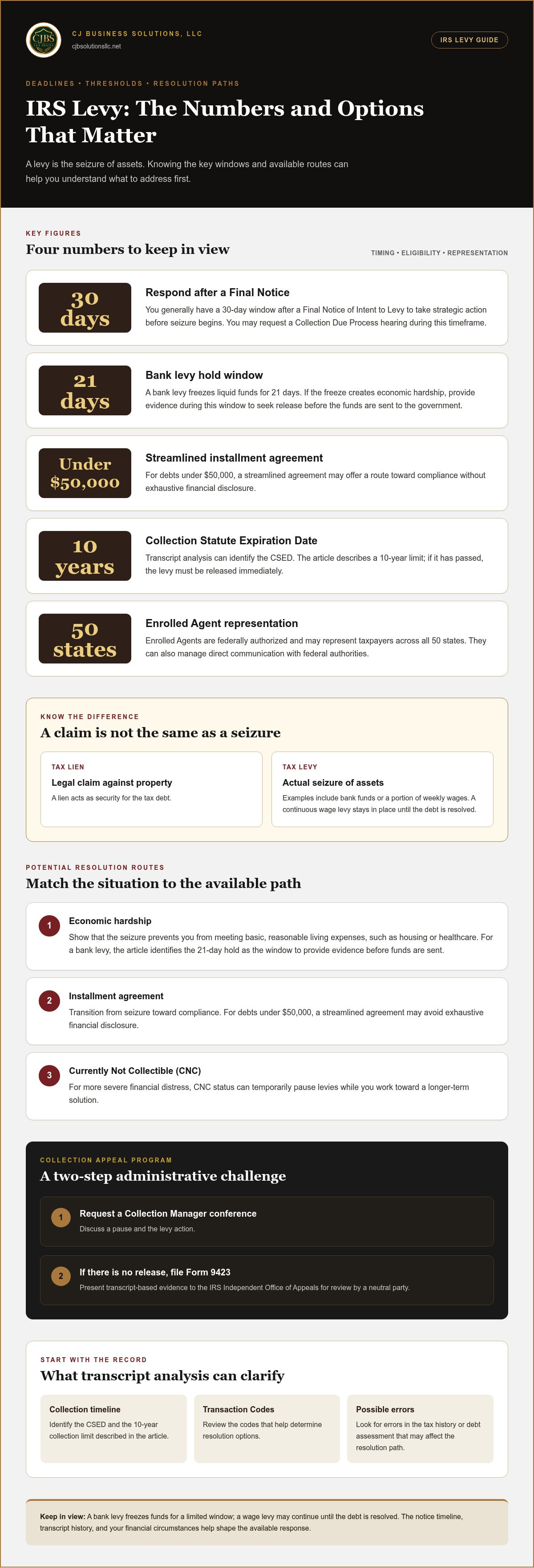
It's helpful to distinguish between an IRS tax lien and a tax levy, as they represent different stages of the collection process. A lien is a legal claim against your property that acts as security for your debt. In contrast, a levy is the actual seizure of assets, such as funds in your bank account or a portion of your weekly wages. Providing professional IRS levy release assistance often begins by identifying the triggers for these actions, which typically include unfiled tax returns or ignored correspondence like the CP504 notice. Once you receive a Final Notice of Intent to Levy, you generally have a 30-day window to take strategic action before the seizure begins.
Within this timeframe, you have the right to request a Collection Due Process hearing. This legal avenue allows you to propose alternatives and seek professional IRS levy release assistance. It's useful to recognize the difference between a bank levy, which freezes liquid funds for 21 days, and a continuous wage levy that stays in place until the debt is resolved. Understanding these distinctions helps you prioritize your response and maintain your financial survival.
The Critical Role of IRS Transcript Analysis
Decoding your official tax transcript is the most reliable way to begin any resolution strategy. These internal records allow us to identify the Collection Statute Expiration Date (CSED), which is the date the IRS must legally stop all collection efforts. If the 10-year limit has passed, the levy must be released immediately. Transcript analysis reveals the specific Transaction Codes that dictate your resolution options, providing a clear map of your tax history. By identifying errors the authorities might have missed, you can secure a path toward compliance that respects your current financial capacity.
Proven Strategies for Securing an IRS Levy Release
While the IRS definition of a levy emphasizes the government's authority to seize assets, it doesn't mean your situation is permanent. One of the most effective methods for obtaining relief is demonstrating economic hardship. This involves proving that the seizure prevents you from meeting basic, reasonable living expenses like housing or healthcare. If your bank account is frozen, you have a 21-day window to provide this evidence and secure a release before the funds are sent to the government.
Another path involves transitioning from a state of seizure to one of compliance through an installment agreement. For many, a streamlined agreement for debts under $50,000 provides a way forward without exhaustive financial disclosure. For those in more severe distress, "Currently Not Collectible" (CNC) status can serve as a temporary shield. This designation pauses levies while you work toward a long-term solution. If you're feeling overwhelmed, seeking professional IRS levy release assistance can help you navigate these requirements with confidence.
Navigating the Collection Appeal Program (CAP)
The Collection Appeal Program offers a structured way to challenge a levy action through specific administrative steps. You'll first request a conference with a Collection Manager to discuss a pause. If this doesn't result in a release, you can formally appeal by filing Form 9423. During this process, presenting transcript-based evidence to the IRS Independent Office of Appeals ensures your case is reviewed by a neutral party. This methodical approach is a cornerstone of effective IRS levy release assistance, and exploring tax resolution services can help you manage these filings accurately.
The Advantage of Professional Representation by an Enrolled Agent
Choosing an Enrolled Agent (EA) provides a unique advantage because these professionals are federally authorized by the U.S. Department of the Treasury. Unlike some legal experts who focus on courtroom litigation, an EA specializes specifically in the administrative paths of the tax code. They possess the right to represent taxpayers across all 50 states, ensuring you have access to a seasoned mentor regardless of where you reside. This national authority allows them to navigate the internal logic of the IRS with quiet confidence.
When you seek IRS levy release assistance, your representative takes on the role of a reliable guide. They manage all direct communication with federal authorities, which immediately reduces the burden on your daily life. It's their responsibility to ensure the government follows the correct procedures for How to Get an IRS Levy Released. This professional shield allows you to focus on your recovery while a steady partner negotiates the terms of your resolution, ensuring your rights are protected throughout the process.
Developing a Sustainable Resolution Path
A successful resolution isn't just about stopping a single seizure; it's about creating a stable future. By integrating transcript analysis with strategic audit defense, an EA can identify errors that may have led to an incorrect assessment of your debt. We also look for opportunities to leverage penalty abatement, which can remove "failure to pay" or "failure to file" charges that often compound the problem. This methodical approach encourages a steady pace toward financial freedom through professional tax and accounting services. You aren't just resolving a debt; you're building a foundation of compliance that provides long-term security and prevents the anxiety of future levies. This calm, thorough process ensures that you remain in control of your financial destiny.
Restoring Financial Stability through Expert Guidance
Regaining financial control is a deliberate journey that begins with understanding your procedural rights and identifying the most viable path toward compliance. We've explored how a strategic response to a levy notice can protect your liquid assets and how professional transcript analysis reveals the internal data necessary for a successful resolution. CJ Business Solutions, LLC provides national representation for all U.S. taxpayers, offering a calm and steady approach to federal tax debt resolution. Led by a seasoned Enrolled Agent, our firm focuses on decoding your tax history to find errors and opportunities for relief that others might miss.
To take the next step toward stability, you're invited to Request a Professional Transcript Analysis and Levy Consultation. With the right IRS levy release assistance, you can move past the current crisis and build a foundation for lasting financial freedom. You don't have to navigate this complex process alone.
Frequently Asked Questions
How long does it take for the IRS to release a bank levy after I contact them?
The IRS typically issues a release within a few business days once you establish a valid resolution path, such as an installment agreement or proof of economic hardship. For bank levies, the 21-day hold period provides a critical window to secure this release before funds are permanently transferred. Professional representation ensures that the necessary documentation reaches the correct department through the proper administrative channels.
Can the IRS levy my wages if I am currently in a payment plan?
Generally, the IRS is prohibited from issuing new levies while a formal installment agreement is in place and you remain compliant with the terms. If you receive a notice while in a payment plan, it may indicate a processing error or a default on a specific condition. Professional IRS levy release assistance can help clarify your status and resolve any discrepancies with the collection department immediately.
What is the difference between a wage garnishment and a bank account levy?
A bank account levy is a one-time seizure of the specific funds available in your account at the moment the notice is received by the bank. In contrast, a wage levy is continuous, meaning the IRS will deduct a portion of every paycheck until the debt is satisfied or the levy is released. Both actions require distinct strategic responses to protect your basic financial survival and household stability.
Is it possible to get an IRS levy released if I haven’t filed my taxes in years?
It is possible, but the IRS typically requires you to become compliant by filing all missing returns before they will grant a release. We use transcript analysis to identify exactly which years are missing and what income has been reported to the government. This allows us to prepare accurate returns and negotiate for IRS levy release assistance simultaneously, providing a clear path back to good standing.

Article by
Crystal R. Johnson, MBA EA
Crystal Johnson founded CJ Business Solutions to give individuals and small-business owners something often missing from the tax and accounting process: clear explanations, practical solutions, and trusted support.
With more than 27 years of accounting and financial experience, Crystal helps clients understand complicated tax matters, restore compliance, respond to IRS concerns, and make stronger business decisions. As an Enrolled Agent, she is federally authorized to represent taxpayers before the Internal Revenue Service.


