

While many taxpayers instinctively reach for a CPA the moment an IRS notice arrives, the most effective defense often comes from a specialist with a different set of credentials. We recognize that receiving an audit letter is a stressful experience, frequently leading to anxiety about financial penalties and confusion over complex tax codes. It's natural to feel overwhelmed when you're required to justify your financial history to the federal government.
This guide explores the critical differences in the enrolled agent vs cpa for audit comparison to help you secure the most effective representation. You'll learn how these professional roles differ in their scope of practice and federal licensing. By understanding these distinctions, you can develop a clear defense strategy aimed at minimizing your tax liability. We'll examine the unique advantages each professional offers, ensuring you feel supported as you move toward a calm, professional resolution.
Key Takeaways
- Understand the fundamental distinction between federal and state licensing to determine which professional possesses the authority required for your specific IRS matter.
- When comparing an enrolled agent vs cpa for audit defense, you'll discover why a deep focus on tax law and IRS procedures often outweighs a general accounting background.
- Review a practical checklist to help you decide if your situation, such as tax resolution or audit defense, warrants the specialized skills of an Enrolled Agent.
- Explore how a methodical approach to transcript analysis can reveal the most effective path toward reducing your tax liability and easing the stress of an audit.
Professional Authority: Federal vs. State Licensing
Choosing the right professional begins with understanding their source of authority. An Enrolled Agent (EA) is a federally authorized tax practitioner who has demonstrated technical expertise in taxation. Unlike a Certified Public Accountant (CPA), who is licensed by a specific state board to handle broad financial management, the EA's authority comes directly from the federal government. This distinction is vital when evaluating an enrolled agent vs cpa for audit defense. While both professionals possess unlimited representation rights before the IRS, their foundational training differs significantly.
Every EA is a tax specialist by definition; their entire professional focus is dedicated to the tax code. In contrast, many CPAs spend their careers focusing on corporate financial statements, business consulting, or general accounting. When considering the enrolled agent vs cpa for audit choice, remember that the EA’s technical depth is specifically tailored to federal disputes. It's helpful to clarify that while all EAs are tax specialists, not all CPAs specialize in tax representation or the nuances of an audit.
The Federal Advantage of the Enrolled Agent
EAs are the only tax professionals who receive their right to practice directly from the U.S. Treasury Department. This federal designation allows for consistent representation across all 50 states without the need for local licensing. To earn this status, they must pass a comprehensive three-part exam solely on the IRS tax code. This technical focus ensures your representative is a specialist in federal tax law and administrative procedures, acting as a reliable guide through the complexities of your case.
Audit Defense Strategy: Technical Depth vs. General Accounting
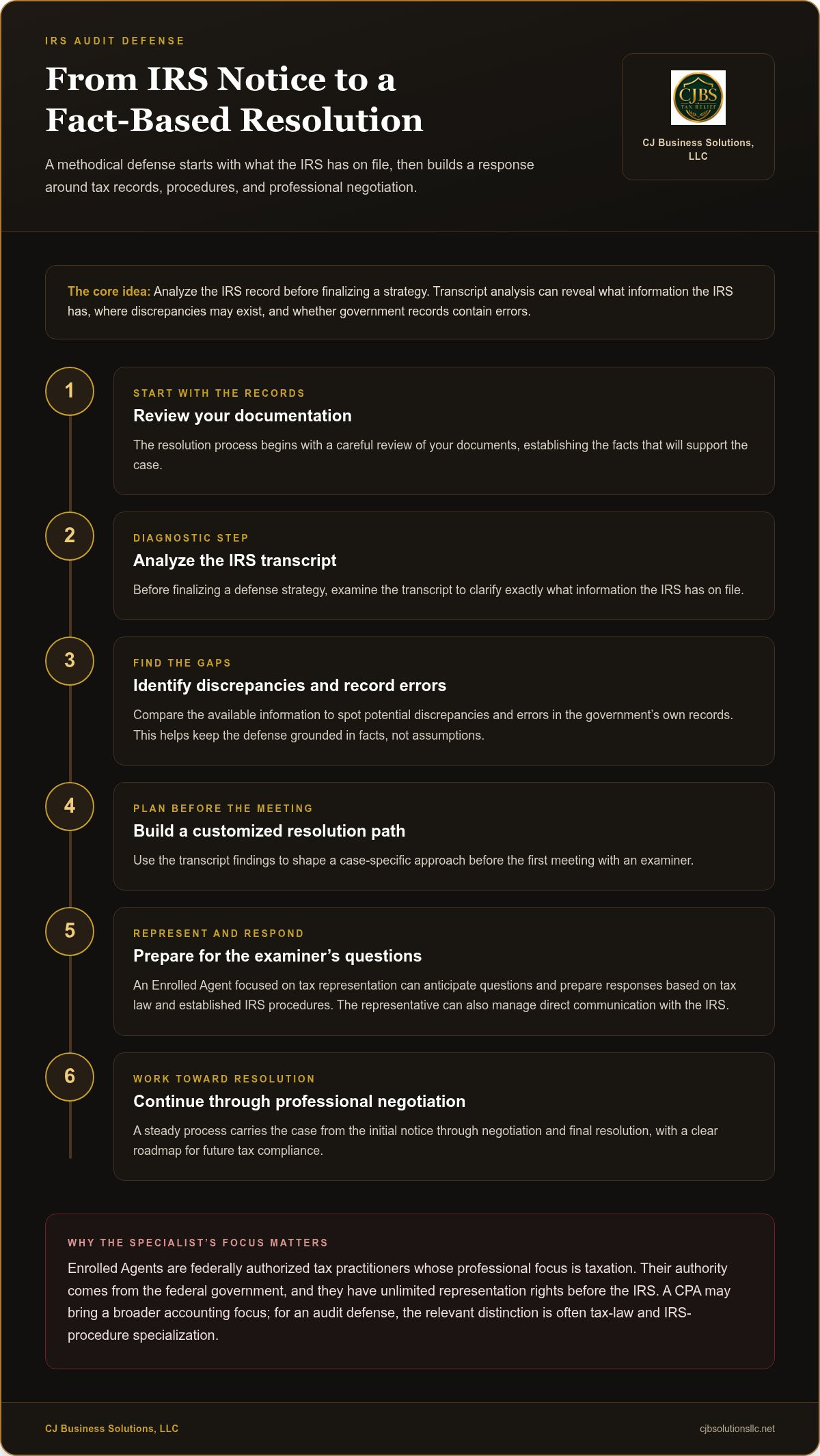
A successful defense relies on a nuanced understanding of administrative law and the Internal Revenue Manual. When evaluating an enrolled agent vs cpa for audit representation, it's helpful to consider their primary focus. CPAs generally prioritize the accuracy of financial statements, ensuring that every figure aligns with accounting principles. In contrast, an Enrolled Agent focuses on tax law compliance and the art of negotiation. This specialization allows them to act as a vital buffer, managing all direct communication with the IRS so you don't have to.
This approach represents a shift from reactive accounting to a proactive defense. By referencing the IRS definitions of tax professionals, we see that EAs are specifically tested on their ability to represent clients during disputes. They anticipate the examiner's questions and prepare responses based on established IRS procedures rather than just historical data. This proactive mindset is a key differentiator in the enrolled agent vs cpa for audit decision.
The Role of IRS Transcript Analysis in Defense
Before any strategy is finalized, we utilize IRS transcript analysis as a diagnostic tool. It creates clarity. This process identifies exactly what information the IRS has on file and where potential discrepancies exist. At CJ Business Solutions, LLC, we use this analysis to develop a customized resolution path before the first meeting with an examiner. This data-driven methodology prevents unexpected surprises and allows us to identify errors in the government’s own records. If you're facing a notice, starting with our transcript analysis services provides the clarity needed to proceed with confidence. This methodical first step ensures that your defense is built on facts, not assumptions.
When to Choose an Enrolled Agent for Your IRS Case
Deciding between an enrolled agent vs cpa for audit defense often comes down to the specific nature of the conflict. If your primary concern involves federal tax debt, complex audit defense, or tax resolution services, an Enrolled Agent is frequently the most strategic choice. Because their entire practice is dedicated to IRS matters, they offer a level of technical specialization that is often more cost-effective than hiring a generalist. Their focus remains fixed on the tax code, ensuring your defense is built on a foundation of specific knowledge rather than broad accounting principles.
We embrace the "Reliable Guide" philosophy, which prioritizes long-term financial compliance over simple, one-time filings. While a CPA might excel at preparing financial statements for diverse business needs, an EA's strength lies in defending those figures against federal scrutiny. For federal audits, the depth of tax law knowledge is the most critical factor in the enrolled agent vs cpa for audit decision. It's about finding a partner who understands the nuances of the IRS and prioritizes your standing with the Treasury.
Developing a Long-Term Resolution Path
Moving from an initial audit notice to a final resolution requires a methodical and steady hand. We encourage you to seek a consultant who values transparency and clarity at every stage. The process begins with a careful review of your documentation and continues through persistent, professional negotiation. By choosing a specialist who understands the quiet confidence required for effective IRS interaction, you ensure your case is handled with dignity and precision. This approach doesn't just resolve the current dispute; it provides a clear roadmap for your future tax health.
Securing Your Financial Future with Expert Representation
Choosing between an enrolled agent vs cpa for audit defense is a significant decision that impacts both your financial outcome and your peace of mind. We've explored how federal licensing provides a distinct advantage in tax disputes and why technical specialization is essential for a successful resolution. By prioritizing methodical transcript analysis, you can transform a stressful IRS notice into a manageable path forward.
CJ Business Solutions, LLC is led by an Enrolled Agent specializing in tax resolution and national representation. We invite you to contact CJ Business Solutions, LLC today for a professional IRS transcript analysis and audit strategy defense. Our goal is to act as your reliable guide, offering the expertise needed to protect your interests. You don't have to face the IRS alone; we're here to support your long-term success.
Frequently Asked Questions
Is an Enrolled Agent as high-ranking as a CPA for IRS representation?
In the eyes of the IRS, an Enrolled Agent holds the same level of authority for representation as a CPA or an attorney. Both professionals possess unlimited representation rights, meaning they can represent any taxpayer before any office of the IRS on any tax matter. While their licensing bodies differ, their standing during an audit or appeal is legally identical.
What can an Enrolled Agent do that a CPA cannot during an audit?
While both can represent you, an Enrolled Agent focuses exclusively on the tax code and IRS administrative procedures. A CPA's license allows them to perform financial statement audits for banks or public companies, a service EAs don't provide. However, for an IRS audit, an EA's technical depth in tax law often provides a more specialized defense strategy than a generalist accountant.
Do I need a CPA if I am already being audited by the IRS?
You aren't required to hire a CPA when facing an audit. When weighing an enrolled agent vs cpa for audit defense, many taxpayers find that an Enrolled Agent is a more targeted choice. Since EAs specialize in tax resolution and federal tax issues, they're often better equipped to handle the specific negotiations and procedural hurdles involved in a federal audit.
Can an Enrolled Agent represent me in any state?
Yes, an Enrolled Agent can represent you in any state across the country. Because their license is granted by the federal government rather than a state board, their authority is national. This allows them to assist taxpayers with federal tax issues regardless of where the taxpayer lives or where the audit is conducted, providing a consistent level of expert support.
Why is transcript analysis important for my audit defense?
Transcript analysis acts as a vital diagnostic tool that reveals exactly what information the IRS has recorded about your accounts. By reviewing these documents, a professional can identify errors in the government’s data and anticipate the auditor's focus. This process creates a clear roadmap for your defense, ensuring that your strategy is proactive and based on verified facts rather than assumptions.

Article by
Crystal R. Johnson, MBA EA
Crystal Johnson founded CJ Business Solutions to give individuals and small-business owners something often missing from the tax and accounting process: clear explanations, practical solutions, and trusted support.
With more than 27 years of accounting and financial experience, Crystal helps clients understand complicated tax matters, restore compliance, respond to IRS concerns, and make stronger business decisions. As an Enrolled Agent, she is federally authorized to represent taxpayers before the Internal Revenue Service.


