

Did you know the IRS plans to increase the audit rate for high-income individuals to 16.5% during 2026 while deploying advanced AI to flag inconsistencies? If you've received a notice in the mail, that statistic likely mirrors the weight you feel. It's a common concern to worry about whether a general accountant can navigate the complexities of a federal examination or if the technical terminology will lead to avoidable penalties. You deserve a partner who offers stability and quiet confidence during such a pivotal time.
Understanding the nuances of an enrolled agent vs cpa for audit defense is the first step toward a successful resolution. While both professionals maintain unlimited representation rights, their tactical approaches to IRS procedures differ significantly. This article will help you discover the strategic advantages of each role, providing you with a clear defense plan. We'll explore how specialized transcript analysis and federal expertise can minimize your liability; allowing you to move forward with peace of mind and a protected financial future.
Key Takeaways
- Gain clarity on the fundamental differences between state-licensed CPAs and federally-authorized Enrolled Agents to determine which professional best fits your current needs.
- Evaluate the strategic advantages of an enrolled agent vs cpa for audit defense, focusing on the distinction between general accounting logic and specialized IRS procedural logic.
- Learn how "unlimited representation rights" empower your representative to manage all communications with the IRS, providing a steady buffer between you and the examiner.
- Discover why a specialized transcript analysis is a critical first step in building a defense plan that protects your financial interests and reduces potential liabilities.
- Understand the tactical moments when transitioning from a general accountant to a tax resolution specialist is necessary for a successful audit outcome.
Understanding the Designations: EA and CPA Roles in Tax Representation
When you face an IRS examination, the question of an enrolled agent vs cpa for audit representation often arises. Both professionals are highly qualified, yet they operate under different authorities and focus on distinct areas of financial practice. Choosing the right one depends on whether you need a generalist to manage your overall business health or a specialist to navigate the technical intricacies of the tax code. We view this choice as selecting the right partner to walk beside you through a complex process.
The CPA: A Broad Financial Authority
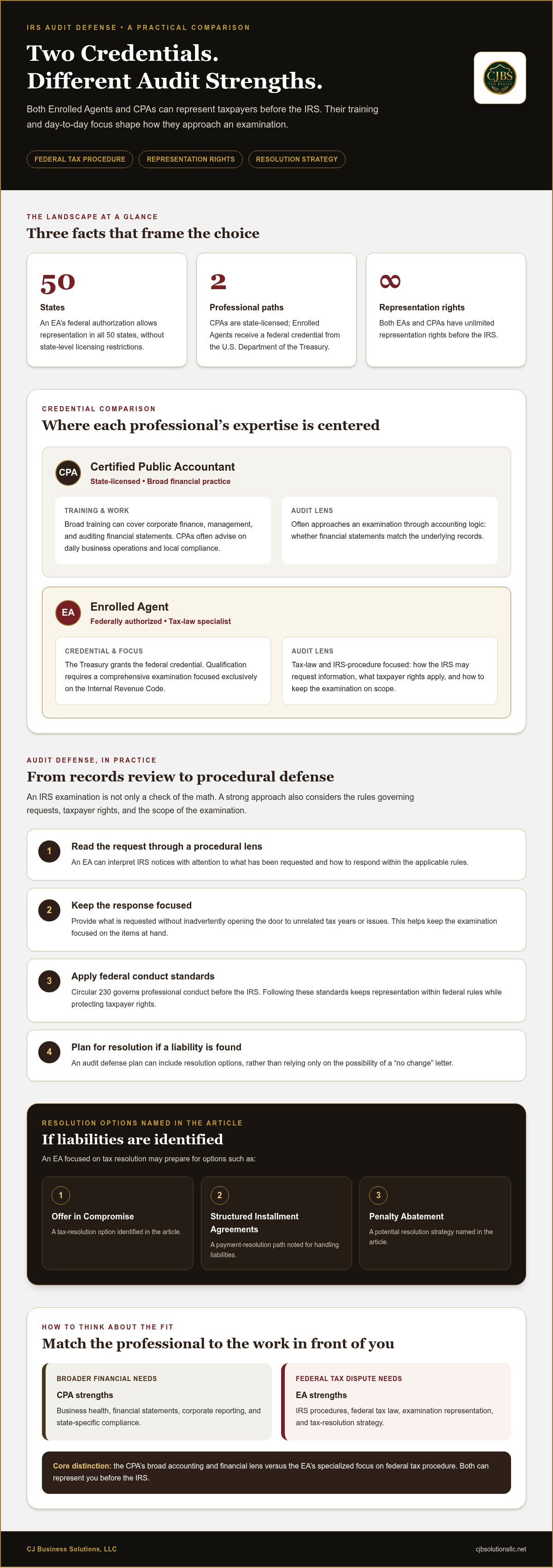
Certified Public Accountants are licensed by state boards of accountancy. Their training is intentionally broad, covering diverse disciplines such as corporate finance, management, and the auditing of financial statements. Because their licensing is managed at the state level, they often serve as the primary advisor for daily business operations and local compliance. They ensure that a company's books are accurate and that they meet the standards required for external reporting. While many CPAs offer tax services, their expertise is frequently rooted in accounting logic and general financial management. This makes them excellent partners for maintaining the ongoing health of a business, particularly when corporate reporting or state-specific compliance is the priority.
The Enrolled Agent: The IRS Specialist
The Enrolled Agent (EA) designation is a federal credential granted by the U.S. Department of the Treasury. Unlike CPAs, EAs are the only tax professionals who receive their right to practice directly from the federal government. This federal authorization allows them to represent taxpayers in all 50 states without the restrictions of state-level licensing. Their certification process is uniquely rigorous, requiring them to pass a comprehensive examination that focuses exclusively on the Internal Revenue Code. The Department of the Treasury considers EAs "dedicated tax professionals" because their entire scope of practice is centered on tax law, preparation, and representation. They don't spend their time on general bookkeeping or corporate auditing; instead, they focus their energy on the complexities of federal tax disputes.
Selecting between an enrolled agent vs cpa for audit defense often comes down to the source of their expertise. A CPA brings a wide lens to your financial situation, which is helpful for high-level financial planning. However, an EA acts as a reliable guide who speaks the specific language of the IRS. Because their career is built around the federal tax code, they're uniquely equipped to handle the high-stakes environment of an audit. They focus on protecting your interests within the specific procedural rules set by the Treasury. This methodical approach provides a reassuring presence when you need a representative who understands the nuances of tax law as well as the agents conducting the examination.
Strategic Differences: Why Specialization Matters in an IRS Audit
While many taxpayers assume an audit is simply a review of their math, the reality is far more strategic. When comparing an enrolled agent vs cpa for audit defense, the primary difference lies in their tactical approach to the Internal Revenue Service. A CPA often views an audit through the lens of accounting logic, focusing on whether the financial statements match the underlying records. While this is essential for business health, an audit requires a deep understanding of IRS procedural logic. This involves knowing not just what the numbers say, but how the IRS is legally allowed to ask for them and what rights you have to protect your information.
Accounting vs. Tax Law Procedure
Having perfectly balanced books does not always guarantee a successful audit outcome if the procedural defense is weak. Agents are trained to look for specific patterns, and an Enrolled Agent interprets IRS notices through a tactical lens that a generalist might miss. They understand the flow of information; providing exactly what is requested without inadvertently opening doors to unrelated tax years or issues. Circular 230 is the federal regulation governing professional conduct before the IRS. By adhering to these standards, an EA ensures that your representation remains within the bounds of federal law while leveraging every available taxpayer right. This methodical filtering of information acts as a buffer, lowering your stress and keeping the examination focused on the specific items at hand.
Negotiation and Resolution Strategies
The tactical advantage of an Enrolled Agent often comes from their mastery of the Internal Revenue Manual (IRM), which is the official guide for IRS employees. This knowledge allows them to identify resolution paths that are often overlooked. Both EAs and CPAs hold unlimited representation rights, but the way they exercise those rights during a negotiation can vary. An EA’s focus is almost exclusively on tax resolution, meaning they spend their time studying the specific habits and requirements of the Treasury Department. While a generalist might simply hope for a "no change" letter, an EA is prepared with a plan for tax resolution if liabilities are found. This includes navigating complex options like an Offer in Compromise, structured Installment Agreements, or Penalty Abatement. They don't just defend the past; they negotiate a sustainable future. If you're feeling uncertain about your current representation, exploring a specialized transcript analysis can provide the diagnostic clarity needed to build a stronger defense.
Unlimited Representation Rights: How Federal Authorization Protects You
When you are facing a federal examination, the concept of representation rights becomes your primary shield. Both the Enrolled Agent and the CPA are granted unlimited representation rights by the Internal Revenue Service. This means they're authorized to handle every aspect of your case, from initial meetings and correspondence to appeals and collections. This professional buffer is essential for maintaining a calm environment. By allowing a representative to speak on your behalf, you avoid the risk of providing unnecessary information that could inadvertently expand the scope of the examination.
One significant advantage of working with an Enrolled Agent is the national portability of their credentials. While a CPA's license is managed by a specific state board, an EA's authority is granted at the federal level. This is particularly beneficial if your business operates in multiple states or if you've moved since filing the return under review. An EA can represent you before any IRS office across the country without the need for state-specific reciprocity. This ensures that your enrolled agent vs cpa for audit defense remains consistent and uninterrupted, regardless of geographic borders.
The Power of Transcript Analysis
An IRS transcript acts as a detailed roadmap of your tax history. It contains a record of every notice sent, every payment received, and every internal adjustment made by the government. At CJ Business Solutions, LLC, we utilize specialized transcript analysis as a diagnostic tool to identify hidden red flags before the auditor brings them to your attention. By decoding these transcripts, we can often predict the IRS's next move and identify errors in their records. This review is a critical first step in any defense strategy because it replaces uncertainty with clear, actionable data, allowing us to build a resolution path based on facts rather than guesswork.
Federal Standards of Practice
Because EAs are federally authorized, they must adhere to a uniform standard of expertise and ethics mandated by the Department of the Treasury. This federal oversight ensures a high standard of care and professional conduct for every taxpayer they serve. CJ Business Solutions, LLC believes in maintaining total transparency throughout the representation process. Our goal is to act as a seasoned mentor, ensuring you feel fully informed and supported at every stage. This methodical approach helps lower the stress of an audit, providing you with the stability of a reliable partner who understands the intricacies of federal tax law and the rights afforded to you by the Treasury Department.
Tactical Selection: Matching Your Situation to the Right Professional
Choosing the right representative is not a matter of prestige or title, but rather a reflection of the specific challenges your audit presents. While many assume that a CPA is the default choice for any business-related tax matter, the decision between an enrolled agent vs cpa for audit defense should be based on the nature of the inquiry. If the IRS is questioning the fundamental structure of your bookkeeping, the professional who maintains those records is often best equipped to explain them. However, if the examination shifts toward the interpretation of federal tax law or the negotiation of tax debt, the specialized focus of an Enrolled Agent becomes a significant asset.
Small businesses often find themselves in a vulnerable position during an audit because their personal and professional finances are frequently intertwined. In these instances, the procedural focus of an Enrolled Agent helps keep the examination narrow and focused. They act as a steady partner, ensuring that the auditor does not stray into unrelated tax years or personal accounts without cause. This methodical approach is an investment in risk mitigation, aiming to resolve the matter with the least amount of financial and emotional strain possible.
Scenario A: Financial Statement Discrepancies
If the audit centers on how your financial statements were prepared or how specific transactions were categorized in your ledger, your current CPA’s deep knowledge of your bookkeeping is their primary asset. They can speak directly to the accounting logic used to build your records. In these cases, it's often helpful to have your CPA coordinate with an audit specialist to ensure that your financial reporting aligns perfectly with the claims made on your tax return. This teamwork provides a comprehensive defense that covers both the accuracy of the numbers and the legal requirements of the tax code.
Scenario B: Complex Tax Disputes and Resolution
When the IRS challenges your filing status, the validity of certain deductions, or the interpretation of a specific tax law, the situation requires a representative who lives and breathes the Internal Revenue Code. An EA is the logical choice for these complex disputes because their training is dedicated exclusively to tax law and resolution strategies. They approach the problem as a seasoned mentor, helping you understand the long-term compliance path while negotiating settlements or penalty removals. If you're facing a high-stakes examination, we encourage you to contact CJ Business Solutions, LLC for a specialized audit strategy that protects your interests.
Expert Audit Defense with CJ Business Solutions, LLC: The EA Advantage
When evaluating the tactical benefits of an enrolled agent vs cpa for audit defense, the specialized focus on tax resolution at our firm provides a distinct advantage. CJ Business Solutions, LLC combines the technical authority of an Enrolled Agent with a soft-touch methodology designed to lower your stress. We understand that an audit often feels like a storm of complex information. Our firm serves as a calm port, focusing on substance and expertise to ensure your interests are represented with quiet confidence and a methodical standard of care.
A Methodical Approach to IRS Challenges
Our approach begins by de-escalating the situation through professional representation that acts as a buffer between you and the examiner. We believe that a successful resolution is built on a foundation of transparency and thorough preparation. By conducting a detailed transcript analysis, CJ Business Solutions, LLC identifies potential errors and negotiates outcomes that prioritize your long-term financial health. This diagnostic phase allows us to move beyond the initial anxiety of an IRS notice toward a clear, actionable resolution plan that protects your financial future.
Partnering for Your Financial Stability
We are deeply proud of the professional relationships we build, acting as a seasoned mentor rather than just a service provider. Our firm prioritizes education, ensuring you understand every step of the strategic defense plan we implement. If you are seeking a stable and dependable entity to represent you, we invite you to take the first step toward resolution. Contact CJ Business Solutions, LLC today to secure expert audit representation. We look forward to helping you navigate the complexities of the federal tax system with the highest standard of care and professional dedication.
Securing Your Financial Future with Professional Representation
Choosing between an enrolled agent vs cpa for audit defense is a decision that shapes the trajectory of your resolution. While a CPA provides essential broad financial oversight, an Enrolled Agent offers the specialized procedural mastery required to navigate federal examinations with precision. By leveraging federal authorization and a deep focus on the Internal Revenue Code, you gain a representative who acts as a buffer between you and the IRS. This methodical approach ensures your rights remain protected throughout every stage of the process.
At CJ Business Solutions, LLC, we prioritize your peace of mind through expert IRS audit strategy defense and EA-led national tax representation. We believe every successful defense starts with specialized transcript analysis services to identify errors and predict the government's next move. If you're ready to transition from audit anxiety to a clear, actionable plan, we invite you to Request a Professional Transcript Analysis and Audit Strategy Consultation. You don't have to face this challenge alone; we're here to serve as your steady partner in securing a stable financial outcome.
Frequently Asked Questions
Can an Enrolled Agent represent me in an IRS audit just as well as a CPA?
Yes, an Enrolled Agent can represent you with the same legal authority as a CPA. Both designations hold unlimited representation rights before the IRS, which allows them to handle all communications, meetings, and appeals on your behalf. While a CPA's expertise is often broader in scope, an EA's training is focused exclusively on the tax code and federal procedures.
Do I need to be present during the audit if I hire an Enrolled Agent?
You typically don't need to be present during the examination if you've authorized a professional to act on your behalf. By filing Form 2848, you allow your representative to serve as your voice in all meetings with the auditor. This arrangement creates a professional buffer that helps prevent the accidental disclosure of unnecessary information that could expand the scope of the inquiry.
What is the main difference between an EA and a CPA regarding tax law?
The primary distinction lies in their licensing and their core area of focus. CPAs are licensed by state boards and are trained in a wide variety of accounting and auditing disciplines. In contrast, Enrolled Agents are federally authorized by the U.S. Department of the Treasury and must demonstrate a high level of expertise specifically in the Internal Revenue Code and tax resolution.
Is an Enrolled Agent more affordable than a CPA for audit defense?
While fees vary based on the complexity of the case and the professional's experience, Enrolled Agents often provide a highly competitive option for specialized tax defense. Because their practice is dedicated solely to tax matters, they're often able to navigate disputes efficiently. When comparing an enrolled agent vs cpa for audit representation, it's helpful to consider the value of their specialized procedural knowledge.
How does transcript analysis help in an IRS audit?
Transcript analysis allows your representative to see exactly what the IRS has on file regarding your tax history. It acts as a diagnostic tool that reveals internal codes, payment records, and potential red flags before the auditor even mentions them. This clarity allows for the creation of a more proactive and strategic defense plan based on hard data rather than guesswork.
Can an Enrolled Agent help with state tax audits as well as federal?
Yes, Enrolled Agents can represent taxpayers in state tax matters as well as federal ones. Although their license is granted at the federal level, their authority to practice before the IRS is recognized nationwide. Most states allow EAs to represent clients in local audits, providing a consistent and stable defense across different jurisdictions.
What should I do first if I receive an IRS audit notice?
Your first step should be to carefully read the notice to understand which tax years and items are being questioned. It's advisable to gather the requested records immediately but refrain from contacting the IRS agent directly until you've consulted with a professional. Early preparation and seeking a seasoned mentor can significantly lower the emotional temperature of the situation.
Why do some people prefer an EA over a CPA for tax resolution services?
Many taxpayers prefer Enrolled Agents for tax resolution services because of their deep familiarity with the Internal Revenue Manual. EAs spend their careers negotiating settlements, such as Offers in Compromise and installment agreements. Their specific focus on resolving tax debt often makes them a more tactical choice than a general accountant when dealing with complex IRS collection matters.

Article by
Crystal R. Johnson, MBA EA
Crystal Johnson founded CJ Business Solutions to give individuals and small-business owners something often missing from the tax and accounting process: clear explanations, practical solutions, and trusted support.
With more than 27 years of accounting and financial experience, Crystal helps clients understand complicated tax matters, restore compliance, respond to IRS concerns, and make stronger business decisions. As an Enrolled Agent, she is federally authorized to represent taxpayers before the Internal Revenue Service.


