

What if the most effective way to handle a complex IRS notice wasn't a rushed phone call, but a methodical deep dive into the agency's own internal records? When you're facing a 7% interest rate on underpayments or the looming threat of a lien, the pressure can feel immense. It's understandable to feel anxious about the audit process or confused by technical federal notices. You've worked hard for your financial standing, and you deserve a clear, stable path to protect it. Professional IRS tax resolution services provide that clarity by replacing uncertainty with a data-driven strategy.
We understand that the tax code is daunting, particularly as the IRS continues to modernize its enforcement capabilities. This guide will show you how specialized transcript analysis and expert advocacy can help you stop collection actions and potentially reduce your total liability. We'll walk through the essential steps of the resolution process, from initial diagnostics to achieving long-term compliance, so you can finally move forward with peace of mind.
Key Takeaways
- Learn how professional IRS tax resolution services integrate tax law and strategic accounting to advocate for your rights and halt collection actions.
- Discover the unique advantages of working with an Enrolled Agent, a federally licensed professional authorized to represent you before the IRS across the country.
- Understand why transcript analysis serves as the essential diagnostic tool for identifying the exact status of your account and uncovering potential relief options.
- Explore realistic pathways for resolving federal debt, including the components of the "Fresh Start" program and data-driven negotiation strategies.
- Gain a new perspective on the audit process by learning how meticulous preparation can transform an intimidating notice into a manageable request for information.
Understanding IRS Tax Resolution Services and Your Taxpayer Rights
Facing federal tax challenges often feels like standing in the path of a slow-moving storm. You know the clouds are gathering, but you might not know how to find shelter. IRS tax resolution services offer that shelter by providing a methodical, legally grounded approach to settling outstanding liabilities and managing audits. Unlike traditional accounting, which focuses on historical reporting, resolution is a forward-facing discipline that operates at the intersection of tax law, accounting, and strategic negotiation.
The foundation of every successful case is the Taxpayer Bill of Rights. These ten fundamental protections ensure that the process remains fair and transparent. For instance, you have the right to be informed, the right to pay no more than the correct amount of tax, and, perhaps most importantly, the right to retain representation. While the IRS publishes these rights, exercising them effectively often requires a professional advocate who understands how to use them as a shield against aggressive collection tactics. Moving from a reactive stance to a proactive one allows you to regain control of your financial narrative.
The Difference Between Tax Preparation and Resolution
It's a common misconception that standard tax preparation is the same as resolution. Tax preparation is a compliance function; it's about looking backward to report income and expenses for a specific period. Resolution, however, is a problem-solving function. It addresses disputes, errors, or an inability to pay. Your standard preparer may be excellent at filing forms, but they might not be equipped to defend a complex position during a federal dispute. Resolution professionals shift the focus from simply filing to actively defending your financial interests through programs like an Offer in Compromise.
When to Seek Professional Representation
Identifying when to step back and let an expert take the lead is a critical skill. Certain red flag notices, such as a Notice of Federal Tax Lien or a Final Notice of Intent to Levy, require immediate attention. Communicating directly with the IRS without a representative carries risks; you might inadvertently provide information that complicates your case. Engaging IRS tax resolution services at this stage ensures that your rights are protected while a formal resolution plan is established. Professional intervention can often pause aggressive collection actions, such as wage garnishments or bank levies, providing the necessary time to build a sustainable defense.
The Strategic Role of an Enrolled Agent in Federal Tax Disputes
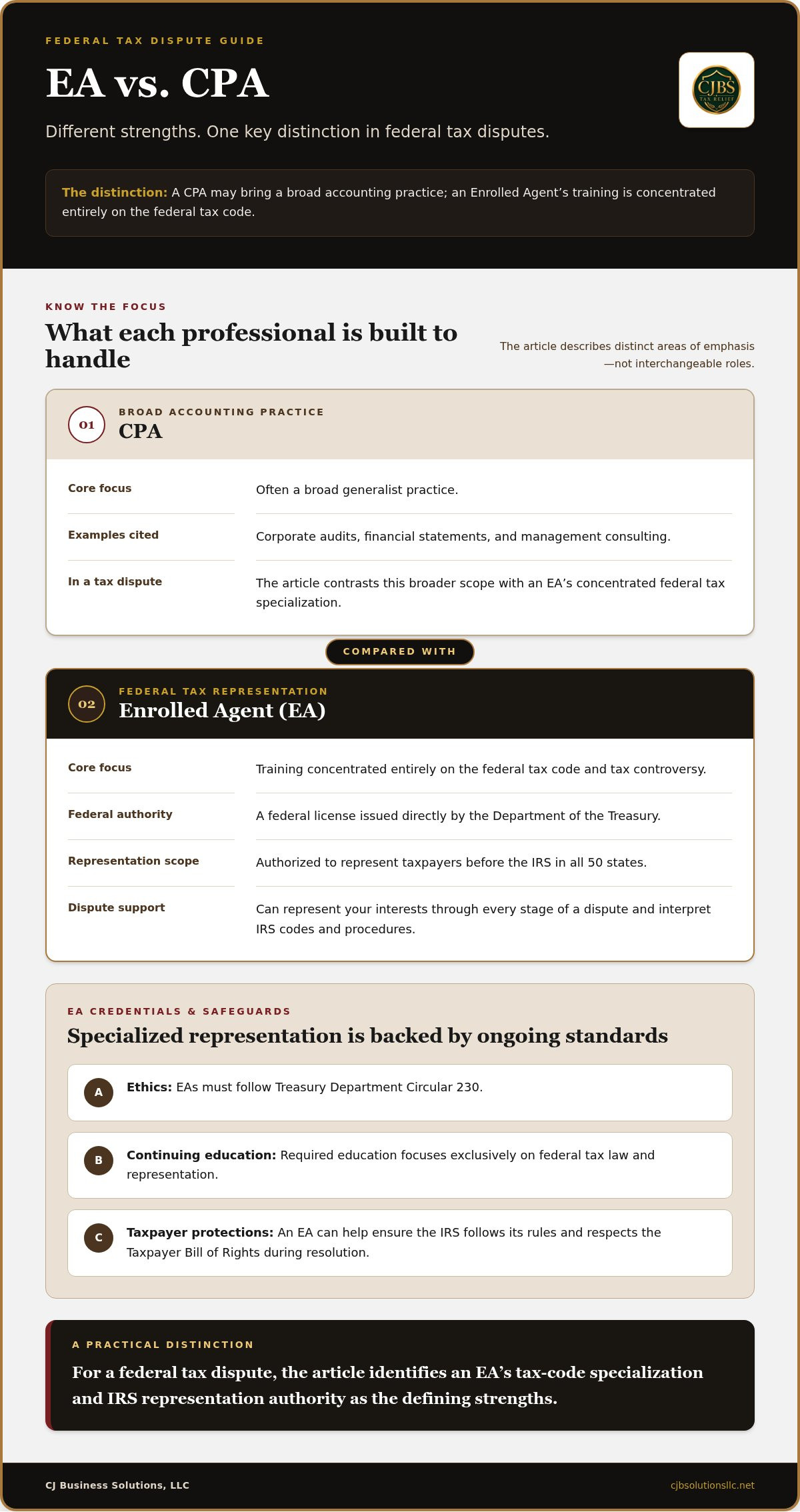
An Enrolled Agent (EA) serves as a specialized advocate, holding a federal license issued directly by the Department of the Treasury. While many professionals offer general tax help, the EA designation is unique because it's the only credential specifically designed for tax representation. These experts are authorized to represent taxpayers in all 50 states, providing a consistent level of care regardless of where you reside. Because an EA specializes in tax controversy, they understand the technical nuances of IRS tax resolution services better than a generalist might. They don't just file forms; they represent your interests during every stage of a dispute.
To maintain this status, an EA must adhere to strict ethical standards outlined in Treasury Department Circular 230. They're required to complete regular continuing education that focuses exclusively on federal tax law and representation. This commitment ensures they remain a "Reliable Guide" through the shifting landscape of tax regulations. By deeply understanding the Taxpayer Bill of Rights, an EA can ensure that the IRS adheres to its own rules during your resolution process. This level of oversight provides a layer of protection that's often missing when taxpayers attempt to handle disputes on their own.
EA vs. CPA: Which Expert Do You Need for Resolution?
When choosing an expert, it's helpful to understand their core focus. A CPA is often a broad generalist who handles corporate audits, financial statements, or management consulting. In contrast, an EA's training is concentrated entirely on the federal tax code. This specialization allows them to speak the "IRS language" fluently, interpreting internal codes and procedures that others might overlook. If you're seeking a partner who understands the inner workings of the agency, an Enrolled Agent led firm can provide the steady confidence you need to resolve complex issues.
Maintaining Long-Term Financial Compliance
Resolving a current tax issue is only half the battle. A seasoned EA works to ensure that your financial habits support long-term health. They integrate accurate accounting practices into the resolution strategy, helping you avoid the "red flags" that might trigger future audits. This methodical approach creates a reliable partnership, turning a period of high stress into a foundation for permanent financial stability. By focusing on both the current resolution and future compliance, they help you achieve a state of quiet confidence in your tax standing.
Deciphering Your Tax History Through Expert Transcript Analysis
An IRS transcript is much more than a simple summary of your past filings; it's a comprehensive internal log that tracks every action, assessment, and communication associated with your tax account. While the IRS provides a "Get Transcript" service for the public, the raw data often consists of cryptic transaction codes that are difficult to interpret without specialized training. At CJ Business Solutions, LLC, we view transcript analysis as the mandatory first step in our process. It allows us to see exactly what the IRS sees, providing a clear diagnostic view of your account before any formal negotiations begin. This methodical review often reveals discrepancies between your records and the agency's data, ensuring that we're working with the most accurate information possible.
By reviewing these records, an Enrolled Agent can identify specific transaction codes that signal upcoming collection movements or past procedural errors. For instance, we can often see if a payment was misapplied to the wrong tax year or if an automated substitute for return was filed on your behalf. This level of insight is essential for building an effective strategy within IRS tax resolution services. Understanding the internal "roadmap" of your account helps us predict the agency's next steps, allowing us to stay ahead of potential levies or liens rather than simply reacting to them.
Identifying Hidden Issues Before the IRS Does
A specialist decodes these transcripts to find critical tolling dates and the specific statutes of limitations that apply to your debt. Transcript analysis allows a professional to pinpoint whether a tax gap stemmed from an assessment error, a missing credit, or an unfiled return. By reviewing this data, we can uncover unfiled returns that you might have forgotten or identify where the IRS has failed to credit a payment you already made. This proactive review ensures that no stone is left unturned in your defense.
Using Data to Negotiate Favorable Outcomes
A clear data trail serves as a powerful tool during an audit or settlement negotiation. When we can point to specific transcript entries, it strengthens your position and ensures the IRS is working with the same facts as your representative. This history is also vital for supporting a "Reasonable Cause" argument to abate penalties, such as the 5% monthly failure-to-file penalty. While the IRS began automatically identifying some eligible taxpayers for First-Time Abate (FTA) in 2026, many complex cases still require a manual, data-driven request to achieve the best results. Having a steady, reliable record of your account history allows us to advocate for you with quiet confidence.
Navigating Common Paths to Resolving Federal Tax Debt
Once the diagnostic phase of transcript analysis is complete, the focus shifts toward choosing a sustainable resolution path. The IRS "Fresh Start" program provides the primary framework for these options, offering several routes for taxpayers to settle their debts or structure payments. However, selecting the right path requires a methodical evaluation of your financial capacity. It's not about finding a "trick" to avoid taxes; it's about using established federal programs to find a solution that the IRS will actually accept. In 2024, the IRS accepted approximately 21% of Offers in Compromise, a statistic that underscores the importance of submitting a well prepared, data-driven proposal rather than a speculative one.
Navigating these choices can be overwhelming, especially with the rise of aggressive marketing from "OIC mills" that the IRS placed on its 2026 "Dirty Dozen" list of tax scams. A professional approach to IRS tax resolution services focuses on transparency and realistic outcomes. By aligning your resolution strategy with your actual ability to pay, you create a path that the IRS is more likely to approve, leading to a permanent resolution rather than a temporary fix. This steady, logical progression is the most reliable way to restore your financial standing and achieve long-term compliance.
Understanding Settlement Options Like Offer in Compromise
An Offer in Compromise (OIC) allows you to settle your tax debt for less than the full amount you owe. The IRS evaluates your income, expenses, and asset equity to determine if the offer represents the most they can expect to collect. While the application fee for an OIC is $205, this may be waived for qualifying low-income taxpayers. For those who don't qualify for an OIC, a long-term installment agreement is often a viable alternative. Individual taxpayers owing $50,000 or less can typically set up these agreements to pay their balance over time. In cases of extreme financial hardship, you may qualify for "Currently Not Collectible" status, which pauses collection actions while your financial situation is monitored.
Managing IRS Collections and Wage Garnishments
If you're already facing active collection actions like wage garnishments or bank levies, professional intervention is essential. A structured resolution plan acts as a "calm port" in a financial storm, providing a formal process to request a release of the levy. Defending against federal tax liens is also a priority, as these public records can significantly impact your credit and ability to manage property. By engaging an expert to represent your interests, you can often stop aggressive actions and replace them with a manageable payment plan. If you're ready to explore these options with a reliable partner, you can request a consultation for IRS tax resolution services to begin your journey toward financial recovery.
Securing Your Financial Future with Professional Audit Defense
Receiving an IRS audit notice often triggers immediate anxiety, yet it's helpful to remember that this document is essentially a formal request for information rather than a final judgment on your financial integrity. The IRS uses these examinations to verify that the data reported on a return aligns with the underlying records. By approaching the situation with meticulous preparation, you can transform an intimidating process into a manageable procedural step. Small business owners, in particular, find value in this methodical approach, as the IRS has increased its focus on complex partnerships and high-income earners through 2026. Protecting your interests requires a seasoned mentor who can manage the tactical details while you maintain your daily focus.
Our philosophy centers on the idea that a strong defense is built on transparency and technical accuracy. When you engage professional IRS tax resolution services for audit defense, you're securing an advocate who understands the inner workings of the agency. We take over all direct correspondence with the IRS, ensuring that every response is precise and legally grounded. This professional buffer prevents the common mistakes that occur when taxpayers attempt to handle an examination alone. It's a steady, reliable way to navigate a stressful period with quiet confidence.
Building a Proactive Audit Defense Strategy
A successful defense relies on organizing your documentation to meet specific IRS substantiation requirements. We review every line item on your return with a critical eye, ensuring that your records support each claim. This methodical process helps to limit the scope of the audit, often preventing the agency from expanding its inquiry into other tax years or categories. By defending each item with clear evidence, we provide the IRS with the information they need while protecting you from unnecessary exposure. It's about being prepared, not just reactive.
How CJ Business Solutions Guides Your Recovery
Our commitment to your success extends beyond the conclusion of an audit. We maintain a steady, rhythmic flow of communication to ensure you feel fully supported throughout the process. Once the immediate challenge is resolved, we help you transition back into standard tax and accounting compliance. This ensures that the lessons learned during the resolution process become the foundation for your future financial health. If you're currently facing a federal examination and need a reliable guide, you can speak with an Enrolled Agent about your tax resolution options to begin building your defense. We're here to provide the stability and expertise you need to move forward with peace of mind.
Restoring Your Financial Peace of Mind
Achieving a resolution with the IRS is a methodical journey that begins with understanding your rights and ends with long-term financial stability. By utilizing expert transcript decoding, you can move beyond the confusion of technical notices and gain a clear view of your account status. This data-driven approach, combined with the advocacy of a federally licensed professional, ensures that your interests are protected at every stage of the process. Whether you're facing an audit or managing outstanding debt, the right strategy can stop collection actions and provide a sustainable path forward.
CJ Business Solutions provides national representation for federal tax issues, acting as a reliable guide through the complexities of the tax code. Our firm is led by a federally licensed Enrolled Agent who specializes in complex transcript decoding to identify errors and relief options that others might overlook. If you're ready to replace uncertainty with a professional plan, it's time to explore how dedicated IRS tax resolution services can help you regain control. You don't have to face these challenges alone.
Schedule a consultation with a tax resolution specialist at CJ Business Solutions and begin your journey toward a stable financial future.
Frequently Asked Questions
What exactly are IRS tax resolution services?
IRS tax resolution services are professional representation services designed to help individuals and businesses resolve outstanding tax liabilities, audits, or collection actions through established legal and administrative channels. These services involve a strategic combination of tax law, accounting, and negotiation to find a sustainable solution for the taxpayer. By working with a specialist, you can address issues like unfiled returns or back taxes while ensuring your rights are protected throughout the process.
Is an Enrolled Agent better than a CPA for tax resolution?
An Enrolled Agent is often preferred for tax resolution because they hold a federal license from the Department of the Treasury specifically to represent taxpayers before the IRS. While CPAs are highly skilled in broad accounting and financial reporting, Enrolled Agents focus their entire practice on the federal tax code and controversy. This specialization allows them to navigate the inner workings of the agency and speak the technical "IRS language" with a high degree of precision.
How long does the IRS tax resolution process typically take?
The timeline for resolution varies significantly based on the complexity of the case and the specific program being utilized. For example, a simple installment agreement might be established in a few weeks, whereas an Offer in Compromise can take several months or longer to process. In 2026, processing times are influenced by the agency's continued investment in automation, though complex manual reviews still require a steady and patient approach to achieve the best outcome.
Can I resolve my tax debt on my own without professional help?
You can technically represent yourself before the IRS, but doing so often carries risks due to the complexity of the tax code. Navigating technical notices and collection actions requires a deep understanding of procedural rules and taxpayer rights. Professional representation provides a buffer between you and the agency, ensuring that you don't inadvertently provide information that complicates your case or leads to unfavorable outcomes during high stakes negotiations.
What is IRS transcript analysis and why is it important?
IRS transcript analysis is the methodical process of reviewing the agency's internal logs to understand the exact status and history of a tax account. It's the critical first step in identifying errors, misapplied payments, or unfiled returns that could be impacting your balance. By decoding these transaction records, a specialist can predict the agency's next movements and determine which resolution paths, such as penalty abatement or a settlement, are realistically available to you.
Will tax resolution services stop the IRS from garnishing my wages?
Engaging professional IRS tax resolution services can effectively stop or prevent wage garnishments by establishing a formal resolution plan. Once a representative is retained, they can negotiate with the IRS to release a levy or stay collection actions while a sustainable payment agreement is being reviewed. This professional intervention provides the necessary time to address the underlying debt while protecting your immediate income and your family's financial stability.
How much does it cost to hire a tax resolution specialist?
The cost of hiring a specialist depends on the scope of the services required and the complexity of the tax issues being addressed. Professional firms typically structure their fees based on the specific tasks involved, such as transcript analysis, audit defense, or the preparation of a settlement proposal. It's best to consult directly with a firm to understand their professional fee structure and how it aligns with the level of advocacy your specific case requires.
What is the "Fresh Start" program and do I qualify?
The "Fresh Start" program is a collection of IRS initiatives designed to help taxpayers resolve debt through accessible options like installment agreements and Offers in Compromise. Qualification depends on several factors, including your total liability, income, and asset equity. Starting in 2026, the IRS also automatically identifies eligible taxpayers for the First-Time Abate program, though more complex cases still benefit from a professional review to ensure all available relief is secured.

Article by
Crystal R. Johnson, MBA EA
Crystal Johnson founded CJ Business Solutions to give individuals and small-business owners something often missing from the tax and accounting process: clear explanations, practical solutions, and trusted support.
With more than 27 years of accounting and financial experience, Crystal helps clients understand complicated tax matters, restore compliance, respond to IRS concerns, and make stronger business decisions. As an Enrolled Agent, she is federally authorized to represent taxpayers before the Internal Revenue Service.


