

What if the most effective way to resolve your tax concerns isn't waiting for a letter, but proactively reading the IRS's own internal records? It is quite common to feel overwhelmed by the cryptic codes and formal language found in official documents. The ability to identify tax issues transcript analysis is a foundational skill for anyone seeking to resolve their standing with the IRS. This process serves as a vital diagnostic phase, allowing you to address potential problems with a sense of calm and preparation.
This article will guide you through the process of decoding your transcripts to uncover hidden red flags, unfiled returns, and clerical errors before they lead to more serious complications. We will explain the significance of various transcript types and specific transaction codes, such as the TC 150 that marks your assessment date. By following our comprehensive checklist, you will gain the clarity needed to correct existing errors and build a steady, reliable path toward full tax resolution.
Key Takeaways
- Understand how IRS transcripts serve as the essential diagnostic tool for reviewing your tax history and current standing with the agency.
- Learn to identify tax issues transcript analysis by decoding transaction codes that indicate whether your returns were processed or if specific notices have been issued.
- Differentiate between the four primary types of IRS transcripts to ensure you request the document that provides the most relevant information for your needs.
- Follow a secure, methodical process for obtaining your records through official channels, whether you require immediate digital access or archived paper copies.
- Discover how an Enrolled Agent utilizes transcript data to develop a professional resolution strategy, such as an Installment Agreement or an Offer in Compromise.
Understanding IRS Transcripts: The Diagnostic Tool for Your Taxes
An IRS transcript serves as the official, comprehensive record of your history within the broader system of Taxation in the United States. While many taxpayers view their filed returns as the final word, the IRS maintains its own internal log of every transaction, notice, and adjustment associated with your account. Accessing these records is a vital first step for anyone who wishes to gain a transparent view of their current tax standing. Relying on your own copies of returns isn't always enough; you need to see exactly what the IRS has documented to ensure there are no surprises.
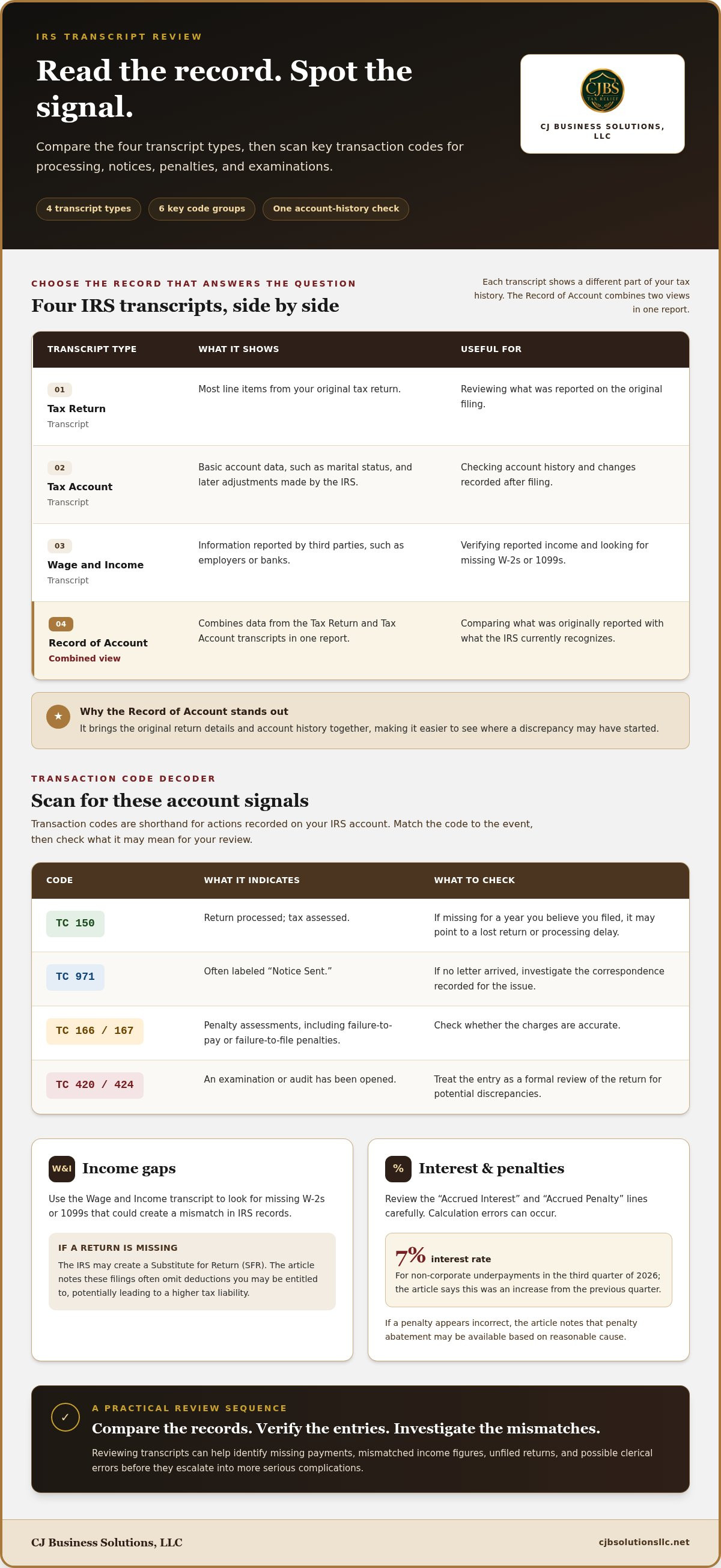
There are four primary types of transcripts available to you. The Tax Return Transcript shows most line items from your original return, while the Tax Account Transcript tracks basic data such as your marital status and any subsequent adjustments made by the agency. The Wage and Income Transcript is particularly useful for verifying information reported by third parties like employers or banks. However, the most robust option is often the Record of Account Transcript. It is through these documents that we can truly identify tax issues transcript analysis as a necessary diagnostic exercise.
Why a 'Record of Account' is Often the Most Valuable
The Record of Account Transcript is highly regarded by professionals because it combines the data from both the Tax Return and the Tax Account transcripts into one cohesive report. This allows for a side-by-side comparison of what was originally reported versus what the IRS currently recognizes as accurate. It provides a complete picture of a specific tax year, making it much easier to spot where a discrepancy might have originated. When you have both the original filing and the account history in one place, the path to resolution becomes much clearer.
The Role of Transcript Analysis in Audit Prevention
By reviewing these records regularly, you can identify potential red flags such as missing payments or mismatched income figures before the IRS initiates a formal inquiry. Taking this proactive step helps you maintain control over your financial narrative. Transcript analysis is a preventative compliance tool for 2026 that allows taxpayers to resolve inconsistencies before they escalate into formal examinations. This methodical approach ensures you're always one step ahead in managing your obligations with quiet confidence.
Checklist: How to Identify Critical Tax Issues in Your Transcripts
Once you obtain your IRS records, the next step is to scan for specific transaction codes, or TCs. These numerical indicators act as a shorthand for every action the IRS has taken on your account. To effectively identify tax issues transcript analysis requires a methodical review of these codes to ensure your records align with your actual financial history. We recommend looking for the following key entries:
- Transaction Code 150: This entry confirms that your tax return has been officially processed and the tax has been assessed. If this code is missing for a year you believe you filed, it may indicate a lost return or a processing delay.
- Transaction Code 971: Often labeled as "Notice Sent," this code suggests that the IRS has mailed correspondence regarding a specific issue. If you haven't received a letter but see this code, it's a sign that you should investigate further.
- Transaction Codes 166 and 167: These codes represent the assessment of penalties, such as those for failure to pay or failure to file. Spotting these early allows you to verify if the charges are accurate.
- Transaction Codes 420 and 424: These are critical indicators that an "Examination" or audit has been opened. Seeing these codes means the IRS is formally reviewing your return for potential discrepancies.
Spotting Unfiled Returns and Income Mismatches
A Wage and Income transcript is your best resource for identifying missing 1099s or W-2s that might cause a mismatch in the IRS system. If the IRS determines a return is missing, they may eventually create a "Substitute for Return" (SFR) on your behalf. These filings often lack the deductions you're entitled to, which leads to a much higher tax liability than necessary. Identifying these gaps early is a vital part of maintaining your tax health.
Detecting Incorrect Interest and Penalty Calculations
Review the "Accrued Interest" and "Accrued Penalty" lines carefully. For the third quarter of 2026, the interest rate for non-corporate underpayments is 7%, which is an increase from the previous quarter. Errors in these calculations can occur; however, if you find discrepancies, you might be eligible for "Penalty Abatement" based on reasonable cause. Utilizing professional transcript analysis services ensures that you identify tax issues transcript analysis with the precision needed to protect your interests.
How to Securely Obtain and Review Your IRS Records
Securing your financial data is a vital priority when you begin to identify tax issues transcript analysis. The IRS provides several pathways to access your records, each suited to different needs and timelines. For most taxpayers, the "Get Transcript" online portal is the most efficient method, offering immediate access to digital copies of your records for the current and recent tax years. This digital access allows for a swift diagnostic review without the wait times associated with traditional mail.
If you require information from archived years beyond what the portal provides, you may need to submit Form 4506-T by mail. While this method takes longer, it remains a reliable way to gather a complete history of your account. As you review these documents, you might consult the Official IRS guide to tax transcripts to better understand the specific data points included in each version. Organizing these records by tax year allows you to spot multi-year trends, such as recurring penalties or consistent income discrepancies. Additionally, pay close attention to the "Cycle Code," which indicates exactly when the IRS last updated your file during their weekly processing cycles.
Navigating the 2026 IRS Identity Verification Process
As of 2026, the IRS continues to utilize ID.me for secure identity verification. This process requires a government-issued photo ID and a live "selfie" to ensure that sensitive tax data remains protected. If you encounter difficulties with the digital process, alternative verification methods involving video calls with a representative are available. Maintaining high security standards ensures your personal information remains confidential throughout your review.
Common Roadblocks When Requesting Transcripts
It's not uncommon to see a message stating "No Record of Return Filed," which can happen if the IRS hasn't processed your submission or if a Substitute for Return has not yet been generated. Also, you'll notice that certain personal details, like Social Security numbers, are "masked" to protect you from identity theft. If these roadblocks feel overwhelming, our team provides professional transcript analysis services to help you navigate the complexities of IRS record-keeping with ease.
Beyond Identification: Developing a Strategic Tax Resolution Plan
While the ability to identify tax issues transcript analysis is a significant milestone, it represents only the first half of the journey toward financial peace of mind. Once you've diagnosed the discrepancies or liabilities within your account, the focus must shift toward active resolution. Understanding the data is essential; however, applying that information to negotiate with the IRS requires a different set of strategic skills. This transition from awareness to action is where many taxpayers find the most benefit from professional guidance.
The raw data found in your transcripts provides the leverage needed for various resolution paths. For instance, if your records show a substantial liability that you can't pay in full, the information gathered during your analysis serves as the foundation for requesting an Offer in Compromise or an Installment Agreement. If your transcript flags indicate an impending investigation, engaging in strategic IRS audit strategy defense becomes a priority. Having a clear roadmap allows you to move away from the stress of the unknown and toward a definitive solution.
The Advantage of an Enrolled Agent (EA) in Transcript Analysis
Enrolled Agents are uniquely positioned to assist because they hold specialized IRS representation authority, granting them the same rights as CPAs or attorneys to represent clients before the agency. This training is particularly valuable for decoding the more complex transaction histories that often accompany long-standing tax disputes. By having a seasoned mentor by your side, you ensure that your rights are protected throughout the negotiation process. This level of professional support transforms a confusing list of codes into a clear, actionable strategy for compliance.
Next Steps: Your Roadmap to IRS Compliance
To begin the resolution phase, we recommend gathering all relevant financial documents and your recent transcripts for a comprehensive review. Setting a realistic timeline for correcting errors or filing amended returns is a vital part of maintaining your standing with the agency. If you're ready to move forward with a steady partner, you may Schedule a professional transcript analysis with CJ Business Solutions, LLC. Taking this step ensures that you aren't just identifying problems, but actively resolving them with quiet confidence and expertise.
Securing Your Financial Future Through Proactive Analysis
Taking control of your standing with the IRS begins with the quiet confidence that comes from being fully informed. As we've explored, the ability to identify tax issues transcript analysis provides is the most reliable way to uncover discrepancies or unfiled returns before they escalate into more formal examinations. By understanding the narrative within your official records, you move from a place of uncertainty to one of clear, actionable steps. It's a diagnostic approach that allows you to address potential errors and manage liabilities with a sense of stability and preparation.
If you're ready to transition from simply identifying issues to actively resolving them, our team is here to act as your seasoned mentor. We provide expert representation by a licensed Enrolled Agent who specializes in strategic IRS audit strategy defense and comprehensive tax resolution paths. You don't have to navigate these complex transaction histories alone; professional support is available to ensure your rights are protected at every stage. We invite you to request a professional IRS transcript analysis from CJ Business Solutions, LLC to begin your journey toward lasting compliance. Reclaiming your peace of mind is a methodical process, and we're committed to supporting you through every step of the way.
Frequently Asked Questions
What is the most important code to look for on an IRS transcript?
Transaction Code 150 is generally considered the most critical entry because it signifies that your return has been processed and your tax liability has been officially assessed. This code is essential for determining the Collection Statute Expiration Date, which is usually 10 years from the date of assessment. Monitoring this code allows you to understand exactly when the IRS clock began ticking for a specific tax year, providing a clear starting point for any resolution strategy.
Can transcript analysis help me stop an IRS wage garnishment?
Yes, transcript analysis can be a vital tool in halting a wage garnishment by identifying the specific procedural triggers that led to the collection action. By reviewing your transaction history, a professional can determine if the IRS issued the required notices or if a Substitute for Return was filed on your behalf. Once the root cause is identified, we can develop a methodical plan to resolve the liability and request a release of the levy through established IRS programs.
How far back can I go with IRS transcript analysis?
You can typically access transcripts for the current year and the three prior years through the IRS online portal for immediate review. If your situation requires a more extensive historical review, you may request records for up to 10 years by submitting Form 4506-T. This longer timeline is often necessary to identify tax issues transcript analysis involves, especially when dealing with unfiled returns or long-term debt that has accrued interest over several processing cycles.
Does requesting my transcript alert the IRS and trigger an audit?
Requesting your own transcript does not alert the IRS in a way that triggers an audit or any other enforcement action. The IRS actually encourages taxpayers to monitor their own records to ensure accuracy and maintain compliance. Accessing your files is a routine administrative task that demonstrates a proactive approach to your tax health; it is a safe and secure way to gain clarity without inviting unwanted scrutiny or increasing your risk profile.
What is the difference between a Tax Account and a Tax Return transcript?
A Tax Return transcript provides most line items from your original return as you filed it, which is helpful for verifying your reported income and deductions. In contrast, a Tax Account transcript shows any subsequent activity on your account, including payments, credits, and adjustments made by the IRS after the return was processed. Both documents are useful, but the account transcript is the primary tool used to identify tax issues transcript analysis requires for resolving active disputes or balances.

Article by
Crystal R. Johnson, MBA EA
Crystal Johnson founded CJ Business Solutions to give individuals and small-business owners something often missing from the tax and accounting process: clear explanations, practical solutions, and trusted support.
With more than 27 years of accounting and financial experience, Crystal helps clients understand complicated tax matters, restore compliance, respond to IRS concerns, and make stronger business decisions. As an Enrolled Agent, she is federally authorized to represent taxpayers before the Internal Revenue Service.


