

An IRS audit is not an accusation of wrongdoing; it's a request for clarification that follows a predictable administrative path. Receiving an official notice often triggers a sense of immediate alarm, yet most examinations are simply a request for documentation to verify the details of your return. While it's natural to feel overwhelmed by the complexity of federal tax law, you can learn how to navigate IRS audit process steps with a calm and methodical approach. By shifting your perspective from one of defense to one of organized transparency, you can manage the situation with professional composure.
We understand that the fear of the unknown, coupled with concerns about potential 7% interest rates or accuracy-related penalties, can make this period feel incredibly stressful. This guide will provide you with a clear roadmap to manage the examination from the initial letter to the final resolution. You'll discover how to exercise your rights as a taxpayer, organize your records effectively, and understand the specific timeline the IRS follows in 2026. Let's walk through these steps together to ensure you feel fully informed and prepared for the path ahead.
Key Takeaways
- Identify the specific notice number, such as a CP2000 or Letter 525, to clarify the exact scope and requirements of the IRS inquiry.
- Learn how to methodically navigate IRS audit process steps by distinguishing between simple correspondence examinations and in-person office audits.
- Discover how professional transcript analysis can decode internal IRS codes to reveal the specific triggers behind your audit before you provide a response.
- Gain a clear understanding of the examination timeline, moving from the initial Information Document Request to the final resolution phase.
- Understand the strategic advantage of partnering with an Enrolled Agent who maintains unlimited representation rights to act as your advocate throughout the process.
Receiving an IRS Audit Notice: The Initial Response Phase
Opening an envelope from the Internal Revenue Service often triggers a sense of immediate concern. It's helpful to reframe this experience as an administrative request for substantiation rather than a legal accusation. The IRS audit process is a structured mechanism used to verify that the figures reported on your return match the documentation held by the government. When you understand that this is a routine part of tax administration, you can begin to navigate IRS audit process requirements with a steady hand. The first step is identifying the specific notice number, such as a CP2000 or Letter 525, which defines the scope of the inquiry.
Before you pick up the phone, establish a methodical filing system for all correspondence. Many taxpayers feel an urgent need to call the auditor to explain their situation, but this is often a tactical error. Speaking with an agent without a prepared strategy can lead to accidental disclosures that broaden the audit. A professional approach involves gathering your records first and reviewing the specific items under question. This allows you to present a clear, concise response that addresses the IRS's needs without inviting unnecessary scrutiny into unrelated areas of your financial life.
Distinguishing Between Types of IRS Notices
The "Summary of Proposed Changes" on your notice is the most informative section of the document. It details the discrepancies the IRS has identified, such as unreported income from a 1099-NEC or a disallowed deduction. An automated underreporter notice is different from a manual field audit, as it's generated by computer software comparing your return to third-party data. Regardless of the type, the "Response Date" is your most critical deadline. While the 2026 interest rate for underpayments is 7%, failing to respond by the stated date can trigger additional penalties and remove your right to challenge the findings within the initial administrative phase.
Maintaining a Composed Professional Mindset
Managing the emotional weight of an examination is easier when you rely on logical preparation. A quiet, confident posture prevents the frantic energy that often leads to mistakes. By treating the auditor with professional courtesy while remaining focused on the documentation, you maintain control over the narrative. Many taxpayers find that securing representation provides a helpful buffer, allowing a seasoned mentor to handle the direct communication. This ensures that the flow of information is precise and intentional, which is the most effective way to navigate IRS audit process hurdles and reach a fair resolution.
Understanding the Three Types of IRS Examinations
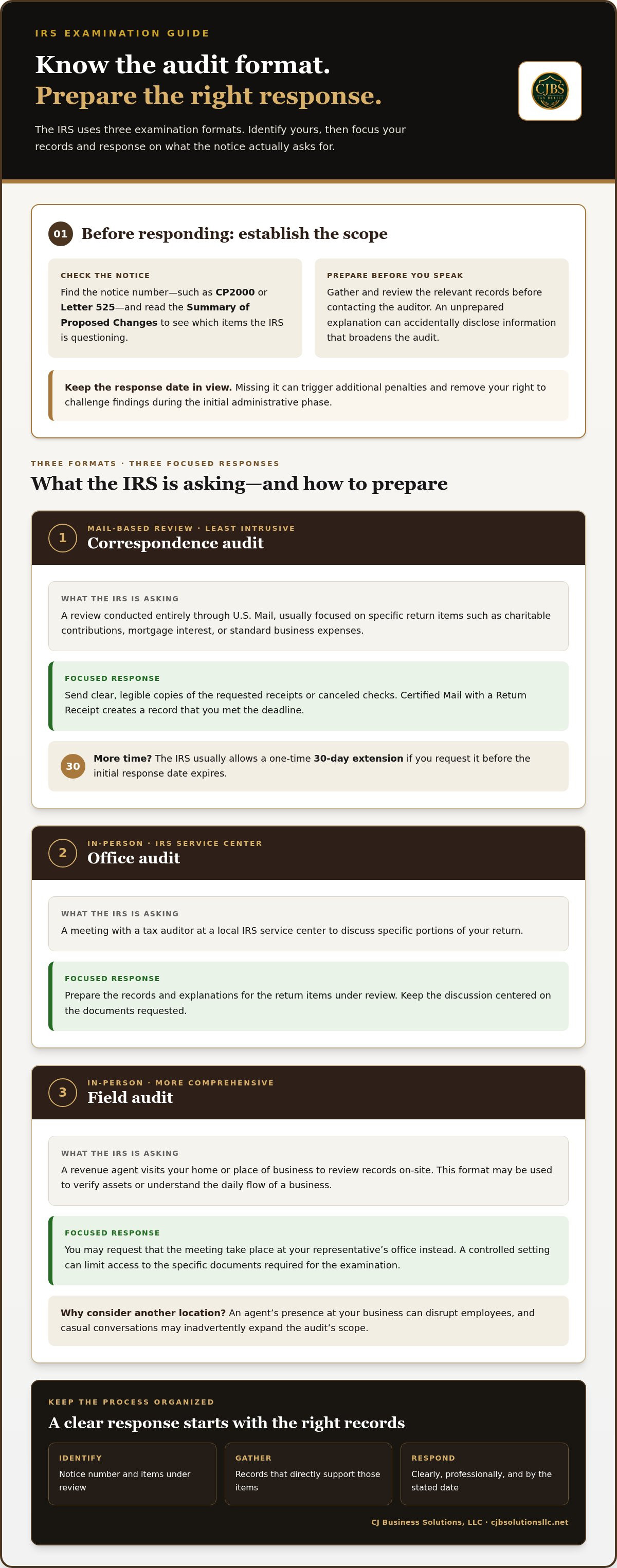
The Internal Revenue Service categorizes its reviews into three primary formats, each determined by the complexity of the items being questioned. Whether you're dealing with a simple clarification or a deep dive into business records, knowing how to navigate IRS audit process requirements starts with identifying which examination style the agency has selected for you. Each format has its own set of procedural norms and documentation expectations.
Correspondence Audits: The Most Common Format
These are the least intrusive types of IRS examinations and are conducted entirely through the U.S. Mail. Typically, the IRS focuses on specific line items such as charitable contributions, mortgage interest, or standard business expenses. If you receive one of these requests, your primary goal is to provide clear, legible copies of receipts or canceled checks. We recommend sending all documentation via Certified Mail with a Return Receipt requested. This creates a formal paper trail that proves you met your deadlines. If you find that you need more time to gather records from banks or previous employers, the IRS usually allows for a one-time 30-day extension, provided you request it before the initial response date expires.
Office and Field Audits: The In-Person Dynamic
When an audit involves more complex issues, such as self-employment income or rental property depreciation, the IRS may request an in-person meeting. An office audit occurs at a local IRS service center, where you meet with a tax auditor to discuss specific portions of your return. A field audit is more comprehensive. It involves a revenue agent visiting your home or place of business to observe operations and review records on-site. The IRS chooses this method when they need to verify the existence of assets or understand the daily flow of a business.
It's generally advisable to avoid hosting a field audit at your place of business if possible. An agent's presence can be disruptive to employees and may lead to casual conversations that inadvertently expand the scope of the audit. You have the right to request that the meeting take place at your representative's office instead. This keeps the environment controlled and ensures that the agent only accesses the specific documents required for the examination. Preparing a clean, quiet workspace for the agent shows that you're organized and take the process seriously. If the prospect of an in-person interview feels daunting, tax resolution services can help you prepare your defense and act as your advocate during the meeting.
Organizing Your Defense with Transcript Analysis
While many taxpayers begin their defense by gathering old shoe boxes of receipts, a more strategic first step involves looking behind the curtain of the government's data. Most people don't realize that the IRS maintains a detailed history of their account that goes far beyond the numbers on a filed return. By utilizing transcript analysis, you can more effectively navigate IRS audit process complexities by seeing the exact transaction codes the auditor is using to evaluate your history. Seeking professional representation early in this phase ensures that you aren't just reacting to requests but are proactively identifying discrepancies before they become permanent liabilities.
The Power of Professional Transcript Decoding
Transcript analysis allows you to move beyond the surface-level numbers on your tax return to examine the underlying account activity. The IRS uses a series of internal transaction codes that record every action taken on your file, from the moment your return is processed to the day an audit is triggered. By decoding these patterns, you can identify the specific red flags that drew the agency's attention, such as a mismatch between your reported income and the 1099-K data provided by payment processors. This high-level review often reveals errors in the IRS's own calculations or instances where the government has failed to apply credits or overpayments you were entitled to receive. Transcript analysis serves as a diagnostic roadmap for resolution.
Substantiating Your Deductions Methodically
Once you understand the triggers, you must organize your evidence to address the specific Information Document Requests (IDRs) issued by the auditor. It's helpful to remember that while the IRS prefers primary documents like receipts and canceled checks, the Cohan Rule provides a legal precedent for using secondary evidence. This rule allows for the estimation of certain expenses if you can prove the expenditure occurred, even if the exact receipt is missing. You should use this rule sparingly, as it requires a credible explanation to satisfy an auditor's scrutiny.
When you navigate IRS audit process documentation requirements, remember that more is not always better. Providing more documentation than the IDR specifically requests is rarely beneficial; it can inadvertently lead the auditor to ask new questions about unrelated transactions. It's best to provide exactly what is asked for, neatly organized and clearly labeled. This methodical approach demonstrates that you're prepared and helps keep the scope of the audit from expanding into other tax years or categories.
The Step-by-Step IRS Audit Process Timeline
An IRS audit isn't a single event, but rather a sequence of administrative steps governed by strict statutory deadlines. Understanding this progression allows you to maintain your composure and ensure that your rights remain protected at every stage. When you navigate IRS audit process milestones, you move through five distinct phases that lead from the initial request for data to a final, binding resolution. This progression is designed to be transparent, though it requires careful attention to the calendar to avoid losing your right to appeal.
- Step 1: Receipt of the Information Document Request (IDR). This is the auditor's first formal list of required evidence and sets the tone for the examination.
- Step 2: The Examination Phase. During this period, the agent reviews your substantiation, compares it to your return, and may ask follow-up questions.
- Step 3: The 30-Day Letter. Formally known as the "Revenue Agent's Report," this document outlines the auditor's proposed adjustments to your tax liability.
- Step 4: The 90-Day Letter. This "Statutory Notice of Deficiency" is your final window to challenge the IRS's findings without first paying the disputed tax.
- Step 5: Final Resolution. The case closes through a signed agreement, a settlement in the Office of Appeals, or a judicial ruling in Tax Court.
Navigating the Information Document Request (IDR)
The IDR is the most critical document in the early phase of an audit. It's helpful to provide precise, documented answers that address the auditor's questions without offering extraneous information that wasn't requested. If a request seems vague or overly broad, we suggest asking for clarification in writing rather than guessing what the auditor needs. Managing this timeline is essential, as missing a deadline for an IDR can lead the auditor to disallow deductions prematurely. If you've received a notice and aren't sure how to respond, our IRS audit strategy defense services can help you manage these critical deadlines with professional precision.
Responding to Audit Findings and the Appeals Process
At the end of the examination, the IRS will present you with their findings in an "Agreed" or "Unagreed" format. If you agree with the changes, you sign the report and arrange for payment, which in 2026 includes a 7% interest rate on underpayments. However, if you disagree, you have the right to file a formal protest to move your case to the IRS Independent Office of Appeals. This is often a tactical advantage, as appeals officers have more flexibility to settle disputes based on the "hazards of litigation" than a field auditor does. Settling at this stage is usually more efficient and less costly than taking a case all the way to the U.S. Tax Court.
Securing Professional Representation: The Enrolled Agent Advantage
Choosing the right representation is often the most significant decision you'll make when you face an examination. While many taxpayers believe any tax preparer can assist, there's a vital distinction between a standard accountant and an Enrolled Agent. An Enrolled Agent is a federally authorized tax practitioner who has earned technical expertise in the field of taxation. They're empowered by the U.S. Department of the Treasury to represent taxpayers before the Internal Revenue Service for audits, collections, and appeals. This status provides unlimited representation rights, which means they can stand in your place during any interaction with the government.
An Enrolled Agent acts as a seasoned mentor who understands the internal manual procedures that auditors follow. This insight is invaluable when you need to navigate IRS audit process hurdles, as it allows your representative to anticipate the agency's next steps. By speaking the technical language of the IRS, an Enrolled Agent ensures that the dialogue remains focused and professional. This level of expertise often leads to more favorable settlement outcomes, as the representative can identify when an auditor is overstepping or when a specific tax law can be interpreted in your favor. Having this buffer allows you to continue your daily life without the stress of direct confrontation with a revenue agent.
Why CJ Business Solutions, LLC is Your Reliable Guide
Our firm prioritizes a methodical approach to audit strategy defense that begins with the transcript analysis we discussed earlier. We don't just react to letters; we use historical data to build a proactive defense that addresses the root cause of the inquiry. Throughout every interaction, CJ Business Solutions, LLC is committed to protecting your rights under the Taxpayer Bill of Rights. This includes ensuring you're informed of the reasons for the audit and that you're treated with professional courtesy. Beyond resolving the immediate crisis, we focus on establishing long-term compliance patterns that help prevent you from falling into future audit cycles.
Taking the First Step Toward Resolution
If you've received a notice, a professional consultation is the most effective way to assess the severity of the situation. Early intervention is key to reducing potential liabilities and preventing the "scope creep" that can happen when a taxpayer attempts to handle an audit alone. By reviewing your notice and your tax history, we can provide a clear perspective on the most likely path to resolution. Taking this first step allows you to move from a state of uncertainty to one of organized preparation. We invite you to Contact CJ Business Solutions, LLC for a composed, professional audit defense strategy.
Moving Forward with Confidence and Clarity
The path to resolving a federal tax examination is paved with organization and professional insight. By understanding the specific type of audit you face and utilizing strategic transcript analysis, you can effectively navigate IRS audit process requirements without the burden of uncertainty. We've explored how a methodical approach to the Information Document Request and a clear grasp of the statutory timeline can protect your rights and minimize potential liabilities. Shifting your focus from reactive stress to proactive preparation is the most reliable way to secure a fair outcome.
At CJ Business Solutions, LLC, we provide a national federal tax resolution focus led by an expert Enrolled Agent with full representation rights. Our strategic transcript analysis services allow us to identify resolution paths by seeing the data the IRS already has on file. If you're ready to move toward a final resolution with a reliable guide by your side, we invite you to schedule a methodical review of your IRS notice with our Enrolled Agent. You don't have to face the IRS alone; with the right preparation and support, you can reach a successful conclusion and restore your peace of mind.
Frequently Asked Questions
How long does the average IRS audit process take to complete?
The duration of an IRS examination depends heavily on the complexity of the issues and the type of audit conducted. Correspondence audits often conclude within three to six months, while in-person office or field audits can extend for a year or more. Providing organized documentation promptly helps ensure you navigate IRS audit process steps as efficiently as possible and prevents unnecessary delays in reaching a final resolution.
Can I represent myself during an IRS audit interview?
You have the legal right to represent yourself during any interaction with the IRS. However, many taxpayers find that direct communication with an auditor can be stressful and may lead to accidental disclosures. Engaging a professional representative allows you to maintain a helpful buffer, ensuring that all responses are technical, precise, and limited to the specific scope of the Information Document Request provided by the agent.
What happens if I cannot find the receipts the IRS is asking for?
If original receipts are unavailable, you may be able to substantiate expenses using secondary evidence such as bank statements, canceled checks, or contemporaneous logs. The Cohan Rule sometimes allows for the estimation of certain expenses if you can prove the expenditure occurred. We suggest gathering as much alternative documentation as possible to demonstrate a good-faith effort to comply with the auditor's request for substantiation.
Is an Enrolled Agent different from a CPA when it comes to an audit?
Both professionals can represent you, but their focus areas often differ. An Enrolled Agent is federally authorized by the U.S. Department of the Treasury and specializes specifically in tax law and resolution. While a CPA may handle broad corporate accounting or financial statements, an Enrolled Agent's expertise is concentrated on the technicalities of the tax code and the internal procedures used during a federal IRS examination.
What are the most common red flags that trigger an IRS audit?
Audits are often triggered by discrepancies between your return and third-party data, such as 1099-K or 1099-NEC forms. Other common factors include unusually large charitable contributions relative to income or significant business losses over multiple years. The IRS also uses automated scoring systems to identify returns that deviate significantly from the statistical norms of similar taxpayers in your specific income bracket or geographic area.
Can an IRS audit result in a refund instead of a bill?
It's entirely possible for an audit to conclude with a "no change" report or even a refund in your favor. If the examination reveals that you missed eligible credits or overpaid your liability, the auditor is required to adjust the return accordingly. Using transcript analysis helps you navigate IRS audit process challenges by identifying these potential overpayments or unutilized credits before the auditor even begins their formal review.
What should I do if I disagree with the auditor's final findings?
You aren't required to sign the auditor's report if you believe the findings are incorrect. You can request a meeting with the auditor's supervisor or file a formal protest to move your case to the IRS Independent Office of Appeals. If a resolution isn't reached there, you'll receive a Notice of Deficiency, which gives you a 90-day window to petition the U.S. Tax Court for a ruling.
Does an audit mean the IRS thinks I committed tax fraud?
An audit is simply a request for verification and does not imply an accusation of tax fraud. Most examinations are routine administrative reviews focused on substantiating deductions or clarifying reported income. Fraud is a specific legal determination involving the intentional underpayment of taxes, which carries much higher penalties and requires a significantly higher burden of proof from the government than a standard civil examination.

Article by
Crystal R. Johnson, MBA EA
Crystal Johnson founded CJ Business Solutions to give individuals and small-business owners something often missing from the tax and accounting process: clear explanations, practical solutions, and trusted support.
With more than 27 years of accounting and financial experience, Crystal helps clients understand complicated tax matters, restore compliance, respond to IRS concerns, and make stronger business decisions. As an Enrolled Agent, she is federally authorized to represent taxpayers before the Internal Revenue Service.


