

Receiving a formal notice from the IRS often feels like an invitation to a conflict that you aren't prepared to manage. Many taxpayers find that the most effective path to a favorable outcome isn't found in aggressive confrontation, but through a methodical review of the data the government already holds. When you're confronted with complex audits or collection notices, professional tax controversy resolution becomes a vital tool for protecting your financial stability. It's understandable to feel a sense of unease when the tax code seems designed to be confusing, especially when your financial future feels at risk. You aren't alone in these concerns, and there's a reliable way to address them with composure.
If you're seeking clarity, this guide will show you how professional tax controversy resolution and strategic transcript analysis can protect your financial future during IRS disputes. We'll explore how a data-driven approach allows for a fair and impartial resolution, helping to minimize tax liabilities and penalties. By looking at the specific diagnostic steps an Enrolled Agent takes, you'll see how to transform a stressful audit into a manageable process. We'll also discuss the peace of mind that comes from long-term compliance and having a seasoned mentor by your side during every step of the resolution process in 2026.
Key Takeaways
- Understand that tax controversy involves more than just formal audits, often stemming from simple clerical errors or late filings that require a methodical response.
- Learn how the Taxpayer First Act strengthens your right to a fair and impartial review during the federal appeals process.
- Discover how professional tax controversy resolution uses detailed transcript analysis as a diagnostic tool to uncover issues before they escalate.
- Identify why an Enrolled Agent serves as a specialized federal tax mentor to help you navigate complex IRS disputes with quiet confidence.
- Develop a clear roadmap for transitioning from immediate dispute resolution to a state of long-term financial stability and compliance.
Understanding Tax Controversy: More Than Just an IRS Audit
A tax controversy is more than a simple misunderstanding; it represents any formal dispute regarding tax liability or the government's collection efforts. While many people associate these conflicts solely with high-profile corporate cases, individual taxpayers and small business owners often find themselves in the middle of these disagreements. For many, the process of tax controversy resolution begins when the IRS challenges a specific position taken on a return or asserts that additional funds are owed. In 2026, as the IRS continues to modernize its enforcement through automated systems, the emotional and financial stakes for national taxpayers remain high. It's easy to feel overwhelmed by the complexity of the tax code, but understanding the nature of the dispute is the first step toward a composed resolution.
The role of a professional guide in these moments is to act as a calm port in a storm. By providing a clear perspective, an expert helps to lower the "temperature" of the dispute, moving the focus away from anxiety and toward a methodical solution. This steady approach ensures that you aren't just reacting to notices, but rather following a logical progression toward a fair outcome. It feels much better to have a seasoned mentor who prioritizes your long-term trust over immediate conversion, allowing you to engage with the process at your own pace.
Common Triggers for Federal Tax Disputes
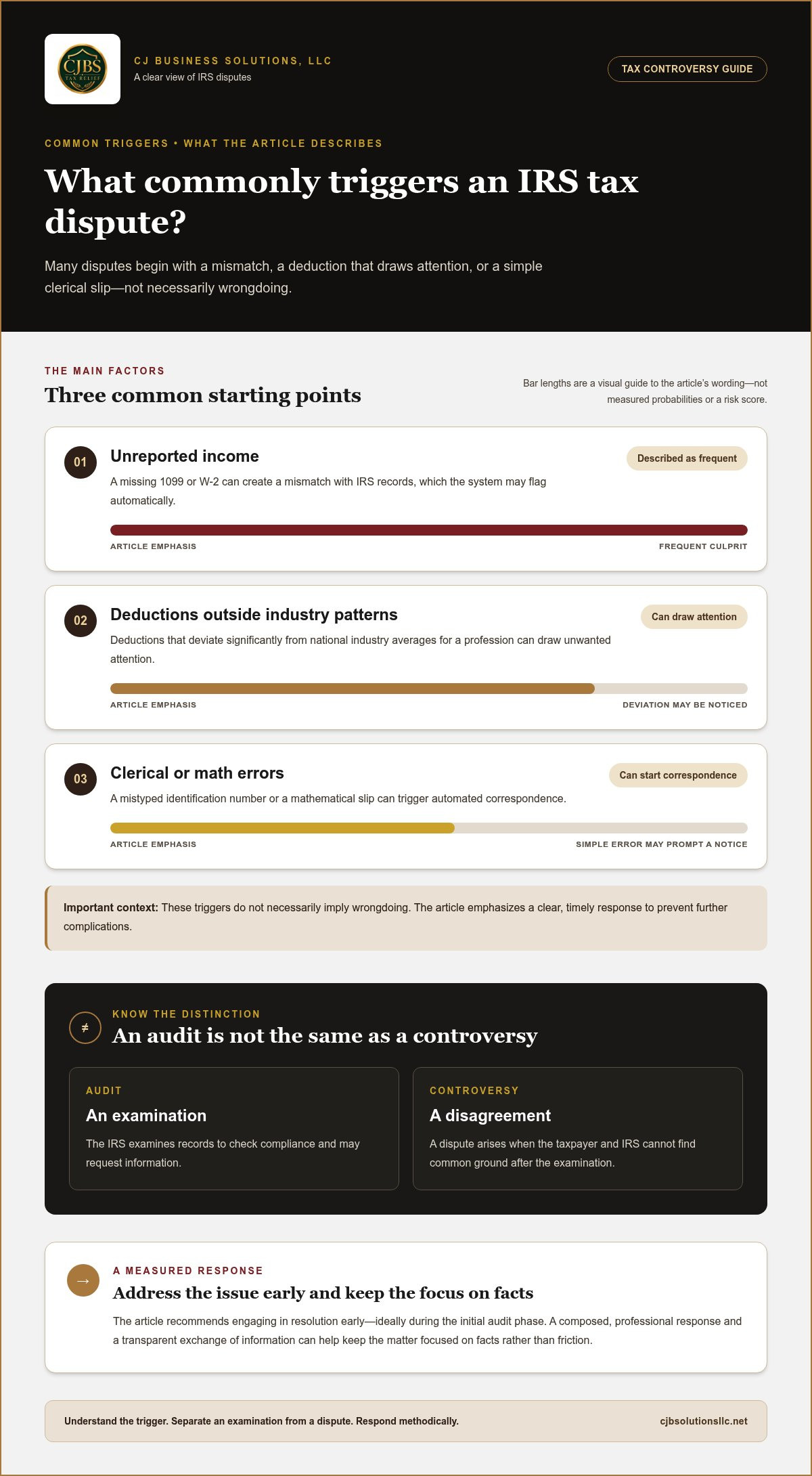
Disputes often start with simple, identifiable triggers. Unreported income is a frequent culprit; a missing 1099 or W-2 form leads to a mismatch in the IRS database that the system flags automatically. Additionally, aggressive deductions that deviate significantly from national industry averages for your specific profession can draw unwanted attention. Even clerical errors, such as a mistyped identification number or a mathematical slip, can initiate automated correspondence that feels much more threatening than it truly is. These issues don't necessarily imply wrongdoing, but they do require a clear and timely response to prevent further complications.
The Distinction Between Audit and Controversy
It's helpful to distinguish between an audit and a controversy. An audit is an examination of your records to ensure compliance; it's a request for information. A controversy, however, is the resulting disagreement when the taxpayer and the IRS cannot find common ground after that examination. Engaging in tax controversy resolution early, ideally during the initial audit phase, often prevents the situation from escalating into more severe collection tactics. Intervening at the first sign of a mismatch allows for a more transparent exchange of information. Maintaining a composed, professional stance from day one ensures that the conversation remains focused on the facts rather than the friction, protecting your long-term financial health.
As we move through 2026, the IRS has increased its reliance on digital diagnostic tools. This shift means that disputes are often identified faster than in previous years. While this speed can feel intimidating, it also provides an opportunity for faster resolution if you have the right data in hand. Approaching these disputes with a service-oriented mindset allows you to address the government's concerns without sacrificing your autonomy or your business's stability.
The Federal Appeals Process: Your Rights Under the Taxpayer First Act
The Taxpayer First Act remains a foundational piece of legislation that protects your interests when disagreements with the IRS arise. By 2026, the procedural benefits of this act have become well established, particularly the codification of the Independent Office of Appeals. This office serves as a dedicated forum for tax controversy resolution, ensuring that taxpayers have access to a review process that is structurally separate from the divisions that initially conducted the audit or collection action. The primary mandate of this office is to be fair and impartial, providing a venue where disputes can be settled through logical discussion rather than adversarial litigation.
Resolving an issue at the appeals level is often the most prudent path for individuals and small businesses. Litigation is not only expensive but also time-consuming, often taking years to reach a conclusion. In contrast, the federal appeals process typically follows a more predictable timeline. While each case is unique, many taxpayers find that their matters are addressed within several months of filing a formal protest. This methodical pace allows for a thorough review of the facts without the urgent pressure of a trial date. If you feel that an IRS determination doesn't accurately reflect your financial reality, exploring your options for professional representation can provide the clarity needed to proceed.
Navigating the Independent Office of Appeals
To begin this process, you'll generally submit a written request for an appeals conference after receiving a formal notice of determination. This meeting is best viewed as a professional consultation where both parties review the strengths and weaknesses of the case. You should expect a composed environment where the Appeals officer listens to your perspective and evaluates the evidence presented. Preparing for this meeting requires organizing specific documentation, such as bank statements, receipts, or legal arguments, that supports your position and clarifies any discrepancies found during the initial audit.
Taxpayer Rights You Should Know
Under the Taxpayer Bill of Rights, which the Taxpayer First Act further strengthened, you possess several essential protections. These include the right to be informed about IRS decisions and the right to receive quality service from agency employees. Perhaps most importantly for tax controversy resolution, you have the right to retain representation from a qualified professional, such as an Enrolled Agent. This ensures that you aren't navigating the complexities of the tax code alone. You also maintain the right to appeal an IRS decision in an independent forum, ensuring that the person reviewing your case has no prior involvement in the dispute and can offer a fresh, unbiased perspective.
Strategic Resolution Through Detailed IRS Transcript Analysis
When you're facing a disagreement with the IRS, the most valuable resource at your disposal is the agency's own internal log of your account. An IRS transcript is the primary source of truth, documenting every action taken on your file, from the moment a return is processed to the assessment of interest and penalties. Effective tax controversy resolution relies heavily on this data because it allows you to see exactly what the IRS sees. Instead of guessing why a notice was sent, transcript analysis provides a clear, documented history that serves as the foundation for a logical defense strategy. It's a methodical way to gain clarity and lower the stress of the unknown.
An Enrolled Agent plays a vital role in this process by acting as a seasoned mentor who can "decode" the cryptic transaction codes and dates found within these documents. These codes, such as a Transaction Code 420 indicating an audit or a 290 representing an additional tax assessment, tell a story that isn't always clear to the average taxpayer. By translating these internal markers into plain language, a professional helps you understand the current status of your case and anticipates the IRS's next move. This level of insight ensures that you're always one step ahead, allowing for a more composed and transparent resolution process.
What Your IRS Transcript Reveals
A detailed review of your transcript uncovers critical information that often remains hidden in standard correspondence. These documents reveal assessment dates, which are essential for determining the statute of limitations on collections, as well as a complete payment history and detailed penalty accruals. You might also find specific "flags" that indicate upcoming collection actions or automated enforcement triggers. In many cases, transcript analysis identifies errors in IRS record-keeping, such as misapplied payments or incorrect assessment dates, which can be used to resolve a dispute quickly and fairly. Having this data allows you to address the root cause of the controversy with precision.
Proactive vs. Reactive Resolution
Waiting for an IRS letter to arrive in the mail is a high-risk strategy that often leads to unnecessary anxiety and compounded interest. By the time a formal notice reaches your door, the IRS may have already initiated a process that is difficult to pause. Taking a proactive approach through regular transcript review acts as a preventative financial measure, allowing you to catch discrepancies before they escalate into full-blown disputes. Transcript analysis serves as a comprehensive diagnostic tool for your tax health, identifying potential vulnerabilities before they manifest as formal disputes. Embracing this methodical way of working ensures that you maintain your autonomy and protect your financial future with quiet confidence.
Evaluating Your Representation: Why an Enrolled Agent Is Vital
Choosing the right representative is a decision that significantly impacts the trajectory of an IRS dispute. An Enrolled Agent is a federally-authorized tax practitioner who has technical expertise in the field of taxation and is empowered by the U.S. Department of the Treasury to represent taxpayers. Unlike other professionals who may have a broader financial focus, an Enrolled Agent's training is concentrated entirely on the complexities of the tax code and agency procedure. This specialization makes them a vital partner in tax controversy resolution, as they possess a deep understanding of the internal mechanics of the IRS. Having a dedicated expert by your side provides a sense of stability, ensuring that your case is handled with the quiet confidence it deserves.
One of the most practical benefits of this representation is the creation of a professional buffer. When an Enrolled Agent handles your case, they manage all direct communication with the agency, which effectively lowers the emotional intensity of the situation. This allows you to focus on your daily life or business operations while your representative handles the methodical work of the dispute. If you're ready to secure this level of protection, you can learn more about our tax resolution services and how we can assist with your specific needs.
Enrolled Agents vs. CPAs in Controversy
While CPAs are excellent for general accounting and state-level business matters, Enrolled Agents focus their entire professional practice on federal tax law. This distinction is important because EAs hold unlimited representation rights, meaning they can represent any taxpayer before any administrative level of the IRS. In a controversy setting, specialized knowledge of IRS audit strategy defense is often more valuable than general bookkeeping. An EA's ability to navigate the specific nuances of the Internal Revenue Manual provides a strategic advantage that helps in reaching a fair and impartial resolution.
The Value of Professional Composure
A seasoned mentor does more than just file paperwork; they provide the professional composure necessary to navigate high-stakes meetings. It's easy for a taxpayer to inadvertently provide information that complicates their case when they're feeling anxious. An Enrolled Agent manages these interactions carefully to ensure that only relevant, accurate data is shared, avoiding the risk of accidental self-incrimination. This mentor-like relationship prioritizes your long-term success, ensuring that every piece of financial reporting is precise and aligned with the goal of achieving peace of mind. By maintaining this steady cadence, your representative ensures that the resolution process remains transparent and logical from start to finish.
Long-Term Compliance: Moving from Resolution to Stability
Successful tax controversy resolution is a significant milestone, but it's best viewed as the foundation for a more stable financial future rather than just the end of a difficult chapter. Once the immediate dispute is settled, the focus shifts naturally toward maintaining a state of continuous compliance. For small businesses and individuals, this transition requires a clear recovery roadmap that replaces the anxiety of "crisis mode" with the quiet confidence of methodical financial management. By establishing proactive habits now, you ensure that the progress made during the resolution process is preserved for years to come. It's a relief to move away from the friction of a dispute and toward a transparent, predictable routine.
A seasoned mentor understands that the strength of professional relationships is built on long-term trust and consistent results. Ongoing tax and accounting services play a vital role in this new phase, acting as an early warning system that identifies potential issues before they can evolve into new controversies. This collaborative approach allows you to engage with your finances at your own pace, knowing that a reliable guide is monitoring the landscape for any shifts in federal requirements. When you transition from reacting to IRS notices to proactively managing your tax health, you regain a sense of autonomy over your financial life.
Steps to Prevent Future IRS Disputes
Implementing a robust record-keeping system is the most effective way to protect your interests in 2026 and beyond. As digital reporting becomes more integrated into the federal system, having clear, organized documentation for every deduction and income source ensures that you can respond to any inquiry with transparency. It's also helpful to stay informed about how new tax laws specifically impact your industry, as these changes often trigger automated IRS flags. We recommend incorporating annual transcript reviews as a standard practice in your financial calendar. This diagnostic step allows you to verify that the IRS's records align perfectly with your own, catching clerical errors before they ever trigger a formal notice.
The Path to Financial Peace
Moving from a state of high-stress dispute to a stable, compliant financial state is a journey that preserves both your reputation and your wealth. Professional tax controversy resolution isn't just about the numbers on a page; it's about the peace of mind that comes from knowing your affairs are in order. We invite you to view our firm as a dedicated partner in your ongoing success, providing the expertise and support needed to navigate the complexities of federal tax law with ease. When you have a reliable resource that's always available but never intrusive, you can focus on your professional and personal goals, secure in the knowledge that your financial future is protected by a high standard of care.
Securing Your Financial Future Beyond the Dispute
Achieving a fair outcome with the IRS is a process that rewards patience and a data-driven approach. By utilizing specialized transcript analysis to identify hidden tax issues and understanding your rights under the Taxpayer First Act, you can transform a stressful situation into a manageable one. An Enrolled Agent provides the national representation needed for federal tax audits and disputes, acting as a steady buffer between you and the agency. This methodical way of working ensures that your interests are protected and that you're following a logical path toward stability.
If you're ready to move toward a lasting resolution, we invite you to speak with an Enrolled Agent about your tax resolution needs today. Our firm is led by an Enrolled Agent with specialized IRS representation rights, offering the expertise required for effective tax controversy resolution. We're here to act as your seasoned mentor, providing the resources and support you need to maintain long-term compliance. You don't have to face complex tax issues alone, and we're genuinely invested in your success and well-being. There's a clear path to financial peace, and it begins with a single, composed step forward.
Frequently Asked Questions
What exactly is tax controversy resolution?
Tax controversy resolution is the administrative process used to settle disagreements with the IRS regarding tax assessments or collection efforts. It focuses on reaching a fair agreement through the agency's internal appeals system rather than through the court system. This approach allows taxpayers to address issues like audit findings or penalty assessments in a methodical and transparent environment.
How is an Enrolled Agent different from a tax attorney in an IRS dispute?
An Enrolled Agent is a federally-authorized practitioner who specializes specifically in tax law and IRS procedures, whereas a tax attorney has a broader legal background. EAs focus their professional practice on the technical administrative aspects of audits and transcript analysis. Both have unlimited representation rights before the IRS, but an EA acts as a specialized mentor for federal tax matters.
Can I resolve a tax dispute if I have already received a final notice from the IRS?
Yes, you can still seek a resolution even after receiving a final notice, though your options become more time-sensitive. Actions such as requesting an Appeals conference or filing for a Collection Due Process hearing remain available to protect your interests. It's important to act quickly to preserve your rights and prevent automated collection activities like levies or liens from escalating.
What is the Independent Office of Appeals, and is it truly independent?
The Independent Office of Appeals is a separate division within the IRS designed to resolve disputes fairly and impartially without litigation. It is structurally independent from the examination and collection divisions to ensure a fresh perspective on your case. This separation was further solidified by the Taxpayer First Act to protect taxpayer autonomy and ensure a balanced review process.
How long does the tax controversy resolution process typically take?
The timeline for a typical resolution varies, but many administrative disputes are settled within several months of the initial filing. While complex cases involving extensive documentation may take longer, a steady and organized approach helps to keep the process moving forward. Professional representation ensures that all deadlines are met, which is a vital part of effective tax controversy resolution.
What are the most common reasons for an IRS audit in 2026?
Audits are frequently triggered by discrepancies between reported income and third-party documents like 1099s or W-2s. Additionally, deductions that are significantly higher than the national average for your specific industry often prompt a closer look by the agency's automated systems. Simple clerical errors on a return can also lead to automated correspondence that initiates a formal dispute.
Will hiring a professional for resolution make me look more suspicious to the IRS?
No, the IRS generally views professional representation as a sign that the taxpayer is taking the matter seriously and intends to comply with the law. Having an expert handle the communication often makes the process more efficient for the agency as well. It provides a professional buffer that ensures all information shared is accurate, relevant, and presented in a composed manner.
What documents should I gather before starting the resolution process?
You should begin by organizing your tax returns for the years in question along with any formal notices or letters received from the IRS. Supporting evidence such as bank statements, receipts, and relevant business records is also essential for building a clear and logical case. Having these documents ready allows for a more transparent and thorough analysis at the start of the process.

Article by
Crystal R. Johnson, MBA EA
Crystal Johnson founded CJ Business Solutions to give individuals and small-business owners something often missing from the tax and accounting process: clear explanations, practical solutions, and trusted support.
With more than 27 years of accounting and financial experience, Crystal helps clients understand complicated tax matters, restore compliance, respond to IRS concerns, and make stronger business decisions. As an Enrolled Agent, she is federally authorized to represent taxpayers before the Internal Revenue Service.


