

What if the professional standing between you and the Internal Revenue Service held a federal license created specifically for that purpose? It's entirely natural to feel a sense of apprehension when a formal notice arrives in the mail, especially when the tax code feels like an impenetrable maze. You might worry about aggressive collection tactics or feel a heavy weight of stress from an impending audit. Seeking IRS representation by enrolled agent can provide the clarity and stability you need during these challenging times. These professionals are the only tax practitioners who receive their right to practice directly from the U.S. Treasury, making them uniquely qualified to handle federal tax conflicts.
In this guide, you'll discover how an Enrolled Agent's federal authorization provides the highest level of tax defense and a clear path to resolution for your IRS challenges. We will explain the strategic benefits of specialized transcript analysis and how a dedicated advocate helps you fully understand your rights as a taxpayer. By the end of this article, you'll have a thorough understanding of how to reduce audit stress and move toward a reliable solution for your tax debt. We invite you to explore how a seasoned mentor can help you find a calm port in the storm of complex tax regulations.
Key Takeaways
- Learn why an Enrolled Agent’s federal authorization from the U.S. Treasury offers a unique level of protection that state-licensed professionals may not provide.
- Understand the strategic advantages of IRS representation by enrolled agent, where a specialist acts as a professional buffer to manage communication and prevent over-disclosure during audits.
- Discover how specialized transcript analysis can decode complex IRS records to identify errors and establish a clear, methodical path toward tax resolution.
- Explore the core differences between CPAs and Enrolled Agents to ensure you choose a representative with a dedicated focus on federal tax advocacy.
- Gain a clearer understanding of your rights as a taxpayer and how a reliable guide helps you navigate aggressive collection tactics with quiet confidence.
What is IRS Representation by an Enrolled Agent?
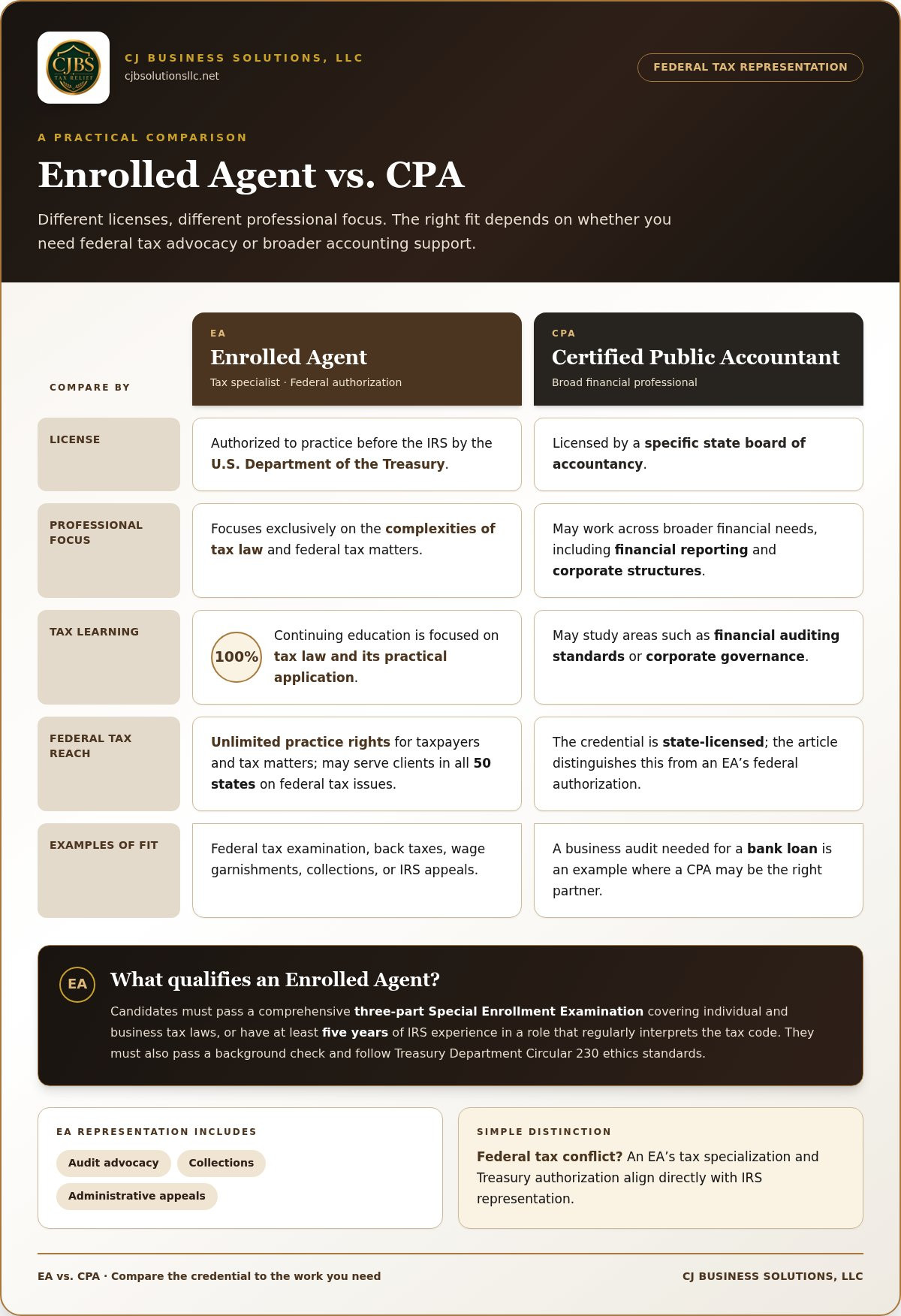
An Enrolled Agent is a tax professional who has earned the privilege of representing taxpayers before the Internal Revenue Service. This designation is not merely a title; it's a federal authorization. The term "enrolled" signifies that the individual is specifically authorized by the U.S. Department of the Treasury to practice before the IRS. Choosing IRS representation by enrolled agent ensures that you're working with a practitioner who has met the highest standards of the federal government. They're specialists. While other professionals might divide their time between various financial tasks, an Enrolled Agent focuses exclusively on the complexities of the tax code.
The journey to becoming an Enrolled Agent is rigorous. Candidates must pass a comprehensive three-part Special Enrollment Examination that covers individual and business tax laws. Alternatively, they must have at least five years of experience as an IRS employee in a role that regularly interprets the tax code. Beyond technical knowledge, these professionals must pass a background check and adhere to the strict ethical standards outlined in Treasury Department Circular 230. This process ensures they possess both the skill and the character to serve as a reliable guide through difficult tax situations.
The Origin of the Enrolled Agent Credential
The roots of this credential date back to 1884. Following the Civil War, many citizens faced challenges when filing claims for property lost during the conflict. Congress established the role of the Enrolled Agent to ensure that representatives were of good character and possessed the necessary technical knowledge to assist the public. Over time, this role evolved from handling property claims to providing expert advocacy in modern tax matters. Because their authorization is federal, it differs significantly from state-level professional licensing. This historical foundation of stewardship continues to define the profession today.
Unlimited Practice Rights Explained
One of the most significant benefits of IRS representation by enrolled agent is the scope of their authority. These professionals hold "unlimited" practice rights. This means they're unrestricted in which taxpayers they can represent and the types of tax matters they can handle. Because their authorization is federal rather than state-based, they can serve clients in all 50 states for federal tax issues. Their rights include:
- Audit Advocacy: Representing you during examinations of your tax returns.
- Collections: Negotiating payment plans or settlements for outstanding tax debt.
- Appeals: Challenging IRS decisions within the agency's administrative appeals system.
Whether you're facing a simple inquiry or a complex federal audit, an Enrolled Agent provides a stable and knowledgeable presence. They act as a professional bridge between you and the federal government, ensuring your rights are protected at every step.
Enrolled Agent vs. CPA: Choosing the Right Professional
Choosing between a Certified Public Accountant (CPA) and an Enrolled Agent (EA) depends largely on the nature of your financial needs. While both are respected credentials, their paths to expertise diverge significantly. CPAs are often generalists in the broad financial world. They manage business audits, financial reporting, and complex corporate structures for diverse clients. Conversely, an Enrolled Agent is a specialist whose entire professional focus is dedicated to the intricacies of the tax code. This specialization makes them uniquely qualified to handle the specific pressures of federal tax advocacy.
The distinction in licensing is also a critical factor to consider. A CPA is licensed by a specific state board of accountancy, meaning their authority and specific knowledge are often tied to state-specific regulations. In contrast, an Enrolled Agent holds a federal license directly from the U.S. Treasury. This federal authorization is why seeking IRS representation by enrolled agent is such a stable choice for those facing challenges with the national tax authority. It provides a level of consistency in federal matters that state-based licenses may not always match, ensuring that your representative is an expert in the exact rules the IRS follows.
Tax Specialization vs. General Accounting
Enrolled Agents focus 100% of their continuing education on tax law and its practical application. This depth of study allows them to stay current with the thousands of annual changes to the federal tax code. While a CPA might spend significant time studying financial auditing standards or corporate governance, an EA is looking specifically at resolution strategies for individual and business taxpayers. Identifying which professional matches your problem is essential. If you need a business audit for a bank loan, a CPA is the right partner. However, if you're facing a federal tax examination, an EA's specialized focus is often more appropriate for your needs.
When to Hire an Enrolled Agent
You should consider an Enrolled Agent when you're dealing with specific IRS challenges such as audits, back taxes, or wage garnishments. Their national standing makes them a reliable guide for federal issues that cross state lines. Federal authorization is the primary differentiator that allows an Enrolled Agent to represent any taxpayer before any IRS office in the country. If you're feeling overwhelmed by an audit notice, you might find it helpful to explore the tax resolution services offered by a dedicated specialist. Their methodical approach to tax defense often provides a more cost-effective path to resolution than general accounting firms can offer.
Ultimately, hiring a specialist ensures that you're not just another file in a busy accounting practice. When the IRS is your primary concern, having a representative who speaks the agency's language fluently is invaluable. An Enrolled Agent acts as a calm port in the storm, using their specialized knowledge to protect your interests and provide a clear understanding of your rights as a taxpayer.
The Strategic Advantage of Enrolled Agent Audit Defense
One of the most immediate benefits of IRS representation by enrolled agent is the creation of a professional buffer between you and the tax authority. When an audit notice arrives, your first instinct might be to explain every detail of your financial history to the revenue agent. However, providing too much information can inadvertently lead to further inquiries or an expanded audit scope. An Enrolled Agent acts as your primary point of contact, managing all correspondence and attending meetings on your behalf. This professional distance helps maintain a focused and calm environment, ensuring that the examination remains limited to the specific issues identified in the initial notice.
A methodical approach is essential when dealing with federal tax examinations. Your representative understands the procedural boundaries that IRS agents must respect. By carefully reviewing every request for information, an Enrolled Agent ensures that the government doesn't overstep its authority. This advocacy is rooted in a deep respect for the Taxpayer Bill of Rights, which grants you the right to be represented and the right to a fair and just tax system. Having a seasoned mentor by your side provides the stability needed to face these challenges with quiet confidence.
Protecting Taxpayer Interests during Examinations
Accuracy is the foundation of a successful audit defense. By managing the flow of communication, your representative ensures that every document submitted is both necessary and accurate. This prevents the common mistake of over-disclosure, where taxpayers provide records that weren't requested and potentially open new avenues for investigation. It's helpful to understand that Enrolled Agents are governed by Treasury Department Circular 230. This regulation mandates a high standard of professional conduct and ethical responsibility, ensuring that your interests are always prioritized during the examination process.
Negotiating Favorable Resolution Outcomes
The goal of any tax defense strategy is to reach a resolution that is both fair and manageable. Choosing IRS representation by enrolled agent allows you to lean on someone who understands the internal mechanics of the IRS. If the audit results in a tax liability, your advocate can negotiate various resolution options. These might include an Offer in Compromise, which allows you to settle your debt for less than the full amount, or a structured Installment Agreement that fits your current financial situation.
Additionally, your representative can seek penalty abatement. If you have a history of compliance but faced a specific hardship that led to a tax error, the IRS may agree to remove certain penalties. This methodical negotiation process is designed to reduce your financial burden and provide a clear path forward. With the right guidance, a stressful tax situation can be transformed into a manageable plan for long-term compliance.
Transcript Analysis: Decoding the Path to Resolution
An IRS transcript is a technical log of every action taken on your tax account. To the untrained eye, these documents appear as a series of cryptic dates and three-digit numbers known as transaction codes. While they're often unreadable to laypeople, they're the primary source of truth for anyone providing IRS representation by enrolled agent. These records reveal the back-end view of your tax history, showing exactly what the agency believes you owe and how they arrived at that figure.
A methodical review of these transcripts is a critical step in any successful resolution plan. It allows a professional to identify the Collection Statute Expiration Date (CSED), which is the deadline by which the IRS must collect a debt. Without this data, you might inadvertently extend the time the government has to collect from you. Understanding the timeline is essential for maintaining stability and planning your financial future with quiet confidence.
Identifying Errors and Hidden Opportunities
Specialized analysis often reveals discrepancies that aren't visible on standard billing notices. By decoding transaction codes, an Enrolled Agent can spot unapplied payments, miscalculated interest, or penalties that were assessed in error. For example, a "Code 670" indicates a payment, while a "Code 290" shows an additional tax assessment. If these don't align with your personal records, it provides a clear opportunity for correction.
- Unapplied Credits: Finding payments that were sent but never credited to the correct tax year.
- Penalty Overlays: Identifying when the IRS has stacked penalties that may be eligible for abatement.
- Tolling Events: Determining if specific actions, like a bankruptcy or a previous appeal, have paused the collection clock.
By verifying that every credit has been correctly applied and every penalty is legally justified, transcript analysis prevents taxpayers from making unnecessary payments to the federal government.
Developing a Data-Driven Defense Strategy
Moving from guesswork to an evidence-based strategy is the hallmark of a seasoned mentor. At CJ Business Solutions, LLC, we use detailed transcript analysis services to protect our clients and build a roadmap for resolution. This data-driven approach removes the ambiguity from your tax situation, allowing us to see exactly what the IRS sees before we ever begin negotiations.
There is a profound sense of peace that comes from a clear, data-backed review of your tax history. Instead of reacting to aggressive collection notices, you can take proactive steps based on verified facts. This methodical preparation ensures that your defense is rooted in the actual records held by the Treasury, providing a stable foundation for resolving your federal tax challenges once and for all.
Partnering with a Reliable Guide for Tax Resolution
Facing the Internal Revenue Service shouldn't feel like a solitary battle. The weight of tax debt or an audit notice often brings a sense of isolation and persistent worry. By choosing IRS representation by enrolled agent, you gain a partner who understands the high stakes of federal advocacy. This relationship is built on stability and a shared goal of moving from a place of anxiety to one of structured resolution. It's about finding a calm port where professional expertise replaces the noise of aggressive collection tactics. A seasoned mentor doesn't just solve a problem; they provide the steady guidance needed to navigate a complex system with quiet confidence.
The transition from stress to resolution begins with a methodical plan. While the tax code is vast, the right professional helps you focus only on what matters for your specific case. This targeted approach ensures that your time and resources are used effectively. By prioritizing long-term financial compliance, a dedicated representative helps you build a future where tax notices no longer cause a sense of dread. You're not just closing a file; you're establishing a foundation of transparency and accuracy that will serve you for years to come.
The CJ Business Solutions, LLC Approach
At CJ Business Solutions, LLC, we believe that effective representation requires more than just technical skill. It requires an approachable and helpful perspective that prioritizes your peace of mind over transactional goals. Our audit strategy defense is tailored to the specific circumstances of each client, whether you're a small business owner or an individual taxpayer. We don't rely on high-pressure sales tactics. Instead, we focus on methodical transcript analysis and accurate reporting to ensure that once your current challenge is resolved, you remain in good standing. This foresight helps prevent future IRS challenges before they have a chance to begin.
Taking the First Step Toward Resolution
Engaging with a professional is the first step toward reclaiming your financial autonomy. When you're ready to start, the process is designed to be as low-stress as possible. During an initial consultation, your Enrolled Agent will listen to your concerns and review the notices you've received. To make this first meeting most effective, it's helpful to gather a few essential documents:
- Recent IRS notices: Any letters or bills you've received in the mail.
- Tax returns: Copies of your filings for the years currently under review.
- Payment records: Proof of any payments that may not have been correctly applied.
- Financial statements: A general overview of your current income and expenses.
Having these items ready allows your representative to begin the transcript analysis process immediately. This data-driven start ensures that your resolution plan is based on verified facts rather than guesswork. If you're ready to move forward with a steady and reliable partner, you can Consult with an Enrolled Agent at CJ Business Solutions, LLC today. Taking this step doesn't just resolve a tax debt; it provides you with the clarity and confidence to face the future without the shadow of IRS uncertainty.
Moving Toward a Clear Financial Future
Resolving a conflict with the IRS is a methodical process that requires both technical precision and a steady hand. We have discussed how the federal authorization of an Enrolled Agent provides a unique level of protection, ensuring your rights are respected regardless of geographic boundaries. By utilizing specialized transcript analysis, you can move beyond the confusion of cryptic codes to identify a clear, data-driven path to resolution. Seeking IRS representation by enrolled agent means you're no longer navigating these complexities alone; instead, you're supported by a professional who translates federal procedure into actionable results.
At CJ Business Solutions, LLC, we're led by a federally authorized Enrolled Agent who specializes in professional audit strategy defense. Our firm focuses on providing stability and expert transcript analysis to help you resolve outstanding tax challenges with quiet confidence. If you're ready to replace anxiety with a structured plan, we invite you to secure your tax resolution roadmap with CJ Business Solutions, LLC. There is a reliable way through the storm, and we are here to serve as your seasoned mentor toward long-term compliance and lasting peace of mind.
Frequently Asked Questions
What is an Enrolled Agent vs. a CPA for an IRS audit?
An Enrolled Agent specializes exclusively in taxation, while a CPA often handles broader financial reporting and auditing. For an IRS audit, an EA's deep focus on the federal tax code provides a specialized level of advocacy. While CPAs are licensed by individual states, EAs hold a federal license from the U.S. Treasury, making them particularly adept at navigating national tax challenges and ensuring your rights are upheld.
Can an Enrolled Agent represent me in any state?
Yes, an Enrolled Agent can represent you in any state for federal tax matters. Because their license is issued by the federal government rather than a state board, they're not restricted by geographic boundaries when dealing with the IRS. This makes them a reliable choice for taxpayers who move between states or have business interests in multiple locations, providing consistent advocacy regardless of where you reside.
What are the benefits of IRS representation by an Enrolled Agent?
The primary benefits of IRS representation by enrolled agent include having a professional buffer between you and the IRS and gaining access to unlimited practice rights. These specialists manage all communications, attend audits on your behalf, and ensure your rights are protected under the Taxpayer Bill of Rights. Their methodical approach helps reduce the stress of complex federal examinations while providing a clear path toward resolution.
How much does it cost to hire an Enrolled Agent for tax resolution?
The cost of hiring an Enrolled Agent for tax resolution typically depends on the complexity of your case and the specific services required. While we don't provide fixed pricing here, many find that EAs offer a cost-effective solution compared to other tax professionals because of their specialized focus on resolution rather than general accounting. We recommend a consultation to discuss your specific needs and develop a tailored strategy.
Can an Enrolled Agent stop an IRS wage garnishment?
An Enrolled Agent can certainly assist in stopping an IRS wage garnishment by negotiating a resolution on your behalf. They work to establish an installment agreement, an Offer in Compromise, or a "Currently Not Collectible" status. By acting quickly and providing the necessary financial documentation to the IRS, they help restore your financial stability and stop aggressive collection actions that threaten your livelihood.
What is the highest credential the IRS awards to tax professionals?
The Enrolled Agent status is the highest credential the IRS awards to tax professionals. Individuals who hold this designation have either passed a comprehensive three-part examination on federal tax law or have extensive experience as an IRS employee. This federal authorization distinguishes them as elite practitioners in the field of tax representation and advocacy, requiring them to adhere to strict ethical standards and continuing education.
Do Enrolled Agents have the same confidentiality privileges as attorneys?
Enrolled Agents have a limited client privilege that applies to non-criminal tax matters before the IRS. Under Section 7525 of the Internal Revenue Code, this privilege allows for confidential communication regarding tax advice between the practitioner and the taxpayer. It's important to understand that this is not as broad as the attorney-client privilege, which extends to criminal matters and state court proceedings, making it a limited protection.
How does transcript analysis help in an IRS audit defense?
Transcript analysis helps in an audit defense by identifying specific transaction codes that reveal the IRS's internal actions on your account. This specialized review can uncover unapplied payments, miscalculated penalties, or errors in the statute of limitations for collections. It provides a data-driven foundation for your defense strategy, ensuring that every negotiation is based on verified federal records rather than guesswork or incomplete billing notices.

Article by
Crystal R. Johnson, MBA EA
Crystal Johnson founded CJ Business Solutions to give individuals and small-business owners something often missing from the tax and accounting process: clear explanations, practical solutions, and trusted support.
With more than 27 years of accounting and financial experience, Crystal helps clients understand complicated tax matters, restore compliance, respond to IRS concerns, and make stronger business decisions. As an Enrolled Agent, she is federally authorized to represent taxpayers before the Internal Revenue Service.


