

Receiving a federal tax notice can feel like a sudden weight on your shoulders, especially when you realize that interest rates for individual underpayments have reached 7% as of July 2026. It's entirely natural to feel overwhelmed by complex transcripts or the threat of an unexpected levy. You likely want to resolve these matters correctly but may feel unsure where to begin or how to effectively communicate with the IRS. Working with a professional tax resolution consultant provides you with a steady partner who understands the nuances of federal tax law and can protect your financial interests.
We understand that your goal is to find a clear, manageable path toward compliance while shielding your assets from aggressive collection tactics. Discover how a professional tax resolution consultant navigates complex IRS challenges to protect your financial future and restore your peace of mind. This article explains the vital role of methodical transcript analysis, the protective benefits of working with an Enrolled Agent, and the specific strategies used to manage federal audits. We'll examine how expert representation ensures you're treated fairly while establishing a stable foundation for your financial life.
Key Takeaways
- Understand how a tax resolution consultant moves beyond basic tax preparation to provide strategic representation and defense against IRS controversies.
- Learn why Enrolled Agents offer a specialized advantage through their federally-authorized, unlimited representation rights before the IRS.
- Discover how methodical transcript analysis acts as a master record to identify potential red flags before they escalate into formal audits.
- Identify the essential credentials and communication styles to look for when selecting a representative who prioritizes your long-term trust and autonomy.
- Explore how expert representation helps you navigate complex federal tax laws to restore your compliance and protect your financial future.
What is a Tax Resolution Consultant and How Do They Help?
A professional tax resolution consultant serves as an authorized representative for individuals and businesses engaged in disputes with the IRS. While many people associate tax professionals solely with the annual filing of returns, this specific role focuses on the complex field of tax controversy. These experts don't just report your income; they actively defend your interests when the government questions your filings or demands payment you cannot immediately provide. By acting as a professional buffer, a consultant manages all direct communication with federal agents. This helps lower your personal stress and prevents you from inadvertently sharing information that could complicate your case.
The transition from simple tax preparation to strategic resolution is a significant shift in perspective. Most taxpayers are accustomed to a transactional relationship where they provide documents and receive a completed return. However, when you face a federal audit or a collection action, you need a partner who understands the strategic side of tax law. A tax resolution consultant provides that steady hand, ensuring that your rights are respected while you work toward a manageable outcome.
The Scope of Professional Tax Representation
The work involves much more than just answering a phone call. It requires a methodical review of your situation to ensure the IRS is acting within its own established rules. A professional representative typically manages several critical tasks:
- Responding to formal IRS notices and federal inquiries with precise, documented evidence.
- Negotiating collection alternatives, such as installment agreements, that align with your actual financial capacity.
- Conducting a thorough assessment of tax liabilities to identify potential errors or miscalculations made by the agency.
Whether you're a small business owner facing a payroll tax issue or an individual dealing with unfiled returns from previous years, the goal remains the same. You need a sustainable path to compliance that protects your assets and your livelihood.
Why a Consultant is Different from a Standard Preparer
It's helpful to understand that tax preparation is fundamentally retrospective. A preparer looks at what happened last year and records it on a form. In contrast, a consultant is prospective and strategic. They look at the current problem and build a path toward a future where you're fully compliant and protected from aggressive tactics like garnishments.
Consultants possess a deep understanding of the Internal Revenue Manual (IRM), which is the official guide for IRS employees. This specialized knowledge allows them to analyze the "why" behind a tax issue. They don't just see a balance due; they look for the underlying cause, such as a missed deduction or an incorrect assessment. They use that information to build a defense. This level of care ensures that you aren't just paying a bill, but rather resolving a problem correctly and permanently.
Enrolled Agents vs. CPAs: Choosing Your IRS Representative
When you begin searching for assistance with an IRS matter, the variety of professional titles can feel quite confusing. You'll likely encounter both Enrolled Agents (EAs) and Certified Public Accountants (CPAs), and while both are highly qualified, they serve different primary roles. Choosing a tax resolution consultant who holds the Enrolled Agent credential ensures that your representative has met rigorous federal standards specifically designed for tax controversy. The IRS provides helpful choosing a tax professional guidance to help you verify these credentials and understand the different levels of representation available to you.
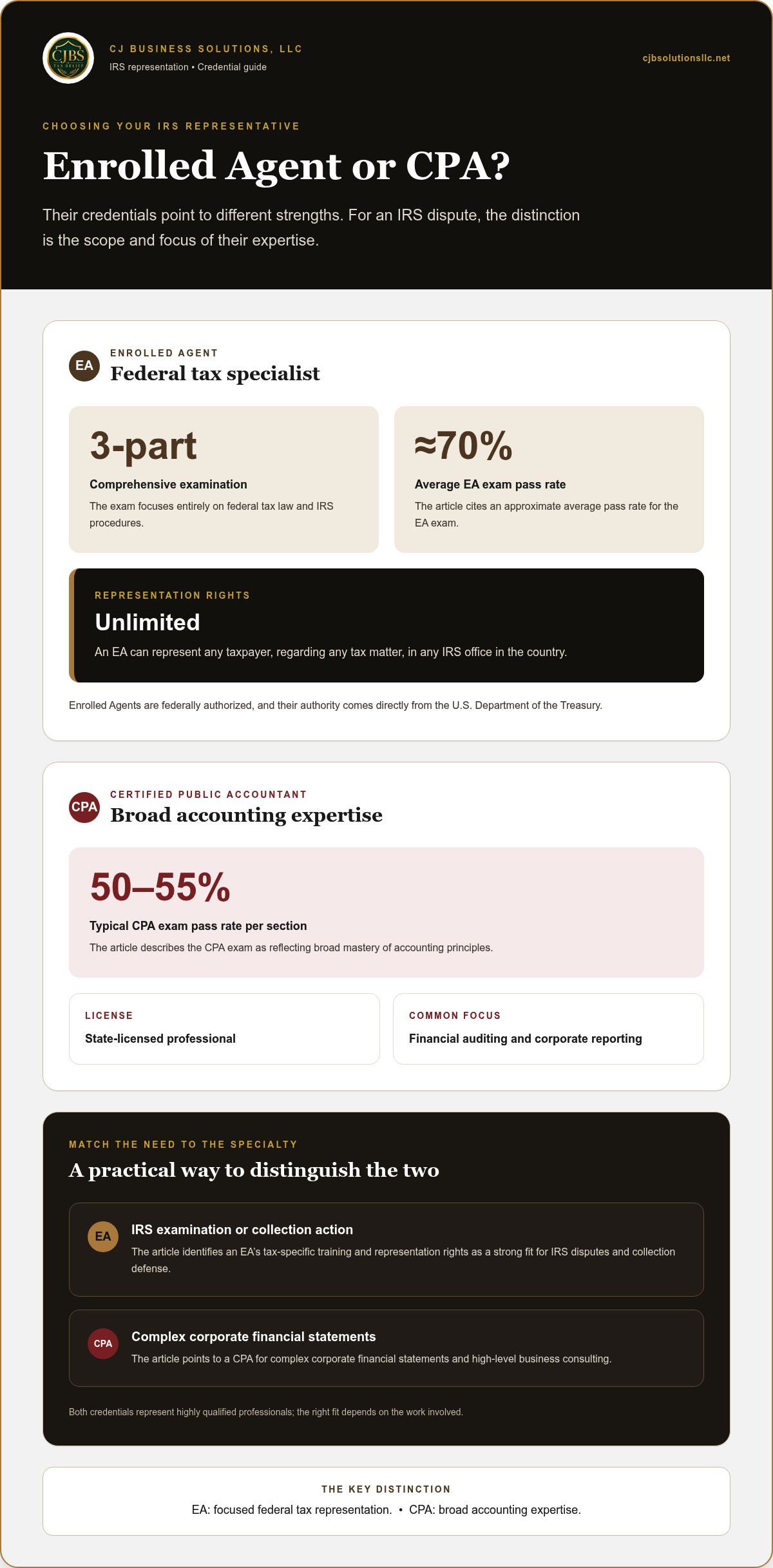
The distinction often comes down to the scope of their expertise. A CPA is a state-licensed professional whose training covers a broad spectrum of accounting, including financial auditing and corporate reporting. Their focus is often on the general health of a business's books. In contrast, an Enrolled Agent is a federally-authorized tax practitioner who has demonstrated technical expertise in every aspect of federal taxation. This specialized focus is why many people prefer an EA when dealing with specific IRS disputes or collection actions.
The Unique Rights of an Enrolled Agent
Enrolled Agents are the only tax professionals who derive their authority directly from the U.S. Department of the Treasury. To earn this designation, they must pass a comprehensive three-part examination that focuses entirely on federal tax law and IRS procedures. Statistics show that the average pass rate for the EA exam is approximately 70%, reflecting a deep level of specialized knowledge. Once credentialed, EAs possess unlimited representation rights. This means they can represent any taxpayer regarding any tax matter in any IRS office in the country, providing a level of consistency that state-specific licenses may not offer.
Which Professional is Right for Your Audit?
If your primary need involves complex corporate financial statements or high-level business consulting, a CPA is often the right choice. Their exam pass rates, which typically range between 50% and 55% per section, reflect a broad mastery of accounting principles. However, if you're facing an IRS examination or need a strategic defense against collection actions, the tax-specific training of an EA is invaluable. They understand the nuances of the Internal Revenue Manual and how to navigate the specific protocols federal agents follow during an audit.
A reliable guide doesn't just fill out forms; they act as a steady mentor who understands the emotional and financial stakes of your case. If you're seeking a partner who understands these nuances, exploring the tax resolution services offered by an EA-led firm can provide the steady guidance you need to move forward with confidence. By combining methodical accounting practices with specialized tax defense, you ensure your case is handled with both technical precision and professional care.
The Strategic Importance of IRS Transcript Analysis
Many taxpayers view their relationship with the IRS through the limited lens of the notices they receive in the mail. However, the internal records the agency maintains tell a much more detailed story. IRS transcripts function as the master record of your tax history, documenting every return filed, every payment processed, and every penalty assessed. A skilled tax resolution consultant begins any engagement by performing a methodical review of these documents. This analysis allows your representative to see exactly what the IRS sees, providing a level of transparency that's otherwise impossible to achieve.
Decoding these records requires specialized training, which is why the IRS provides resources on how to choose a tax professional who can interpret these internal codes accurately. These transcripts contain specific transaction codes that reveal the timing of IRS actions and the status of your account. By identifying red flags within these codes before they escalate, a consultant can address issues early, potentially preventing a standard inquiry from turning into a full-scale federal audit.
Identifying Errors and Resolution Paths
The foundation of an effective resolution strategy is factual accuracy. It's common for payments to be misapplied or for penalties to be calculated incorrectly. For example, with the individual underpayment interest rate set at 7% for the third quarter of 2026, even a small accounting error can grow quickly. Transcript analysis allows your representative to identify these discrepancies and build a factual argument for their correction.
This process also reveals the exact Collection Statute Expiration Date (CSED). The IRS generally has ten years to collect a tax debt, but various actions can "toll" or extend this timeframe. A tax resolution consultant uses transcript data to calculate these dates precisely, ensuring you don't pay on a debt that's legally uncollectible. This methodical approach provides a clear, data-driven path toward compliance.
Proactive Audit Strategy Defense
When facing a federal examination, information is your most significant advantage. Transcript analysis serves as a proactive audit strategy defense by revealing what the IRS already knows before you ever attend a meeting. By reviewing the "Information Returns" transcript, your consultant can see the data reported by third parties, such as employers or banks, and cross-reference it with your records.
This allows your representative to identify potential mismatches and prepare explanations or documentation in advance. Instead of reacting to the auditor's questions, you can present a defense based on the IRS's own internal data records. This level of preparation demonstrates professional competence and can lead to a more efficient, predictable outcome for your case.
Evaluating Tax Resolution Services: A Reference Guide
Selecting the right representative to handle your IRS case is a decision that impacts your financial stability for years to come. In 2026, the IRS continues to warn taxpayers about "Offer in Compromise mills" in its annual Dirty Dozen list of tax scams. These aggressive marketing firms often prioritize high-volume sales over individualized care. A qualified tax resolution consultant operates differently, acting as a seasoned mentor who prioritizes transparency and education. Instead of making grand promises, they focus on a methodical review of your specific situation to find a sustainable solution.
A professional approach always begins with a thorough examination of your records. If a firm suggests a specific settlement outcome before they have analyzed your IRS transcripts, it is a sign that they may be prioritizing their own fees over your actual needs. Quality representation is built on data, not sales pitches. You should look for a partner who explains the "why" behind every recommendation, ensuring you feel empowered to make informed decisions about your federal tax obligations.
Questions to Ask a Potential Consultant
Before you sign a representation agreement, it is helpful to understand exactly who will be managing your case and what their process looks like. Consider asking these specific questions during your initial conversation:
- "Will you be the one representing me directly before the IRS, or will my case be handed to a junior staffer?"
- "What is your specific strategy for analyzing my IRS transcripts to identify potential errors or misapplied payments?"
- "How do you handle IRS audit defense for small businesses compared to individual taxpayers?"
The answers to these questions will reveal whether the professional has a methodical, hands-on approach or if they operate a transactional, high-volume firm. A dedicated tax resolution consultant will be happy to explain their strategy in detail, as their goal is to build long-term trust.
Red Flags to Avoid in Tax Resolution
Being able to identify warning signs early can save you from additional stress and financial loss. One of the most common red flags is a promise of "pennies on the dollar" settlements without a full financial review. While the IRS does offer an Offer in Compromise (OIC) program, which has a non-refundable application fee of $205 in 2026, eligibility is strictly based on your ability to pay, income, and asset equity. No one can guarantee an OIC acceptance without first performing a detailed analysis of your financial standing.
Other red flags include aggressive sales tactics that create a false sense of urgency or firms that lack a clear professional history in tax representation. If you find yourself feeling pressured rather than supported, it may be time to seek a different perspective. If you're ready to work with a partner who values substance over flash, we invite you to learn more about our tax resolution services and how a methodical approach can provide the clarity you need.
Restoring Your Compliance with CJ Business Solutions
Resolving a federal tax dispute is rarely a simple matter of signing a single document. It requires a commitment to accuracy and a deep understanding of IRS protocols. By choosing a tax resolution consultant who is also an Enrolled Agent, you ensure your case is handled with technical precision and federal authority. CJ Business Solutions approaches every case as a steady partner, focusing on the quality of the resolution rather than the speed of the transaction. We believe that true success is found in long-term compliance, helping you move past current challenges and into a more stable financial future.
Our firm operates as a seasoned mentor, providing the quiet confidence you need when facing complex federal inquiries. We don't rely on high-pressure tactics or outlandish promises. Instead, we offer a composed and reassuring environment where your autonomy is respected. We understand that your goal is to protect your livelihood and restore your peace of mind, and we're here to provide the expert representation required to achieve those outcomes.
A Methodical Path to Resolution
Our process is designed to be thorough and transparent, ensuring you're never left wondering about the status of your case. We begin by looking at the facts through a comprehensive transcript analysis. This allows us to see the same data the IRS uses, helping us identify errors or misapplied payments that might otherwise go unnoticed. By establishing this factual foundation, we can develop a customized audit defense or resolution strategy that aligns with your specific financial situation.
This methodical approach extends beyond the initial fix. We provide ongoing support to ensure you remain in good standing with the IRS in the years to come. This includes educating you on the requirements for future filings and helping you understand the triggers that can lead to federal scrutiny. We're invested in your long-term success, acting as a knowledgeable resource that is always available to answer your questions.
The Peace of Mind of Expert Representation
Perhaps the most significant benefit of professional representation is the restoration of your peace of mind. Facing the IRS alone is a daunting experience that can impact your health, your family, and your business. We act as your authorized representative, removing the stress of direct communication with federal agents. This allows you to focus on your daily life while we work to protect your personal and business assets from aggressive collection actions.
Expert representation ensures that your rights are protected and that the IRS adheres to its own internal guidelines. If you're ready to find a calm port in the storm of tax controversy, we invite you to contact CJ Business Solutions today to discuss your tax resolution needs. Together, we can build a clear and manageable path toward financial stability and long-term compliance.
Securing Your Financial Future Through Expert Representation
Navigating the intricacies of federal tax law requires more than just a quick fix; it demands a strategic and methodical approach. As we've explored, the specialized expertise of an Enrolled Agent provides a distinct advantage through unlimited representation rights and a deep understanding of IRS protocols. By utilizing specialized transcript analysis, a tax resolution consultant can uncover the factual data necessary to build a robust defense and identify a clear path toward compliance.
Whether you're facing a complex federal audit or seeking relief from aggressive collection actions, having a steady partner by your side makes a significant difference. CJ Business Solutions is dedicated to providing the expert audit strategy defense and personalized care you deserve. We prioritize your long-term stability over immediate transactions, acting as a reliable guide through every step of the process.
If you're ready to address your IRS challenges with confidence, we invite you to schedule a professional consultation with our Enrolled Agent to resolve your IRS issues. Taking this first step allows you to regain control of your financial life and restore the peace of mind you've been seeking. We look forward to helping you find a stable path forward.
Frequently Asked Questions
What exactly does a tax resolution consultant do?
A tax resolution consultant acts as your authorized representative to manage disputes and negotiations with the IRS. They handle all direct correspondence with federal agents, which helps prevent you from making statements that could negatively impact your case. Their work includes analyzing your tax history through transcripts, identifying errors, and proposing sustainable solutions such as installment agreements or penalty abatement.
Is an Enrolled Agent better than a CPA for tax resolution?
An Enrolled Agent is a federally-authorized practitioner who specializes specifically in taxation and holds unlimited representation rights before the IRS. While CPAs are highly skilled in general accounting and financial statement audits, EAs must pass a rigorous three-part federal exam dedicated entirely to tax law and procedure. For matters involving tax controversy or audit defense, the specialized training of an EA is often exceptionally well-suited to the task.
How much does a tax resolution consultant cost?
The cost of professional representation depends on the complexity of your case and the specific services required to reach a resolution. Most firms provide a quote after an initial assessment of your situation and a review of your IRS transcripts. It's helpful to prioritize a tax resolution consultant who offers transparency in their fee structure and avoids making specific outcome promises before they have thoroughly examined your records.
Can a consultant stop an IRS wage garnishment or levy?
Yes, a consultant can often stop or prevent collection actions by negotiating a formal resolution with the IRS. By proposing an alternative such as an installment agreement or demonstrating financial hardship, your representative can work to have a levy or garnishment released. Acting quickly is essential, as the IRS is often more willing to pause collection efforts when a professional representative presents a viable, data-backed plan for compliance.
What is the difference between tax relief and tax resolution?
Tax resolution refers to the formal process of settling a tax debt or correcting a compliance issue through legal and administrative channels. In contrast, "tax relief" is often used as a broader marketing term to describe the potential outcome of that process. Resolution is methodical and based on tax law, involving specific actions like transcript analysis and audit defense to reach a final, sustainable agreement with the government.
How long does the tax resolution process typically take?
The timeline for resolution varies significantly based on the type of issue you're facing and the current IRS processing speeds. A simple installment agreement might be established in a few weeks, while more complex matters like an Offer in Compromise or a federal audit can take several months to over a year. Your consultant will provide a more precise estimate after evaluating the specific transaction codes and status of your account.
Do I need a consultant if I only received one IRS notice?
While a single notice regarding a minor clerical error may not always require professional help, it is often wise to seek a consultation if the notice involves a balance due or an examination. Even a single letter can indicate underlying issues in your tax history. A professional can perform a transcript review to ensure that responding to one notice doesn't inadvertently trigger further inquiries or reveal unrelated discrepancies.
What happens during an IRS audit strategy defense session?
During an audit strategy defense session, your representative performs a methodical review of the items the IRS is questioning and cross-references them with your documentation. You'll work together to identify potential risks and prepare clear, factual explanations for the auditor. This proactive approach ensures that you're prepared for the examination and that your representative can manage the interview process while protecting your rights and assets.

Article by
Crystal R. Johnson, MBA EA
Crystal Johnson founded CJ Business Solutions to give individuals and small-business owners something often missing from the tax and accounting process: clear explanations, practical solutions, and trusted support.
With more than 27 years of accounting and financial experience, Crystal helps clients understand complicated tax matters, restore compliance, respond to IRS concerns, and make stronger business decisions. As an Enrolled Agent, she is federally authorized to represent taxpayers before the Internal Revenue Service.


