

What if the most important document in your financial history is currently telling a story that simply isn't true? It's understandable to feel overwhelmed when you're faced with a wall of IRS transaction codes and automated entries. Many taxpayers experience genuine anxiety when they suspect a mistake but don't know how to translate the technical language on the page.
This guide is designed to help you master identifying tax transcript errors so you can protect your financial reputation. You'll learn how to decode these records, spot hidden discrepancies, and use professional transcript analysis to prepare for a successful resolution. We will examine common line item mistakes, such as misapplied payments, and explain how an Enrolled Agent can help you navigate the path toward IRS accuracy. With the right information, you can move forward with quiet confidence and clarity.
Key Takeaways
- Understand the common causes behind IRS record discrepancies, ranging from simple manual entry mistakes to complex system migration issues.
- Learn a methodical cross-referencing strategy that compares your Return Transcript with Wage and Income records to uncover reporting inconsistencies.
- Gain clarity on identifying tax transcript errors by reviewing your Account Transcript for assessment dates and transaction codes that don't align with your records.
- Discover how professional transcript analysis by an Enrolled Agent can serve as a proactive shield, helping you build a strategic audit defense before a minor issue becomes a crisis.
Decoding the IRS Language: Common Sources of Tax Transcript Errors
An IRS tax transcript serves as a summary of the agency's internal account of your filing history. It's more than just a copy of your return; it represents the IRS's master ledger for your financial identity. Discrepancies often emerge from manual data entry mistakes, misapplied payments, or server-side migration issues within the agency's complex systems. Mastering the art of identifying tax transcript errors starts with understanding that these records are the primary source of truth for the IRS, even when they contain inaccuracies.
The agency uses a series of three-digit Transaction Codes (TC) to record every action taken on your account. These codes represent the internal logic the IRS applies to your data. When an automated system triggers a code that contradicts your actual filing, it creates a code-level contradiction that can lead to unexpected notices or audits if left unaddressed. Identifying tax transcript errors early allows you to correct the record before the IRS initiates more formal collection or audit actions.
The Most Common Transaction Codes to Monitor for Errors
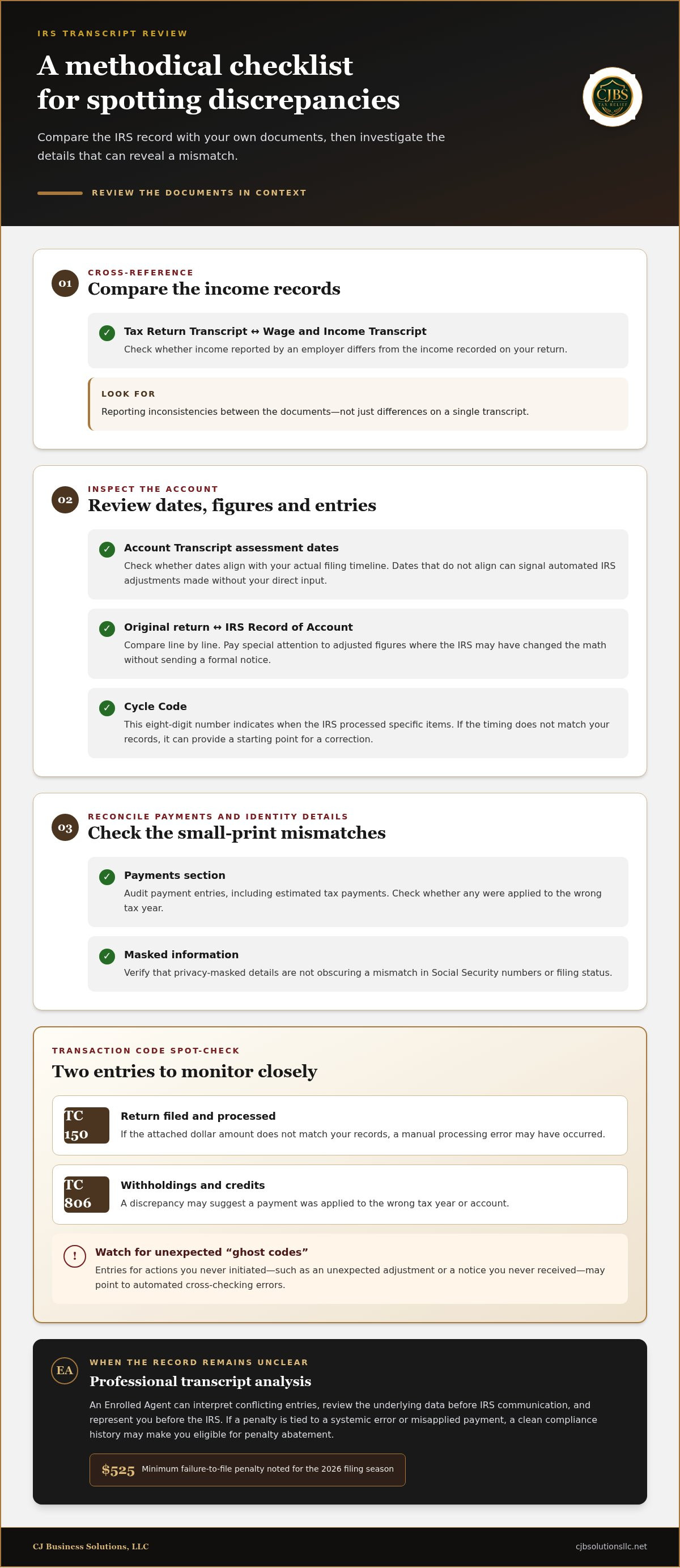
When you review your records, pay close attention to TC 150 and TC 806. TC 150 indicates that your tax return has been filed and processed. If the dollar amount attached to this code doesn't match your personal records, a manual processing error has likely occurred. Similarly, TC 806 tracks your withholdings and credits. Discrepancies here often suggest that a payment was misapplied to the wrong tax year or account.
You should also stay alert for ghost codes. These are entries that appear on your transcript for actions you never initiated, such as an unexpected adjustment or a notice you never received. These often signal automated IRS cross-checking errors that don't reflect your actual tax liability. A seasoned mentor, such as an Enrolled Agent, can help you decode these contradictions and build a proactive strategy before a minor record error turns into a significant financial burden.
A Step-by-Step Framework for Identifying Discrepancies
To begin identifying tax transcript errors, you must look beyond a single document. Start by cross-referencing your "Tax Return Transcript" against your "Wage and Income Transcript." This comparison helps reveal if an employer reported income differently than what you recorded. Next, review your "Account Transcript" carefully. You're looking for assessment dates that don't align with your actual filing timeline, as these often signal automated IRS adjustments that occurred without your direct input.
The next phase involves a detailed audit of the "Payments" section. It's common for estimated tax payments to be misapplied to the wrong tax year, especially if you've made multiple payments throughout the season. You should also verify that "Masked" information, intended for privacy, isn't obscuring a mismatch in Social Security numbers or filing status. These small details are often where the most impactful errors hide. If you find these steps overwhelming, seeking transcript analysis services from a professional can provide the clarity and stability you need to resolve the issue.
Comparing Your Original Return to the IRS Record of Account
A line-by-line comparison between your original return and the IRS Record of Account is essential for identifying tax transcript errors. Look specifically for "Adjusted" figures where the IRS may have changed your math without sending a formal notice. Understanding the "Cycle Code" is also vital. This eight-digit number tells you exactly when the IRS processed specific items. If the timing doesn't match your records, it provides a clear starting point for a correction. This methodical approach ensures no detail is overlooked during your review.
Resolving Errors through Professional Transcript Analysis
While it's natural to want to contact the IRS directly after identifying tax transcript errors, doing so without professional guidance can lead to unintended complications. Automated systems often respond to initial inquiries with generic notices that may further obscure the original issue. A seasoned mentor can help you avoid these pitfalls by interpreting the underlying data before communication begins. This proactive approach prevents you from accidentally triggering an audit through miscommunication or providing conflicting information to the agency.
When a transcript discrepancy results in unfair financial burdens, such as the minimum failure-to-file penalty which has increased to $525 for the 2026 filing season, "Penalty Abatement" becomes a vital tool for relief. If you have a clean compliance history, you may be eligible to have these charges removed. An Enrolled Agent uses professional transcript analysis to demonstrate that the penalty stemmed from a systemic error or misapplied payment rather than taxpayer negligence. This methodical process ensures that interest and fees are adjusted to reflect your actual liability.
The Strategic Advantage of Enrolled Agent Representation
Professional representation ensures that error corrections are processed accurately the first time, saving you from the frustration of repeated automated mistakes. An Enrolled Agent leverages their unlimited representation rights to speak directly with the IRS on your behalf while identifying tax transcript errors that require formal adjustment. By utilizing the factual contradictions found during a deep-dive analysis, they can negotiate tax resolutions or settlements that are grounded in the agency's own records. This steady strategy turns a confusing document into a powerful asset for your financial defense.
Securing Your Financial Future Through Accurate Documentation
Managing your relationship with the IRS requires a methodical approach and a steady hand. By understanding the underlying logic of transaction codes and cross-referencing your records, you take a significant step toward protecting your financial interests. Identifying tax transcript errors early serves as a vital preventative measure, ensuring that automated discrepancies don't evolve into complex audit triggers. This process provides the clarity needed to navigate the tax landscape with quiet confidence.
If you suspect an inaccuracy, professional guidance offers the stability you need. CJ Business Solutions, LLC, is led by an Enrolled Agent with unlimited representation rights. We specialize in federal audit strategy and resolution, providing the expertise to decode complex records on your behalf. You're invited to request a professional transcript analysis from CJ Business Solutions, LLC to begin your path toward a clear resolution. We're here to serve as your reliable guide.
Frequently Asked Questions
What is the most common error found on an IRS tax transcript?
One of the most frequent discrepancies involves misapplied payments, where a tax payment is credited to the wrong year or account. This often happens if you make estimated payments without specifying the correct period. Data entry errors from third-party reporting, such as incorrect 1099 figures, also rank highly. Identifying tax transcript errors of this nature is essential for maintaining an accurate balance with the agency.
How long does it take for the IRS to fix a transcript error after it is identified?
While processing times vary, most transcript corrections take between 4 and 12 weeks once the IRS acknowledges the discrepancy. Complex issues involving identity verification or extensive cross-referencing may extend this timeline. It's helpful to maintain a steady line of communication and keep detailed records of all submissions. Working with a professional can often help streamline this process by ensuring the initial request is technically sound.
Can a transcript error trigger an IRS audit automatically?
Certain discrepancies can trigger an automated audit through the IRS's computer matching programs. If the Wage and Income Transcript shows income that isn't reflected on your return, the system flags the mismatch. This automated process often leads to a CP2000 notice. Identifying tax transcript errors before these automated systems flag your account allows you to address the issue proactively rather than defensively.
What should I do if my Wage and Income transcript shows income I never earned?
You should first contact the employer or payer listed on the transcript to request a corrected form. If they're unresponsive, you may need to file a formal dispute with the IRS. It's also wise to check for potential identity theft if the income source is entirely unknown to you. A seasoned mentor can help you navigate these sensitive steps without causing further alarm or confusion.

Article by
Crystal R. Johnson, MBA EA
Crystal Johnson founded CJ Business Solutions to give individuals and small-business owners something often missing from the tax and accounting process: clear explanations, practical solutions, and trusted support.
With more than 27 years of accounting and financial experience, Crystal helps clients understand complicated tax matters, restore compliance, respond to IRS concerns, and make stronger business decisions. As an Enrolled Agent, she is federally authorized to represent taxpayers before the Internal Revenue Service.


