

Receiving an IRS notice feels like an accusation, but it's actually just an automated system's opening bid in a conversation about your tax return. It's natural to feel a sense of unease when a letter arrives with a strict 30-day deadline. You might worry that this is the start of a full-scale audit or that you've made a mistake that will lead to heavy penalties. Knowing how to respond to IRS notice CP2000 is the first step toward regaining control over your financial narrative.
This guide will show you how to resolve this notice with professional confidence by using transcript analysis to verify the facts. You'll learn the methodical steps to evaluate the proposed changes and choose the most effective path to resolution. We'll walk through how to address the discrepancy clearly so you can restore your peace of mind and move forward with a clear plan.
Key Takeaways
- Recognize that this notice is an automated proposal rather than a final bill, which gives you the opportunity to correct errors before any tax is officially assessed.
- Master the process of how to respond to IRS notice CP2000 by systematically comparing the "Changes Proposed" section with your original return and supporting documents.
- Utilize transcript analysis to identify exactly where the mismatch occurred, ensuring your response is based on verified data rather than guesswork.
- Secure your right to an appeal by providing a clear, evidence-backed statement that addresses discrepancies and seeks to minimize potential interest or penalties.
Understanding the IRS CP2000 Notice: Why You Received It
An IRS CP2000 notice is a computer-generated inquiry from the Automated Underreporter (AUR) program. It arrives when the information reported to the IRS by third parties, such as your employer or bank, doesn't align with the figures on your tax return. This matching process is a primary tool the government uses in Understanding the Tax Gap, or the discrepancy between taxes legally owed and what's actually collected.
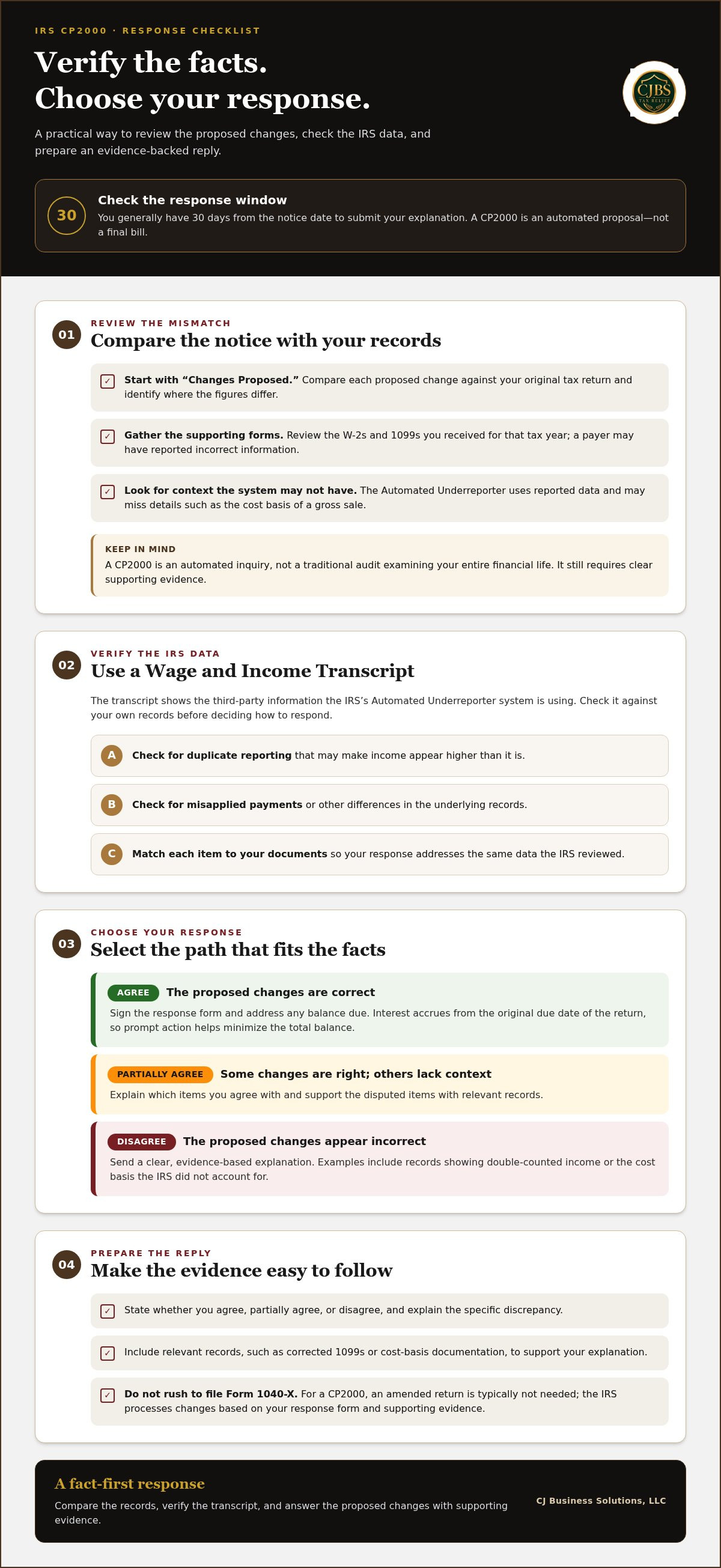
Most of these notices are triggered by simple omissions, such as a missing 1099-B from stock sales or a 1099-INT from a small savings account. It's helpful to view the "Changes Proposed" section as an opening conversation rather than a final bill. You generally have 30 days from the notice date to submit your explanation. Knowing how to respond to IRS notice CP2000 promptly is the best way to resolve the matter before it escalates into a Statutory Notice of Deficiency.
The Difference Between an Underreporter Inquiry and a Traditional Audit
Although this isn't a traditional audit where an agent examines your entire lifestyle, it still demands a high level of evidentiary support. The AUR system operates on raw data and often lacks the context of your unique financial situation. For instance, the system might identify a gross sale but fail to account for your cost basis. Utilizing transcript analysis can help you pinpoint these specific data gaps, allowing you to provide the missing context and resolve the discrepancy without the stress of a full-scale examination.
Evaluating the Notice and Verifying Accuracy
Before you decide how to respond to IRS notice CP2000, you must perform a thorough side-by-side comparison of the documents. Start by reviewing the "Changes Proposed" section against your original tax return to pinpoint exactly where the mismatch occurs. It's helpful to gather every W-2 and 1099 form you received for that year to see if a payer might have reported incorrect data to the agency. Sometimes, the discrepancy is a simple math error, but it often stems from a more substantive reporting issue that requires clarification.
Once you've identified the source of the mismatch, you can choose the most appropriate path for your response:
- Agree: If the IRS is correct, you'll sign the response form and address any balance due.
- Partially Agree: Use this if some changes are right but others are based on incomplete information.
- Disagree: Select this if the IRS's automated system has made an error, such as double-counting income or ignoring a cost basis.
Using Transcript Analysis to Verify IRS Claims
While checking your own files is a good start, the most reliable way to understand the government's position is to request a Wage and Income Transcript. This document reveals exactly what third-party data the Automated Underreporter system is using to build its case. A professional transcript analysis service can decode these complex records to identify duplicate reporting or misapplied payments that often trigger false notices. Transcript analysis provides a clear roadmap for the resolution path by revealing the underlying data driving the IRS's proposal. By verifying the agency's records first, you can more effectively determine how to respond to IRS notice CP2000 with a response grounded in the same facts they see.
Navigating the Resolution: Agreeing, Disagreeing, and Representation
When you decide how to respond to IRS notice CP2000, your choice dictates the next steps of the process. If the proposed changes are accurate, you'll sign the response form and return it to the IRS. It's vital to remember that interest begins accruing from the original due date of the return, so prompt action helps minimize the total balance. However, if you disagree, you shouldn't simply ignore the notice. Instead, you must craft a clear, evidence-based statement supported by documents like corrected 1099s or cost basis records.
A common mistake many taxpayers make is filing an amended return (Form 1040-X) immediately. For a CP2000, you typically don't need to file an amended return; the IRS will process the changes based on your response form and supporting evidence. Resolving the matter through the proper channels ensures your tax account is updated correctly, which prevents future flags and maintains long-term compliance.
The Strategic Advantage of Professional Representation
Engaging an Enrolled Agent provides a steady buffer between you and the IRS. A professional can evaluate your case through a tax transcript analysis service to see if the underreporting was due to reasonable cause, such as a late-arriving document. This expertise is crucial when seeking IRS representation by enrolled agent, as they understand the specific criteria the IRS uses to waive accuracy-related penalties. Having a seasoned mentor guide you through these federal disputes ensures that your rights are protected while you work toward a resolution. Knowing how to respond to IRS notice CP2000 with professional support offers a level of quiet confidence that's hard to achieve alone.
Resolving Your Notice with Professional Confidence
A CP2000 notice doesn't have to be a source of lasting anxiety. By recognizing that this is an automated proposal rather than a final bill, you can approach the situation with clarity. Understanding how to respond to IRS notice CP2000 effectively depends on verifying the specific data the agency has on file through specialized transcript decoding. This methodical process identifies duplicate reporting or missing cost basis information that often triggers these inquiries. With the guidance of an Enrolled Agent, you can navigate these federal disputes through strategic defense and expert representation. To ensure your response is grounded in accurate data, request a professional transcript analysis to verify your CP2000 notice today. Taking this proactive step allows you to resolve the discrepancy with precision. You don't have to face the IRS alone; reliable support is available to guide you toward a resolution.
Frequently Asked Questions
Is a CP2000 notice the same as a tax audit?
A CP2000 notice is not a formal audit; rather, it's an automated underreporter inquiry generated by the IRS matching system. While a traditional audit involves a comprehensive review by an agent, this notice points out a specific mismatch between your return and third-party data. It's helpful to view it as a proposal that you have the right to verify before any tax is officially assessed.
What happens if I ignore an IRS CP2000 notice?
Ignoring this notice is not recommended because the IRS will eventually assess the proposed tax, interest, and penalties as a final balance. If you don't act within the 30-day window, the agency will issue a Statutory Notice of Deficiency, which limits your options for dispute. Knowing how to respond to IRS notice CP2000 promptly prevents these automated assessments from turning into aggressive collection actions.
Can I request more time to respond to a CP2000?
You can often request a 30-day extension to the initial response deadline by contacting the IRS before the original date passes. It's usually a straightforward process that provides the necessary time to gather documents or consult with a professional. Having this extra time ensures you can conduct a thorough transcript analysis to verify the accuracy of the IRS claims before submitting your final response.
Should I file an amended return after receiving a CP2000?
You generally shouldn't file a Form 1040-X amended return because the IRS prefers that you use the response form included with the notice. Filing an amendment separately can lead to processing delays or duplicate assessments on your account. Understanding how to respond to IRS notice CP2000 correctly involves providing a clear explanation and supporting evidence directly to the underreporter unit rather than submitting a new return.

Article by
Crystal R. Johnson, MBA EA
Crystal Johnson founded CJ Business Solutions to give individuals and small-business owners something often missing from the tax and accounting process: clear explanations, practical solutions, and trusted support.
With more than 27 years of accounting and financial experience, Crystal helps clients understand complicated tax matters, restore compliance, respond to IRS concerns, and make stronger business decisions. As an Enrolled Agent, she is federally authorized to represent taxpayers before the Internal Revenue Service.


