

Many taxpayers believe the first step to resolving debt is choosing a relief program, yet jumping into a settlement without a clinical diagnostic is often the costliest mistake you can make. It's understandable to feel a sense of dread when notices mention levies or liens, particularly when the complex codes on your tax transcripts feel like a foreign language. You shouldn't have to guess about your financial future or worry that a single misstep in negotiations will lead to further complications.
By utilizing a professional IRS case analysis service, you can move past the confusion and identify the exact root of your tax issues. This methodical approach provides a clear, strategic roadmap that outlines your viable resolution options, such as an Offer in Compromise or a structured Installment Agreement. We'll explore how this professional diagnostic offers the stability and peace of mind you need to understand your exact standing with the IRS.
Key Takeaways
- Learn why a methodical diagnostic phase is the essential first step to prevent making costly errors when addressing significant tax debt.
- Discover how a professional IRS case analysis service identifies critical internal data, such as collection expiration dates and specific penalty codes.
- Understand the process of transcript analysis and how it reveals the IRS's perspective on your account history and current standing.
- Identify which resolution options, including an Offer in Compromise or a structured Installment Agreement, align with your specific financial roadmap.
Understanding the IRS Case Analysis: Why Diagnosis Precedes the Cure
An IRS case analysis service serves as a comprehensive evaluation of your tax history and current standing with the Internal Revenue Service (IRS). It's helpful to view this process as a medical diagnostic; just as a physician wouldn't suggest a complex treatment without first conducting blood work or an imaging scan, you shouldn't attempt to resolve federal tax debt without an accurate assessment of the underlying data. This preliminary step prevents taxpayers from applying for resolution programs they don't qualify for, which often saves significant time and financial resources.
When you work with an Enrolled Agent, you receive a professional, understated assessment of your federal tax liabilities. This expert guidance acts as a steady hand, ensuring that every decision is based on hard facts rather than guesswork or high-pressure sales tactics. It's a methodical way of working that prioritizes long-term financial compliance over immediate, poorly informed action.
The Difference Between a Consultation and a Case Analysis
While a standard consultation might identify symptoms, such as a notice of intent to levy, a dedicated IRS case analysis service identifies the specific legal and financial causes behind those symptoms. CJ Business Solutions, LLC employs a methodical approach to review IRS records, translating the technical codes found in transcripts into a clear, actionable narrative. Having a professional advocate who understands this specialized language ensures you aren't just reacting to notices. Instead, you're following a deliberate plan built on transparency and clarity. This transition from identifying symptoms to uncovering causes is what allows for a truly effective resolution strategy.
The Essential Components of a Comprehensive Transcript Analysis
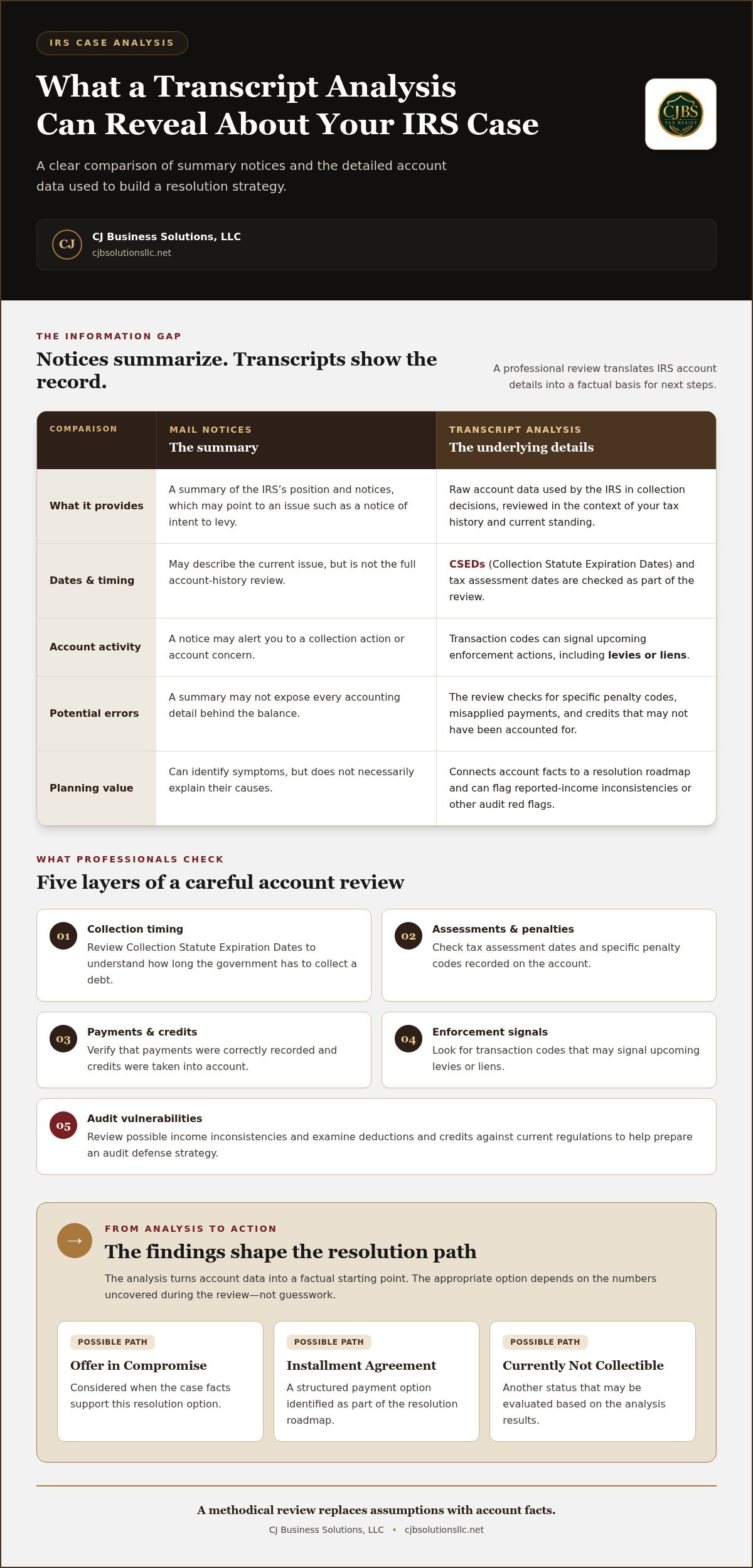
A professional IRS case analysis service relies heavily on a specialized Transcript Analysis Service to uncover the government's internal perspective on your file. While the notices you receive in the mail provide a summary, your transcripts contain the raw data the IRS uses to make collection decisions. This methodical review process ensures that no detail is overlooked, providing a stable foundation for your resolution strategy.
Professionals look for specific markers like Collection Statute Expiration Dates (CSED), which determine how long the government has to collect a debt. They also examine tax assessment dates and specific penalty codes. This level of detail is often where errors are found. For instance, the government might have misapplied a payment or failed to account for a credit. If you're facing persistent issues, the Taxpayer Advocate Service can sometimes help with systemic problems, but a private analysis provides the strategic depth needed for individual defense.
Incorporating an IRS audit strategy defense into this process is vital. It allows you to prepare for federal examinations by identifying potential vulnerabilities before they become active liabilities. This proactive stance is essential for maintaining stability in your financial life.
Decoding IRS Transcripts: What Professionals Look For
Enrolled Agents focus on transaction codes that signal upcoming enforcement actions, such as levies or liens. By verifying that every payment has been correctly recorded, they ensure your liability is accurate. This review also identifies red flags that might trigger an audit, such as inconsistencies in reported income. This methodical review process is why many choose to engage in transcript analysis services before responding to IRS inquiries. It's a proactive way to maintain long-term compliance while lowering your stress through clear, factual information.
Transitioning from Analysis to Action: Your Resolution Roadmap
Once the diagnostic phase is complete, the results of your IRS case analysis service provide the clarity needed to choose a specific resolution path. This isn't a matter of guesswork; rather, it's a logical progression from data to action. Whether your situation warrants an Offer in Compromise, a structured Installment Agreement, or a "Currently Not Collectible" status, the decision is rooted in the hard numbers uncovered during the review. This methodical approach ensures that you don't waste time on applications that the government is likely to reject.
While you can use the official tools to Get Your Tax Record, having a seasoned mentor interpret those files is where true value lies. Tax Resolution and Representation involves more than just filling out forms. It requires negotiating with the government based on a deep understanding of your rights and the specific accounting errors that may have led to the current situation. By addressing these underlying issues, you're not just solving a temporary problem; you're building a foundation for long-term financial compliance. This understated confidence comes from knowing you have an expert advocate who prioritizes your well-being over a quick transaction.
Developing an IRS Audit Strategy Defense
A thorough analysis serves as the essential foundation for defending your interests during a federal examination. By building a defense case through methodical financial reporting and a deep knowledge of tax law, an Enrolled Agent provides the stability needed to face an audit with confidence. This process involves a careful review of every deduction and credit to ensure they align with current regulations. Securing a professional review before the government takes further enforcement action is a proactive step that protects your autonomy and your assets. It's a way to ensure your voice is heard clearly in a complex system.
Securing Your Financial Future Through Informed Action
Navigating federal tax challenges requires a methodical approach that prioritizes facts over guesswork. By choosing an IRS case analysis service, you gain the clarity needed to identify the root of your tax issues and establish a reliable roadmap for resolution. This diagnostic process, led by an Enrolled Agent, ensures that every step you take is supported by precise transcript decoding and national audit defense expertise. You shouldn't have to face the complexities of the tax system alone. Knowing your standing is the first step toward peace of mind.
When you're ready to move toward stability, we invite you to Request a Professional Tax Resolution Analysis. Our team provides the expert representation and thorough data analysis necessary to protect your interests. Taking this first step is a sign of strength. We're here to serve as your steady guide throughout the process.
Frequently Asked Questions
What is an IRS transcript analysis service?
An IRS transcript analysis service involves a detailed review of your official tax records to identify key data points like assessment dates and collection statutes. This methodical review allows an Enrolled Agent to see exactly what the government sees. It's an essential part of an IRS case analysis service because it reveals the technical codes that determine your eligibility for various resolution programs.
How long does a professional IRS case analysis typically take?
The duration of a professional analysis depends on the volume of records and the complexity of your tax history. Typically, once the necessary authorizations are in place, a thorough review can be completed within several business days. This steady pace ensures that every transcript is decoded with precision, allowing for a transparent and accurate assessment of your current standing without rushing the diagnostic phase.
Can an Enrolled Agent represent me if I am facing an IRS audit?
Yes, an Enrolled Agent is authorized to provide full representation for taxpayers facing federal examinations. They use their expertise to develop a methodical audit strategy defense, acting as a seasoned mentor throughout the process. This representation ensures that your rights are protected and that the communication with the government remains professional, organized, and focused on achieving long-term financial compliance.
Will a case analysis tell me exactly how much I can settle for?
While a case analysis provides the hard data required to calculate a potential settlement, it's a diagnostic tool rather than a guarantee of a specific dollar amount. By reviewing your transcripts and financial standing, a professional can determine if you qualify for an Offer in Compromise or another program. This helps you understand your viable options before you begin the formal negotiation process.

Article by
Crystal R. Johnson, MBA EA
Crystal Johnson founded CJ Business Solutions to give individuals and small-business owners something often missing from the tax and accounting process: clear explanations, practical solutions, and trusted support.
With more than 27 years of accounting and financial experience, Crystal helps clients understand complicated tax matters, restore compliance, respond to IRS concerns, and make stronger business decisions. As an Enrolled Agent, she is federally authorized to represent taxpayers before the Internal Revenue Service.


