

Did you know that approximately 13% of individual IRS examinations actually result in no additional tax owed? Receiving an audit notice often feels like a sudden weight on your shoulders; it's perfectly natural to feel a sense of uncertainty or even fear when the government requests a closer look at your private finances. You don't have to face this complexity alone or without a clear plan. By understanding the modern landscape of tax enforcement, you can move through the process with a sense of calm and control.
Our professional roadmap provides the IRS audit help for individuals necessary to protect your interests and minimize potential liability. We will explore a strategic 2026 defense checklist, highlighting why transcript analysis is your most vital first step and how a methodical approach leads to long-term financial compliance. This guide serves as your steady resource for achieving a successful and quiet resolution to your tax examination.
Key Takeaways
- Learn how to verify the authenticity of your IRS notice to protect yourself against modern tax scams and clearly identify which tax years are under examination.
- Discover why professional transcript analysis is the most effective form of IRS audit help for individuals who wish to see exactly what information the government has on file.
- Understand the advantages of partnering with an Enrolled Agent who provides a calm, expert presence and possesses full representation rights before the IRS.
- Explore the various resolution paths available for minimizing your liability, including the criteria for penalty abatement and sustainable installment agreements.
Immediate Actions: Your First-Response IRS Audit Checklist
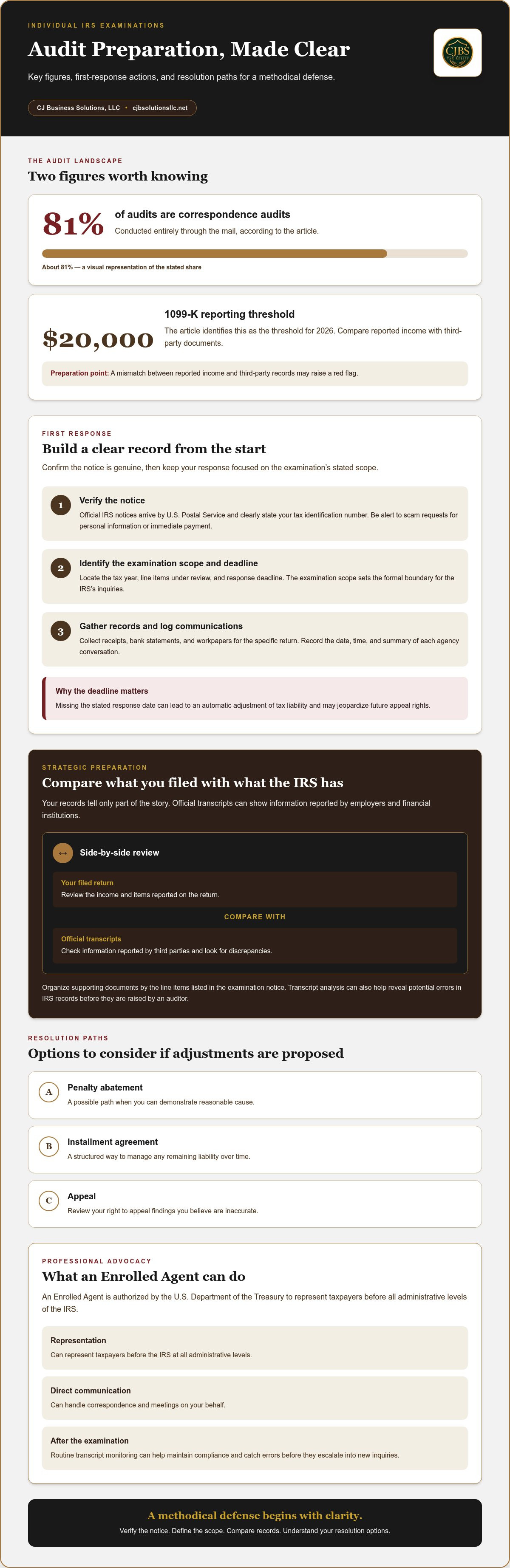
Receiving an official letter from the government can be a jarring experience. Before you react, it's essential to confirm that the communication is genuine. Scammers frequently use the IRS audit process as a pretext to solicit personal information or immediate payments. Real IRS notices arrive via the U.S. Postal Service and will clearly state your tax identification number. Seeking professional IRS audit help for individuals early on ensures you aren't misled by fraudulent claims.
Once authenticity is confirmed, take these steadying steps to organize your defense:
- Locate the specific tax year and the individual line items the IRS intends to review. This prevents you from providing unnecessary information that could expand the inquiry.
- Gather every receipt, bank statement, and workpaper used to prepare that specific return. Organizing these documents now saves significant time during the resolution phase.
- Start a detailed communication log to record the date, time, and summary of every conversation with the agency. This provides a clear trail of your cooperation and the agent's requests.
Decoding the IRS Notice: Identifying the Scope of the Examination
It's helpful to understand that about 81% of audits are correspondence audits, conducted entirely through the mail. If your notice requests an in-person meeting at your home or office, you're facing a more intensive field examination. Regardless of the type, you must locate the "deadline for response" immediately. Finding reliable IRS audit help for individuals at this stage can help you interpret these deadlines with precision. Failing to respond by the stated date can lead to an automatic adjustment of your tax liability and may jeopardize your future appeal rights.
The Examination Scope represents the formal boundary for all IRS inquiries, ensuring the agent remains focused only on the specific items listed in the notice.
Strategic Preparation: Documentation and Transcript Analysis
Preparation begins with seeing what the IRS sees. While your personal records are essential, they only tell half the story. Requesting official transcripts allows you to review the data reported by third parties, such as employers and financial institutions. This step is a cornerstone of effective IRS audit help for individuals. You should perform a side-by-side comparison of your filed return against these transcripts to identify discrepancies before the auditor mentions them. You can find official IRS audit information regarding how they select returns and what data they prioritize on their public portal.
Be mindful of specific triggers in your 2026 tax history. For example, the IRS often uses advanced data analytics to flag mismatches in 1099-K reporting, which maintains a $20,000 threshold for 2026. If your reported income doesn't align with these third-party documents, it creates a red flag. Organizing your substantiation into categories that mirror the specific line items in the examination notice will demonstrate a high standard of care and readiness.
The Transcript Advantage: Uncovering Issues Before the Auditor Does
Deciphering an IRS transcript requires a methodical eye. These documents are filled with complex transaction codes that represent the agency's internal actions and assessments. Utilizing transcript analysis services allows you to decode these patterns and reveal potential errors in IRS records. This specialized IRS audit help for individuals helps you identify mistakes in how the government processed your data before an auditor brings them to your attention. By developing a proactive defense strategy based on these data trends, you can move toward a resolution with clarity and poise.
Professional Advocacy: Navigating the Resolution Phase
The resolution phase is where your strategic preparation meets formal negotiation. It's helpful to approach this final stage with the same methodical care used during your initial documentation phase. If adjustments are proposed, you have several options to consider. You might pursue penalty abatement if you can demonstrate reasonable cause, or you could establish a structured installment agreement to manage any remaining liability over time. Reviewing the IRS audit process ensures you understand your rights to appeal any findings that feel inaccurate.
Securing professional IRS audit help for individuals provides a layer of protection when drafting formal responses. A well-crafted response addresses the agency's specific concerns while carefully preserving your legal standing. Once the audit concludes, establishing a routine for transcript monitoring helps you maintain long-term compliance and catch errors before they escalate into new inquiries. This proactive approach ensures that your financial records remain in good standing with the government.
The Enrolled Agent Difference: Strategic Advocacy for Individuals
An Enrolled Agent is a tax professional authorized by the U.S. Department of the Treasury to represent taxpayers before all administrative levels of the IRS. Unlike generic preparers, an Enrolled Agent acts as a dedicated buffer, handling all direct correspondence and meetings on your behalf. This specialized advocacy allows you to leverage audit defense strategies that are specifically tailored to complex disputes. If you're seeking a steady partner to guide you through this process, you may contact CJ Business Solutions, LLC for a professional consultation on your audit defense. This expert IRS audit help for individuals ensures that your resolution path is both methodical and focused on your long-term financial well-being.
Securing Your Financial Future Through Proactive Defense
Successfully concluding a tax examination is less about reacting to IRS requests and more about establishing a methodical defense. By shifting your focus toward thorough transcript review and organized substantiation, you transform a stressful event into a manageable professional process. These strategic efforts ensure that your final resolution is based on accurate data rather than administrative oversight. You don't have to face the complexities of federal tax law without a steady partner to guide your steps.
Seeking specialized IRS audit help for individuals allows you to leverage expert insights to resolve issues with quiet confidence. You may protect your interests with expert IRS audit defense from CJ Business Solutions, LLC. Our firm is led by an Enrolled Agent who provides the transcript analysis and representation required for a successful audit closure. With this professional roadmap in hand, you can move toward long-term financial compliance with peace of mind.
Frequently Asked Questions
What is the most common reason for an individual IRS audit in 2026?
The most frequent trigger for an individual audit in 2026 is a discrepancy between your reported income and third-party data like W-2 or 1099 forms. IRS technology automatically flags these mismatches for review. These often lead to correspondence audits, which make up about 81% of all cases. Ensuring your return perfectly matches the income documents you receive is your best defense against a sudden inquiry.
How far back can the IRS go when auditing an individual tax return?
The IRS typically has three years to audit a return after it's filed or the due date has passed. This period extends to six years if you omit more than 25% of your gross income from the return. It's helpful to remember that there's no time limit if the IRS suspects fraud or if a return was never filed. Keeping records for seven years is a stable strategy.
Do I have to meet with the IRS auditor in person for an individual audit?
You don't necessarily have to meet with an auditor in person. Since approximately 81% of examinations are handled via mail, most issues are resolved through document exchange. If a field audit is required at your location, you can appoint an Enrolled Agent to handle the meeting on your behalf. This professional IRS audit help for individuals allows you to maintain your daily routine while an expert manages the defense.
How can transcript analysis help me win an IRS audit?
Transcript analysis identifies exactly what the government knows about your finances before you respond to an inquiry. By reviewing these records, you can spot errors in IRS data processing or missing credits that belong to you. This specialized IRS audit help for individuals provides a clear roadmap to resolve disputes by addressing the specific transaction codes the agency uses to determine your final tax liability.

Article by
Crystal R. Johnson, MBA EA
Crystal Johnson founded CJ Business Solutions to give individuals and small-business owners something often missing from the tax and accounting process: clear explanations, practical solutions, and trusted support.
With more than 27 years of accounting and financial experience, Crystal helps clients understand complicated tax matters, restore compliance, respond to IRS concerns, and make stronger business decisions. As an Enrolled Agent, she is federally authorized to represent taxpayers before the Internal Revenue Service.


