

Receiving a notice of assessment from the IRS often feels like a final judgment, yet the initial penalty amount is rarely the final word for those who understand the administrative framework. It's natural to feel overwhelmed by mounting debt and complex jargon, especially when you're worried that a single mistake might lead to harsher enforcement. This burden is significant, but it's important to remember that you don't have to face these complexities without a steady hand to guide you.
This guide explores how methodical IRS audit penalty reduction strategies, rooted in transcript analysis and the "Reasonable Cause" criteria, can provide a path toward financial relief. We'll examine the professional steps required to navigate the abatement process, allowing you to regain peace of mind and establish a clear plan for future compliance. By approaching the situation with a steady, informed perspective, you can transform a stressful tax obligation into a manageable and transparent resolution.
Key Takeaways
- Gain a clear understanding of how common triggers like accuracy errors and compounding interest contribute to a complex tax debt cycle.
- Identify the specific eligibility criteria for administrative waivers and how to utilize IRS audit penalty reduction strategies to address assessments effectively.
- Discover how professional transcript analysis acts as a diagnostic tool to uncover procedural errors that may have occurred during your audit.
- Establish a methodical roadmap for long-term financial stability by leveraging the expertise of an Enrolled Agent to manage complex negotiations.
Understanding the IRS Penalty Landscape and Common Triggers
Receiving a formal assessment notice from the IRS often prompts a sense of finality, yet it's helpful to view these documents as a starting point for dialogue rather than an immutable judgment. Understanding the IRS tax noncompliance and penalty framework is the first step in regaining control over your financial standing through effective IRS audit penalty reduction strategies. While Failure to File and Failure to Pay penalties are common, they differ significantly in how they're assessed. Interest accrues on both the underlying tax and the penalties themselves, creating a compounding cycle that can feel overwhelming. Small businesses often face these assessments due to common triggers like mismatched 1099 forms or disproportionate deductions.
By shifting your perspective, you can approach the situation with the quiet confidence needed to explore IRS audit penalty reduction strategies. This methodical approach transforms a stressful enforcement action into a structured negotiation. We've found that transparency regarding the cause of an error often opens doors to more favorable outcomes during the resolution process.
Identifying the Specific Penalties in Your Audit Report
To begin a successful defense, you'll need to locate the specific penalty codes listed within your audit report. Accuracy-related penalties under Section 6662 are frequently the primary focus of audit defense because they carry a high percentage of the tax due. The IRS distinguishes between "negligence," which suggests a failure to make a reasonable attempt to comply, and "substantial understatement," which involves exceeding specific financial thresholds. Differentiating these terms is vital, as the documentation required for abatement varies based on the IRS's characterization of the mistake.
Strategic Pathways to IRS Penalty Abatement and Reduction
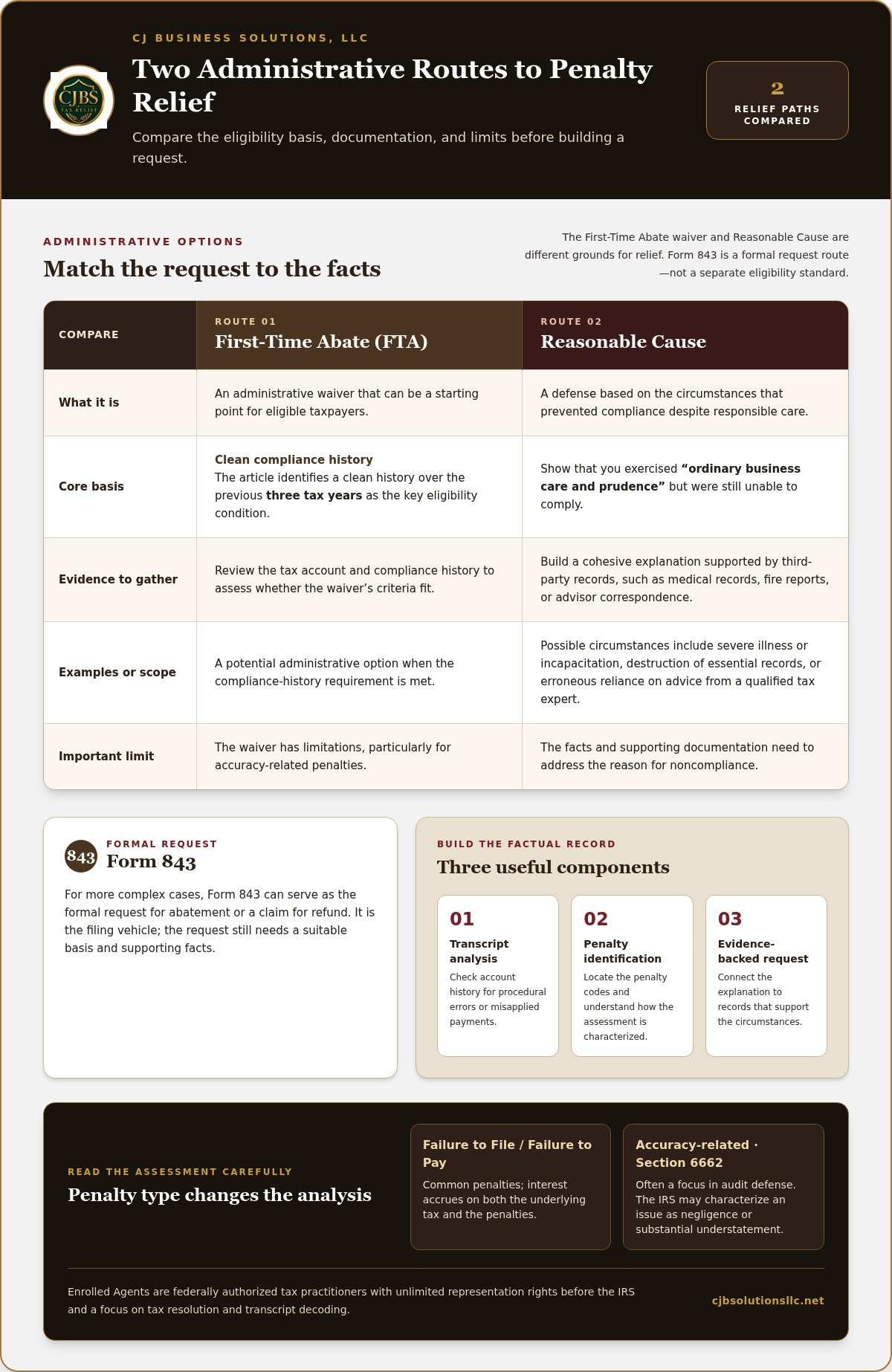
While the IRS maintains strict enforcement, several administrative avenues exist to mitigate the financial impact of an audit. The First-Time Abate (FTA) waiver is often the most accessible starting point for those with a clean compliance history over the previous three tax years. It's a helpful administrative tool, but it has limitations, particularly when dealing with accuracy-related penalties. For more complex cases, understanding IRS official penalty relief and abatement options is essential. This often involves filing Form 843, which serves as the formal request for abatement or a claim for refund.
Proving Reasonable Cause: The Key to Penalty Removal
The "Reasonable Cause" standard is arguably the most effective tool in the suite of IRS audit penalty reduction strategies. To succeed, you must demonstrate that you exercised "ordinary business care and prudence" but were still unable to comply. Reasonable cause is a defense against willful neglect that anchors your formal request for relief. Substantiating this claim requires a cohesive narrative supported by third-party evidence.
Common scenarios that meet this standard include:
- Severe illness or incapacitation of the taxpayer or an immediate family member.
- Destruction of essential records due to fire, natural disaster, or other casualties.
- Erroneous reliance on professional advice from a qualified tax expert.
Collecting medical records, fire reports, or correspondence with advisors creates a factual foundation for your defense. If you're feeling overwhelmed by the documentation process, our tax resolution services can help organize your evidence into a compelling case. This methodical approach ensures your narrative aligns with the specific standards the IRS expects during a formal review.
Leveraging Transcript Analysis and Professional Representation
A successful defense relies on more than just a well-written letter; it requires a deep understanding of the data the IRS uses to make its determinations. Transcript analysis serves as a diagnostic tool that reveals the internal history of your tax account. By decoding these records, we can often identify procedural errors or misapplied payments made by the agency itself. This objective data provides a strong foundation for your IRS audit penalty reduction strategies, turning a subjective plea into a fact-based correction. Understanding the IRS audit process and taxpayer rights helps you realize that you aren't simply at the mercy of an initial assessment.
Beyond resolving the immediate crisis, professional representation focuses on establishing a long-term compliance roadmap. This forward-looking approach ensures that the same triggers don't lead to recurring penalties in future years. It's about creating a sense of stability and confidence in your financial future. We prioritize building a relationship based on trust and steady guidance, ensuring you feel supported through every step of the resolution process.
Why Enrolled Agent Representation is Your Best Audit Defense
Enrolled Agents (EAs) hold a unique status as federally authorized tax practitioners. Unlike general accountants, EAs have unlimited representation rights before the IRS and specialize specifically in tax resolution and transcript decoding. This focus allows them to navigate the administrative nuances of the agency with a steady, experienced hand. If you're seeking a partner to handle these complex negotiations, you can learn more about our IRS representation services. Having an expert advocate ensures your case is presented with the precision and dignity it deserves.
Establishing Your Path to Financial Stability
Navigating an audit assessment is a methodical process that requires both patience and precise documentation. We've explored how identifying specific penalty triggers and applying the "Reasonable Cause" standard can significantly alter your financial outcome. By utilizing professional IRS audit penalty reduction strategies, you transition from a position of uncertainty to one of informed action. A specialized Enrolled Agent provides the expert representation needed to decode complex tax histories, ensuring that every procedural error is identified through methodical transcript analysis. This focus on stable, long-term tax resolution allows you to move forward with confidence.
If you're ready to address your audit with a seasoned partner, we invite you to Request a Professional Transcript Analysis and Audit Defense Consultation. It's possible to resolve these challenges and restore your peace of mind through careful, expert guidance. You don't have to manage this burden alone.
Frequently Asked Questions
What is the First-Time Abate (FTA) policy and do I qualify for it?
The First-Time Abate policy is an administrative waiver available to taxpayers who have maintained a clean compliance history for the preceding three tax years. To qualify, you must be current on all tax filings and have paid, or arranged to pay, any tax due. It's one of the most accessible IRS audit penalty reduction strategies for resolving initial failure-to-file or failure-to-pay assessments.
Can I reduce IRS penalties if I cannot afford to pay the underlying tax debt?
You can certainly seek penalty relief even if the underlying tax debt remains unpaid. While the IRS expects the core tax to be addressed, you can request abatement based on "Reasonable Cause" if specific hardships prevented you from meeting your obligations. Resolving the penalties first can significantly reduce the total balance, making it easier to establish a manageable long-term payment plan.
How long does the IRS penalty abatement process typically take?
The duration of the abatement process depends largely on the complexity of your claim and the specific penalty type. Simple administrative waivers may be resolved within two to three months. Cases requiring a detailed narrative or formal appeals often take six months or more to reach a final determination. We focus on providing thorough documentation upfront to help minimize potential delays.
Is it possible to remove accuracy-related penalties after an audit is closed?
It's possible to contest accuracy-related penalties even after an audit has officially closed. This typically involves filing a formal claim for refund or request for abatement to demonstrate that you acted with ordinary business care. Our firm often utilizes transcript analysis during this stage to search for any procedural oversights that might justify a reversal of the original penalty assessment.

Article by
Crystal R. Johnson, MBA EA
Crystal Johnson founded CJ Business Solutions to give individuals and small-business owners something often missing from the tax and accounting process: clear explanations, practical solutions, and trusted support.
With more than 27 years of accounting and financial experience, Crystal helps clients understand complicated tax matters, restore compliance, respond to IRS concerns, and make stronger business decisions. As an Enrolled Agent, she is federally authorized to represent taxpayers before the Internal Revenue Service.


