

What if you could see exactly what the IRS sees on your account before you ever respond to an audit notice? Most taxpayers feel a deep sense of unease when a federal examination letter arrives, often fearing that a single missing receipt or a disorganized folder could lead to significant penalties. It's natural to feel overwhelmed by the uncertainty of the process, particularly when considering that interest rates on individual underpayments have reached 7% per year. This guide provides a comprehensive tax audit preparation checklist designed by tax resolution experts to help you organize your defense and potentially reduce your tax liability. We'll explore how specialized transcript analysis serves as a strategic foundation for your response and outline the specific steps necessary to secure your financial peace of mind through methodical organization and expert representation.
Key Takeaways
- Discover how reviewing your official IRS transcript reveals the specific "red flags" the government is targeting before you ever speak to an auditor.
- Utilize our comprehensive tax audit preparation checklist to organize your 1099s, K-1s, and bank statements in a way that demonstrates transparency and cooperation.
- Learn why an Enrolled Agent provides a superior level of defense by acting as a professional buffer, protecting you from accidental self-incrimination during the examination.
- Master a structured defense strategy that focuses on methodical record-keeping and transcript analysis to help reduce potential tax liabilities and daily compounding interest.
The Foundation of Audit Defense: IRS Transcript Analysis
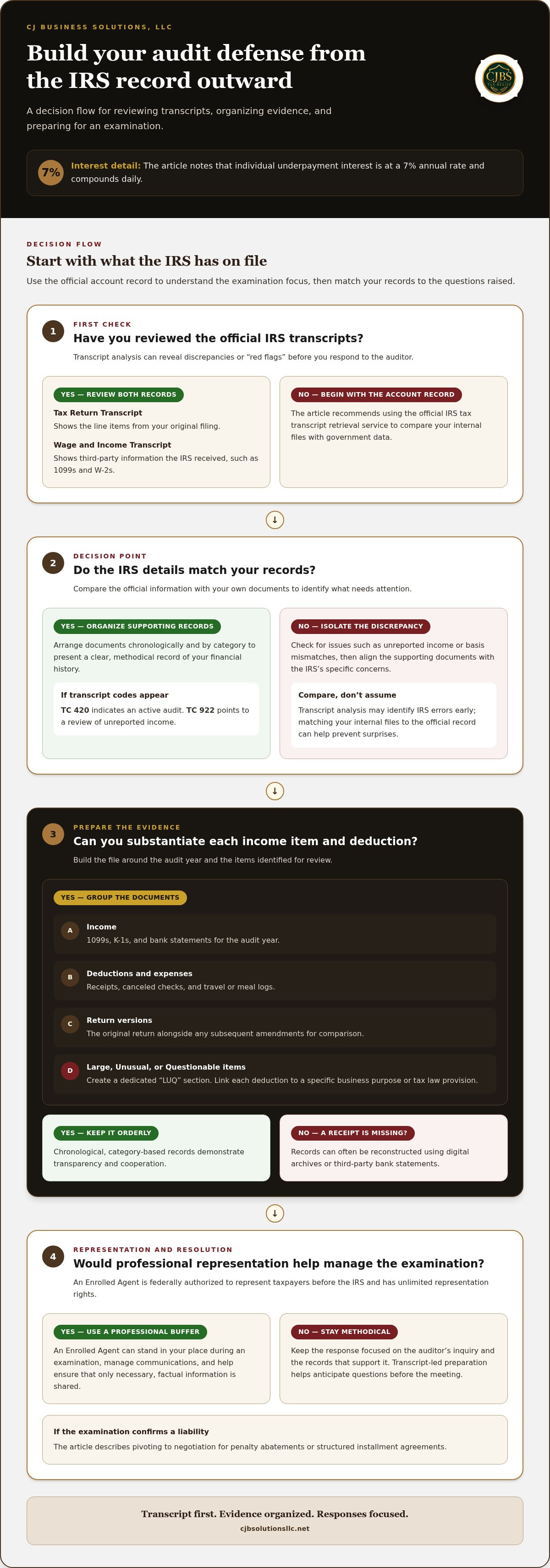
A truly effective tax audit preparation checklist begins with a step most taxpayers overlook: transcript analysis. This process involves a meticulous review of the official IRS record of your tax account. It's helpful to view this as looking over the auditor's shoulder to see exactly what they see. By obtaining these records, we identify the specific "red flags" or discrepancies that triggered the examination, such as unreported income or basis mismatches.
While standard tax preparation focuses on gathering existing receipts, professional transcript decoding identifies IRS errors early in the process. Integrating transcript data into your tax audit preparation checklist ensures that your documentation directly addresses the agency's specific concerns. Since underpayment interest currently compounds daily at a 7% annual rate, identifying and correcting these errors quickly is essential for minimizing your total liability. This methodical approach provides a level of stability and clarity that generic software simply cannot offer.
Understanding the IRS View of Your Tax History
The IRS maintains several types of records, each serving a distinct purpose in your defense. A Tax Return Transcript shows the line items from your original filing, while a Wage and Income Transcript displays data the IRS received from third parties, like 1099s and W-2s. Professionals with Enrolled Agent representation rights use these documents to decode internal transaction codes. For example, TC 420 indicates an active audit, whereas TC 922 points to a review of unreported income. Understanding these markers allows your representative to anticipate the auditor's questions and prepare a more robust defense strategy.
The Essential Tax Audit Preparation Checklist for 2026
A successful defense begins with an organized presentation of your financial history. When you arrange records chronologically and by category, you demonstrate a spirit of transparency and cooperation to the auditor. This methodical approach often sets a positive tone for the entire examination. Your tax audit preparation checklist should prioritize the following items:
- Primary income documents, including 1099s, K-1s, and bank statements for the audit year.
- Substantiation for deductions, such as receipts, canceled checks, and logs for travel or meals.
- A copy of the original return alongside any subsequent amendments for a side-by-side comparison.
To ensure your records align with government data, we recommend using the official IRS tax transcript retrieval service. Matching your internal files to the official record prevents surprises during the meeting. If you find yourself missing specific receipts, you can often reconstruct records using digital archives or third-party bank statements.
Categorizing Income, Deductions, and Business Expenses
It's particularly useful to create a dedicated section for "Large, Unusual, or Questionable" (LUQ) items mentioned in your notice. Every deduction should be linked to a specific business purpose or tax law provision to satisfy the auditor's inquiry. Following this structured tax audit preparation checklist ensures that every expense is accounted for, providing you with the quiet confidence needed to navigate the audit process. If you require assistance organizing complex records, our team offers professional tax resolution services to help you prepare your defense strategy.
Strategic Representation: Why an Enrolled Agent is Your Best Defense
An Enrolled Agent is a federally authorized tax practitioner who has earned the privilege of representing taxpayers before the Internal Revenue Service. Unlike seasonal staff or automated software, an Enrolled Agent maintains unlimited representation rights. This status allows them to stand in your place during an examination, acting as a professional buffer. This arrangement is a critical component of a tax audit preparation checklist because it helps prevent accidental self-incrimination. By managing all communications, your representative ensures that only necessary, factual information is shared, protecting you from volunteering extraneous details that might unintentionally expand the inquiry.
Effective defense involves more than just presenting a tax audit preparation checklist of receipts; it requires active advocacy for favorable resolution paths. While the IRS provides official IRS audit procedures and documentation requirements, the practical application of these rules often allows for professional negotiation. At CJ Business Solutions, LLC, we prioritize a calm, methodical partnership. We don't simply react to auditor requests. Instead, we anticipate them to ensure your long-term financial compliance remains the primary focus.
Navigating the Examination with Expert Audit Defense
Our strategy centers on a transcript-led defense. By analyzing your official records before the first meeting, we understand the IRS position before the auditor even speaks. If the examination confirms a liability, we pivot to negotiating penalty abatements or structured installment agreements. This proactive approach aims to lower the emotional weight of the process while securing a sustainable path forward for your finances.
Securing Your Path to a Favorable Resolution
A successful defense against a federal examination relies on more than just historical records; it requires a strategic understanding of the official IRS account. By integrating specialized transcript analysis with a comprehensive tax audit preparation checklist, you position yourself to address potential red flags with precision. Our approach, led by a seasoned Enrolled Agent, focuses on building a robust federal tax resolution strategy that prioritizes your long-term compliance and financial stability. We're here to serve as your reliable guide through this complex process, offering the expertise needed to manage communications and advocate for your best interests. We invite you to Request a Professional Transcript Analysis and Audit Consultation to begin your defense with quiet confidence. Taking these methodical steps today ensures that you're fully prepared for whatever the examination may bring. We look forward to helping you achieve lasting peace of mind.
Frequently Asked Questions
How far back can the IRS go in a tax audit?
Generally, the IRS can audit tax returns filed within the last three years. This standard three-year statute of limitations applies to most examinations. However, if a substantial error is identified, such as omitting more than 25% of your gross income, the IRS may extend this look-back period to six years. There is no time limit for fraudulent returns or cases where no return was filed at all.
What happens if I cannot find the receipts for my deductions?
If you find yourself missing specific receipts while completing your tax audit preparation checklist, you may still substantiate expenses through alternative records. Bank statements, canceled checks, and digital transaction histories often serve as acceptable secondary evidence. It's helpful to remember that auditors look for a clear business purpose, so documenting the narrative behind the expense can support your claim even when the original paper receipt is unavailable.
Can I represent myself in an IRS audit, or do I need a professional?
You have the legal right to represent yourself during an audit, but many taxpayers find the process overwhelming. Engaging a professional, such as an Enrolled Agent, offers a layer of protection by providing a buffer between you and the auditor. A representative with unlimited practice rights can manage all communications, ensuring that you don't accidentally volunteer information that could expand the scope of the examination or lead to additional liabilities.
What is the difference between a correspondence audit and a field audit?
A correspondence audit is conducted entirely through the mail and typically focuses on simple errors or missing documentation for specific line items. In contrast, a field audit is more comprehensive and involves a revenue agent visiting your home or place of business. Field audits usually require a more detailed tax audit preparation checklist, as the examiner will likely review your entire financial operation to ensure full compliance with federal laws.
How long does a typical IRS audit take to resolve?
The duration of an audit varies significantly based on the complexity of the issues and the type of examination. A simple correspondence audit might be resolved within a few months if the documentation is clear. However, more involved field audits can last a year or longer. Utilizing specialized transcript analysis early in the process often helps expedite a resolution by identifying and addressing the IRS's concerns before they escalate.

Article by
Crystal R. Johnson, MBA EA
Crystal Johnson founded CJ Business Solutions to give individuals and small-business owners something often missing from the tax and accounting process: clear explanations, practical solutions, and trusted support.
With more than 27 years of accounting and financial experience, Crystal helps clients understand complicated tax matters, restore compliance, respond to IRS concerns, and make stronger business decisions. As an Enrolled Agent, she is federally authorized to represent taxpayers before the Internal Revenue Service.


