

While many advertisements promise effortless settlements, the reality is that the IRS acceptance rate for an Offer in Compromise remains steady at approximately 14%. For a company facing federal liabilities, tax debt relief for businesses is rarely about finding a hidden loophole or a magic resolution. It's understandable if you feel overwhelmed by the threat of asset seizure or confused by the conflicting advice offered by various firms. You've worked hard to build your enterprise, and the thought of an audit or wage garnishment is a heavy burden to carry. This guide provides a professional framework to help you evaluate your resolution options and choose expert representation that aligns with your specific needs. We'll explore the strategic shift toward the Simple Payment Plan framework, the role of Enrolled Agents in federal defense, and the methodical steps required to achieve lasting IRS compliance.
Key Takeaways
- Learn how to evaluate IRS programs like the Offer in Compromise and the Simple Payment Plan framework to determine which path best serves your company's financial health.
- Discover why an Enrolled Agent's federal authorization provides a distinct advantage when managing the various administrative levels of the IRS.
- Understand how a thorough transcript analysis and financial review establish the necessary foundation for successful tax debt relief for businesses.
- Gain clarity on how submitting a formal representation authorization can shift the weight of direct IRS communication so you don't have to handle it yourself.
Evaluating Business Tax Debt Relief Options and Eligibility
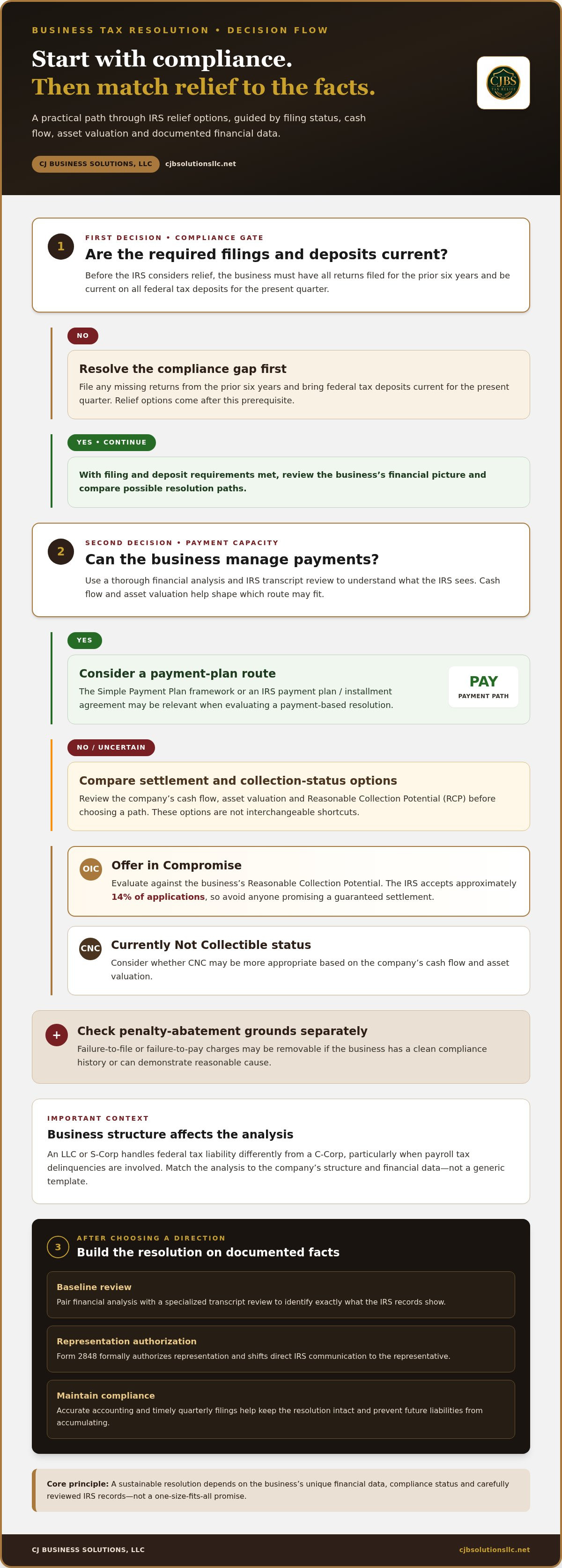
Securing effective tax debt relief for businesses requires a clear understanding of the specific programs available through the IRS. While advertisements often highlight the Offer in Compromise (OIC), it's a formulaic process where the IRS accepts only about 14% of applications based on your Reasonable Collection Potential. Other paths, such as the new Simple Payment Plan framework or Currently Not Collectible (CNC) status, may be more appropriate depending on your company's cash flow and asset valuation. A significant part of reducing your total burden involves Penalty Abatement. This can remove failure-to-file or failure-to-pay charges if you have a clean compliance history or can demonstrate reasonable cause. You should be cautious of any firm promising a "one-size-fits-all" settlement; legitimate resolution is always based on your unique financial data rather than a generic template. This methodical approach is the only sustainable way to achieve tax debt relief for businesses while protecting your assets.
Determining the Right Resolution Path for Your Business
Choosing between a short-term payment plan and a long-term debt settlement depends heavily on your specific business structure. For example, an LLC or S-Corp handles federal tax liability differently than a C-Corp, particularly when addressing payroll tax delinquencies. Before the IRS considers any relief, they require absolute compliance. This means your business must have all returns filed for the prior six years and be current on all federal tax deposits for the present quarter. Working with federally authorized Enrolled Agents ensures that your financial analysis and transcript reviews are handled with professional precision. These experts help you move beyond surface-level advice to find a steady, reliable path toward IRS compliance that respects your company's long-term viability.
Selecting a Representative: Why Enrolled Agents Lead the Way
Choosing the right representative is a pivotal decision for any company facing federal liabilities. While CPAs typically focus on financial reporting and attorneys on legal litigation, Enrolled Agents hold a unique federal authorization to represent taxpayers before all administrative levels of the IRS. As of 2026, there are over 75,000 active Enrolled Agents nationwide who possess deep expertise in the Internal Revenue Code. For many, this specialization makes them the preferred choice for tax debt relief for businesses. Unlike regional practitioners, EAs can practice across state lines, providing a consistent defense strategy for companies with national operations.
A seasoned representative acts as a shield. They manage all direct correspondence with IRS revenue officers, ensuring that your rights are protected and that you aren't forced into premature financial disclosures. When interviewing a firm, prioritize those that offer transparent, steady communication instead of high-pressure sales tactics. A trustworthy guide will be honest about IRS Offer in Compromise eligibility and won't promise a settlement before reviewing your specific financial data. If you're looking for a methodical tax resolution firm, focus on practitioners who value substance and long-term compliance over quick fixes.
The Strategic Advantage of IRS Transcript Analysis
Specialized transcript analysis allows a representative to look behind the curtain of IRS records to identify processing errors that others might miss. By analyzing historical data, an expert can often uncover hidden resolution opportunities or predict upcoming collection actions before they escalate. This foresight enables the development of a preemptive defense strategy that keeps your business operational. Transcript analysis is a diagnostic tool that prevents costly filing mistakes.
Implementing Your Business Tax Resolution Strategy
Implementing a successful strategy for tax debt relief for businesses begins with a baseline assessment of your company's standing. You first conduct a thorough financial analysis paired with a specialized transcript review to identify exactly what the IRS sees. It's a diagnostic phase. Once this baseline is established, submitting Form 2848, the formal representation authorization, is the next logical step. This document officially moves the burden of direct communication from your desk to a professional representative. You shouldn't have to face the IRS alone. With authorization in place, your representative can negotiate a resolution plan, such as those found within the framework of IRS payment plans and installment agreements. These negotiations are rooted in documented financial health rather than speculation. Finally, maintaining long-term compliance through accurate accounting and timely quarterly filings ensures the resolution remains intact. It prevents future liabilities from accumulating.
Protecting Your Interests During an IRS Audit
An audit defense strategy is essential to limit the scope of an examination and protect your business records from overreaching inquiries. Professional representation ensures the IRS follows proper procedural boundaries, preventing unreasonable requests for information that could disrupt your daily operations. A seasoned mentor will review every document before it reaches an agent, maintaining a calm and organized defense. It's about stability. This level of care allows you to focus on running your business while your representative handles the complexities of federal oversight. To start this process, you can schedule a consultation with CJ Business Solutions to begin your transcript analysis and establish your defense baseline.
Charting Your Path to Federal Tax Compliance
Resolving corporate tax issues is a methodical process that rewards patience and precision. You've learned that effective tax debt relief for businesses depends on a diagnostic approach, beginning with a specialized transcript analysis to identify the exact standing of your accounts. By partnering with a federally authorized Enrolled Agent, you gain a reliable guide who can navigate complex audit strategy defense and negotiate structured resolution plans on your behalf. You don't have to carry the weight of IRS communication alone. Taking the first step toward a resolution provides the stability your company needs to thrive. If you're ready to move toward a clear and compliant future, please Request a Professional Consultation with CJ Business Solutions. It's a steady way to reclaim your peace of mind while ensuring your business remains protected.
Frequently Asked Questions
What is the difference between an Enrolled Agent and a CPA for business tax debt?
Enrolled Agents are federally authorized by the U.S. Treasury Department to represent taxpayers across all administrative levels of the IRS in every state. While CPAs are state-licensed and often manage broad accounting tasks, Enrolled Agents specialize specifically in the tax code. For tax debt relief for businesses, this specialization provides a focused expertise in handling complex collections, audits, and appeals directly with federal authorities.
Can the IRS really seize my business assets if I am in a relief program?
The IRS generally pauses enforced collection actions, such as levies or seizures, once you've entered an approved relief program or have a pending installment agreement. It's vital to stay current with all filing and payment requirements to maintain these protections. A professional representative ensures your account is correctly coded in the IRS system, which helps prevent automated collection activities from occurring during the resolution process.
How long does the business tax resolution process typically take?
The duration of the resolution process depends on the complexity of your case and the specific IRS program. A standard installment agreement might be finalized in several weeks, but an Offer in Compromise often requires nine to twelve months for a full evaluation. We utilize transcript analysis to monitor your account's status, providing you with steady updates and managing expectations as the IRS processes your request.
What are the warning signs of a business tax relief scam?
You should be wary of any firm that guarantees a specific settlement result before reviewing your financial records or transcripts. Legitimate tax debt relief for businesses is a formulaic process based on objective data like asset equity and cash flow. Other red flags include high-pressure sales tactics, requests for large upfront fees without a clear service plan, or claims of having "special influence" with IRS agents.

Article by
Crystal R. Johnson, MBA EA
Crystal Johnson founded CJ Business Solutions to give individuals and small-business owners something often missing from the tax and accounting process: clear explanations, practical solutions, and trusted support.
With more than 27 years of accounting and financial experience, Crystal helps clients understand complicated tax matters, restore compliance, respond to IRS concerns, and make stronger business decisions. As an Enrolled Agent, she is federally authorized to represent taxpayers before the Internal Revenue Service.


