

Challenging an incorrect tax assessment doesn't require an aggressive courtroom battle. In reality, the vast majority of audit disputes reach an equitable resolution through calm administrative channels, which is why engaging professional IRS audit appeal services is often your most effective safeguard against premature collections. When a revenue agent issues an unexpected examination report, the strict 30-day response deadline and the prospect of steep back taxes and penalties can understandably feel overwhelming.
It's entirely reasonable to feel intimidated by complex bureaucratic procedures, but you don't have to accept an examiner's findings as the final word. In this guide, you'll learn how administrative appeals protect your taxpayer rights, resolve disputed examinations, and overturn flawed assessments through diagnostic transcript analysis and verified facts, long before litigation becomes a consideration.
Key Takeaways
- Taxpayers possess the statutory right to request an independent administrative review, ensuring that an examiner's preliminary findings are never the final word.
- Diagnostic transcript analysis serves as an essential first step, uncovering underlying accounting discrepancies and procedural errors within IRS records.
- Engaging professional IRS audit appeal services enables you to present a well-documented dispute designed to reduce or eliminate contested deficiencies.
- Representation by a federally authorized Enrolled Agent shields you from direct examiner contact and safeguards your rights throughout the entire review process.
Understanding the IRS Audit Appeals Process and Taxpayer Rights
An IRS audit appeal offers an objective administrative review of contested findings, providing a practical alternative to costly courtroom litigation. Under the Taxpayer Bill of Rights, you retain the statutory right to challenge an examiner's position before an independent body. Initiating this process halts immediate tax assessments and collections while discussions proceed. With guidance from federally authorized enrolled agents, you can resolve unagreed audit issues through fair administrative compromise rather than prolonged legal battles.
Deciphering the 30-Day Letter and Examination Report
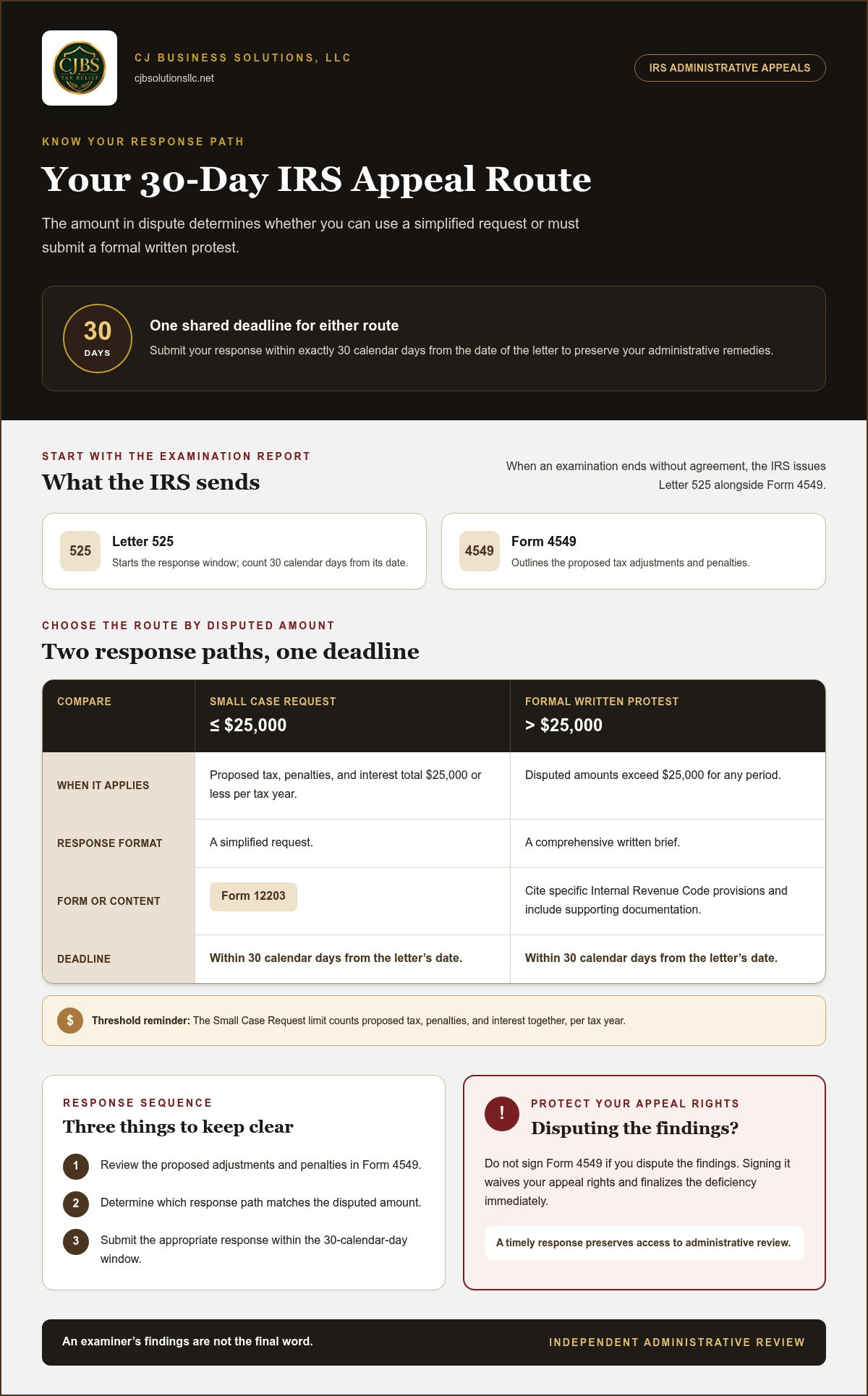
When an examination ends without mutual agreement, the IRS issues Letter 525 alongside Form 4549, which outlines proposed tax adjustments and penalties. Signing Form 4549 waives your appeal rights and finalizes the deficiency immediately, which is why taxpayers disputing findings shouldn't sign it. Preserving your administrative remedies requires submitting a timely response within exactly 30 calendar days from the letter's date.
Your formal response path depends strictly on the disputed dollar threshold:
- Small Case Request: If the proposed tax, penalties, and interest total $25,000 or less per tax year, you can submit a simplified request using Form 12203.
- Formal Written Protest: When disputed amounts exceed $25,000 for any period, you must file a comprehensive brief citing specific Internal Revenue Code provisions and supporting documentation.
Relying on specialized IRS audit appeal services ensures your protest is accurately assembled and filed before this critical deadline expires, keeping the door open to an equitable resolution.
Strategic Case Preparation: Developing an Effective Audit Appeal
A successful appeal relies on methodical factual substantiation rather than dramatic courtroom rhetoric. Presenting a compelling case to the IRS Independent Office of Appeals requires pinpointing the exact accounting or legal errors committed during the preliminary audit. By organizing clear records that refute an examiner's flawed assumptions, taxpayers can dismantle unjustified proposed assessments with quiet precision.
Utilizing IRS Transcript Analysis to Reconstruct Examination Data
Before drafting your formal protest, a specialized diagnostic review of your master tax file is indispensable. Comprehensive transcript analysis services reveal internal transaction codes, tracking how the agency handled your return and highlighting procedural discrepancies.
A rigorous diagnostic review focuses on key mechanical details:
- Wage and Income Transcripts: Cross-referencing third-party information reports confirms uncredited withholdings, estimated payments, or duplicate reporting errors.
- Transaction Code Sequencing: Examining assessment codes verifies whether statutory notification intervals and assessment statutes of limitations were strictly observed.
- Disallowed Expense Groupings: Isolating specific deductions rejected by the examiner allows you to build targeted documentation binders for the appeals officer.
Once procedural baseline data is confirmed, the protest letter must clearly connect corroborating records to governing tax code sections. Professional IRS audit appeal services provide the structured framework required to present these complex financial analyses persuasively, ensuring your dispute is backed by authoritative documentation.
Professional Representation: Navigating Appeals with an Enrolled Agent
Civil audit disagreements rarely require courtroom trials. Enrolled Agents hold unlimited practice rights under Treasury Circular 230, empowering them to represent taxpayers before all administrative levels of the agency. When you designate an Enrolled Agent through Form 2848, they manage every conference and written communication directly. This representation shields you from adversarial questioning, preventing innocent misstatements from complicating your defense.
Appeals Officers approach cases differently than field auditors. While examiners follow rigid internal positions, officers within the IRS Independent Office of Appeals must evaluate the "hazards of litigation." They assess the probability that the government might lose if the case proceeded to court. This distinction allows an authorized representative to negotiate principled compromises, split disputed issues, and resolve contested assessments equitably.
Securing Fair Settlements and Long-Term Tax Compliance
Experienced representation focuses on resolving underlying liabilities while mitigating unnecessary secondary costs. Professional IRS audit appeal services help secure durable agreements through proven administrative remedies:
- Penalty Abatement: Representatives present documented arguments under reasonable cause provisions to eliminate 20% accuracy-related penalties.
- Form 870-AD Agreements: Settling in Appeals involves executing a formal closing agreement that contains mutual non-reopening covenants, providing finality.
- Preventative Accounting Standards: Establishing disciplined recordkeeping protocols ensures that future returns remain fully compliant and audit-resistant.
Working alongside an Enrolled Agent turns a stressful examination into an orderly review. Rather than facing bureaucratic hurdles alone, you gain a steady partner dedicated to protecting your taxpayer rights from start to finish.
Protect Your Taxpayer Rights Through Administrative Appeal
Receiving an unagreed examination report can feel unsettling, but an auditor's preliminary findings don't have to be the final word. Acting within the 30-day window preserves crucial administrative remedies that prevent premature tax assessments and open a pathway toward a balanced resolution. Grounding your dispute in thorough documentation and comprehensive transcript analysis diagnostics ensures that your position rests on objective facts rather than unverified assumptions.
You don't have to manage these intricate administrative procedures alone. Through professional IRS audit appeal services led by a federally authorized Enrolled Agent, our dedicated civil tax resolution and audit defense practice provides the steady, seasoned guidance you need. If you're facing an unagreed audit report, schedule a consultation with CJ Business Solutions, LLC to review your appeal options and work toward an equitable settlement with quiet confidence.
Frequently Asked Questions
What is the deadline to file an appeal after an IRS audit?
The deadline to request an administrative appeal is exactly 30 calendar days from the date printed on your preliminary examination letter, such as Letter 525. This timeframe is strictly enforced by the examination division. If you need additional time to gather corroborating records, you must request a written extension from the examining agent before this initial window expires.
Can an Enrolled Agent represent me at the IRS Appeals Office?
Yes, Enrolled Agents hold unlimited practice rights under Treasury Circular 230 to represent taxpayers before all administrative levels of the IRS, including the Independent Office of Appeals. Through specialized IRS audit appeal services, an Enrolled Agent handles conferences directly, drafts written protests, and presents technical legal arguments so you never have to speak with government agents yourself.
What happens if I miss the 30-day IRS audit appeal deadline?
Missing the 30-day deadline forfeits your opportunity for a preliminary review through the local examination group, prompting the IRS to issue a formal Statutory Notice of Deficiency. This document grants you 90 calendar days to file a judicial petition. If that statutory deadline also passes without action, the proposed tax adjustments become final and move directly into active collection.
How does an administrative appeal differ from US Tax Court litigation?
An administrative appeal is an informal dispute process conducted through an IRS Appeals Officer rather than an adversarial courtroom trial. Appeals Officers evaluate settlement potential based on the hazards of litigation, allowing for flexible compromises and penalty reductions. Professional IRS audit appeal services focus on achieving these private administrative solutions, avoiding the procedural rigidities and public exposure of formal court dockets.

Article by
Crystal R. Johnson, MBA EA
Crystal Johnson founded CJ Business Solutions to give individuals and small-business owners something often missing from the tax and accounting process: clear explanations, practical solutions, and trusted support.
With more than 27 years of accounting and financial experience, Crystal helps clients understand complicated tax matters, restore compliance, respond to IRS concerns, and make stronger business decisions. As an Enrolled Agent, she is federally authorized to represent taxpayers before the Internal Revenue Service.


