

Pleading financial hardship to the Internal Revenue Service rarely removes penalties; verified transcript data does. If you are watching failure-to-pay penalties compound each month while trying to decipher intimidating notices, that frustration is completely understandable. The good news is that you don't have to face the tax agency in the dark. Exploring legitimate IRS penalty relief options can help you halt compounding assessments and protect your financial standing.
In this guide, you will discover the exact administrative and statutory avenues available to reduce or eliminate tax penalties in 2026. We will outline the specific eligibility benchmarks for First Time Abate, the new Automatic Exemption from Penalty framework, and reasonable cause criteria. You will also learn the structured procedure required to request relief calmly without inviting unnecessary IRS scrutiny.
Key Takeaways
- Review the latest IRS penalty relief options, including the transition toward automated administrative relief, to determine if your compliance record allows for immediate penalty removal.
- Understand the regulatory benchmarks of reasonable cause to determine whether circumstances like severe illness or system failures meet the threshold of ordinary business care.
- Rely on thorough IRS transcript analysis to uncover accurate assessment dates and procedural records before submitting an abatement request.
- Prepare a well-documented submission pathway, utilizing formal petition methods and administrative appeals through an Enrolled Agent to resolve balances effectively.
Understanding Common IRS Penalties and Statutory Abatement Programs
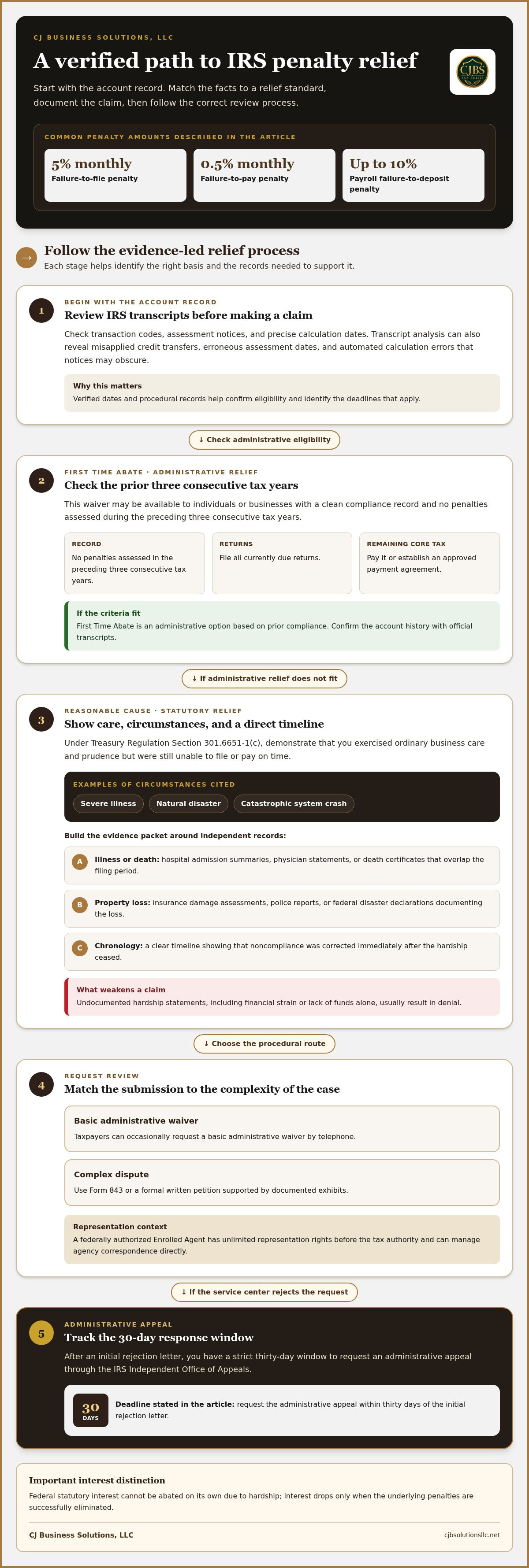
The Internal Revenue Code authorizes several assessments that can rapidly inflate a balance. While many taxpayers are familiar with the 5% monthly failure-to-file penalty or the 0.5% failure-to-pay penalty, small business owners often encounter failure-to-deposit penalties on payroll taxes that reach up to 10%. Reviewing the common types of IRS penalties on your account is an essential first step. Federal law does not allow statutory interest to be abated on its own due to hardship; interest drops only when you successfully eliminate the underlying penalties through legitimate IRS penalty relief options.
First Time Penalty Abatement: Administrative Relief for Compliant Taxpayers
Administrative relief offers an accessible path forward for individuals and businesses with a steady record of filing on time. Under the Internal Revenue Manual, the First Time Abate policy provides a waiver if you have maintained clean compliance with no penalties assessed during the preceding three consecutive tax years. Before the agency grants this relief, you must file all currently due returns and either pay or establish an approved payment agreement for any remaining core tax liability.
Unlike statutory relief mechanisms under Internal Revenue Code Section 6404, which require clear evidence of IRS ministerial errors or procedural delays, administrative relief simply rewards prior compliance. Reviewing your official tax transcripts beforehand confirms whether your account history meets these criteria before you contact the agency.
Qualifying for Reasonable Cause Relief and Documenting Your Defense
When prior compliance records do not qualify for administrative waivers, statutory reasonable cause serves as the primary standard under Treasury Regulation Section 301.6651-1(c). To successfully petition the government, you must demonstrate that you exercised ordinary business care and prudence yet remained unable to file or pay on time. Valid grounds generally include life-altering events such as severe illness, natural disasters, or catastrophic system crashes. If you wish to see how the agency evaluates these life events, the official guidelines explain when individuals qualify for reasonable cause under established legal criteria.
Securing relief under these provisions starts with objective data. Conducting a detailed transcript analysis reveals specific IRS transaction codes, assessment notices, and precise calculation dates that dictate your statutory deadlines. Partnering with a dedicated professional for thorough transcript analysis services ensures every assessment is accurately verified before you submit an appeal.
Assembling Substantiating Evidence to Overcome Initial IRS Denials
Subjective hardship claims without documentation usually result in automatic denials. The IRS looks for clear causality backed by independent third-party records. Strong evidentiary packets generally require:
- Hospital admission summaries, physician statements, or death certificates directly overlapping the filing period.
- Insurance damage assessments, police reports, or federal disaster declarations detailing property loss.
- A clean chronological timeline showing that you cured the noncompliance immediately after the hardship ceased.
Vague hardship letters that simply cite financial strain or lack of funds invite immediate rejection. By grounding your claim in verified dates, you protect your broader IRS penalty relief options and present an unassailable legal defense.
Navigating Formal Requests, Appeals, and Professional Representation
Selecting among available IRS penalty relief options requires choosing the appropriate procedural channel. While taxpayers can occasionally request basic administrative waivers by telephone, complex disputes demand Form 843 or a formal written petition supported by documented exhibits. Should the service center issue an initial rejection letter, you maintain a strict thirty-day window to request an administrative appeal through the IRS Independent Office of Appeals. Navigating official IRS penalty relief avenues within these deadlines prevents premature collection enforcement while your defense undergoes formal review.
Direct representation brings composed structure to these interactions. They require careful handling. Because a federally authorized Enrolled Agent holds unlimited representation rights before the tax authority, they manage all agency correspondence directly. This advocacy shields you from aggressive collection notices and unannounced levy actions while presenting your compliance record in the most favorable light.
Securing Long-Term Resolution Through Diagnostic Tax Transcript Analysis
Meticulous transcript analysis serves as the necessary cornerstone for any sustainable penalty defense. A diagnostic examination uncovers misapplied credit transfers, erroneous assessment dates, and automated calculation errors that standard notices obscure. Correcting these line items allows your representative to coordinate penalty reductions alongside structured installment agreements, ensuring lasting compliance. If you wish to review your IRS penalty relief options with experienced guidance, we invite you to consult CJ Business Solutions, LLC for dedicated tax resolution and representation services.
Taking the Next Step Toward Lasting Tax Relief
Resolving accumulated tax penalties doesn't require uncertain guesswork or stressful confrontations. By understanding the precise statutory criteria and preparing documented timelines, you can pursue legitimate IRS penalty relief options that protect your financial security. The key lies in verifying your account data before initiating contact.
At CJ Business Solutions, LLC, our detailed transcript analysis methodology diagnoses underlying account errors and pinpoints valid relief avenues. Led by a federally authorized Enrolled Agent with direct IRS advocacy rights, we handle complex communications so you don't have to carry the burden alone. When you are ready to resolve your balance with clarity and composure, request a professional consultation with CJ Business Solutions, LLC to secure the dependable path forward you deserve.
Frequently Asked Questions
What qualifies as reasonable cause for IRS penalty abatement?
Reasonable cause requires demonstrating that you exercised ordinary business care and prudence despite facing extraordinary, unavoidable circumstances. Acceptable situations include serious medical emergencies, natural disasters, unavoidable absence, or destruction of essential records by casualty. Conversely, a general lack of funds or simply relying on an outside preparer does not meet statutory standards. Objective documentation must tie directly to the dates of noncompliance.
How many times can you use the IRS First Time Penalty Abatement?
You can use First Time Abate once per tax type, provided you satisfy the clean compliance rule for the prior three years. This administrative waiver isn't a strict lifetime limit. If you maintain uninterrupted compliance for three consecutive years following an abatement, you regain eligibility for future periods. It remains one of the simplest IRS penalty relief options for compliant filers.
Does the IRS waive the interest charged on tax penalties?
The IRS cannot waive statutory interest simply for hardship reasons, because interest accrual is mandated by federal statute under the Internal Revenue Code. However, when underlying penalties are eliminated through valid IRS penalty relief options, the interest charged on those penalties automatically drops proportionally. Interest only disappears on its own if the agency caused unreasonable, documented ministerial delays.
What should I do if the IRS denies my penalty relief request?
If the IRS rejects your initial request, you can submit a formal administrative appeal within thirty days of the date printed on your denial notice. Carefully review the letter to identify missing documentation or factual errors. Working alongside a federally authorized Enrolled Agent allows you to prepare a structured appeal packet, presenting a fortified case before the IRS Independent Office of Appeals.

Article by
Crystal R. Johnson, MBA EA
Crystal Johnson founded CJ Business Solutions to give individuals and small-business owners something often missing from the tax and accounting process: clear explanations, practical solutions, and trusted support.
With more than 27 years of accounting and financial experience, Crystal helps clients understand complicated tax matters, restore compliance, respond to IRS concerns, and make stronger business decisions. As an Enrolled Agent, she is federally authorized to represent taxpayers before the Internal Revenue Service.


