

A standard corporate shield will not protect your personal savings when the IRS moves to collect delinquent payroll taxes. If you're facing aggressive Revenue Officer inquiries or the dread of personal bank levies, you're not alone in feeling overwhelmed by the agency's reach. A successful trust fund recovery penalty defense doesn't depend on courtroom battles, but rather on addressing procedural claims through established administrative channels before any assessment takes place.
In this guide, you'll learn how to defend against personal liability by disproving responsible person status and establishing a clear lack of willfulness. We'll walk through the critical role of Form 4180 interviews, strategic transcript analysis, and administrative appeals that work to protect your personal finances while establishing a viable path forward for your business.
Key Takeaways
- Understand how Internal Revenue Code Section 6672 bypasses corporate liability shields to target personal assets for unpaid employee tax withholdings.
- Discover how detailed transcript analysis and objective record reviews establish an effective trust fund recovery penalty defense before the IRS finalizes an assessment.
- Learn which documentary evidence, such as bank signature cards and corporate minutes, effectively demonstrates a lack of financial control or willfulness.
- Explore the administrative appeals process and viable business payment arrangements that protect your personal finances while resolving underlying tax obligations.
Understanding the Trust Fund Recovery Penalty and Assessing Your Exposure
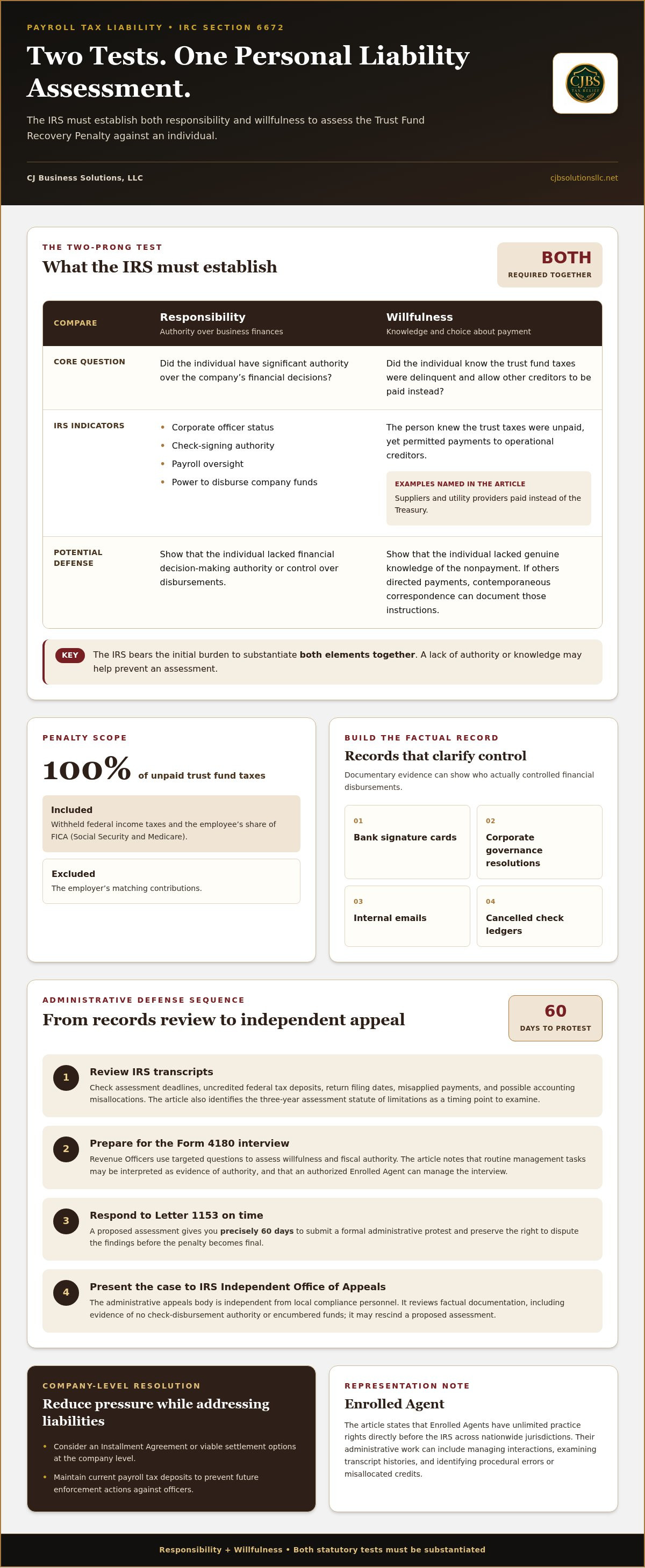
Under Internal Revenue Code Section 6672, the IRS can bypass traditional entity protections to hold individuals personally liable for unpaid payroll taxes. This enforcement mechanism, known formally as the Trust Fund Recovery Penalty, pierces corporate shields and limited liability protections without requiring a judicial proceeding. The penalty equals 100% of the unpaid trust fund taxes, which include withheld federal income taxes and the employee's share of FICA (Social Security and Medicare). It excludes the employer's matching contributions.
Operating through a corporation or an LLC provides no shield against this assessment. The IRS views withheld payroll funds as money held in trust for the United States government. An effective trust fund recovery penalty defense begins by evaluating whether the IRS has accurately calculated these underlying liabilities before any personal assessment occurs. Conducting an early transcript analysis often reveals accounting misallocations or uncredited deposits, allowing representatives to identify procedural defects long before formal collection efforts escalate.
The Two Prongs of Personal Liability: Responsibility and Willfulness
To assess personal liability under Section 6672, Revenue Officers must satisfy two distinct statutory tests concurrently:
- Responsibility: The individual must have possessed significant authority over business finances. Key indicators include corporate officer status, check-signing authority, payroll oversight, and the power to disburse company funds.
- Willfulness: The individual knew trust fund taxes were delinquent yet permitted payments to other operational creditors, such as suppliers or utility providers, instead of the Treasury.
The IRS bears the initial burden to substantiate both elements together. If an individual lacked financial decision-making authority or genuine knowledge of the nonpayment, a targeted trust fund recovery penalty defense can prevent the assessment entirely.
How to Build a Trust Fund Recovery Penalty Defense Strategy
A sound trust fund recovery penalty defense begins with an objective review of official records rather than subjective recollections. Conducting a thorough IRS transcript analysis verifies statutory assessment deadlines, pinpoints uncredited federal tax deposits, and confirms exact return filing dates. According to the official IRS definition of the Trust Fund Recovery Penalty, liability requires clear factual proof. Uncovering misapplied payments or demonstrating that the three-year assessment statute of limitations has run can resolve an inquiry before an interview even occurs.
Documentary evidence serves as your strongest safeguard. Gathering bank signature cards, corporate governance resolutions, internal emails, and cancelled check ledgers establishes who actually controlled financial disbursements. If you're organizing these records under IRS scrutiny, partnering with an experienced firm like CJ Business Solutions, LLC ensures your administrative file clearly reflects your operational boundaries.
Challenging the Form 4180 Interview and Proposed Assessments
The Form 4180 interview represents a pivotal moment in any investigation. Revenue Officers use these targeted questions to elicit admissions of willfulness, often interpreting routine management tasks as evidence of fiscal authority. Retaining an Enrolled Agent allows an authorized representative to manage these interactions directly, ensuring questions are addressed accurately without accidental misstatements.
If superior officers, board members, or commercial lenders mandated payments to suppliers over payroll taxes, contemporaneous correspondence must document those directives. Should the IRS issue Letter 1153 proposing an assessment, you have precisely 60 days to submit a formal administrative protest. Acting within this window preserves your right to dispute the findings before the penalty becomes final.
Navigating Administrative Appeals and Comprehensive Tax Resolution Options
Filing a timely protest brings your case before the IRS Independent Office of Appeals. This administrative body functions independently from local compliance personnel, providing a neutral forum to evaluate your records. When presenting your trust fund recovery penalty defense, an appeals officer reviews factual documentation rather than assumptions, focusing strictly on whether statutory criteria under the IRS definition of the Trust Fund Recovery Penalty were met. Demonstrating an absence of check disbursement authority or showing that funds were encumbered can lead the officer to rescind a proposed assessment entirely.
Resolving corporate liabilities simultaneously reduces pressure on individuals targeted by collections. Negotiating an Installment Agreement or exploring viable settlement options at the company level allows the entity to pay down back taxes systematically. Maintaining active compliance with current payroll tax deposits prevents future enforcement actions against officers, establishing long-term stability for ongoing business operations.
Selecting Qualified Representation to Resolve Payroll Tax Controversies
Enrolled Agents possess unlimited practice rights directly before the IRS, representing taxpayers across all nationwide jurisdictions. This federal credential ensures knowledgeable guidance through administrative appeals without the overhead associated with courtroom litigation. An Enrolled Agent focuses on the administrative mechanics of tax controversy, examining transcript histories to identify procedural errors and misallocated credits.
Timing remains critical when addressing proposed trust fund assessments. If Letter 1153 arrives, the sixty-day window to file a formal protest begins immediately. Engaging federally authorized representation promptly safeguards your procedural appeal rights and shields personal bank accounts from premature enforcement.
Securing Your Financial Stability Through Early Administrative Action
Protecting your personal assets against IRS assessment requires deliberate preparation before statutory deadlines expire. Establishing that you lacked financial authority or disproving willful intent forms the foundation of an effective trust fund recovery penalty defense. In addition, performing an early transcript analysis and managing communications through administrative channels can resolve disputes without the strain of courtroom proceedings.
You don't have to confront aggressive collection inquiries alone. Professional representation led by a federally authorized Enrolled Agent ensures your procedural rights remain protected nationwide. We invite you to request a confidential consultation with CJ Business Solutions to evaluate your transcripts and establish a dependable path forward. With the right administrative approach, you can safeguard your personal finances and regain lasting peace of mind.
Frequently Asked Questions
Can filing business bankruptcy eliminate Trust Fund Recovery Penalty liability?
No, business bankruptcy does not eliminate or discharge personal liability for trust fund taxes. Because these funds represent employee withholdings held in trust for the government, federal law treats them as non-dischargeable debt. Even if the entity liquidates entirely, the IRS retains the authority to pursue responsible individuals. A proper trust fund recovery penalty defense focuses on resolving liability administratively before assessment.
What should I do immediately after receiving IRS Letter 1153?
You should note the postmark date immediately to track your sixty-day administrative appeal window. Do not sign Form 2751, which agrees to the assessment. Instead, order complete IRS account transcripts to evaluate the calculation. Conducting a prompt transcript review allows you to identify uncredited deposits or expired assessment statutes before drafting a formal protest for the Independent Office of Appeals.
Is an employee without corporate ownership vulnerable to Form 4180 assessment?
Yes, non-owner employees can be targeted if they exercise practical control over company bank accounts. The IRS evaluates operational authority rather than equity ownership. Bookkeepers, office managers, or controllers who sign checks and disburse vendor payments often face scrutiny. Building an effective trust fund recovery penalty defense requires presenting internal communications showing you merely followed explicit instructions without independent financial decision-making authority.
Can an Enrolled Agent represent me during an IRS Trust Fund interview?
Yes, an Enrolled Agent holds unlimited practice rights to represent taxpayers before all administrative divisions of the IRS nationwide. Your representative can handle correspondence, organize financial documentation, and appear during the Form 4180 interview. Having a federally authorized practitioner manage these discussions provides an objective buffer, ensuring inquiries are answered accurately without making inadvertent admissions regarding financial authority or willfulness.

Article by
Crystal R. Johnson, MBA EA
Crystal Johnson founded CJ Business Solutions to give individuals and small-business owners something often missing from the tax and accounting process: clear explanations, practical solutions, and trusted support.
With more than 27 years of accounting and financial experience, Crystal helps clients understand complicated tax matters, restore compliance, respond to IRS concerns, and make stronger business decisions. As an Enrolled Agent, she is federally authorized to represent taxpayers before the Internal Revenue Service.


