
The option that promises the smallest balance may not be the one that fits your finances. Choosing among IRS tax debt settlement options can feel difficult when you’re unsure whether IRS records are accurate, monthly payments are affordable, or a settlement claim is realistic. The right path depends on verified account details, your financial circumstances, and eligibility, not on a guaranteed outcome.
This guide compares installment agreements, an Offer in Compromise, Currently Not Collectible status, and penalty relief. You’ll learn which records to gather and how to compare each option against your income, expenses, assets, and ability to pay. Reviewing IRS transcripts can help clarify balances and account activity before you decide what to do next, whether you review the facts yourself or seek tax-resolution guidance.
Key Takeaways
- Compare an Offer in Compromise, an installment agreement, Currently Not Collectible status, and penalty relief by what each may address and what it cannot guarantee.
- Assess which IRS tax debt settlement options may fit by reviewing income, allowable expenses, assets, liabilities, and realistic payment capacity.
- Check IRS account records and confirm required tax returns are filed before relying on a proposed resolution.
- If transcripts are unclear or your tax liabilities are complex, a professional review can help clarify the facts and possible next steps.
IRS tax debt settlement options: what each path can and cannot do
An IRS balance can bring real uncertainty, especially if you’re not sure the amount is correct or what you can afford. Compare the available paths without assuming that any one of them will erase the debt or stop collection. The right fit depends on your account details, filing status, and financial circumstances.
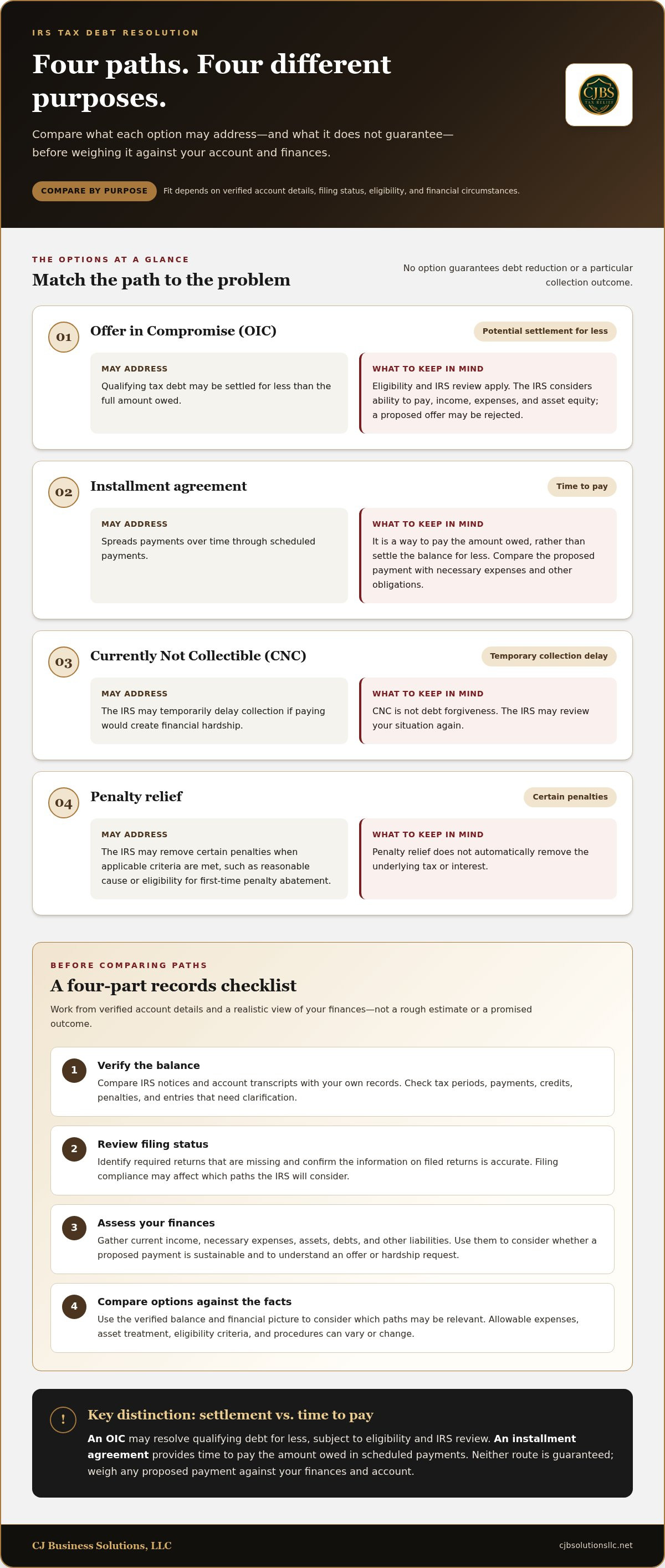
- Offer in Compromise (OIC): May let eligible taxpayers settle qualifying tax debt for less than the full amount owed. The IRS considers factors such as ability to pay, income, expenses, and asset equity. Learn more about the Offer in Compromise (OIC) program.
- Installment agreement: Spreads payments over time rather than settling the balance for less. Compare the proposed payment with your necessary expenses and other obligations to assess whether it is sustainable.
- Currently Not Collectible (CNC) status: The IRS may temporarily delay collection if paying would create financial hardship. It isn’t debt forgiveness, and the IRS may review your situation again.
- Penalty relief: The IRS may remove certain penalties when applicable criteria are met, such as reasonable cause or eligibility for first-time penalty abatement. This does not automatically remove the underlying tax or interest.
How an Offer in Compromise differs from a payment plan
An OIC is a potential settlement for less than the full amount, subject to IRS review and eligibility requirements. An installment agreement generally gives you time to pay the amount owed in scheduled payments. The key difference is what each option is designed to address: an OIC may resolve qualifying debt for less, while an installment agreement provides time to pay. Neither route is guaranteed. The IRS may reject a proposed offer, and a payment plan must be considered in light of your finances and account.
Before comparing IRS tax debt settlement options, check whether the IRS balance and account history are accurate. Review payments, credits, penalties, and the tax periods listed on your account against your own records. Transcript analysis can help identify items to clarify, while an assessment of income, expenses, assets, and liabilities can show what may be sustainable. Be cautious of promises of guaranteed debt reduction or collection delays.
How to assess eligibility and compare IRS tax debt settlement options
A measured review helps you compare choices against your actual account and finances. Work through these steps before deciding which paths to explore:
- Verify the balance. Compare IRS notices with account transcripts and your own records. Check the tax periods involved, and note payments, credits, penalties, or entries that need clarification.
- Review filing status. Identify any missing required returns and confirm that the information on filed returns is accurate. Filing compliance may affect which resolution paths the IRS will consider.
- Assess your finances. Gather current income, necessary expenses, assets, debts, and other liabilities. These details can help you assess whether a proposed monthly payment is sustainable and may inform how the IRS evaluates an offer or hardship request.
- Compare options. Use the verified balance and financial picture to consider which paths may be relevant. Then check the IRS tax debt options overview for current guidance.
An option’s suitability depends on documented facts and current IRS rules. Allowable expenses and the treatment of assets can vary by situation, so avoid relying on a rough estimate or a promised outcome. Eligibility criteria and procedures can also change. Verify current IRS requirements before applying rather than assuming a fixed threshold applies to you.
What financial records and IRS account details should you review?
Gather relevant tax returns, IRS notices, income records, and a clear summary of household expenses, assets, and liabilities. Compare the information with your IRS account transcripts, paying attention to account activity, payments, and tax periods that may need clarification. If the records are difficult to interpret, transcript analysis services may help you understand what to review before comparing possible paths.
Next steps for choosing an IRS tax debt resolution path
Before relying on a proposed resolution, confirm that the IRS account reflects your payments and other relevant activity, and address any required tax returns that remain unfiled. Keep notices and supporting records together, then compare possible paths against a payment amount you could sustain. If you’re considering an Offer in Compromise, review the IRS’s current Offer in Compromise guidance before deciding whether to explore an application.
These steps can help identify what remains uncertain. A transcript entry that doesn’t match your records, liabilities spanning several tax periods, or difficulty understanding which IRS tax debt settlement options may apply can be good reasons to seek a professional review. Clarifying the facts first keeps your next step grounded in your account rather than in a general promise.
When can an Enrolled Agent or tax resolution professional help?
An Enrolled Agent or tax resolution professional may help review returns, notices, transcripts, and financial information; explain potential resolution paths; and, where authorized, communicate with the IRS about your matter. The purpose is to understand the circumstances and prepare a realistic approach, not to assure a particular result. Representation or professional guidance doesn’t guarantee that the IRS will accept an offer, reduce a balance, delay collection, or act within a particular timeline.
CJ Business Solutions, LLC offers transcript analysis and tax resolution support for taxpayers who want help reviewing their account and considering next steps. You can Discuss your tax resolution questions with CJ Business Solutions, LLC if you’d like to explore whether a review may be useful.
Take a Clear, Informed Next Step
The most useful next step is often a careful review, not a quick promise. Confirm your IRS account details, address missing filings, and consider which resolution path aligns with your documented finances. The right choice among IRS tax debt settlement options depends on your circumstances and current IRS criteria. No professional can guarantee acceptance or a particular result.
If transcripts are unclear or you’re uncertain how to compare your choices, professional guidance may help bring the facts into focus. CJ Business Solutions is led by an Enrolled Agent and provides IRS transcript analysis, tax resolution, and IRS audit defense. A review can help clarify account details and possible next steps without promising a specific outcome.
A measured, well-informed approach can help you move forward with greater clarity, one practical step at a time.
Frequently Asked Questions
Is an Offer in Compromise the same as settling IRS tax debt?
An Offer in Compromise (OIC) is one IRS program that may allow an eligible taxpayer to resolve qualifying tax debt for less than the full amount owed. It differs from an installment agreement, which generally spreads payments over time. An OIC isn’t automatically approved, so check current IRS eligibility criteria and application requirements before deciding whether to apply.
Can I settle IRS tax debt if I cannot afford to pay it?
Difficulty paying doesn’t automatically qualify you for a particular settlement option. Depending on your verified finances and IRS account status, you may be able to explore a payment arrangement, an Offer in Compromise, or a temporary collection status. Review your account records and current IRS criteria before choosing a path, and be cautious of anyone promising a guaranteed reduction.
What happens if I cannot pay my IRS tax debt in full?
Your next step depends on your account, filing status, and financial circumstances. You may need to review payment arrangements or other collection options with the IRS. Don’t ignore notices, since doing so can make it harder to understand your account and respond appropriately. Check the balance and account activity, then follow the instructions and deadlines in any notice you receive.
How do I know which IRS tax debt resolution option is right for me?
To compare IRS tax debt settlement options, first confirm the balance and review your IRS transcripts and filed returns. Then consider your income, expenses, assets, liabilities, and realistic ability to pay. Compare those documented facts with current IRS requirements. If transcripts are unclear or your liabilities are complex, an Enrolled Agent or other qualified tax professional can help assess possible next steps.
If you need help reviewing IRS transcripts or comparing possible tax resolution paths, contact CJ Business Solutions, LLC to discuss your questions.

Article by
Crystal R. Johnson, MBA EA
Crystal Johnson founded CJ Business Solutions to give individuals and small-business owners something often missing from the tax and accounting process: clear explanations, practical solutions, and trusted support.
With more than 27 years of accounting and financial experience, Crystal helps clients understand complicated tax matters, restore compliance, respond to IRS concerns, and make stronger business decisions. As an Enrolled Agent, she is federally authorized to represent taxpayers before the Internal Revenue Service.


