

In a single fiscal year, the IRS issued more than 1.7 million levies and seizures, a figure that underscores the agency’s return to robust enforcement levels. If you’ve received a notice of intent to levy or are watching interest rates compound at 7%, the weight of federal tax debt can feel overwhelming. It’s natural to feel a sense of urgency when your financial stability is at stake, especially as automated enforcement continues to rise. However, it’s helpful to know that a methodical IRS collection defense can effectively halt aggressive actions and protect your hard-earned assets.
We understand that navigating these complex notices requires a steady hand and a clear strategy. By focusing on data-driven analysis and professional representation, you can move away from the stress of mounting penalties and toward a sustainable resolution. This guide provides a detailed look at the administrative tools available to you, from transcript analysis to collection due process hearings. You’ll learn how to establish a manageable path forward that ensures your long-term financial compliance and provides much-needed peace of mind.
Key Takeaways
- Gain clarity on the IRS collection lifecycle, allowing you to anticipate administrative actions before they escalate to more aggressive measures like levies.
- Learn how a methodical IRS collection defense leverages strategies such as Installment Agreements and Offers in Compromise to create a manageable path toward debt resolution.
- Recognize the importance of transcript analysis as a vital diagnostic phase to identify specific errors, penalty codes, and the statutory limits on your debt.
- Understand how professional representation helps translate complex IRS notices into a clear, actionable timeline for resolving your federal tax obligations.
- Discover proactive steps to organize your financial records and secure a professional assessment that prioritizes your long-term stability and compliance.
Understanding the IRS Collection Process and Your Rights
Effective IRS collection defense is best understood as the strategic application of administrative procedures to resolve tax liabilities. It isn't a confrontation, but rather a methodical application of the rules set by the Internal Revenue Service (IRS) to protect your financial interests. By engaging with these procedures early, you shift from a reactive stance to a proactive one, ensuring that your voice is heard before automated systems take over.
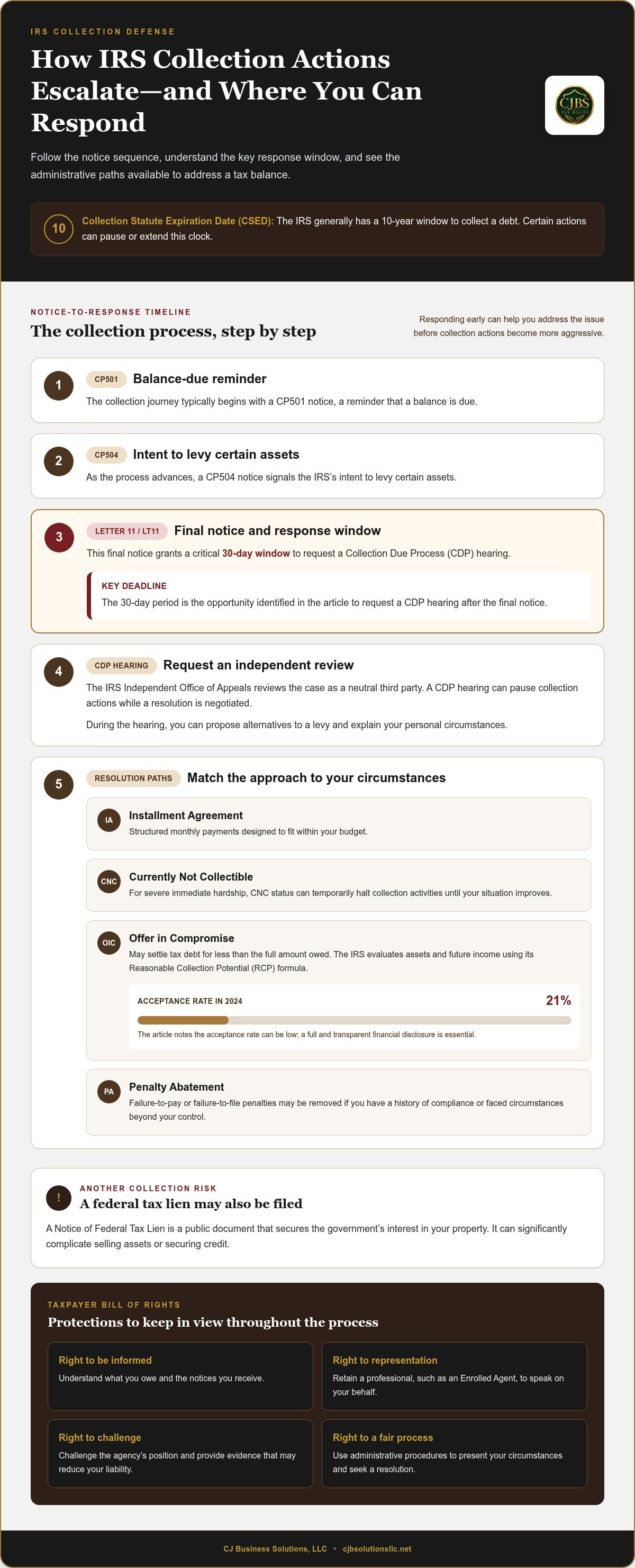
The collection journey typically begins with a CP501 notice, which serves as a polite reminder of a balance due. If left unaddressed, the process moves through increasingly urgent communications. Central to any defense strategy is the Collection Statute Expiration Date (CSED), a 10-year window the agency has to collect a debt. Understanding this timeline is vital, as certain actions can pause or extend this clock, impacting your long-term recovery plan.
Common IRS Collection Notices to Watch For
As the process matures, you may receive a CP504 notice, which signals an intent to levy certain assets. This is often followed by a Letter 11 or LT11, the final notice that grants you a critical 30-day window to request a Collection Due Process (CDP) hearing. A CDP hearing is a powerful tool that can pause collection actions while a resolution is negotiated. Additionally, a Notice of Federal Tax Lien may be filed; this public document secures the government's interest in your property and can significantly complicate your ability to sell assets or secure credit.
The Taxpayer Bill of Rights in Collections
You possess fundamental protections known as the Taxpayer Bill of Rights. This includes the right to be informed about what you owe and the right to retain professional representation, such as an Enrolled Agent, to speak on your behalf. You also have the right to challenge the agency’s position and provide evidence that may reduce your liability. Exercising these rights promptly is the most effective way to prevent aggressive automated enforcement and ensure your IRS collection defense is built on a foundation of transparency and fairness.
Key IRS Collection Defense Strategies and Resolution Paths
Once you understand the administrative landscape, the next step involves selecting the specific resolution path that aligns with your financial reality. An Installment Agreement (IA) is often the most accessible path, allowing for structured monthly payments that fit within your budget. For those facing severe immediate hardship, seeking 'Currently Not Collectible' (CNC) status can temporarily halt collection activities until your situation improves. These options form the core of a methodical IRS collection defense strategy, prioritizing long-term stability over temporary fixes.
Negotiating an Offer in Compromise (OIC)
An Offer in Compromise allows you to settle your tax debt for less than the full amount owed. The process is governed by the 'Reasonable Collection Potential' (RCP) formula, which the IRS uses to evaluate your assets and future income. Because the OIC acceptance rate can be quite low, as evidenced by the 21% acceptance rate in 2024, providing a full and transparent financial disclosure is essential. It's often helpful to consult with a seasoned mentor to ensure your application reflects your true ability to pay. You can learn more about these requirements in the official guide on The IRS Collection Process.
Collection Due Process (CDP) Hearings
If you receive a final notice of intent to levy, requesting a CDP hearing is a vital protective measure. This proceeding is overseen by the IRS Independent Office of Appeals, which acts as a neutral third party to review your case. During the hearing, you have the opportunity to propose alternatives to a levy, such as an IA or an OIC, ensuring that the agency considers your personal circumstances before taking aggressive action. This formal review is a cornerstone of a robust IRS collection defense.
Another effective way to reduce your balance is through Penalty Abatement. If you have a history of compliance or faced circumstances beyond your control, you might qualify to have failure-to-pay or failure-to-file penalties removed. This simple adjustment can significantly lower the total amount you owe. If you're unsure which path is right for your situation, exploring tax resolution services can provide the clarity needed to make an informed decision.
The Strategic Advantage of Transcript Analysis and Professional Representation
Before selecting a resolution path like an Installment Agreement or an Offer in Compromise, it is helpful to undergo a thorough diagnostic phase. This is where transcript analysis becomes a cornerstone of an effective IRS collection defense. Rather than relying on the summary provided in a standard notice, decoding your official transcripts allows you to see exactly what the agency sees. This transparency ensures that any strategy we develop is rooted in the specific data of your account, providing a stable foundation for your financial recovery.
What Your IRS Transcripts Reveal About Your Case
There are several types of transcripts, but the Record of Account is often the most useful as it combines data from your return with a history of account changes. By examining these documents, we can identify specific penalty codes and, more importantly, pinpoint the exact Collection Statute Expiration Date (CSED). Identifying IRS errors in transcript coding, such as misapplied payments or incorrect assessment dates, can lead to an immediate and significant debt reduction. This methodical review prevents overpayment and ensures you aren't held liable for debts that have legally expired under the IRS Collection Process guidelines.
Why Choose an Enrolled Agent for Collection Defense?
An Enrolled Agent (EA) is a federally authorized tax practitioner who has earned the right to represent taxpayers before the IRS. Unlike other professionals who may have a broad focus, EAs specialize specifically in tax matters and possess unlimited representation rights. This expertise allows them to act as a vital buffer between you and aggressive revenue officers, handling all communications so you can focus on your daily life. It’s a partnership built on stability and quiet confidence, moving at a pace that ensures you feel fully informed at every turn.
Choosing a seasoned mentor to guide you through this process can lower your stress and provide the technical expertise needed to navigate complex administrative hurdles. If you are ready to gain a clearer picture of your standing, securing professional transcript analysis services is a proactive first step toward achieving long-term financial compliance.
Proactive Steps to Resolve Your IRS Collection Issues
Establishing a clear timeline is the first step in any successful IRS collection defense strategy. It’s helpful to gather all correspondence, starting from the initial CP501 notice through to any recent intent to levy. By organizing these documents by date, you create a comprehensive record that allows for a more precise evaluation of your standing. Once your records are in order, securing a professional transcript analysis is the most effective way to confirm the total amount owed and identify any administrative errors that may be inflating your balance.
With a clear diagnostic in hand, you can begin to evaluate which resolution path aligns with your current financial capacity. This might involve preparing an Offer in Compromise, which saw a 21% acceptance rate in 2024, or perhaps establishing a structured Installment Agreement. Engaging an Enrolled Agent during this phase provides a vital buffer, as they can initiate contact with the agency to halt automated collection actions while your proposal is under review. This methodical approach replaces the stress of uncertainty with a structured, manageable plan.
Maintaining Long-Term Financial Compliance
Resolving an existing debt is a significant milestone, but maintaining that resolution requires ongoing diligence. Most agreements, including Offers in Compromise and Installment Agreements, are contingent upon staying current with all future tax filings and payments. Establishing accurate accounting and tax preparation habits today acts as a preventative measure against future collection issues. It’s a commitment to your long-term financial health that ensures the progress you’ve made remains secure.
Taking the First Step Toward Resolution
Addressing federal tax debt is most effective when approached with a calm, methodical mindset rather than avoidance. While the complexity of the IRS collection defense process can feel daunting, a professional consultation can help clarify the specific resolution paths available for your unique situation. This initial conversation is designed to provide you with the resources and information needed to move forward with confidence. If you’re ready to begin, you can Contact CJ Business Solutions for a professional transcript analysis and collection defense strategy.
Moving Toward Financial Stability
Resolving federal tax debt is a journey that begins with clarity and a methodical plan. Throughout this guide, we’ve explored how understanding the collection lifecycle and your fundamental rights can transform a stressful situation into a manageable process. By utilizing specialized IRS transcript analysis, you gain the diagnostic insight needed to identify errors and confirm your exact standing. This data-driven foundation is essential for a successful resolution, ensuring that any path you choose is sustainable for your long-term financial health.
Our team, led by an Enrolled Agent, specializes in providing the stability and expertise required to navigate these complex hurdles. Whether you need an expert audit strategy defense or a clear path to compliance, we’re here to act as a seasoned mentor. You can secure your financial future with expert IRS collection defense at CJ Business Solutions. Taking the first step doesn't have to be overwhelming. With a steady partner, a clear path to resolution is well within reach.
Frequently Asked Questions
What is the 10-year statute of limitations on IRS collections?
The IRS generally has 10 years from the date of a tax assessment to collect the debt, a period formally known as the Collection Statute Expiration Date (CSED). Once this window closes, the agency’s legal authority to collect the balance typically expires, and the debt is no longer legally enforceable. It’s helpful to remember that certain actions, such as filing for an Offer in Compromise or a bankruptcy petition, can pause or extend this clock, making transcript analysis vital for tracking your specific timeline.
Can the IRS really seize my house or bank account?
Yes, the IRS possesses the legal authority to seize assets, including bank account balances and physical property, though such actions are typically reserved as a last resort. Before a seizure occurs, the agency must send a series of notices and provide a final notice of intent to levy with a right to a hearing. Engaging in a methodical IRS collection defense early in the process is the most effective way to protect your assets and prevent these aggressive automated actions from escalating.
What is the difference between an IRS lien and an IRS levy?
An IRS lien is a legal claim against your property that acts as security for a tax debt, while a levy is the actual legal seizure of your property to satisfy that debt. A lien protects the government’s interest and can impact your credit or your ability to sell assets like a home. In contrast, a levy allows the IRS to take assets directly, such as funds from your bank account or a portion of your monthly wages, to pay down what you owe.
How do I stop an IRS wage garnishment immediately?
To stop a wage garnishment, you must typically establish an alternative resolution path, such as an installment agreement, or demonstrate that the garnishment causes an immediate financial hardship. If you’ve received a final notice of intent to levy, requesting a Collection Due Process (CDP) hearing within the 30-day window can pause the garnishment while your case is reviewed. Professional representation helps navigate these administrative steps quickly to secure a release from your employer and restore your full take-home pay.
Is it possible to settle my tax debt for less than what I owe?
Yes, it's possible to settle your liability for less than the full amount through the Offer in Compromise (OIC) program. The IRS evaluates your ability to pay based on a formula that considers your income, monthly expenses, and equity in assets. While settling for less is a significant component of many IRS collection defense plans, the process is rigorous, as evidenced by the 21% acceptance rate in 2024. Success requires a transparent and accurate disclosure of your financial situation.

Article by
Crystal R. Johnson, MBA EA
Crystal Johnson founded CJ Business Solutions to give individuals and small-business owners something often missing from the tax and accounting process: clear explanations, practical solutions, and trusted support.
With more than 27 years of accounting and financial experience, Crystal helps clients understand complicated tax matters, restore compliance, respond to IRS concerns, and make stronger business decisions. As an Enrolled Agent, she is federally authorized to represent taxpayers before the Internal Revenue Service.


