

Most people don't realize that the IRS can legally bypass the court system to seize a portion of your paycheck without ever filing a lawsuit. If you are currently facing this situation, it is important to know that you can take immediate steps to stop IRS wage garnishment and protect your livelihood.
It is a heavy burden to carry, especially when you are already feeling the weight of a complex tax debt. The sudden loss of your disposable income is stressful enough, but the added concern of your employer discovering your private financial struggles can feel truly overwhelming. You might find yourself feeling confused by the dense language and technical jargon in the notices arriving at your door.
Fortunately, you have specific legal rights that allow you to secure your income and regain control over your monthly earnings. This guide will show you how professional tax representation and methodical strategy can transform a desperate situation into a structured, manageable resolution.
We will explore the 2026 exemption amounts defined in Publication 1494, the power of detailed transcript analysis, and the proven steps to secure an immediate levy release while building a long-term plan for your tax debt.
Key Takeaways
- Gain a clear understanding of the IRS collection timeline to identify the most effective moment to intervene before your earnings are diverted.
- Explore the specific legal criteria required to stop IRS wage garnishment through economic hardship claims or the 2026 streamlined installment agreement pathways.
- Discover how professional transcript analysis reveals critical data points, such as the expiration of collection statutes, that may halt IRS activity.
- Learn how to apply national and local financial standards to protect your household income while negotiating a sustainable resolution.
- Establish a methodical plan for long-term tax health to ensure that your financial future remains secure and compliant once a levy is released.
Understanding the IRS Wage Garnishment Process in 2026
A wage garnishment is a specific type of IRS administrative action that requires your employer to withhold a portion of your earnings and send it directly to the government. It's helpful to distinguish between a tax lien and a tax levy. While a lien is a public claim against your property to secure a debt, a levy is the actual seizure of those assets. The IRS often favors this method because it provides a consistent, automated stream of collection from a reliable source. Understanding these mechanics is the first step toward finding a way to stop IRS wage garnishment before it disrupts your household budget.
The Final Notice: Your Last Warning Before Garnishment
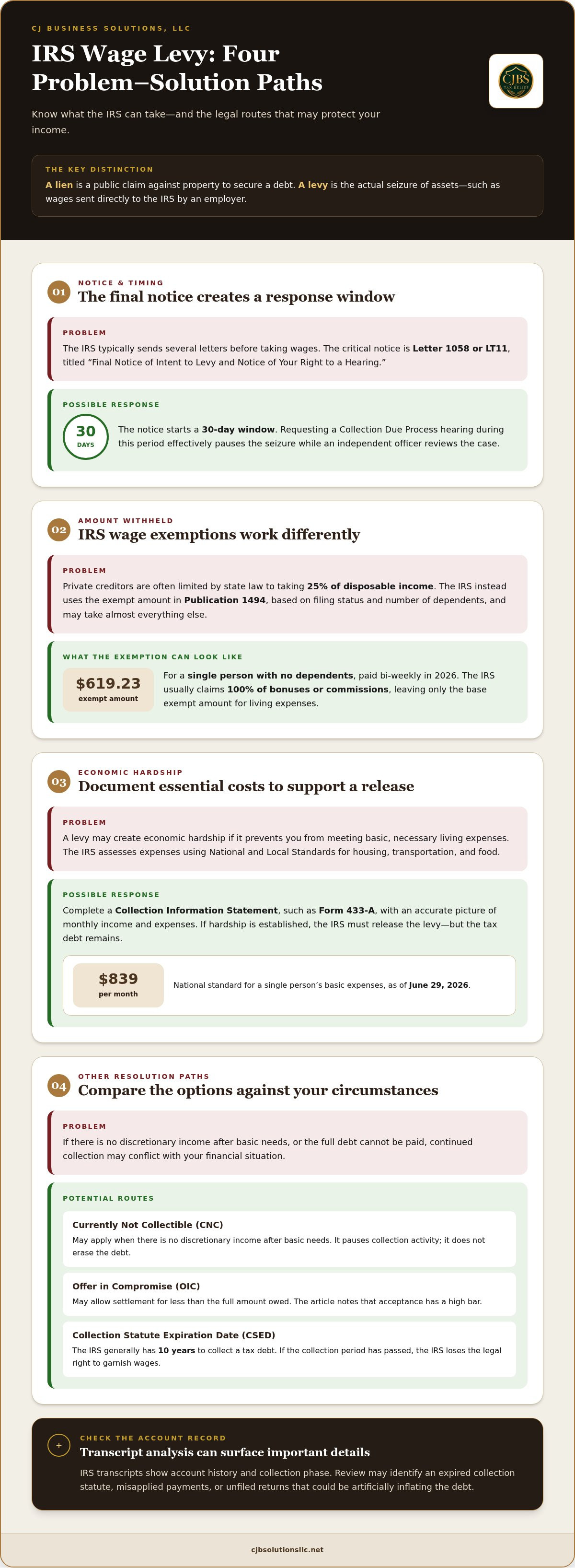
Before the first dollar is taken, the IRS must follow a strict procedural timeline. You'll typically receive several letters, but the most critical are Letter 1058 or LT11. These documents are titled "Final Notice of Intent to Levy and Notice of Your Right to a Hearing." Once you receive this, a 30-day window begins. This period is your most valuable opportunity to stop IRS wage garnishment because it allows you to request a Collection Due Process hearing, which effectively pauses the seizure while your case is reviewed by an independent officer.
How Much Can the IRS Actually Take?
Private creditors are usually limited by state laws, often taking only 25% of disposable income. However, the IRS uses a different calculation found in Publication 1494. They allow you to keep a small "exempt amount" based on your filing status and number of dependents, and they take almost everything else. For example, a single person with no dependents paid bi-weekly in 2026 has an exempt amount of only $619.23. If you earn bonuses or commissions, the IRS usually claims 100% of those additional funds, leaving you with only your base exempt amount to cover all living expenses.
Proven Legal Pathways to Release an IRS Wage Levy
While the IRS possesses broad authority to collect delinquent taxes, they're also bound by specific legal requirements to release a levy under certain conditions. For many taxpayers, the most immediate way to stop IRS wage garnishment is to demonstrate that the seizure is creating an actual economic hardship. This means proving that the levy prevents you from meeting basic, necessary living expenses. Official IRS levy information confirms that once a hardship is established, the agency must release the levy, although the underlying debt remains to be addressed.
Proving Economic Hardship with Professional Accuracy
Proving hardship is a methodical process that requires the completion of a Collection Information Statement, such as Form 433-A. This document provides a comprehensive snapshot of your monthly income and expenditures. It's vital to document every cost accurately, as the IRS applies strict National and Local Standards for housing, transportation, and food. As of June 29, 2026, the national standard for a single person's basic expenses is $839 per month. An Enrolled Agent acts as a seasoned mentor during this process, ensuring that every allowable expense is accounted for to maximize your protected income. If you find these forms or calculations confusing, our team provides tax resolution services to help you navigate these requirements with precision.
Alternative Resolution Paths: CNC and OIC
If your financial situation is particularly severe, you may qualify for Currently Not Collectible (CNC) status. This designation doesn't erase the debt, but it pauses all collection activity because you have no discretionary income after meeting basic needs. Alternatively, an Offer in Compromise (OIC) allows you to settle the debt for less than the full amount owed. While the OIC has a high bar for acceptance, it represents a path toward total resolution and an effective way to stop IRS wage garnishment permanently. Finally, we always verify the Collection Statute Expiration Date. The IRS generally has ten years to collect a tax debt; if that time has passed, they lose the legal right to garnish your wages entirely.
Strategic Defense: Using Transcript Analysis to Stop Collections
While most taxpayers focus on the final balance shown on a notice, the true strategy for resolution often lies within the raw data of your IRS transcripts. These internal records provide a detailed history of your account, moving beyond surface-level bills to reveal exactly which collection phase your account is in. By utilizing transcript analysis services, we can decode the complex transaction codes that the IRS uses to track your debt. It's frequently the most effective way to stop IRS wage garnishment because it uncovers procedural flaws that the IRS may have overlooked during the automated collection process.
A primary focus of this analysis is identifying the Collection Statute Expiration Date (CSED). The IRS generally has a ten-year window to collect a tax debt. If our review shows this timeframe has lapsed, the IRS is legally barred from continuing any collection activity, including a wage levy. We also look for misapplied payments or unfiled returns that might be artificially inflating your debt. Official IRS information on wage levies outlines the authority they have to seize funds, but it doesn't account for the human error that can occur during data entry at a service center.
Finding Errors that Void the Levy
IRS processing errors are more common than many realize, and these mistakes can serve as significant leverage when negotiating a release. Transcript analysis identifies if a 'Notice of Intent to Levy' was improperly issued by verifying if the required statutory notices were sent to your last known address before the garnishment began. If the IRS failed to follow these precise mailing requirements, the levy may be legally voided, providing an immediate path to reclaim your income.
The Enrolled Agent Advantage in Representation
Working with an Enrolled Agent (EA) provides a distinct advantage in federal tax matters. Unlike a standard tax preparer, an EA is federally authorized to represent taxpayers before all administrative levels of the IRS. By filing Form 2848, a Power of Attorney, we take the burden of direct communication off your shoulders. This allows us to advocate for you as a seasoned mentor, using transcript data to challenge inaccuracies and secure the best possible outcome for your financial future.
Securing Your Financial Future After the Levy is Stopped
While achieving a levy release provides immediate relief, it's essential to recognize that this is only the first step in a comprehensive tax resolution strategy. Once you stop IRS wage garnishment, the focus shifts toward preventing the issue from resurfacing in the future. The IRS requires ongoing compliance to maintain any resolution agreement. This includes ensuring that all 2026 tax returns are filed on time and that your current withholding or estimated tax payments are sufficient to cover your year-end liability. Maintaining this "audit defense" mindset ensures that you remain in control of your financial standing, and CJ Business Solutions, LLC provides the steady guidance needed to navigate these post-levy requirements.
Building a Long-Term Resolution Plan
Transitioning from an emergency levy release to a sustainable plan requires a methodical approach. Whether you've entered a streamlined installment agreement or are pursuing a settlement, staying in good standing is vital. We recommend ongoing transcript monitoring as a proactive diagnostic tool. This practice allows us to identify potential red flags, such as unposted payments or new assessments, before they ever escalate into fresh collection actions. It's a way to look around the corner and address small issues before they become emergencies.
Next Steps: Taking Control of Your IRS Situation
Taking control of your IRS situation means moving beyond the stress of complex notices and automated collection cycles. When you have a dedicated representative handling all IRS correspondence, you gain a level of peace of mind that allows you to focus on your personal and professional life. At CJ Business Solutions, LLC, we act as a seasoned mentor, standing between you and the agency to ensure your rights are protected at every turn. Our goal is to provide the stability and quiet confidence you need to resolve your debt permanently.
If you're ready to move toward a permanent resolution, we invite you to Contact CJ Business Solutions, LLC for a Professional Transcript Analysis today. Initiating a professional review of your IRS file is the most reliable way to stop IRS wage garnishment and ensure your income remains secure for the long term.
Regaining Your Financial Peace of Mind
A wage levy can feel like an insurmountable obstacle, but it is actually a manageable situation when approached with the right diagnostic tools and professional guidance. By understanding the 2026 exemption standards and utilizing specialized transcript analysis, you can identify the most effective strategy to stop IRS wage garnishment and protect your household's stability. Whether your path involves proving economic hardship or negotiating a streamlined installment agreement, the goal is always to move from immediate crisis to a sustainable, long-term resolution.
At CJ Business Solutions, LLC, we provide national service to taxpayers across the country, offering the expertise of a federal Enrolled Agent who understands the nuances of IRS audit strategy and debt negotiation. We believe in being a reliable partner who handles the complex communication so you don't have to. You deserve a clear roadmap that leads away from the stress of tax debt and toward a secure financial future.
Secure Your Income with Professional Tax Resolution Services
You have the right to a fair resolution, and we are here to help you navigate that process at your own pace. Taking that first step today can change the trajectory of your financial year and provide the stability you need to move forward with confidence.
Common Questions Regarding Wage Levies
Can an Enrolled Agent stop a wage garnishment faster than I can?
An Enrolled Agent can often expedite the process because they have access to dedicated IRS practitioner lines and a deep understanding of the necessary documentation. While a taxpayer might spend weeks navigating complex phone trees or mailing incomplete forms, a professional representative knows exactly how to present a hardship case or an installment agreement to meet IRS standards. This methodical approach is often the most efficient way to stop IRS wage garnishment and prevent further financial strain.
What happens to my paycheck the moment the IRS releases the levy?
The IRS will issue Form 668-D, which is the official Release of Levy, and send it directly to your employer's payroll department. This document instructs your employer to stop diverting your wages for all future pay periods immediately. It's often helpful to follow up with your payroll administrator to ensure they've received the notification so your very next paycheck reflects your full earnings.
Is it possible to get back money that the IRS has already garnished?
It's generally quite difficult to recover funds that have already been sent to the IRS, as these are typically applied to your outstanding tax debt immediately. However, if you can prove that the levy was "wrongful," perhaps because the debt was already paid or the collection statute had expired, you may be eligible for a refund. In most cases, the focus remains on securing a release for future earnings rather than clawing back past seizures.
Will my employer fire me if they receive an IRS wage levy notice?
You're protected by federal law under 15 U.S.C. § 1674, which prohibits an employer from firing an employee because their earnings have been subjected to garnishment for any single debt. While the situation can feel personal, it's a common administrative matter for most payroll departments. Maintaining open, professional communication with your employer while you work to stop IRS wage garnishment can help alleviate any workplace anxiety.
How long does it take for the IRS to process a levy release request?
The timeline for a levy release can vary, but it often takes between one and five business days once the IRS receives and approves your resolution plan. The speed of the process depends largely on the accuracy of your financial statements and the responsiveness of the assigned IRS representative. Using professional representation ensures that your request is handled with the precision required to avoid unnecessary delays in the review process.

Article by
Crystal R. Johnson, MBA EA
Crystal Johnson founded CJ Business Solutions to give individuals and small-business owners something often missing from the tax and accounting process: clear explanations, practical solutions, and trusted support.
With more than 27 years of accounting and financial experience, Crystal helps clients understand complicated tax matters, restore compliance, respond to IRS concerns, and make stronger business decisions. As an Enrolled Agent, she is federally authorized to represent taxpayers before the Internal Revenue Service.


