

What if the most effective way to lower your tax debt isn't simply asking for a payment plan, but first verifying that the IRS's calculations are accurate? Many taxpayers face sleepless nights as interest rates of 7% compound daily, fearing that a single mistake on a complex form could trigger a bank levy or wage garnishment. If you're seeking IRS installment agreement help, you deserve a methodical approach that prioritizes your long-term financial stability over a quick, stressful fix.
This guide will explain how professional transcript analysis can reveal the true state of your account and ensure you aren't overpaying. We'll walk through how to secure a manageable monthly payment, which can even reduce your failure-to-pay penalty from 0.5% to 0.25% per month. By gaining total clarity on your liability through expert representation, you can protect your assets and establish a resolution that finally brings you peace of mind.
Key Takeaways
- Learn to distinguish between various payment plans, like streamlined or partial payment agreements, to ensure you're entering a contract that's sustainable for your household.
- Discover why transcript analysis is the most effective way to verify your tax liability and check if any of your debt has passed its legal collection expiration date.
- Understand how an Enrolled Agent provides essential IRS installment agreement help by acting as a professional buffer between you and aggressive collection actions.
- Gain the clarity needed to transform a stressful tax dispute into a methodical, step-by-step resolution that protects your assets and your future.
Understanding IRS Payment Plans and the Risks of a DIY Approach
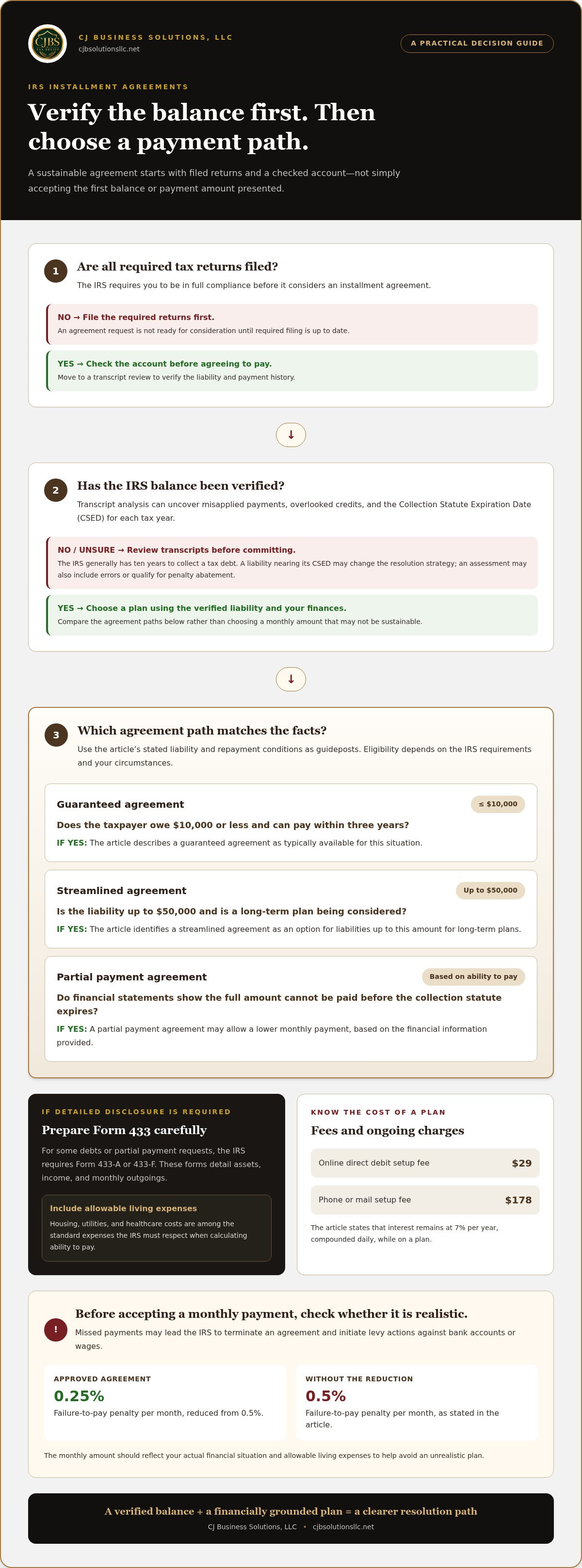
An IRS Installment Agreement is a formal legal contract between you and the federal government. It allows you to settle your tax debt over time, but the IRS requires you to be in full compliance first. This means all required tax returns must be filed before they'll even consider your request. While the IRS website promotes online applications as a quick fix, these automated systems often overlook errors in the original assessment. Setup fees for these plans vary, ranging from $29 for online direct debit applications to $178 for those handled by phone or mail. Seeking professional IRS installment agreement help ensures you aren't agreeing to pay more than you actually owe.
The IRS offers several options based on your total liability and financial situation:
- Guaranteed Agreements: Typically for those who owe $10,000 or less and can pay within three years.
- Streamlined Agreements: Available for liabilities up to $50,000 for long-term plans.
- Partial Payment Agreements: These allow for a lower monthly payment if your financial statements prove you can't pay the full amount before the collection statute expires.
The Consequences of Defaulting on an Unrealistic Plan
If a monthly payment is set too high, you risk the stress of a default. The IRS handles missed payments strictly; they may terminate the agreement and initiate immediate levy actions against your bank accounts or wages. Even while on a plan, interest remains at 7% per year, compounded daily as of late 2026. However, an approved agreement reduces the failure-to-pay penalty from 0.5% to 0.25% each month. Professional representation ensures your payment aligns with your actual cost of living, protecting your family's basic needs while you work toward resolution. This methodical approach to IRS installment agreement help prevents the cycle of broken agreements and mounting penalties.
Preparing Your Case: The Power of IRS Transcript Analysis
Transcript analysis is a forensic review of your federal tax history. Before you commit to any IRS payment plans, it's vital to ensure the balance is correct. Many taxpayers unwittingly accept assessments that include misapplied payments or overlooked credits. By performing a deep dive into your transcripts, an expert can identify the Collection Statute Expiration Date (CSED). This date is crucial. The IRS generally has only ten years to collect a tax debt. If some of your liability is nearing this limit, it may significantly change your negotiation strategy. Knowing exactly when the clock runs out on each tax year provides a level of protection that automated systems simply don't offer.
Professional IRS installment agreement help often begins with this diagnostic step. It prevents you from paying on debt that should legally be written off or reduced through penalty abatement. This methodical review provides a transparent view of your standing, allowing you to move forward with quiet confidence. If you're unsure about the accuracy of your current liability, a comprehensive transcript analysis can provide the clarity you need to negotiate from a position of knowledge.
Navigating Financial Disclosures and Form 433
When a debt exceeds certain thresholds, or if you're requesting a partial payment plan, the IRS requires detailed financial disclosures via Form 433-A or 433-F. These forms are complex and demand a precise accounting of your assets, income, and monthly outgoings. A key part of this process is documenting "allowable living expenses." These are standard costs for housing, utilities, and healthcare that the IRS must respect when calculating your ability to pay. An expert provides IRS installment agreement help by ensuring these figures are documented accurately, protecting your household budget from aggressive collection tactics. This strategic preparation transforms a stressful disclosure into a controlled, professional presentation that reflects your true financial reality.
Securing Professional Representation for Your Tax Resolution
Directly engaging with federal collection officers can be an overwhelming experience. Seeking professional IRS installment agreement help allows you to step back while an expert manages the complex correspondence and negotiations. An Enrolled Agent (EA) possesses the unique authority to represent taxpayers before all levels of the IRS, from initial collections to appeals. This professional buffer does more than just lower your stress; it ensures that your rights are protected throughout the resolution process.
Beyond simply setting up a payment plan, an expert evaluates your eligibility for penalty abatement. If you have "reasonable cause" for a late filing or payment, such as a serious illness or natural disaster, you may qualify for relief from certain penalties. When exploring options for paying taxes, having an advocate who understands these nuances can lead to a more favorable total outcome. This comprehensive approach focuses on long-term compliance, helping you establish habits that prevent future tax issues and protect your financial standing for years to come.
The Strategic Advantage of an Enrolled Agent
Unlike "quick fix" tax companies that often rely on high-volume processing, an Enrolled Agent provides a methodical and personalized defense. They're specifically trained in tax resolution and collection defense, maintaining a deep understanding of the Internal Revenue Manual. This specialized expertise is vital when managing aggressive collection actions or complex financial disclosures. Providing dedicated IRS installment agreement help is about substance over flash, helping you secure a sustainable agreement that truly fits your budget. Speak with our Enrolled Agent about your IRS installment agreement options today.
Moving Forward with Confidence and Clarity
Securing a sustainable resolution requires a deep understanding of your tax history and a strategic approach to negotiation. We've explored how forensic transcript analysis ensures you aren't overpaying and how professional representation protects your assets from aggressive collection actions. When you seek expert IRS installment agreement help, you gain a partner who prioritizes your long-term financial health and peace of mind.
CJ Business Solutions, LLC is led by an Enrolled Agent with federal representation rights, specializing in forensic transcript analysis and audit strategy defense. We invite you to Request a Professional Transcript Analysis and Consultation to find the clarity you deserve. You don't have to manage this complex process alone. A methodical, step-by-step approach can turn a stressful tax dispute into a manageable path forward.
Frequently Asked Questions
How much does it cost to set up an IRS installment agreement in 2026?
Setup fees for 2026 depend on your application method. An online application with direct debit costs $29, while applying by phone or mail without direct debit can cost $178. Low-income taxpayers may qualify for fee waivers or a $43 reimbursable fee. Seeking professional IRS installment agreement help ensures you choose the most cost-effective path for your specific financial situation.
Can the IRS reject my request for a payment plan?
Yes, the IRS may decline a request if you haven't filed all required tax returns. They might also reject a plan if they believe you have the assets to pay the debt immediately. Providing incomplete financial statements on Form 433 often leads to delays or denials. A methodical review of your finances before applying helps prevent these common complications.
Will an installment agreement stop the IRS from taking my tax refund?
An approved agreement does not prevent the IRS from seizing your future tax refunds. By law, the government will apply any federal or state refunds to your unpaid balance until the debt is satisfied. While this helps pay down the 7% interest more quickly, you should plan your household budget without expecting a refund check until your liability is cleared.
What is the difference between a short-term payment plan and an installment agreement?
A short-term plan allows up to 180 days to pay the balance and carries no setup fee for debts under $100,000. In contrast, a long-term installment agreement covers periods up to 72 months and requires a fee. Short-term plans are often best for those who only need a few months to liquidate assets or secure personal financing.
Do I need an Enrolled Agent to help me with my IRS payment plan?
Representation isn't legally required, but it provides a strategic advantage. An Enrolled Agent uses transcript analysis to verify that the IRS isn't overcharging you before you sign a contract. This professional IRS installment agreement help acts as a buffer against aggressive collections and ensures your repayment terms are sustainable. Having a seasoned mentor guide you often leads to better outcomes.

Article by
Crystal R. Johnson, MBA EA
Crystal Johnson founded CJ Business Solutions to give individuals and small-business owners something often missing from the tax and accounting process: clear explanations, practical solutions, and trusted support.
With more than 27 years of accounting and financial experience, Crystal helps clients understand complicated tax matters, restore compliance, respond to IRS concerns, and make stronger business decisions. As an Enrolled Agent, she is federally authorized to represent taxpayers before the Internal Revenue Service.


