

What if the most significant risk to your personal savings isn't a market downturn, but the specific way the IRS handles the process of resolving payroll tax debt? Many business owners feel a deep sense of unease when aggressive collection notices arrive, especially with 2026 underpayment interest rates reaching 7% this year. It's natural to feel overwhelmed by the complexity of federal requirements or the looming shadow of the Trust Fund Recovery Penalty. You've worked tirelessly to build your enterprise, and the thought of a tax lien threatening your livelihood is understandably distressing.
There's a methodical path forward that prioritizes your business's continuity and your personal peace of mind. This guide explores how transcript analysis serves as a vital diagnostic tool to clarify your standing. We'll outline a clear strategy to halt collections and safeguard your assets through specialized resolution paths, helping you return your focus to your company's long-term health and stability.
Key Takeaways
- You will gain a clear understanding of why the IRS prioritizes Form 941 collections and how you can protect your personal assets from the Trust Fund Recovery Penalty.
- We provide a detailed look at the strategic options for resolving payroll tax debt, including streamlined installment agreements that help maintain your business's financial stability.
- You will learn how the diagnostic process of transcript analysis provides a transparent view of your tax history, ensuring your resolution plan is based on accurate data.
- Understand the advantages of working with an Enrolled Agent, a professional who holds an elite status for federal tax representation and specializes in strategic audit defense.
Understanding Payroll Tax Debt and the Personal Liability Trap
When a business withholds taxes from an employee's paycheck, those funds don't belong to the company. They're held in trust for the U.S. Treasury. This fiduciary responsibility is why the IRS views Form 941 debt with such gravity. Understanding Payroll Tax obligations helps clarify that these are not just business expenses; they're employee contributions. Because these funds were never yours to keep, the IRS prioritizes their collection over standard income tax obligations.
The path toward resolving payroll tax debt often begins with a CP2100 notice, which signals a discrepancy. If left unaddressed, the situation progresses through increasingly urgent communications. This cycle typically culminates in the 1058 Final Notice of Intent to Levy. At this stage, the government gains the authority to seize business assets or bank accounts to satisfy the debt. The Trust Fund Recovery Penalty serves as the IRS's primary mechanism for piercing the corporate veil to hold individuals personally accountable for unpaid trust fund taxes.
The Trust Fund Recovery Penalty (TFRP) Explained
The IRS doesn't limit its reach to the business entity alone. It looks for "responsible persons," which can include owners, officers, or even employees with check-signing authority. If you had the power to direct payments and chose to pay other creditors instead of the IRS, you meet the "willfulness" standard. This assessment often occurs during a Form 4180 interview. Having an Enrolled Agent present is vital during this meeting, as your responses determine if your personal bank accounts and assets become fair game for collection. A proactive strategy for resolving payroll tax debt is the most reliable way to prevent these personal consequences.
Strategic Options for Resolving Federal Payroll Tax Liabilities
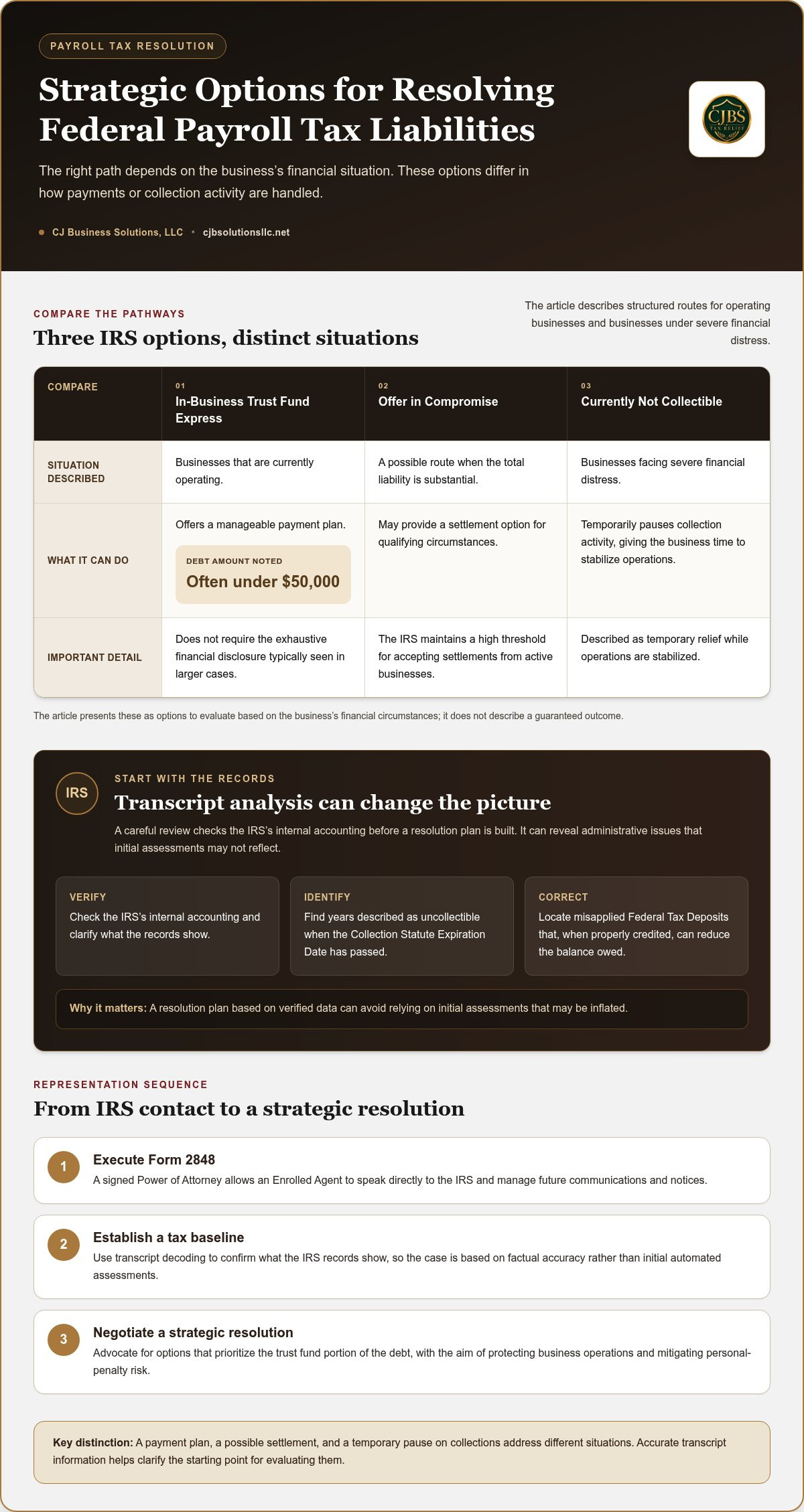
When exploring the landscape of resolving payroll tax debt in 2026, it's helpful to understand that the IRS provides several structured pathways tailored to different financial situations. For businesses that are currently operating, an In-Business Trust Fund Express agreement allows for a manageable payment plan, often for debts under $50,000, without requiring the exhaustive financial disclosure typically seen in larger cases. If the total liability is substantial, an Offer in Compromise might be considered, though the IRS maintains a high threshold for accepting these settlements for active businesses. For those facing severe financial distress, Currently Not Collectible status offers a temporary pause on collection activities, providing much-needed breathing room while you stabilize your operations. Reviewing the available IRS options for tax debt is a constructive first step toward regaining control.
The Power of IRS Transcript Analysis in Resolution
We believe that every successful resolution starts with a meticulous diagnostic phase. Transcript analysis allows us to verify the IRS's internal accounting and identify "uncollectible" years where the Collection Statute Expiration Date has passed. It's surprisingly common to find misapplied Federal Tax Deposits that, when properly credited, can significantly reduce the total balance owed. At CJ Business Solutions, LLC, we prioritize transcript decoding to uncover administrative errors that automated IRS systems often overlook. This methodical approach ensures your resolution plan is based on accurate data rather than initial, often inflated, assessments. If you're feeling uncertain about your current standing, our transcript analysis services provide the clarity needed to build a sustainable and stress-reducing path forward.
Working with an Enrolled Agent to Protect Your Business Interests
An Enrolled Agent holds an elite status granted directly by the IRS, authorized to represent taxpayers across the country. While many business owners rely on a general CPA for annual filings, an EA specializes specifically in tax controversy and resolution. This distinction is vital when you're resolving payroll tax debt, as the process requires a deep familiarity with IRS procedural manuals that go beyond standard accounting. It's a specialized focus that ensures your case is handled by someone who speaks the language of federal tax authorities every day.
At CJ Business Solutions, LLC, we utilize a "soft-touch" methodology that prioritizes your peace of mind. We understand that receiving a final notice of intent to levy causes significant stress, so we focus on a methodical, logical progression rather than high-pressure tactics. Our ultimate goal is your long-term financial compliance and the maintenance of a stable relationship with the IRS. We don't just aim for a temporary fix; we strive to establish a sustainable path that respects your company's autonomy.
Steps to Professional Representation
- Step 1: Execute Form 2848. By signing a Power of Attorney, you allow your EA to speak directly to the IRS. This step effectively halts the direct pressure on you, allowing a professional to manage all future communications and notices.
- Step 2: Establish a Tax Baseline. We use our specialized transcript decoding to verify exactly what the IRS records show. This ensures we're negotiating from a position of clarity and factual accuracy rather than responding to initial, automated assessments.
- Step 3: Negotiate a Strategic Resolution. We advocate for IRS tax debt relief options that prioritize the trust fund portion of the debt. This strategy is designed to protect your business operations while proactively mitigating the risk of personal penalties.
Securing Your Business Continuity and Personal Peace of Mind
The process of resolving payroll tax debt doesn't have to be defined by high-pressure notices or the fear of personal asset seizure. By understanding the fiduciary nature of trust fund liabilities and utilizing precise transcript analysis, you can establish a clear, factual baseline for negotiation. A methodical approach ensures that your business operations remain protected while you address federal obligations in a sustainable way.
At CJ Business Solutions, LLC, we provide national representation led by an Enrolled Agent authorized to practice before the IRS. Our specialized expertise in complex transcript decoding allows us to identify errors that others might miss. We invite you to Request a Professional Transcript Analysis and Resolution Consultation to begin your path toward long-term financial compliance. You've built a valuable enterprise; we're here to help you protect its stability and your peace of mind.
Frequently Asked Questions
Can the IRS take my personal house for my business’s payroll tax debt?
The IRS can potentially seize a personal residence if the Trust Fund Recovery Penalty is assessed against you personally. Once the corporate veil is pierced, your assets are at risk. While seizing a home is a complex process and often a last resort, it remains a legal possibility. It's better to address these liabilities before the IRS moves toward such aggressive collection actions.
How long does the IRS have to collect unpaid payroll taxes in 2026?
The IRS typically has 10 years to collect unpaid taxes from the date they're assessed. This timeframe is known as the Collection Statute Expiration Date. It's vital to monitor your transcripts. Certain events, like filing for an Offer in Compromise, can extend this window. Understanding your specific dates is a fundamental part of the diagnostic phase we prioritize for every client.
What is the difference between a 941 tax debt and a 940 tax debt?
Form 941 debt involves quarterly withholdings for employee income, Social Security, and Medicare taxes. Form 940 debt covers annual federal unemployment taxes. The IRS views 941 liabilities with much greater urgency. Those funds are held in trust. Consequently, resolving payroll tax debt related to Form 941 is often more complex and carries higher risks for business owners who don't act quickly.
Can I file for bankruptcy to get rid of payroll tax liabilities?
Bankruptcy rarely discharges payroll tax liabilities. The trust fund portion is considered a priority debt. While bankruptcy might offer relief for other financial obligations, it won't eliminate the fiduciary duty to pay withheld taxes. Successfully resolving payroll tax debt usually involves negotiating directly with the IRS. We look for payment plans or settlement programs that recognize the unique nature of these federal obligations.

Article by
Crystal R. Johnson, MBA EA
Crystal Johnson founded CJ Business Solutions to give individuals and small-business owners something often missing from the tax and accounting process: clear explanations, practical solutions, and trusted support.
With more than 27 years of accounting and financial experience, Crystal helps clients understand complicated tax matters, restore compliance, respond to IRS concerns, and make stronger business decisions. As an Enrolled Agent, she is federally authorized to represent taxpayers before the Internal Revenue Service.


