

The arrival of a final notice of intent to levy often brings an immediate sense of urgency, especially when you realize the IRS possesses the unique authority to garnish your wages without first obtaining a court order. You likely feel a heavy burden of concern regarding how this will affect your household budget or what your employer might think when they receive the official paperwork. It's entirely natural to feel unsettled by the complex language found in these federal notices.
If you are currently seeking IRS wage garnishment help, please know that methodical, professional strategies exist to release the levy and restore your financial stability. This guide explains how to utilize detailed transcript analysis to identify underlying issues and negotiate sustainable payment arrangements. We will also discuss the steps required to establish a clear path toward permanent tax compliance and lasting peace of mind.
Key Takeaways
- Understand the legal mechanisms of a wage levy and how the 30-day notice window provides a critical opportunity to protect your income before collections begin.
- Explore how professional IRS wage garnishment help can facilitate a levy release by demonstrating economic hardship or establishing a structured installment agreement.
- Learn how an Enrolled Agent serves as a dedicated buffer between you and the IRS, utilizing full representation rights to negotiate directly on your behalf.
- Discover the importance of strategic transcript analysis as a diagnostic tool to identify underlying errors and ensure your long-term tax compliance.
Understanding IRS Wage Garnishment and Your Rights in 2026
What is Wage Garnishment refers to the legal seizure of your salary to satisfy federal tax liabilities. Unlike private creditors who must seek a judgment through the court system, the IRS doesn't require a court order to initiate this process. This means your employer could receive a directive to withhold a portion of your take-home pay without a judge ever signing an order.
It's a continuous process that remains in effect until the debt is satisfied or a formal resolution is reached. When individuals seek IRS wage garnishment help, they often feel overwhelmed by the speed of these events. Understanding the statutory timeline is the first step toward regaining control over your finances.
The Legal Timeline of an IRS Levy
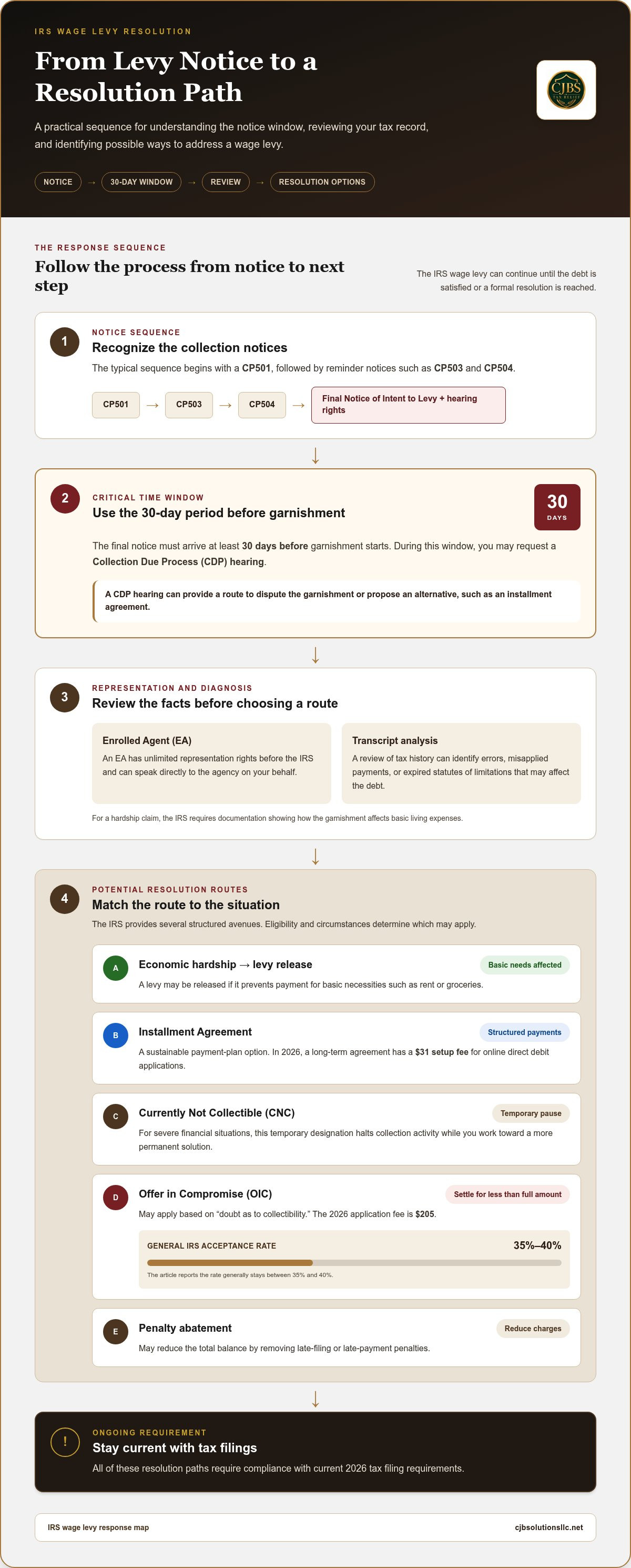
The IRS follows a structured sequence of notifications before seizing funds. It typically begins with a CP501 notice, followed by reminder notices like the CP503 and CP504. Each document serves as a request for payment and a warning of potential collection actions. The final step is the "Final Notice of Intent to Levy and Notice of Your Right to a Hearing," which must arrive at least 30 days before the garnishment starts.
Protecting Your Rights via CDP Hearings
During this 30-day window, you have the right to request a Collection Due Process (CDP) hearing. This legal avenue allows you to dispute the garnishment or propose alternative solutions, such as an installment agreement. This 30-day grace period represents the most vital time for professional intervention to stop the levy before it impacts your paycheck. Accessing professional IRS wage garnishment help during this phase often provides the stability needed to navigate complex federal procedures.
Strategic Methods to Stop or Release an IRS Wage Levy
If you find yourself facing a levy, it's helpful to know that the IRS provides several structured avenues for relief. A levy release is often granted if the garnishment creates an immediate economic hardship, meaning it prevents you from paying for basic necessities like rent or groceries. According to the IRS rules on wage levies, the agency must release a levy if it determines the action is causing such a financial strain.
For many, the most sustainable path to IRS wage garnishment help is establishing an Installment Agreement. In 2026, the IRS offers several options for these payment plans, such as a long-term agreement with a $31 setup fee for online direct debit applications. If your financial situation is more severe, you might qualify for "Currently Not Collectible" status. This temporary designation halts collection activities while you work toward a more permanent solution. It's a helpful bridge for those who truly cannot pay basic living expenses while managing their tax debt.
Advanced Resolution Paths: OIC and Penalty Abatement
An Offer in Compromise (OIC) allows you to settle your debt for less than the full amount based on "doubt as to collectibility." While the application fee for an OIC in 2026 is $205, the IRS acceptance rate generally stays between 35% and 40%. Additionally, penalty abatement can often reduce your total balance by removing late-filing or late-payment charges. It's important to remember that all these paths require you to be fully compliant with your current 2026 tax filing requirements. If you're unsure which strategy fits your needs, exploring tax resolution services can provide the clarity you deserve.
Professional Resolution: How an Enrolled Agent Secures Your Income
An Enrolled Agent (EA) is a federally authorized tax practitioner who possesses unlimited representation rights before the IRS. This distinction is vital for those seeking IRS wage garnishment help because it allows the EA to act as a direct buffer between you and the agency. Instead of managing complex phone calls or correspondence yourself, your representative speaks directly to the IRS on your behalf. This professional distance often lowers a taxpayer's stress significantly, as it replaces emotional interactions with a calm, methodical negotiation process.
A primary goal for many in this situation is to release a levy due to economic hardship. An EA understands the specific documentation the IRS requires to prove that a garnishment prevents you from meeting basic living expenses. By presenting your financial situation clearly and accurately, they can advocate for a release while simultaneously working on a long-term resolution plan that protects your future earnings.
The Power of IRS Transcript Analysis
Effective tax resolution begins with a thorough diagnostic phase. Rather than jumping to a quick fix, a seasoned practitioner uses transcript analysis to review your entire tax history. This process identifies errors, misapplied payments, or even expired statutes of limitations that might invalidate the debt. Understanding these details is the first step in building a robust audit strategy defense and obtaining comprehensive IRS wage garnishment help. It's often through this deep dive into the records that we find the most effective path toward stability. We invite you to partner with a reliable guide who prioritizes your long-term financial health and provides the steady support you need to resolve these issues permanently.
Restoring Stability and Protecting Your Future Income
Resolving a federal levy requires a blend of timely action and technical expertise. By understanding your rights during the 30-day notice period and utilizing detailed transcript analysis, you can move beyond immediate financial fear toward a sustainable resolution. Whether you're seeking IRS wage garnishment help or simply looking to understand your options, the path to recovery's always more manageable with a steady partner by your side.
At CJ Business Solutions, LLC, we focus on protecting national clients through expert IRS representation and audit strategy defense. Led by an Enrolled Agent, our firm prioritizes your long-term financial health by identifying the specific errors or opportunities within your tax history. We invite you to consult with an Enrolled Agent at CJ Business Solutions to stop your wage garnishment and regain your peace of mind. Taking this first step allows you to replace uncertainty with a methodical plan for lasting tax compliance. You don't have to face the IRS alone.
Frequently Asked Questions
How much of my paycheck can the IRS legally garnish in 2026?
The amount exempt from a levy is determined by your filing status, dependents, and pay frequency according to IRS Publication 1494. For 2026, a single taxpayer with no dependents paid weekly has $309.62 exempt from garnishment. Those seeking IRS wage garnishment help often find that professional representation ensures these exemptions are correctly calculated, protecting as much of their take-home income as legally possible.
Can I stop a wage garnishment by filing for bankruptcy?
Filing for bankruptcy generally triggers an automatic stay that stops most IRS collection actions, including wage garnishments. However, bankruptcy is a significant legal step with long-term financial consequences. Many taxpayers find that seeking specialized resolution through programs like installment agreements or offers in compromise provides a more focused solution without the broader impact of a bankruptcy filing on their credit history.
What happens if I ignore the IRS Notice of Intent to Levy?
Ignoring this notice typically leads to the IRS contacting your employer to begin seizing a portion of your salary after the 30-day grace period expires. Once the garnishment starts, it remains continuous until the debt is paid or a formal release is negotiated. Proactive engagement during the initial window allows you to request a Collection Due Process hearing and explore resolution paths.
How long does it take for a professional to get a wage levy released?
A professional can often secure a levy release within a few days to two weeks, depending on the complexity of your tax history. The process involves submitting financial statements to prove economic hardship or establishing a formal payment plan. Utilizing transcript analysis allows a representative to identify the fastest resolution path, providing the IRS wage garnishment help needed to restore your income quickly.

Article by
Crystal R. Johnson, MBA EA
Crystal Johnson founded CJ Business Solutions to give individuals and small-business owners something often missing from the tax and accounting process: clear explanations, practical solutions, and trusted support.
With more than 27 years of accounting and financial experience, Crystal helps clients understand complicated tax matters, restore compliance, respond to IRS concerns, and make stronger business decisions. As an Enrolled Agent, she is federally authorized to represent taxpayers before the Internal Revenue Service.


