
An IRS transcript is far more than a simple summary of your filing; it's a diagnostic roadmap that can alert you to a potential audit long before a formal notice arrives. It's natural to feel uneasy when you see rows of cryptic transaction codes and unfamiliar figures on your official record. Many taxpayers worry that a misunderstood line could lead to unexpected liabilities. Performing a regular tax transcript review for errors is one of the most effective ways to maintain peace of mind and ensure your financial history remains accurate.
This 2026 guide teaches you how to systematically analyze your IRS records to identify discrepancies and decode the language the agency uses to track your account. We'll walk through the transcript types, how to spot common math mistakes, and how to address missing transaction codes that sometimes occur in the IRS system. You'll gain the tools to resolve issues early and understand when to seek the guidance of an Enrolled Agent to protect your interests.
Key Takeaways
- Understand why an IRS transcript provides a more definitive view of your account status than your personal records, helping you identify math errors or reporting mismatches early.
- Learn a methodical approach to cross-referencing your filed Form 1040 with official IRS data to ensure every payment and credit is accurately documented.
- Discover how a proactive tax transcript review for errors can help you identify and resolve discrepancies before they escalate into a formal audit or result in unexpected penalties.
- Gain clarity on the specific procedures for correcting transcript issues, including how to respond to automated notices and when to involve an Enrolled Agent for professional representation.
Understanding the Significance of a Tax Transcript Review
While having a personal copy of your filing is essential for understanding your tax return, it only represents what you submitted to the agency. An IRS transcript, however, reflects what the government actually processed and accepted into their system. This distinction is the primary reason why a tax transcript review for errors is a vital preventative measure. It allows you to see the exact data the IRS is using to calculate your obligations, including any automated adjustments they might have applied without your immediate knowledge.
These documents are particularly helpful for identifying math errors or instances of mismatched information from third-party payers like banks or employers. If a reported income figure doesn't align with your records, the transcript will highlight the discrepancy before it escalates. By addressing these variances early, you can often prevent the issuance of a formal Notice of Deficiency. Given that the IRS interest rate for underpayments is 7% as of July 2026, resolving these issues quickly protects your financial stability and prevents unnecessary debt accumulation.
Choosing the Right Transcript Type
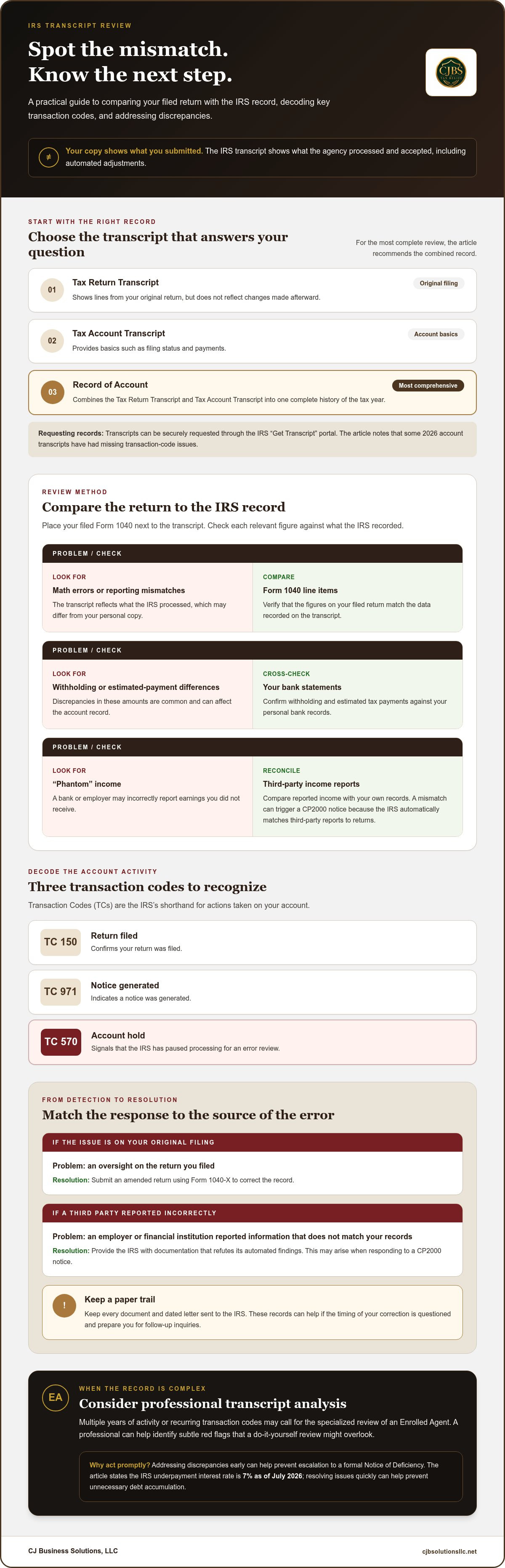
Selecting the appropriate document is necessary for a thorough analysis. While a Tax Return Transcript shows the lines from your original filing, it doesn't reflect changes made after the fact. A Tax Account Transcript provides basics like your filing status and payments. For the most comprehensive tax transcript review for errors, we recommend requesting a Record of Account. This combines both documents into one, offering a complete history of your tax year. You can securely request these via the IRS "Get Transcript" portal, though be aware that some 2026 account transcripts have experienced issues with missing transaction codes. An Enrolled Agent can often decode these documents with a level of precision that ensures no subtle error is missed.
A Systematic Approach to Spotting Errors on Your IRS Record
Conducting a thorough tax transcript review for errors begins with a side-by-side comparison of your records. We suggest placing your filed Form 1040 next to the transcript to verify that every line item matches the data the IRS recorded. It's particularly important to confirm that withholding amounts and estimated tax payments align perfectly with your personal bank statements. Discrepancies here are common. Identifying these errors is often the first step in a successful tax resolution process.
You should also remain vigilant for 'phantom' income entries. These occur when a bank or employer incorrectly reports earnings that you never actually received. Because the IRS uses automated systems to match these third-party reports to your return, even a small reporting error can trigger a CP2000 notice. If you don't reconcile these figures early, the IRS may assume the higher income figure is correct. Understanding the proper protocol for Responding to IRS Notices is essential if you discover these types of mismatches on your record.
Decoding Common Transaction Codes (TCs) That Signal Mistakes
Transaction Codes are the IRS's internal shorthand for every action taken on your account. TC 150 confirms your return was filed, whereas TC 971 indicates a notice was generated. If you encounter TC 570, it signals an 'account hold,' implying the IRS has paused processing for an error review. While these codes are complex, a professional transcript analysis helps you complete a tax transcript review for errors without missing subtle red flags.
Moving from Detection to Resolution of Transcript Discrepancies
Once you've identified a mismatch, the path to resolution depends on the nature of the mistake. If the discrepancy resulted from an oversight on your original filing, submitting an amended return via Form 1040-X is the most effective way to correct the record. However, if the transcript reflects a reporting error by a third party, such as an employer or financial institution, you'll need to provide the IRS with documentation that refutes their automated findings. This often occurs when responding to a CP2000 notice. We recommend maintaining a meticulous paper trail of every document and dated letter sent to the agency, as these records serve as your primary defense if the timeline of your correction is ever questioned. This organized approach helps lower stress and ensures you're prepared for any follow-up inquiries.
When to Engage a Professional Transcript Analysis Service
Complex tax histories involving multiple years of activity or recurring transaction codes often require the specialized eye of an Enrolled Agent. These professionals can identify subtle red flags that a DIY tax transcript review for errors might overlook, helping you avoid missteps that could lead to a full examination. Utilizing a professional tax transcript review for errors as a starting point provides a clear roadmap for resolution. At CJ Business Solutions, LLC, we prioritize education and resource-provision, treating transcript analysis as the foundational step in our comprehensive Tax Resolution Services. By building a strategic IRS audit defense around verified data, we help you resolve federal tax issues with quiet confidence and precision. Our firm acts as a seasoned mentor throughout this process, ensuring that your account is corrected thoroughly so you can move forward without the weight of unresolved liabilities.
Securing Your Financial Record with Confidence
Taking a proactive approach to your tax health is one of the most effective ways to ensure long-term peace of mind. By consistently performing a tax transcript review for errors, you can identify discrepancies between your records and the IRS system before they evolve into more complex issues. We've explored how to decode transaction codes and the steps required to resolve reporting mismatches through formal corrections. Maintaining this level of oversight allows you to address potential liabilities with clarity and composure.
If you encounter a complicated history or a notice that feels overwhelming, professional guidance can provide the stability you need. We invite you to request a professional transcript analysis from CJ Business Solutions, LLC to protect your interests. Our firm is led by a licensed Enrolled Agent who provides strategic audit defense and a comprehensive tax resolution roadmap. A reliable partner is ready to help you find a clear path forward.
Frequently Asked Questions
How do I know if the IRS made a mistake on my tax transcript?
You can identify an IRS mistake by cross-referencing your transcript figures with your original tax records and bank statements. If the "Tax Return" line items don't match your filed Form 1040, or if a payment isn't credited, there's likely a discrepancy. A methodical tax transcript review for errors is the best way to catch these issues before they escalate.
What is the most common error found during a tax transcript review?
The most frequent error involves income reporting mismatches, where third-party data from employers or banks doesn't align with your reported figures. These are often categorized as math errors or underreporting issues. Another common discovery during a tax transcript review for errors is the omission of withholding credits that the IRS hasn't yet properly applied to your account.
Can I fix an error on my transcript without going through a full audit?
Yes, many errors can be resolved through administrative channels without escalating to a full audit. If the mistake originated on your return, you can file an amended return using Form 1040-X. If the error was made by the IRS or a third party, you can often resolve it by responding to an IRS notice with supporting documentation like pay stubs.
What does 'Transaction Code 806' mean on my IRS transcript?
Transaction Code 806 (TC 806) indicates that the IRS has recorded the federal income tax withholding and excess social security taxes shown on your return. It's a credit to your account for the taxes already taken from your wages. If the amount listed under TC 806 doesn't match your W-2 or 1099 forms, it signals a mismatch that requires attention.
How long does it take for the IRS to correct a transcript error after I report it?
The timeline for corrections depends on the complexity of the issue and the current IRS workload. Many taxpayers find that amended returns or correspondence-based corrections can take several months to process. It's helpful to monitor your account regularly, especially since the IRS has reported system issues with missing transaction codes as of May 2026, which can complicate tracking.

Article by
Crystal R. Johnson, MBA EA
Crystal Johnson founded CJ Business Solutions to give individuals and small-business owners something often missing from the tax and accounting process: clear explanations, practical solutions, and trusted support.
With more than 27 years of accounting and financial experience, Crystal helps clients understand complicated tax matters, restore compliance, respond to IRS concerns, and make stronger business decisions. As an Enrolled Agent, she is federally authorized to represent taxpayers before the Internal Revenue Service.


