

What if the most effective way to protect your company isn't just filing forms, but understanding exactly what the IRS sees in your records before they ever send a notice? Most entrepreneurs view tax season with a sense of quiet apprehension, worrying that an unintentional error might disrupt their hard-earned stability. It is natural to feel a bit overwhelmed by shifting regulations, especially as you look toward the specific requirements and deadlines of 2026.
This guide will show you how to transform small business tax compliance from a source of stress into a proactive strategy for long-term security. You'll discover how to build a robust framework that leverages IRS transcript data to identify potential issues before they ever escalate into an audit. We will walk through the essential 2026 filing deadlines, explain the benefits of professional transcript analysis, and outline a methodical approach to audit defense that brings lasting peace of mind to your business operations. By shifting from a reactive mindset to a strategic one, you can focus on growth while knowing your professional obligations are fully met.
Key Takeaways
- Learn how shifting IRS enforcement trends in 2026 specifically impact the self-employed and small business sectors, allowing you to prepare with confidence.
- Discover the importance of "board-ready" record-keeping and how maintaining a clear boundary between personal and business finances protects your corporate integrity.
- Understand how specialized transcript analysis serves as a preventative health check for your small business tax compliance, identifying potential issues before they trigger an audit.
- Gain a clear perspective on the strategic role of an Enrolled Agent in providing federal representation and navigating complex tax resolution options for unresolved notices.
The Foundation of Small Business Tax Compliance in 2026
At its heart, small business tax compliance is the steady, ongoing process of ensuring your business meets its federal reporting and payment obligations. It's much more than a seasonal task. It's a commitment to transparency that serves as a foundation for your company's longevity. For an Overview of the U.S. Tax System, one must look at how federal requirements interact with your specific business structure. In 2026, we are seeing a distinct shift in IRS enforcement trends. The agency is dedicating more resources to the small business and self-employed sectors, which means having clear, accurate records is no longer optional. It's a strategic necessity.
Maintaining consistent small business tax compliance isn't just about avoiding penalties; it's about building a credible history for your enterprise. When your filings are in order, you find it much easier to secure traditional financing or build trust with sophisticated partners who value stability. A compliant business is a stable business.
Core Federal Tax Obligations for Entrepreneurs
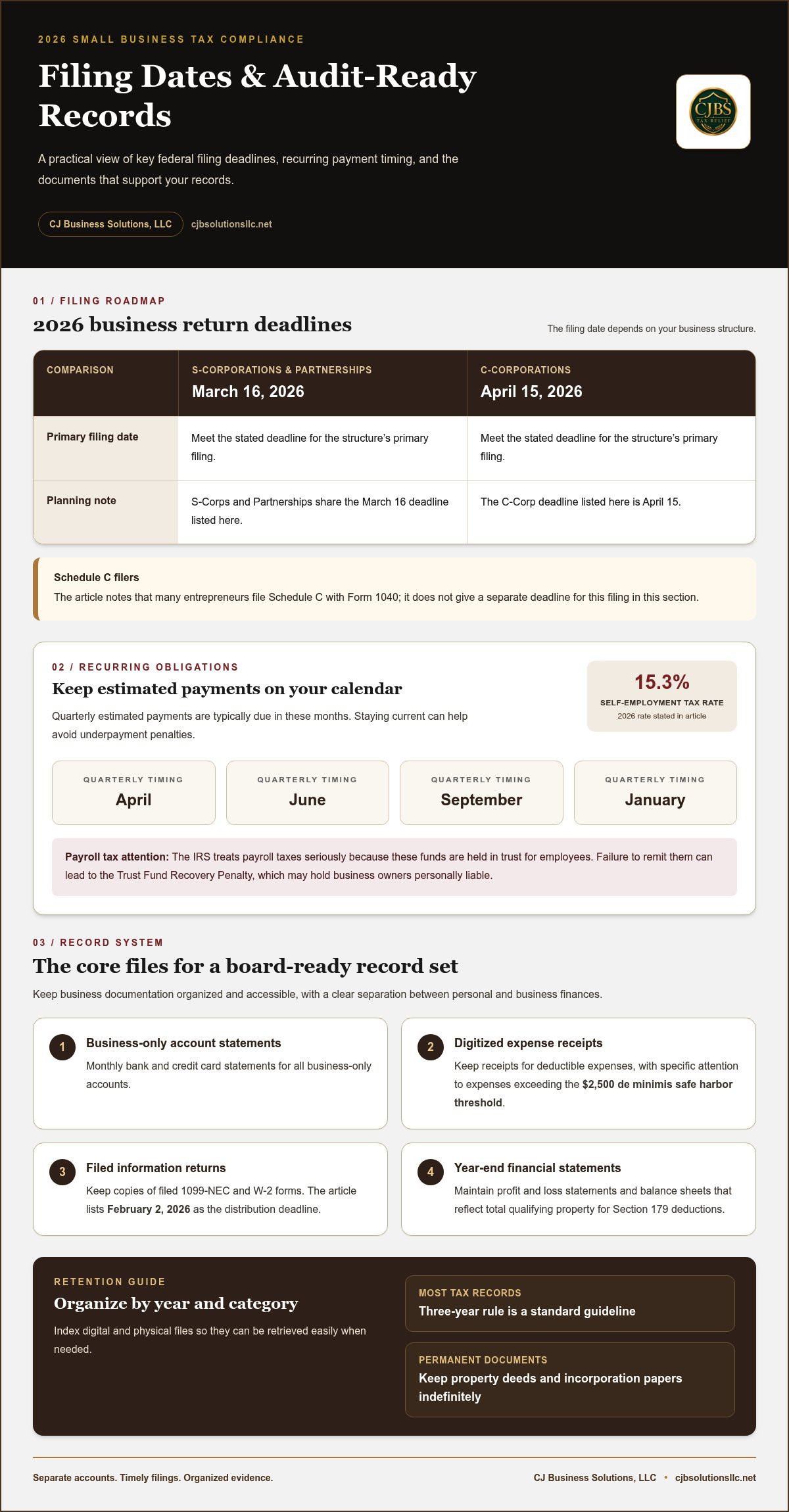
Your specific obligations often depend on whether you file a Schedule C with your Form 1040 or manage a more complex corporate structure. For most, the 2026 self-employment tax rate remains at 15.3%, covering Social Security and Medicare. It's vital to stay current with quarterly estimated payments, typically due in April, June, September, and January, to avoid underpayment penalties. Payroll taxes require even more diligence. The IRS takes these very seriously because they involve funds held in trust for employees. Failing to remit these can lead to the Trust Fund Recovery Penalty, which can hold business owners personally liable.
The Consequences of Non-Compliance
The risks of falling behind extend far beyond simple fines. IRS liens and levies can effectively halt your daily operations by freezing bank accounts or seizing assets. These actions create a public record that can damage your personal credit and limit your ability to scale. Unresolved tax issues often act as a weight on your business, preventing you from taking advantage of new opportunities. Maintaining a proactive compliance strategy ensures you remain in control of your financial future.
Navigating the Pillars: Filing, Reporting, and Record-Keeping
Building a successful enterprise requires more than just a great product; it demands a "board-ready" standard for your financial records. This means maintaining your documentation with such precision that any outside observer could immediately understand your business's health. When you approach small business tax compliance with this level of care, you aren't just following rules. You're creating a professional environment where growth is supported by verifiable data.
A fundamental step in this process is the absolute separation of personal and business finances. Mixing these accounts is a common oversight that can lead the IRS to "pierce the corporate veil," potentially exposing your personal assets to business liabilities. For official guidance on maintaining these boundaries, the IRS Small Business Tax Center provides detailed resources on how to structure your reporting to meet federal expectations. Timely reporting is your best defense against red flags, as it signals to the IRS that your business is managed with diligence and transparency.
To keep your operations running smoothly, ensure you have the following essential documents organized and accessible:
- Monthly bank and credit card statements for all business-only accounts.
- Digitized receipts for all deductible expenses, specifically those exceeding the $2,500 de minimis safe harbor threshold.
- Copies of filed 1099-NEC and W-2 forms, noting the February 2, 2026, deadline for distribution.
- Year-end profit and loss statements and balance sheets that reflect your total qualifying property for Section 179 deductions.
Strategic Record-Keeping for Audit Readiness
Organizing your records shouldn't be a frantic task performed only when a notice arrives. It's better to maintain a system where digital and physical files are indexed by year and category. While the "three-year rule" is a standard guideline for most tax records, it's wise to keep permanent documents, such as property deeds and incorporation papers, indefinitely. Having these files ready for easy retrieval demonstrates a high level of small business tax compliance and significantly lowers the stress of any inquiry.
Choosing the Right Business Structure for Tax Efficiency
Your choice of structure, whether it's an LLC, S-Corp, or C-Corp, dictates your specific filing roadmap. For instance, S-Corps and Partnerships must meet their primary filing deadline by March 16, 2026, while C-Corps have until April 15. Each structure carries different reporting nuances that can impact your overall tax efficiency. If you find the complexities of these requirements taxing, you might consider how professional tax and accounting services can help clarify your specific obligations and maintain your standing with federal authorities.
Advanced Compliance: Audit Defense and Transcript Analysis
While basic record-keeping establishes a reliable foundation, true excellence in small business tax compliance involves looking beneath the surface of your filed returns. Many business owners wait for a formal notice before reviewing their standing, yet the most successful entrepreneurs treat tax health as a proactive endeavor. By utilizing tools often overlooked by the general public, you can identify discrepancies long before they catch the eye of an auditor. This high-level oversight ensures that your business remains a calm port, even when federal enforcement trends shift toward increased scrutiny.
Decoding Your History with Transcript Analysis
An IRS transcript is essentially a comprehensive log of every action taken on your account. It tracks payments, credits, and any automated flags that might suggest an inconsistency. You can use this data as a "preventative health check" to ensure that the 15.3% self-employment tax you've been paying is correctly applied to your record. Following the guidance in the SBA Guide to Paying Business Taxes helps maintain this operational health. Specialized analysis allows you to spot misapplied payments or missing credits that could otherwise lead to unnecessary penalties or interest charges throughout 2026.
The Enrolled Agent Advantage in Audit Defense
Effective audit defense starts months, or even years, before an inquiry letter arrives. It's built upon the "board-ready" standards we discussed earlier, reinforced by professional oversight. An Enrolled Agent is a federally-authorized tax practitioner who has technical expertise in the field of taxation and is empowered by the U.S. Department of the Treasury to represent taxpayers before all administrative levels of the IRS. This status is vital for small business tax compliance because it allows a seasoned mentor to stand between you and the agency.
Professional representation protects you from direct interrogation, ensuring that your rights are upheld and that the conversation remains focused on the facts of your return. You shouldn't view this as a mere expense; it's a strategic investment in your company's stability. Engaging in professional IRS audit strategy defense often pays for itself by preventing the escalation of minor errors into costly, long-term disputes that could otherwise drain your resources and focus.
Resolving Non-Compliance: A Strategic Recovery Roadmap
Receiving an IRS notice often feels like a sudden storm, yet every tax issue has a methodical path to resolution. If you realize you've fallen behind on filings or payments, the first step is to pause and assess the situation with a clear head. Moving from a state of crisis back to steady small business tax compliance is entirely possible with the right strategy and professional guidance. We act as a seasoned mentor during these times, providing the calm expertise needed to navigate complex disputes with federal authorities.
Negotiating Favorable Outcomes with the IRS
One of the most effective ways to reduce a financial burden is through penalty abatement. For the 2025 tax period and 2026 quarterly returns, the IRS Automatic Exemption from Penalty (AEP) program may provide relief to businesses with a consistent history of compliance. If you don't qualify for automatic relief, you can often demonstrate "reasonable cause" for delays, such as unexpected illness or natural disasters. By conducting a strategic transcript review, we build a case for tax debt reduction using tools like an Offer in Compromise or structured Installment Agreements. These Tax Resolution Services are designed to help you settle obligations while protecting your business's daily operations.
Long-Term Maintenance of Tax Health
Once your immediate issues are resolved, the focus shifts to maintaining your stability. Setting up automated systems for your quarterly estimated payments, specifically for the September 15 and January 15 due dates, removes the guesswork from your financial planning. It's also helpful to implement a standard process for payroll taxes to avoid the severe personal liabilities mentioned in earlier sections. An annual compliance review with a professional Enrolled Agent provides an additional layer of security. This proactive approach transforms tax management from a source of stress into a quiet, reliable part of your long-term business success.
Securing Your Business Future for 2026 and Beyond
True small business tax compliance is a journey toward operational stability rather than a simple race to meet a deadline. By adopting a "board-ready" standard for your financial records and embracing proactive tools like specialized IRS transcript analysis, you protect your company from the stress of the unknown. These strategies don't just prevent errors; they build a legacy of transparency that supports your long-term success and peace of mind.
Navigating federal regulations requires a steady hand and a clear perspective. Whether you are seeking comprehensive audit defense strategies or need an Enrolled Agent to represent your interests, we are here to act as your reliable guide. We specialize in helping entrepreneurs resolve complex issues and return to a state of calm, predictable growth. You don't have to manage these professional obligations alone.
Secure your business with expert tax resolution and compliance services to ensure your enterprise remains protected. We look forward to helping you build a more resilient and confident future for your business.
Frequently Asked Questions
What are the most common tax compliance mistakes for small businesses?
The most frequent errors include the co-mingling of personal and business funds and failing to make timely quarterly estimated payments. These oversights often trigger IRS inquiries that could have been avoided with a more methodical approach to record-keeping. Maintaining a "board-ready" standard for your documentation ensures that your small business tax compliance remains intact and your corporate veil is protected from scrutiny.
How does an Enrolled Agent differ from a CPA regarding IRS audits?
While both professionals are highly qualified, an Enrolled Agent is a federally-authorized tax practitioner who specializes specifically in taxation and has unlimited rights to represent taxpayers before the IRS. CPAs are state-licensed and often have a broader focus on general accounting or financial reporting. Because EAs are tested directly by the Treasury on federal tax matters, they are uniquely positioned to handle complex audit defense and strategic representation.
What should I do if my small business has several years of unfiled taxes?
If you have unfiled returns, the most effective step is to begin the filing process as soon as possible to minimize late-filing penalties. The IRS generally views voluntary disclosure more favorably than discovery through a formal enforcement action. You may find it helpful to engage in tax resolution services to explore options such as installment agreements or penalty abatement, which provide a structured and calm path back to good standing.
How much does it cost to have an IRS audit strategy defense in place?
The investment for audit defense services typically depends on the complexity of your business structure and the current state of your financial records. Rather than viewing this as a simple expense, it is better to see it as a strategic safeguard that prevents the escalation of minor errors into significant liabilities. Professional representation ensures that your rights are upheld and that any conversation with federal authorities remains focused, professional, and controlled.
Can IRS transcript analysis help me avoid a future audit?
Yes, specialized transcript analysis acts as a preventative health check by identifying discrepancies or automated flags before the IRS sends an official notice. By reviewing your account history, we can spot misapplied payments or missing credits that might otherwise trigger a manual review. This proactive tool is a cornerstone of robust small business tax compliance, allowing you to address potential issues while they are still manageable and quiet.

Article by
Crystal R. Johnson, MBA EA
Crystal Johnson founded CJ Business Solutions to give individuals and small-business owners something often missing from the tax and accounting process: clear explanations, practical solutions, and trusted support.
With more than 27 years of accounting and financial experience, Crystal helps clients understand complicated tax matters, restore compliance, respond to IRS concerns, and make stronger business decisions. As an Enrolled Agent, she is federally authorized to represent taxpayers before the Internal Revenue Service.


