

The most effective path to resolving tax debt isn't a quick fix found in a marketing slogan; it's a forensic exercise buried within your IRS transcripts. If you've received aggressive collection notices or fear the sudden impact of a bank levy, you're likely feeling a deep sense of uncertainty. It's common to feel overwhelmed by complex codes and the 7% underpayment interest rate set for the third quarter of 2026. Seeking professional help with back taxes is a vital step toward reclaiming your peace of mind and stopping the cycle of compounding penalties.
You deserve a clear, methodical plan to reach "current" status with the IRS and regain your financial stability. Through expert representation, you can navigate the nuances of the Offer in Compromise program or establish a sustainable Installment Agreement that fits your specific circumstances. This guide explores legitimate pathways to resolution, including the new Automatic Exemption from Penalty system launching in the summer of 2026. We'll examine how a detailed transcript analysis serves as the foundation for a successful strategy, allowing you to move forward with quiet confidence and steady professional support.
Key Takeaways
- Recognize the stages of the IRS collection cycle to better understand the timeline from your first notice to more serious enforcement actions.
- Evaluate formal resolution strategies such as Installment Agreements and Offers in Compromise to determine which pathway best supports your financial recovery.
- Identify why seeking help with back taxes from an Enrolled Agent offers specialized expertise in navigating complex federal tax codes and representation.
- Learn how a thorough transcript analysis serves as a necessary first step to identify IRS errors and confirm the accuracy of your reported debt.
- Establish a clear sequence of actions, starting with tax compliance, to stop aggressive collection efforts and regain your long-term financial stability.
Understanding Federal Back Taxes and the IRS Collection Cycle
Understanding what back taxes are is the first step toward resolution. These liabilities accrue when the tax reported on a return isn't paid by the due date, or when the IRS determines a higher tax is owed than what was originally filed. For the third quarter of 2026, the interest rate for underpayment is 7%, and it compounds daily. This means the balance grows every day you wait, making early intervention essential for your financial health.
The IRS follows a steady, predictable collection cycle. It usually begins with a CP501 notice, which acts as a professional reminder of a balance due. If you don't respond, the notices become increasingly firm, eventually leading to a Final Notice of Intent to Levy. This entire process is governed by the Collection Statute Expiration Date (CSED). Generally, the IRS has a 10-year window to collect the debt. While this sounds like a long duration, the combination of interest and the 0.5% monthly failure-to-pay penalty can cause the total amount to swell significantly over a decade.
Common Triggers for Back Tax Liabilities
Many taxpayers find themselves in need of help with back taxes due to specific administrative triggers. If you haven't filed, the IRS may create a "Substitute for Return" (SFR). This version rarely includes the deductions or exemptions you're entitled to, often resulting in a much higher tax bill than necessary. Other common triggers include:
- Underreporting income identified during a federal examination or audit.
- Missing quarterly estimated payments, which is a frequent hurdle for self-employed individuals.
- Errors in calculating credits or deductions that lead to an unexpected balance.
Your Rights as a Taxpayer
Even when you owe the federal government, you aren't without protection. The Taxpayer Bill of Rights ensures you're treated with courtesy and have the right to challenge the IRS's position. One of your most significant protections is the right to retain representation. Seeking professional help with back taxes through an Enrolled Agent provides you with an expert who has federal representation rights. This allows a professional to handle the complex communication with the IRS on your behalf, ensuring your rights are upheld while you work toward a sustainable resolution plan.
Strategic Pathways to Resolving Your Tax Debt
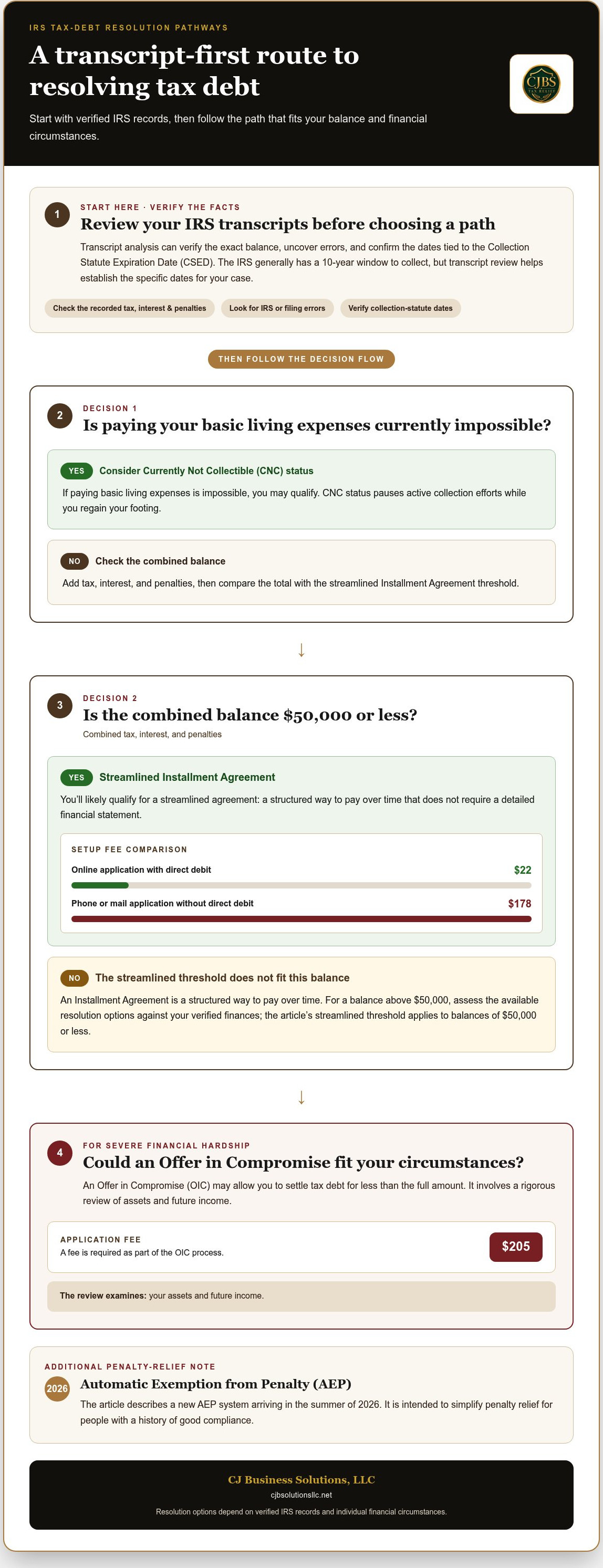
Navigating federal debt requires a clear understanding of the official IRS payment options available to you. For many, an Installment Agreement provides a structured way to pay over time. If you owe $50,000 or less in combined tax, interest, and penalties, you'll likely qualify for a streamlined agreement. This path is often more accessible because it doesn't require a detailed financial statement. Choosing an online application with direct debit can reduce your setup fee to just $22, which is significantly lower than the $178 fee for phone or mail applications without direct debit.
For those facing more severe financial hardship, an Offer in Compromise (OIC) allows you to settle your debt for less than the full amount. This process involves a $205 application fee and a rigorous review of your assets and future income. Alternatively, if paying your basic living expenses is currently impossible, you may qualify for "Currently Not Collectible" status. This status pauses active collection efforts while you regain your footing. You should also be aware of the new Automatic Exemption from Penalty (AEP) system arriving in the summer of 2026, which will simplify relief for those with a history of good compliance.
The Role of IRS Transcript Analysis
Before selecting a path, you must look closely at your official records. A professional review of your IRS transcripts is the most reliable way to identify "hidden" errors or verify the exact dates when the 10-year collection statute expires. This forensic approach ensures you aren't paying more than you legally owe. If you're unsure where to start, our transcript analysis services can provide the clarity you need to move forward with a verified plan.
Small Business vs. Individual Resolution
Business owners face unique challenges, particularly regarding payroll tax liabilities and the Trust Fund Recovery Penalty. Resolving these issues requires a careful balance to maintain business continuity while satisfying federal requirements. Whether you're an individual or an entrepreneur, getting professional help with back taxes ensures that your resolution strategy is tailored to your specific financial reality. This methodical approach helps you avoid the high fees of "OIC mills" and focuses on achieving a sustainable, long-term solution.
Choosing the Right Representation: Enrolled Agents vs. CPAs
While many taxpayers assume a CPA is the default choice for any financial matter, the IRS grants specific federal representation rights to Enrolled Agents (EAs). An EA specializes exclusively in tax law and procedural nuances, making them uniquely qualified for complex resolution cases. This focused expertise is particularly beneficial when you need help with back taxes that involve complicated collection actions or audit examinations. Unlike generalists, an Enrolled Agent acts as a seasoned mentor, standing between you and the IRS to manage both the technical and emotional demands of your case.
If your liability stems from a federal examination, having an expert in audit strategy defense is vital. They can review the examiner's findings to ensure every deduction was properly considered. This professional buffer significantly lowers the stress caused by direct interactions with revenue officers, as your representative handles all correspondence and negotiations on your behalf. You can review the various IRS options for tax debt to see how different status changes might apply to your specific situation.
What to Look for in a Tax Resolution Firm
A reliable firm prioritizes transparency and education over immediate conversion. You should expect a realistic assessment of your case based on your unique financial data, rather than empty promises. It's also important to have direct access to the professional working on your file rather than a sales representative. If you're seeking a partner focused on long-term compliance and stability, our tax resolution services provide the personalized care necessary for a successful outcome.
Red Flags in the Tax Resolution Industry
Be wary of firms that guarantee a specific settlement amount before ever conducting a thorough transcript analysis. The IRS explicitly warns against "Offer in Compromise mills" in its 2026 Dirty Dozen list of scams. These entities often use high-pressure tactics and lack the professional credentials required to offer legitimate help with back taxes. Genuine resolution is a methodical process that requires a deep understanding of your financial history and current ability to pay.
Developing Your Personalized Tax Recovery Roadmap
Moving from the initial stress of a collection notice to a state of resolution requires a disciplined, step-by-step approach. While it's natural to want an immediate fix, the IRS follows a specific procedural order that must be respected to achieve a favorable outcome. This roadmap serves as your guide, ensuring that every action you take strengthens your standing and brings you closer to a sustainable agreement. When you seek professional help with back taxes, your representative will typically follow these four essential phases.
- Step 1: Achieve compliance by filing all delinquent tax returns for the required lookback period.
- Step 2: Execute a forensic transcript analysis to verify the exact nature and age of the debt.
- Step 3: Evaluate your current financial capacity to select the resolution program that best fits your reality.
- Step 4: Formalize the agreement with the IRS and implement systems to maintain compliance moving forward.
The Compliance-First Requirement
A common hurdle in the resolution process is the "Compliance First" rule. The IRS generally won't consider any settlement or payment plan until you've filed all required returns for at least the last six years. If you've lost track of your records, we can help reconstruct your missing data using official IRS records. This proactive step prevents the agency from relying on their own estimates, which often result in a higher liability than you actually owe. Filing these returns is the necessary gateway to any formal negotiation.
Maintaining Long-Term Financial Health
True resolution isn't just about settling the past; it's about securing your future. This involves adjusting your withholding or establishing a routine for quarterly estimated payments to ensure new liabilities don't accrue. For small businesses, ongoing accounting oversight provides the clarity needed to manage payroll taxes and operational costs effectively. These habits turn a one-time settlement into a permanent state of stability. If you're ready to start this journey, please request a professional transcript analysis from CJ Business Solutions, LLC to determine the best path forward for your specific situation.
Your Path to Financial Resolution
Resolving federal tax debt is a deliberate process that begins with understanding your unique standing within the IRS collection cycle. By prioritizing a methodical transcript analysis, you can identify potential errors and confirm the exact dates when statutes of limitations expire. This forensic diagnostic step, combined with achieving full filing compliance, ensures that your resolution plan is built on a foundation of accuracy rather than guesswork. It's a journey that moves at a steady pace, allowing you to feel fully informed before taking each next step toward financial freedom.
When you seek help with back taxes, the quality of your representation plays a pivotal role in the final outcome. Choosing an expert who provides audit strategy defense and specialized federal representation can significantly lower the emotional burden of dealing with revenue officers. We invite you to Schedule a Consultation with an Enrolled Agent to begin developing your personalized recovery roadmap today. With the right guidance and a commitment to long-term compliance, it's entirely possible to move past the anxiety of tax debt and regain the quiet confidence of financial stability.
Frequently Asked Questions
How much does the IRS charge in penalties for back taxes?
The IRS applies several distinct penalties depending on your filing and payment history. For returns due in 2026, failing to file on time results in a 5% monthly penalty of the unpaid tax, while failing to pay results in a 0.5% monthly charge. When combined with the 7% interest rate for the third quarter of 2026, these costs accumulate quickly and can eventually reach a combined maximum of 47.5% of the original tax balance.
Can the IRS really garnish my wages without a court order?
Yes, the IRS possesses the statutory authority to garnish wages or levy bank accounts through an administrative process that doesn't require a separate court order. This power is exercised after the agency sends a series of notices, culminating in a Final Notice of Intent to Levy. Seeking professional help with back taxes before this stage is vital, as it allows your representative to propose a resolution plan that can stop these actions before they reach your employer.
What is the difference between tax debt relief and tax resolution?
While these terms are often used interchangeably, they represent different approaches to debt management. Tax debt relief is a broad term frequently used in marketing, whereas tax resolution describes a methodical, forensic process performed by a professional. This process involves a deep analysis of your IRS transcripts and the selection of specific federal programs to settle your liability. A resolution mindset focuses on long-term compliance and verifying the legal accuracy of the debt reported by the IRS.
How long does it take to settle back taxes with an Offer in Compromise?
Settling a debt through an Offer in Compromise typically takes between six and twelve months from the date of the initial application. This period allows the IRS to conduct a thorough investigation of your assets, monthly expenses, and future earning potential. During this time, you must remain compliant with all current filing requirements. It's a detailed process that requires patience and precise documentation to ensure the IRS reviews your financial reality accurately.
What happens if I cannot afford to pay anything to the IRS right now?
If your current financial situation prevents you from meeting basic living expenses, you may qualify for "Currently Not Collectible" status. This designation pauses active collection efforts, such as levies or garnishments, providing you with the necessary breathing room to stabilize your finances. While interest and penalties continue to accrue on the balance, this status ensures that the IRS doesn't create an undue hardship while you work toward a more permanent resolution strategy.

Article by
Crystal R. Johnson, MBA EA
Crystal Johnson founded CJ Business Solutions to give individuals and small-business owners something often missing from the tax and accounting process: clear explanations, practical solutions, and trusted support.
With more than 27 years of accounting and financial experience, Crystal helps clients understand complicated tax matters, restore compliance, respond to IRS concerns, and make stronger business decisions. As an Enrolled Agent, she is federally authorized to represent taxpayers before the Internal Revenue Service.


