

Tax-ready bookkeeping depends less on sophisticated software than on whether you can explain each transaction. If receipts are scattered across inboxes and accounts, reconciliations are behind, or you’re unsure what supports a deduction, start by building a consistent recordkeeping routine. Bookkeeping for tax compliance means recording business activity and keeping the documents that help explain it.
This guide explains how to organize transactions, reconcile accounts, and review records throughout the year. You’ll learn how to connect supporting documents to the activity they relate to, spot gaps before filing, and decide when professional tax and accounting support can help.
Key Takeaways
- Bookkeeping for tax compliance means maintaining organized, accurate records that support reporting. Tax preparation applies tax rules to those records.
- Use a regular routine to capture and categorize transactions, reconcile accounts, review exceptions, and keep supporting documents together.
- Reconcile accounts throughout the year to find missing entries, duplicates, and unexplained differences before filing periods.
- Choose software, staff support, or professional accounting help based on your transaction volume, record complexity, and need for review. Software alone can’t determine tax treatment or ensure accurate entries.
How bookkeeping supports tax compliance for a small business
Bookkeeping for tax compliance is the organized, accurate recording of business activity in a way that supports applicable tax reporting and filing obligations. It gives you a clear account of income and expenses, with records to explain the figures you report. The forms and documentation required depend on your business structure, activities, and current requirements.
Bookkeeping records financial activity. Tax preparation applies tax rules to that information to determine how it should be reported. Keeping these functions distinct helps you understand what your books show without assuming that a bookkeeping category alone determines a transaction’s tax treatment. For a foundational overview, see Bookkeeping.
Which business records help support tax reporting?
Useful records commonly include sales and other income, business expenses, invoices, receipts, bank activity, payroll records, and asset documentation where applicable. These records connect entries in your books to the underlying business activity. For example, a receipt shows the purchase amount, while a note about the business purpose can make the transaction easier to understand during a later review.
For each transaction, aim to retain information that shows:
- Date and amount: when the activity occurred and its value.
- Business purpose: what the transaction related to.
- Supporting evidence: such as an invoice, receipt, bank record, or payroll document.
Organize documents so you can connect them to the corresponding entries, rather than leaving them in unrelated folders or systems. Requirements vary by entity type and business activity, and forms or documentation can change with current rules. Refer to current IRS guidance or qualified tax and accounting support when a transaction or reporting obligation is unclear.
How to maintain tax-ready books throughout the year
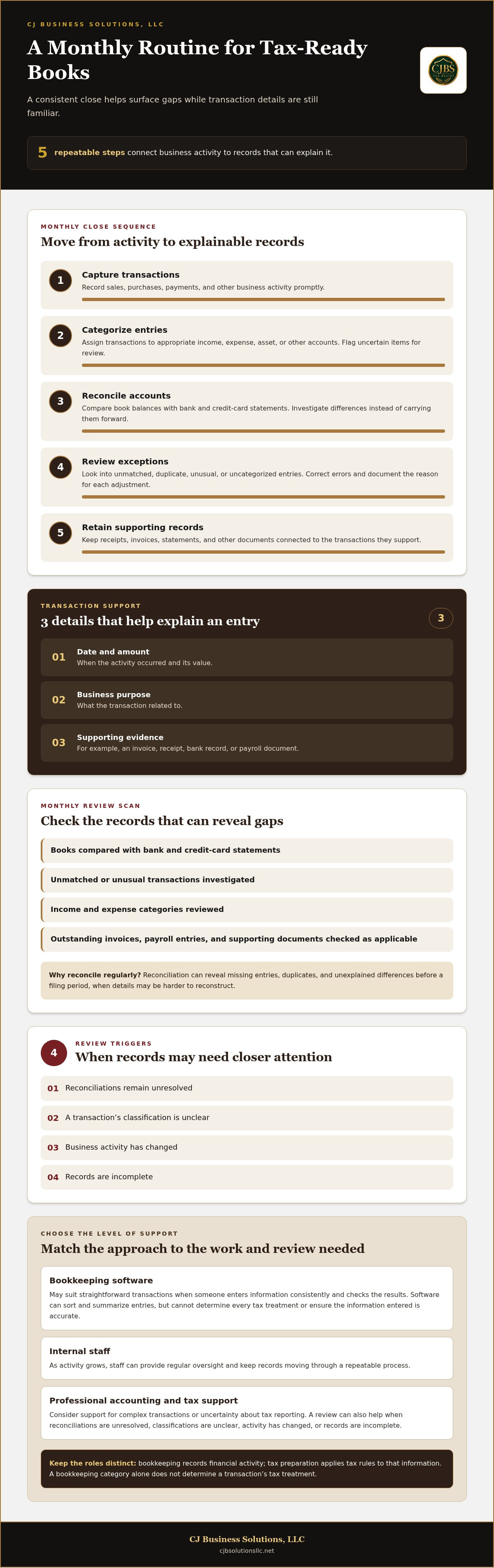
A recurring bookkeeping routine makes it easier to find gaps while the details are still familiar. Set a consistent monthly close date and follow the same sequence each time:
- Capture transactions: Record sales, purchases, payments, and other business activity promptly.
- Categorize entries: Assign each transaction to an appropriate income, expense, asset, or other account. Flag uncertain items for review.
- Reconcile accounts: Compare book balances with bank and credit-card statements. Investigate differences instead of carrying them forward.
- Review exceptions: Look into unmatched, duplicate, unusual, or uncategorized entries. Correct errors and document the reason for each adjustment.
- Retain support: Organize receipts, invoices, statements, and other documents so they remain connected to the transactions they support.
Reconciled accounts and retained support make financial records easier to review. Regular reconciliation can reveal missing entries, duplicates, and unexplained differences before a filing period, when the details may be harder to reconstruct. For general recordkeeping guidance, consult the IRS Tax Guide for Small Business and review the requirements that apply to your business.
What should a monthly bookkeeping review include?
Compare your books with bank and credit-card statements, then investigate unmatched or unusual transactions. Review income and expense categories, outstanding invoices, payroll entries, and supporting documents as applicable. A close calendar helps you complete the same checks consistently. Filing dates and obligations vary by business, so follow the current guidance relevant to your situation.
If your review raises questions about tax-related records, professional tax and accounting support can help you assess what needs attention.
When to use bookkeeping software, internal staff, or professional tax and accounting support
The right approach depends on transaction volume, the complexity of your business activity, and how much review your records need. Software may work for organizing straightforward transactions when someone enters information consistently and checks the results. As activity grows, internal staff can provide regular oversight and keep records moving through a repeatable process. Complex transactions or uncertainty about tax reporting are reasons to seek professional accounting and tax support.
Software can sort and summarize entries, but it can’t determine every tax treatment or ensure that the information entered is accurate. Use it as a recordkeeping tool, not a substitute for informed review. The IRS publication on IRS guidelines on recordkeeping offers a useful reference for understanding business records relevant to federal tax purposes.
When do bookkeeping questions call for tax or accounting review?
Consider a review if reconciliations remain unresolved, a transaction’s classification is unclear, business activity has changed, or records are incomplete. Addressing these concerns before filing can clarify what your books show and what additional support may be needed. Bookkeeping for tax compliance works best when accurate entries are paired with appropriate review.
CJ Business Solutions, LLC provides tax and accounting services to support business owners with tax-related records and reporting, including tax preparation. Led by an Enrolled Agent, the firm also provides IRS audit strategy defense and transcript analysis for IRS issues.
Build a steadier tax-ready routine
Bookkeeping for tax compliance becomes more manageable when you organize records, reconcile accounts regularly, and retain documents that explain business activity. A consistent review routine can surface missing or unusual entries before filing. Software can help organize information, but it does not replace accurate input or informed tax review.
If your records raise questions or you need help preparing tax reporting, professional support can help clarify the next steps. CJ Business Solutions provides tax and accounting services, including tax preparation. When an IRS issue needs further attention, the firm also provides IRS audit strategy defense and transcript analysis.
Learn how CJ Business Solutions can support your tax and accounting needs. A repeatable process and appropriate guidance can help you approach your records and filing responsibilities with greater confidence.
Frequently Asked Questions
Does bookkeeping software ensure tax compliance?
No. Software can organize transactions and generate reports, but accurate categorization, reconciliations, and supporting documents still matter. It also doesn’t determine every tax treatment or guarantee compliance. Review entries regularly, investigate unusual items, and confirm how transactions should be handled. The records and obligations you need depend on your business structure and activities.
How often should a small business reconcile its books for tax compliance?
A consistent recurring schedule, often monthly, is a practical routine, though it isn’t a universal legal requirement. Regular reconciliation helps surface missing or duplicate transactions sooner, while records are easier to investigate. Compare relevant accounts with their statements, resolve differences where possible, and document items that remain unexplained. Adjust the timing to reflect your business activity and transaction volume.
What records should a business keep for tax reporting?
Common records include sales details, invoices, receipts, bank statements, expense documentation, and payroll records where applicable. Keep documents that support reported figures and help explain each transaction’s date, amount, and business context. Recordkeeping and retention needs can vary, so don’t rely on a universal retention period. Verify current IRS guidance and any applicable state requirements for your business.
Can an accountant or tax professional help if my books are behind?
Yes. A tax or accounting professional can review available records, identify gaps or inconsistencies, and support tax preparation or planning next steps. The work needed depends on what documentation is available and the nature of the issues, so outcomes and timing can vary. CJ Business Solutions provides tax and accounting services tailored to business needs, including tax preparation.

Article by
Crystal R. Johnson, MBA EA
Crystal Johnson founded CJ Business Solutions to give individuals and small-business owners something often missing from the tax and accounting process: clear explanations, practical solutions, and trusted support.
With more than 27 years of accounting and financial experience, Crystal helps clients understand complicated tax matters, restore compliance, respond to IRS concerns, and make stronger business decisions. As an Enrolled Agent, she is federally authorized to represent taxpayers before the Internal Revenue Service.


