

Tax preparation for self-employed people starts with knowing what came in, what you spent for the business, and what tax payments you made during the year. If invoices, receipts, mileage logs, or estimated tax records are scattered, it can be hard to reconcile your activity and prepare an accurate return. Organizing those records before you start filing gives you a clearer view of what needs attention.
This guide covers the records to gather, self-employment tax topics to review, estimated payments, and how to assess potential business expenses. It also explains how to choose a filing approach based on your records and circumstances. CJ Business Solutions, LLC provides tax preparation and accounting services for individual and business needs, led by an Enrolled Agent.
Key Takeaways
- Tax preparation for self-employed filers depends on business structure, income sources, and personal circumstances. Identify what applies before selecting forms.
- Gather income records and reconcile deposits to build a clear picture of business receipts before preparing your return.
- Categorize expenses and separate business and personal transactions where possible. Review mixed-use costs carefully.
- DIY software may suit straightforward records, while multiple income sources or unresolved tax questions may call for professional preparation.
Tax preparation for the self-employed: what your return needs to capture
Tax preparation for self-employed filers means organizing business activity and reporting the relevant details on an individual federal return, alongside other income and personal tax information. Business records support the calculations, but they are not a substitute for the return. Your business structure, income sources, and personal circumstances determine which forms apply, so there is no single filing package for everyone.
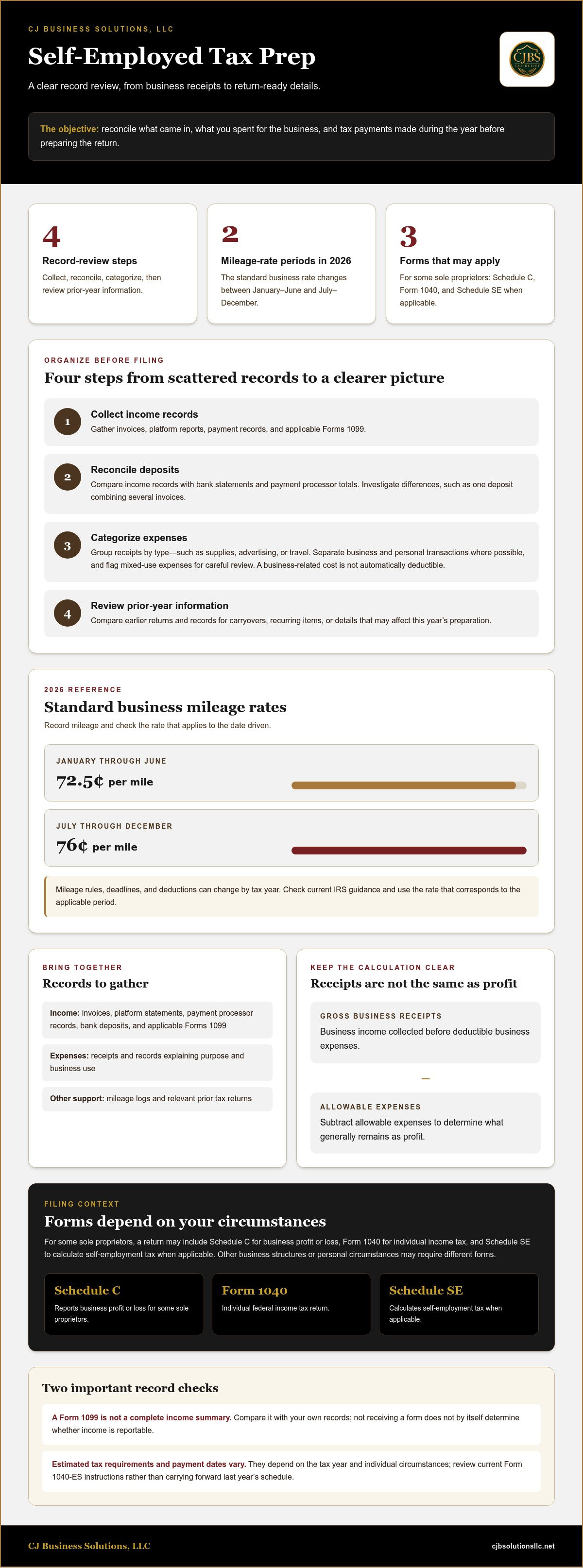
For some sole proprietors, the return may include Schedule C to report business profit or loss, Form 1040 for individual income tax, and Schedule SE to calculate self-employment tax when applicable. Other structures or circumstances may call for different forms. Review the current IRS instructions for each form to understand its purpose and applicability. For a general overview of self-employment and its tax context, see Understanding Self-Employment for Tax Purposes.
Which self-employed income and tax topics belong on your checklist?
Gather platform statements, invoices, payment processor records, bank deposits, and any applicable Forms 1099. Compare them with your own records to spot missing, duplicated, or misclassified payments. A 1099 is an information record, not a complete summary of all business income. Not receiving a form does not by itself determine whether income is reportable. Review IRS guidance on reporting business income rather than relying only on the forms you receive.
Gross business receipts are the business income collected before deductible business expenses; profit is generally what remains after allowable expenses are subtracted. Keep records to support both sides of that calculation. Clear documentation helps you report business activity accurately and gives you a sound basis for reviewing deductions and other tax questions.
How to prepare self-employed taxes: organize records before filing
A consistent review process turns scattered documents into a clearer picture of your business activity. Before entering figures on a return, work through these steps for Tax preparation for self-employed filers:
- Collect income records. Gather invoices, platform reports, payment records, and applicable Forms 1099.
- Reconcile deposits. Compare income records with bank statements and payment processor totals. Investigate differences, such as a deposit that combines several invoices.
- Categorize expenses. Group receipts by type, such as supplies, advertising, or travel. Categories make review easier, but not every business-related cost is deductible. Separate personal and business transactions where possible, and flag mixed-use expenses for careful review.
- Review prior-year information. Compare earlier returns and records for carryovers, recurring items, or details that may affect this year’s preparation.
What records should independent contractors gather before filing?
Gather invoices, bank statements, payment-platform reports, expense receipts, mileage logs, and relevant prior tax returns. Keep records that explain the purpose and business use of expenses, especially costs shared between work and personal use. The IRS’s official guide for self-employed taxes covers filing, estimated taxes, and self-employment tax.
Deadlines, deductions, and mileage rules can change by tax year. For 2026, standard business mileage rates are 72.5 cents per mile from January through June and 76 cents from July through December. Estimated tax requirements and payment dates also depend on the tax year and individual circumstances. Review current Form 1040-ES instructions instead of carrying forward last year’s schedule.
CJ Business Solutions’ tax preparation and accounting services help individuals and businesses organize tax information and prepare returns.
DIY software or professional tax preparation for self-employed filers?
DIY tax software may fit if your business activity is straightforward, your records are complete, and you are comfortable applying the relevant tax rules. Software can guide you through entering income and expenses, but the return’s accuracy still depends on the information you provide and how you classify it.
Professional preparation may be useful if you have multiple income sources, unusual transactions, incomplete records, or questions you cannot resolve after organizing your documents. Consider more than convenience: assess how confident you feel reviewing deductions, reporting business activity, and connecting business figures to your individual return. A careful review supports accurate reporting and ongoing compliance.
When might an Enrolled Agent’s preparation support be useful?
Tax preparation support can help when records have gaps, income sources need careful reconciliation, or you are unsure how a tax rule applies to your circumstances. CJ Business Solutions, LLC provides tax and accounting preparation for individual and business needs and is led by an Enrolled Agent. The firm also provides IRS audit defense and tax resolution services. These services address IRS examination and tax liability issues, which are separate from preparing a return.
Software may suit some filers, while professional review can help others resolve questions that remain after their records are assembled. The right approach depends on the complexity of your return and your comfort with the details. Learn about CJ Business Solutions’ tax and accounting services.
Prepare your next return with greater clarity
Good Tax preparation for self-employed filers begins with organized records and a clear understanding of how business activity connects to the individual return. Reviewing income, expenses, estimated payments, and tax-year guidance helps you identify what needs attention before filing.
If your records are straightforward and you are comfortable applying the rules, DIY software may be suitable. Multiple income sources, record gaps, or unresolved questions may make professional review useful. CJ Business Solutions, LLC provides tax preparation and accounting services for individual and business needs, led by an Enrolled Agent.
For help organizing your records and preparing your return, explore tax preparation and accounting support from CJ Business Solutions.
Frequently Asked Questions
What forms do self-employed people need to file taxes?
Self-employed filers commonly use Form 1040 and, when applicable, Schedule C to report business profit or loss and Schedule SE to calculate self-employment tax. The forms that apply depend on business structure, income sources, and personal circumstances, so there is no single set for every filer. Tax preparation for self-employed individuals also accounts for other income and personal tax details on the individual return.
Can I do my own taxes if I am self-employed?
Yes. You can prepare your own return if you are comfortable with the applicable tax rules and have organized, complete records. DIY software may work well for straightforward business activity and a limited number of income sources. If records are incomplete, transactions are unusual, or questions remain about reporting or deductions, professional preparation can provide additional review and help clarify filing details.
What expenses can I deduct as a self-employed person?
Potential deductions may include eligible business costs such as advertising, travel, home office expenses, health insurance premiums, and retirement plan contributions. Whether a cost qualifies depends on the applicable rules and your circumstances. A purchase is not deductible simply because it relates to work. Keep receipts and records showing the amount, purpose, and business use, especially for expenses shared between personal and business activities.
Do self-employed people have to make estimated tax payments?
Generally, you may need to make estimated payments if you expect to owe at least $1,000 in tax for the year after withholding and credits. These payments can cover both income tax and self-employment tax. Form 1040-ES helps calculate them. Requirements and due dates vary by tax year, so review current IRS instructions and consider how your income changes during the year.

Article by
Crystal R. Johnson, MBA EA
Crystal Johnson founded CJ Business Solutions to give individuals and small-business owners something often missing from the tax and accounting process: clear explanations, practical solutions, and trusted support.
With more than 27 years of accounting and financial experience, Crystal helps clients understand complicated tax matters, restore compliance, respond to IRS concerns, and make stronger business decisions. As an Enrolled Agent, she is federally authorized to represent taxpayers before the Internal Revenue Service.


