

An IRS transcript can be accurate without telling the whole story on its own. If you’re trying to understand an account balance, a missing payment, or an IRS notice, unfamiliar transcript types and transaction codes can be difficult to interpret. Knowing how to get IRS tax transcripts analyzed starts with requesting records that fit your question, then comparing the entries with filed returns, payment records, and notices rather than drawing conclusions from a single code.
This guide explains which transcript types may be useful, how to access them through an IRS Individual Online Account, and how to prepare records for review. You’ll learn what an initial comparison can reveal, when a self-review may be enough, and when professional analysis can help put the records in context. CJ Business Solutions, LLC provides transcript analysis to identify tax issues and inform appropriate tax resolution or audit-defense next steps.
Key Takeaways
- Start with the tax question you need answered, then focus on the relevant tax years and records.
- IRS transcript entries show information recorded on an account. Compare them with filed returns, payment documentation, and notices.
- Getting IRS tax transcripts analyzed means putting entries in context, not interpreting a transaction code on its own.
- Unexplained activity, mismatches, multiple affected years, or an IRS notice may call for professional analysis to clarify the records and possible next steps.
What IRS Tax Transcript Analysis Can, and Cannot, Tell You
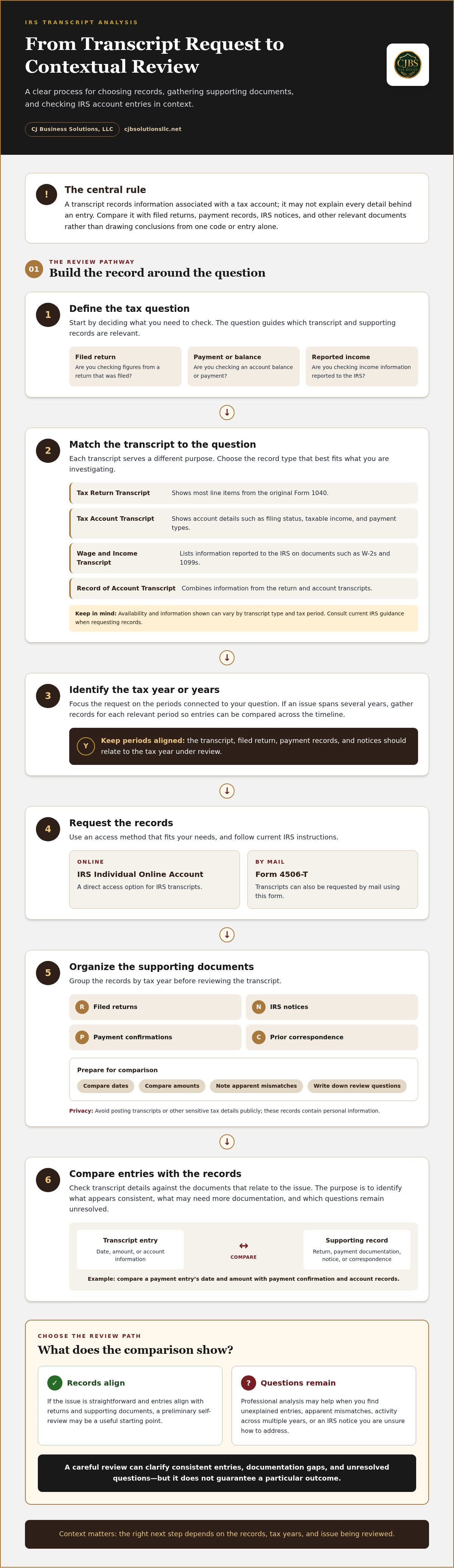
An IRS transcript records information associated with a tax account, but it doesn’t explain every detail behind that information. Transcript analysis means comparing entries with the filed return, IRS notices, payment records, and other relevant documents. For example, a transcript may show a payment entry. Comparing its date and amount with your payment confirmation and account records can help identify whether the information lines up or needs further review.
Transcript analysis puts IRS account entries in context by comparing them with relevant tax documents, rather than drawing conclusions from one entry alone. Transcripts can help identify questions or apparent mismatches, but they may not include every supporting document or explain why an entry appears. The records needed depend on the issue and tax year.
Which IRS transcript types may be relevant?
Each transcript serves a different purpose:
- Tax Return Transcript: Shows most line items from the original Form 1040.
- Tax Account Transcript: Shows account details such as filing status, taxable income, and payment types.
- Wage and Income Transcript: Lists information reported to the IRS on documents such as W-2s and 1099s.
- Record of Account Transcript: Combines information from the return and account transcripts.
Availability and the information shown can vary by transcript type and tax period, so consult current IRS guidance when requesting records. Begin by identifying the question you need answered. A return transcript may help when you’re checking figures from a filed return, while an account transcript may be more relevant to a payment or balance question. For income reported to the IRS, a Wage and Income Transcript may be useful. Comparing the relevant transcript with related documents gives you a clearer basis for deciding what to examine next.
How to Get IRS Transcripts and Prepare Them for Analysis
A focused request makes a review more useful. First, define the question: are you checking a filed return, an account balance or payment, or income reported to the IRS? Then identify the tax year or years connected to that question. If the issue spans several years, gather records for each relevant period so the entries can be compared across the timeline.
What to gather before requesting a transcript review
- Choose the transcript and tax periods. Match the record type and tax years to the question you’re investigating. For a payment question, for instance, an account transcript and the relevant payment documentation may be a useful starting point.
- Request the records. An IRS Individual Online Account is a direct access option. You can also request transcripts by mail using Form 4506-T. The IRS explains available methods and current instructions on its Get Transcript from the IRS page.
- Organize supporting documents. Group filed returns, IRS notices, payment confirmations, and prior correspondence by tax year. Compare dates and amounts, and note any entry that does not appear to match the supporting record.
Keep copies together and write down the specific questions you want the review to address. If a payment doesn’t appear where expected, for example, gather its confirmation and any related IRS notice. Avoid posting transcripts or other sensitive tax details publicly because these records contain personal information.
Getting IRS tax transcripts analyzed involves more than downloading a record. The aim is to assemble the relevant tax years and supporting documents so the entries can be interpreted in context. CJ Business Solutions, LLC provides specialized transcript analysis to help identify tax issues and develop appropriate resolution paths. You can learn about professional IRS transcript analysis.
When Professional IRS Transcript Analysis May Be the Right Next Step
A preliminary self-review can help you confirm which records you have and identify questions to investigate. If the issue is straightforward and the entries align with your returns and supporting documents, that review may be a useful starting point. Professional analysis can help when records are difficult to reconcile, the issue spans several tax years, or you need to understand how an IRS notice relates to your account history.
Consider professional help if you find unexplained entries, apparent mismatches between IRS records and your documents, activity across multiple years, or a notice you’re unsure how to address. Avoid assuming that an isolated transaction code tells the whole story. For official guidance on transcript access and record types, see the IRS Get Transcript page.
What a careful transcript review should help clarify
A careful review compares transcript information with filed returns, payment records, and IRS notices. It can help identify which entries appear consistent, where additional documentation may be needed, and which questions remain unresolved. The appropriate next step depends on the facts, and analysis does not guarantee a particular outcome. An Enrolled Agent-led review can also connect relevant findings with potential tax resolution or IRS audit-defense planning, where appropriate.
If you’re deciding how to get IRS tax transcripts analyzed, consider whether you can interpret the records confidently and determine a sensible next step without relying on a single entry. When the records are difficult to reconcile or the implications are unclear, a contextual review can help. You can explore tax representation and transcript analysis.
Turn IRS Transcript Records Into a Clearer Next Step
Start by identifying the tax years and records relevant to your question. The right transcript can help, but its entries are more useful when compared with filed returns, payment documentation, and IRS notices. Avoid drawing conclusions from an isolated code or entry, especially when records appear incomplete or inconsistent.
If an initial review leaves questions, professional analysis can put the information in context and help identify possible next steps. CJ Business Solutions, LLC provides specialized transcript analysis, tax resolution, and audit defense, led by an Enrolled Agent. The findings and appropriate path depend on the details of your tax situation.
Learn how CJ Business Solutions, LLC can help you understand your IRS tax transcripts. A careful review of the relevant records can help you move forward with greater clarity.
Frequently Asked Questions
How do I get my IRS tax transcripts analyzed?
Start by identifying the tax question and years involved, then obtain the relevant transcripts and compare them with filed returns, IRS notices, payment records, and correspondence. If entries are unclear or records don’t match, professional analysis can help interpret them in context. CJ Business Solutions, LLC provides specialized transcript analysis led by an Enrolled Agent, with findings informing potential tax resolution or audit-defense next steps.
Can I analyze my IRS tax transcript myself?
Yes. You can conduct an initial review by checking the tax period and comparing account information and entries with your returns and supporting records. This may help you identify questions, but transaction codes and account activity can be difficult to interpret in isolation. If you find unexplained entries, mismatches, or issues across multiple years, professional review can help clarify what the records show and which questions remain.
Which IRS transcript should I request for a tax issue?
Choose the transcript based on the question. A Tax Return Transcript shows most line items from the original return; a Tax Account Transcript focuses on account details, including payment types and taxable income. A Wage and Income Transcript lists information reported on forms such as W-2s and 1099s, while a Record of Account combines return and account information. Availability varies by type and tax period.
Does an IRS tax transcript show whether I owe money?
An IRS Tax Account Transcript can show account information, including payment types and balance-related activity, so it may help you understand what the IRS has recorded. Don’t rely on one entry alone to determine your current situation. Compare the transcript with relevant notices, filed returns, and payment documentation, and consider the tax period and timing of recorded activity before drawing conclusions.

Article by
Crystal R. Johnson, MBA EA
Crystal Johnson founded CJ Business Solutions to give individuals and small-business owners something often missing from the tax and accounting process: clear explanations, practical solutions, and trusted support.
With more than 27 years of accounting and financial experience, Crystal helps clients understand complicated tax matters, restore compliance, respond to IRS concerns, and make stronger business decisions. As an Enrolled Agent, she is federally authorized to represent taxpayers before the Internal Revenue Service.


