

What if the first step toward catching up isn’t guessing which returns are missing, but comparing the IRS’s records year by year? If several filing years are unclear, that uncertainty is understandable. IRS tax transcript analysis for unfiled returns can help organize what the agency has recorded, but a transcript is only one part of the picture.
This guide explains how to identify relevant years and distinguish account, wage-and-income, and non-filing records, while clarifying what each can and can’t establish. You’ll also see how transcript entries can guide a review of source documents and help organize next steps for filing and compliance. Led by an Enrolled Agent, CJ Business Solutions, LLC provides transcript analysis to identify tax issues and questions for further review, while keeping complete return information central to the process.
Key Takeaways
- Account and wage-and-income transcripts offer different clues about IRS account activity and reported income.
- Use IRS tax transcript analysis for unfiled returns to build a year-by-year picture, then compare transcript entries with your own tax records.
- Flag missing documents, unexpected entries, and unanswered questions instead of treating transcript information as a complete tax record.
- After identifying possible filing years, organize supporting records, prepare required returns, and review any balances before considering resolution options.
What IRS Transcripts Can Reveal About Unfiled Tax Returns
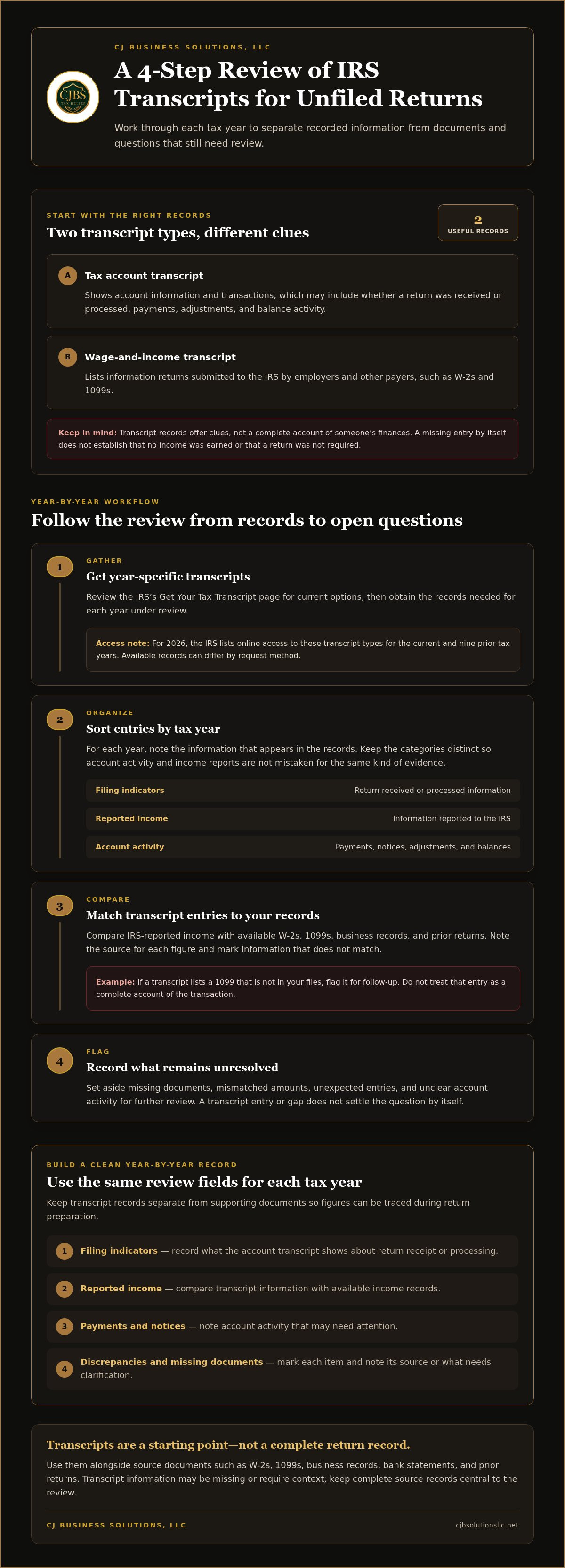
Transcript analysis means reviewing IRS records to understand account activity and income information reported to the agency. Because the Internal Revenue Service (IRS) maintains different records for different purposes, reviewing the right transcript for each year can help distinguish a possible missing return from an incomplete record. For IRS tax transcript analysis for unfiled returns, two useful records are often the tax account transcript and the wage-and-income transcript.
Which IRS transcripts help investigate missing filing years?
A tax account transcript shows account information and transactions, which may include whether a return was received or processed, payments, adjustments, and balance activity. A wage-and-income transcript lists information returns submitted to the IRS by employers and other payers, such as W-2s and 1099s. For 2026, the IRS lists online access to these transcript types for the current and nine prior tax years. Available records can differ by request method.
These records offer clues, not a complete account of someone’s finances. A wage-and-income transcript may not show income that wasn’t reported to the IRS on an information return, and its entries may not include all the context needed to prepare a return. Records and gaps can vary by taxpayer, tax year, and reporting source. A missing entry, by itself, doesn’t establish that no income was earned or that a return wasn’t required.
Transcripts can inform a return review, but they don’t replace complete source documents. Use them alongside available W-2s, 1099s, business records, and prior returns. This comparison can help you identify which figures are supported, which documents are missing, and what needs further review. The IRS record alone may not establish every detail.
How to Analyze IRS Transcripts for Unfiled Returns
A year-by-year review makes the records easier to interpret and helps separate confirmed information from open questions. For IRS tax transcript analysis for unfiled returns, work through each tax year in order:
- Gather year-specific transcripts. Use the IRS’s Get Your Tax Transcript page to review current options and obtain the records you need.
- Organize the entries. For each year, note filing indicators, reported income, payments, notices, and account activity.
- Compare records. Match IRS-reported income with available W-2s, 1099s, business records, and prior returns. For example, if a transcript lists a 1099 that isn’t in your files, flag it for follow-up rather than treating the entry as a complete account of the transaction.
- Flag unresolved questions. Record missing documents, mismatched amounts, and unclear account entries so you can address them during further review.
How should you organize transcript findings by tax year?
Create a separate row for each year, with columns for filing indicators, reported income, payments, notices, and discrepancies. Keep transcript records separate from supporting documents, such as employer forms, bank statements, business records, and copies of prior returns. Note the source for each figure and mark any information that doesn’t match. This makes it easier to trace figures during return preparation.
Transcript-reported income is evidence to review, not necessarily a complete return record. Information may be missing or require context, so don’t assume that a transcript entry or gap settles the question by itself. A methodical review can show what’s documented and what still needs clarification. CJ Business Solutions, LLC provides IRS transcript analysis to identify tax issues and questions for further consideration.
Next Steps After Identifying Unfiled Returns via Analysis
Transcript findings can point to years and issues that need attention, but they don’t determine every filing obligation on their own. A transcript may show account activity or income reports without capturing the full facts needed to decide what returns are required. Use the analysis to identify what to verify next.
A careful sequence can make the work more manageable:
- Gather supporting records. Collect income documents, business records, expense information, and prior returns for each year under review. If a W-2 or 1099 appears missing or incorrect, consult the IRS guidance on a missing or incorrect W-2 or 1099.
- Prepare required returns. Use source records to establish the details for each return rather than relying on transcript entries alone.
- Review account balances. Once returns are filed and processed, examine the IRS account information for balances, payments, or other activity requiring attention.
- Assess resolution options. With a clearer filing history and account picture, consider which tax resolution steps may fit the circumstances.
When can professional transcript analysis help?
Professional review can help reconcile IRS entries with taxpayer records, identify discrepancies, and distinguish documented facts from questions that need follow-up. CJ Business Solutions, LLC is led by an Enrolled Agent and uses transcript analysis to identify tax issues and develop resolution paths. The firm also provides tax resolution and IRS audit defense support. Explore CJ Business Solutions’ tax services for structured support reviewing your records and planning next steps.
Turn Transcript Findings Into a Clearer Filing Plan
IRS records can help identify years and account activity that need attention, while wage-and-income entries offer useful points of comparison. A careful IRS tax transcript analysis for unfiled returns organizes those clues by year and highlights questions to verify against your own records. Transcripts are a starting point, not a substitute for supporting documents or a complete review of your filing situation.
Once you’ve gathered the available records, you can work through required returns, review account balances, and consider appropriate resolution options. CJ Business Solutions, LLC provides specialized transcript analysis, tax resolution, and IRS audit defense support, with an Enrolled Agent leading the firm. Explore transcript analysis and tax resolution support to take a clear, documented next step toward addressing a complex filing history.
Frequently Asked Questions
How can I tell from an IRS transcript whether a tax return was filed?
An IRS account transcript may show filing-related activity, such as whether a return was received or processed, but individual entries need context. Review records for each relevant tax year and compare them with your return copies, filing confirmations, and IRS notices. If the filing status remains unclear, qualified tax guidance can help you interpret the information before drawing conclusions.
Which IRS transcript should I review for an unfiled return?
The right transcript depends on what you need to understand. An account transcript may show account activity, including return processing and transactions, while a wage-and-income transcript may list information reported by employers and other payers, such as W-2s and 1099s. Neither is necessarily a complete record for preparing a return, so compare available transcripts with your own supporting documents.
Can IRS transcripts replace W-2s and 1099s when filing back taxes?
No. Transcripts can help identify reported income, but they aren’t guaranteed substitutes for original forms or complete business records. Information may be incomplete or need clarification. Compare each entry with available W-2s, 1099s, books, and prior returns. If an amount differs or a document is missing, record the discrepancy for follow-up rather than assuming the transcript provides the full tax picture.
What should I do if IRS transcripts show income but I never filed a return?
Organize the transcript information by tax year, then gather related income documents, business records, prior returns, and IRS notices. IRS tax transcript analysis for unfiled returns can help identify filing years and questions to investigate, but the transcript alone doesn’t establish the complete tax result or every filing obligation. CJ Business Solutions, LLC provides transcript analysis to help review tax issues and plan appropriate next steps.

Article by
Crystal R. Johnson, MBA EA
Crystal Johnson founded CJ Business Solutions to give individuals and small-business owners something often missing from the tax and accounting process: clear explanations, practical solutions, and trusted support.
With more than 27 years of accounting and financial experience, Crystal helps clients understand complicated tax matters, restore compliance, respond to IRS concerns, and make stronger business decisions. As an Enrolled Agent, she is federally authorized to represent taxpayers before the Internal Revenue Service.


