

What matters about an Enrolled Agent is not only knowing tax rules, but understanding how they apply to your records and IRS notice. That distinction can be important when you’re facing an audit, an account discrepancy, or a tax debt and need more than routine return preparation. Enrolled Agent tax law expertise connects the details of your case to the federal tax rules and IRS procedures that may affect your next steps.
It’s understandable to want clarity about an EA’s qualifications, authority, and ability to represent you. This article explains the credential’s scope in IRS matters, how representation differs from tax preparation, and what case specific expertise can look like. You’ll also learn how reviewing your account transcript may clarify your IRS account history and help shape an appropriate path forward.
Key Takeaways
- Enrolled Agent tax law expertise is most useful when tax rules and IRS procedures are applied to the specific facts and records in your case.
- Look for relevant experience, careful document review, clear explanations, and a strategy that addresses your particular tax issue.
- An IRS transcript can help clarify account activity and reveal discrepancies that may shape the next steps.
- Understanding the notice, reviewing records, and analyzing account history can help guide an appropriate audit defense or tax resolution approach.
What Enrolled Agent tax law expertise covers in an IRS matter
An Enrolled Agent (EA) is a tax professional authorized by the federal government to represent taxpayers before the IRS. The IRS grants the credential to people who meet its enrollment requirements, including demonstrating tax knowledge and satisfying suitability requirements. The Enrolled Agent overview offers additional background on the credential and its responsibilities.
In practice, Enrolled Agent tax law expertise means applying relevant tax rules and IRS procedures to a taxpayer’s records and circumstances. For example, if an IRS notice questions reported income, the representative can compare the information cited in the notice with the return and supporting documents. The tax year, the records available, and the specific issue all matter when determining what a discrepancy means and how to respond.
What authority does an Enrolled Agent have before the IRS?
Under IRS guidance, EAs have unlimited representation rights before the IRS. With the taxpayer’s authorization, typically through Form 2848, an EA may represent taxpayers in administrative matters before IRS offices on tax matters. This can include communicating with the IRS and addressing an audit or collection issue within the scope of that authorization.
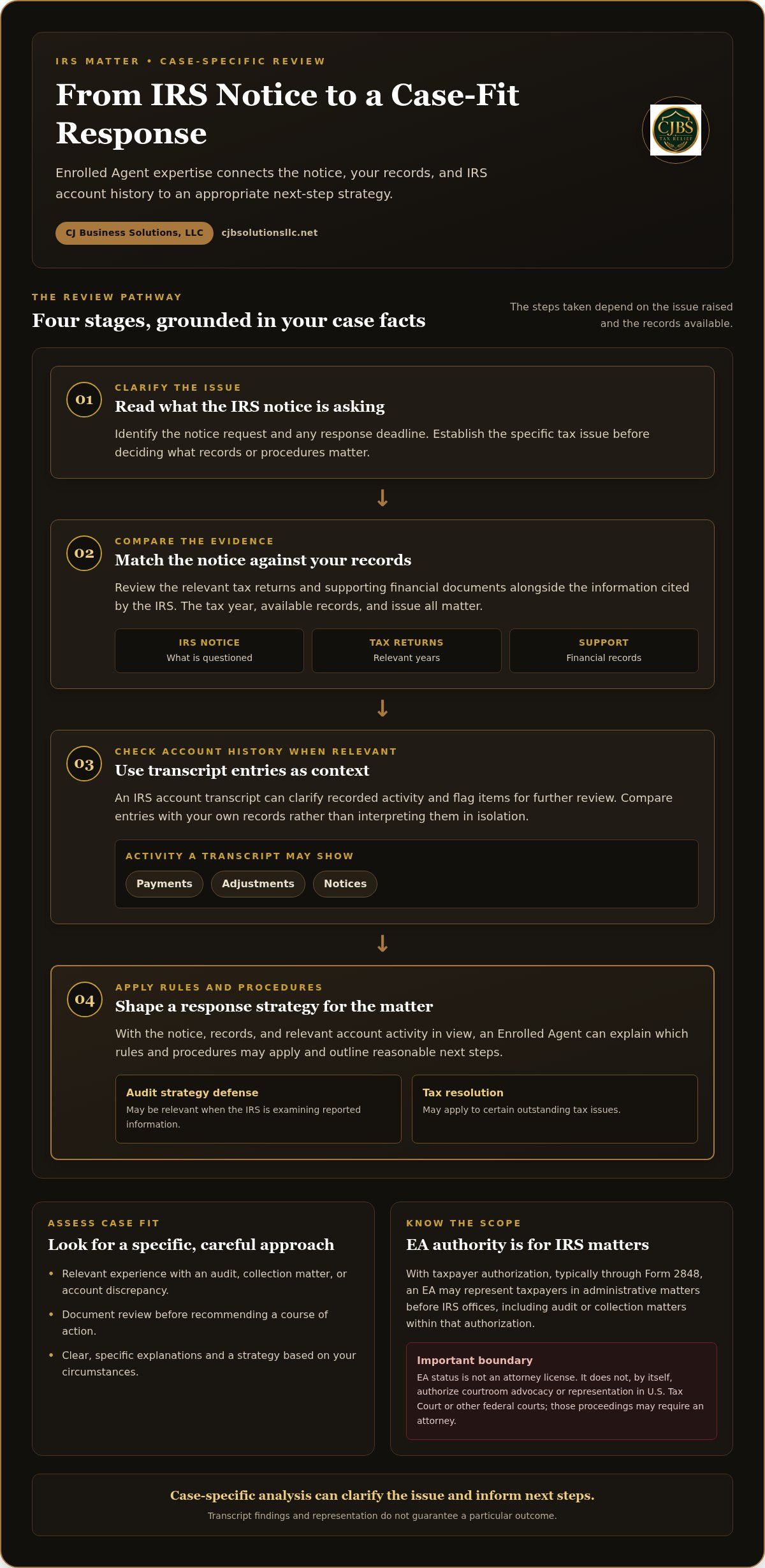
EA status is a tax credential, not an attorney license. An EA’s IRS representation authority does not, by itself, authorize courtroom advocacy or representation in U.S. Tax Court or other federal courts. Those proceedings involve different rules and may require an attorney. Representation also does not guarantee a particular result. The credential’s value is in applying tax knowledge carefully to the case and explaining the available administrative steps.
How to assess an Enrolled Agent’s expertise for your tax issue
A credential establishes professional standing, but it doesn’t show whether an EA’s experience fits your particular IRS matter. Case specific expertise is demonstrated by how a professional examines your records, explains the relevant rules, and connects both to a practical strategy. The National Association of Enrolled Agents describes the profession’s focus on tax matters and representation. The National Association of Enrolled Agents is one resource for learning more about the field.
As you assess an EA’s fit, consider whether they can:
- Describe experience relevant to your issue, such as an audit, collection matter, or account discrepancy.
- Review your documents before recommending a course of action.
- Explain the issue and potential next steps in clear, specific terms.
- Set out a strategy based on your circumstances without promising a particular result.
What should an EA review before recommending a tax strategy?
A careful review may include the IRS notice, tax returns for the relevant years, supporting financial records, and IRS account information. An account transcript can clarify recorded activity, including payments, adjustments, and notices, and may point to items that need further review. Transcript analysis is most useful when the entries are compared with your own records rather than considered on their own.
After reviewing the documents and understanding the issue, an EA can explain which rules and procedures may apply and outline reasonable next steps. You can explore tax representation with CJ Business Solutions.
How Enrolled Agent expertise supports IRS audit defense and tax resolution
A clear process turns an IRS notice into a set of questions to address. Start by identifying what the notice requests and any response deadline. Then compare the notice with the relevant returns and supporting records. If account history could affect the issue, transcript analysis can help clarify payments, adjustments, and other activity recorded by the IRS. With those details in view, an Enrolled Agent can develop a response strategy suited to the matter. The IRS definition of an Enrolled Agent provides official information about the credential and its practice rights.
Comparing IRS account information with notices and taxpayer records gives a representative a clearer basis for explaining the issue, identifying discrepancies, and planning an appropriate response. The right application of Enrolled Agent tax law expertise depends on the case. Audit strategy defense may be relevant when the IRS is examining reported information, while tax resolution may apply to certain outstanding tax issues. The steps taken should fit the matter at hand.
When can transcript analysis and audit defense work together?
Transcript review can provide context for an audit or unresolved issue by showing account activity that may not be clear from a notice alone. For example, it may help determine whether a payment or adjustment appears on the account, which can then be compared with the taxpayer’s records. At an EA led firm, those findings can inform audit strategy or resolution planning, depending on what the review reveals. Transcript findings support case specific analysis, but do not guarantee a particular outcome.
To learn more about the services, explore CJ Business Solutions’ tax services.
Take a Clearer Next Step With Your IRS Matter
Effective IRS representation depends on more than understanding tax rules. It connects those rules to your records, account history, and the issue raised by the IRS. Reviewing the notice, supporting documents, and relevant transcript activity can help shape a response strategy that fits your circumstances. That is where Enrolled Agent tax law expertise becomes practical: it brings clarity to the facts and possible next steps without promising a particular outcome.
CJ Business Solutions is led by an Enrolled Agent and provides IRS audit strategy defense and transcript analysis to help identify tax issues and inform resolution planning. For support with an IRS matter, explore tax representation and transcript analysis with CJ Business Solutions.
Frequently Asked Questions
What does an Enrolled Agent’s tax law expertise include?
An Enrolled Agent’s tax law expertise includes understanding federal tax rules and IRS procedures, then applying them to a taxpayer’s records and circumstances. In an IRS matter, that may involve interpreting a notice, comparing reported information with supporting documents, and reviewing account history. The credential reflects tax specialization, while case specific value depends on careful analysis and a clear explanation of possible next steps.
Can an Enrolled Agent represent me before the IRS?
Yes. An Enrolled Agent with valid representation authority may represent taxpayers before the IRS on tax matters, subject to taxpayer authorization, often documented on Form 2848. This authority covers IRS administrative matters, such as communicating about an audit or collection issue. It doesn’t automatically extend to U.S. Tax Court or other federal courts, and representation can’t guarantee a particular outcome.
Is an Enrolled Agent qualified to help with an IRS audit?
Yes. An Enrolled Agent can help address an IRS audit by reviewing the notice, relevant tax returns, supporting records, and IRS account information, then developing a response approach. With proper authorization, the EA may communicate with the IRS and help explain or substantiate reported tax items. The appropriate work depends on the audit’s scope and facts; no representative can promise the IRS’s decision.
How is an Enrolled Agent different from an attorney for tax matters?
An EA is federally authorized as a tax professional, with expertise focused on tax rules, IRS procedures, and representation before the agency. An attorney is licensed to practice law and may provide legal advice and represent clients in court, subject to applicable rules. EAs generally handle IRS administrative matters, not courtroom litigation. The appropriate professional depends on whether an issue is administrative or judicial.

Article by
Crystal R. Johnson, MBA EA
Crystal Johnson founded CJ Business Solutions to give individuals and small-business owners something often missing from the tax and accounting process: clear explanations, practical solutions, and trusted support.
With more than 27 years of accounting and financial experience, Crystal helps clients understand complicated tax matters, restore compliance, respond to IRS concerns, and make stronger business decisions. As an Enrolled Agent, she is federally authorized to represent taxpayers before the Internal Revenue Service.


