

An IRS notice may be only the visible part of a more complicated account history. When records, transcripts, and notices seem inconsistent, responding before understanding the facts can add uncertainty. Enrolled Agent services for complex tax issues help clarify what the IRS account shows and identify appropriate next steps. Enrolled Agents are federally authorized to represent taxpayers before the IRS, and the work depends on the specific matter.
It’s understandable to worry about missing a response date or replying in a way that complicates matters. This 2026 guide explains when specialized representation can help, which records can define the issue, and how transcript analysis can clarify account history before a strategy is selected. You’ll also learn how CJ Business Solutions, LLC approaches IRS audit strategy defense and tax resolution, so you can understand the process without assuming every case calls for the same solution.
Key Takeaways
- Enrolled Agent services for complex tax issues can involve IRS representation, not only tax return preparation. The support depends on the matter.
- Organize IRS notices, filed returns, payment records, and related correspondence to clarify the issue and define the scope of representation.
- Comparing transcript details with your records can help explain account history before a resolution path is considered.
- Audit strategy defense and tax resolution address different circumstances, so the next steps should fit the facts of your case.
When Enrolled Agent Services Can Help With Complex Tax Issues
An IRS notice, audit request, or account balance that doesn’t match your records can leave you unsure what the issue is or how to respond. Start by identifying what the IRS is asking about and whether it concerns a return, account history, or unpaid federal tax. Enrolled Agent services for complex tax issues can include focused analysis and IRS representation, rather than tax preparation alone.
Different problems call for different support. An audit may require a strategy for organizing records and addressing the items under review. If account records appear disputed or incomplete, transcript analysis can clarify what the IRS has recorded. A federal tax liability may call for tax resolution based on the account facts. These services help address the issue, but they can’t guarantee a particular IRS decision.
What does an Enrolled Agent's IRS representation authority mean?
The IRS recognizes Enrolled Agents as federally authorized tax practitioners with unlimited rights to represent taxpayers before the IRS. This can include representation in matters such as audits, collections, and appeals. It is separate from preparing a return, and it does not mean representing a taxpayer in court litigation. In short, an Enrolled Agent represents taxpayers before the IRS in federal tax matters. The Enrolled Agent overview provides additional background on the credential and its scope.
The appropriate support depends on the issue and its procedural stage. Led by an Enrolled Agent, CJ Business Solutions provides IRS audit strategy defense, transcript analysis, and tax resolution. Identifying the relevant facts and records helps shape the work around the matter at hand.
How to Evaluate Enrolled Agent Services for a Complex Tax Issue
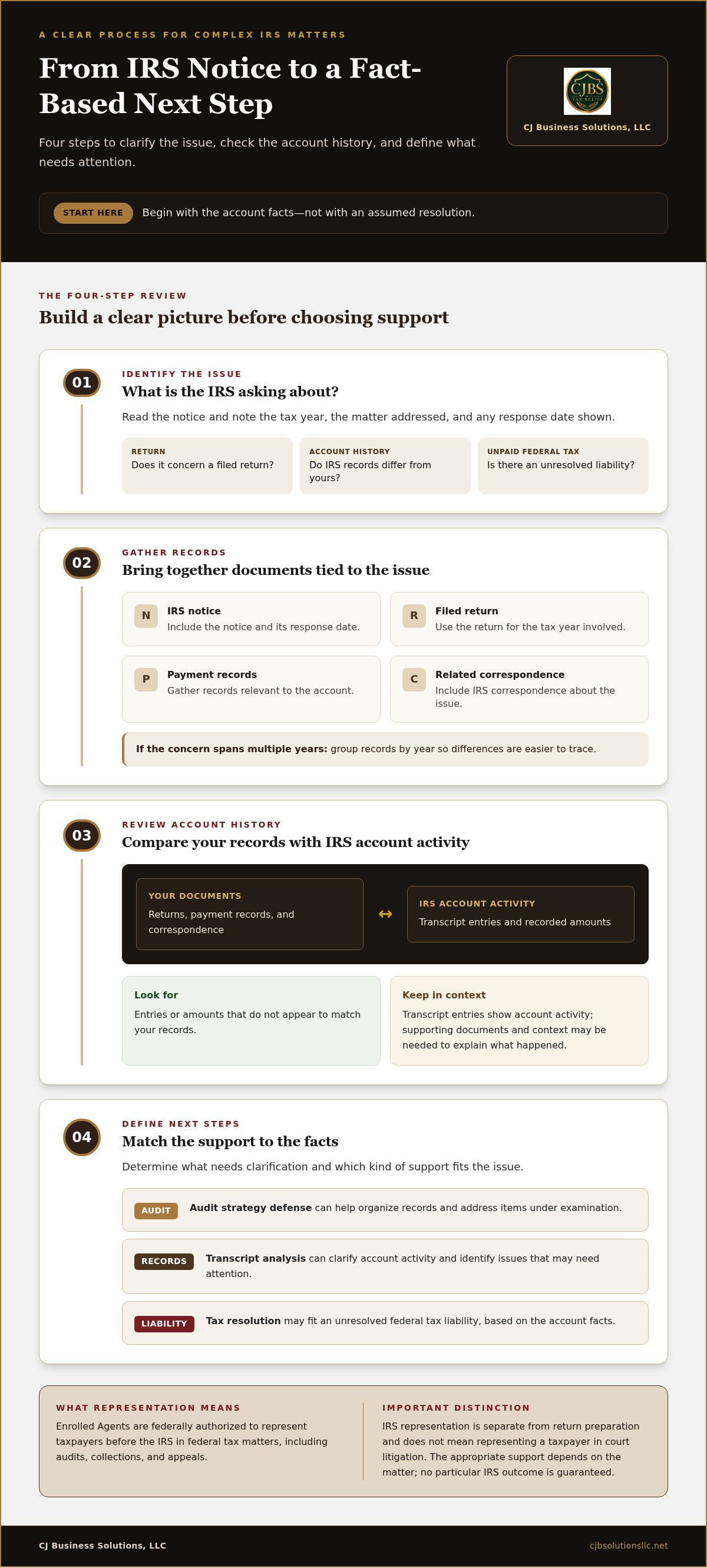
A clear scope starts with the account facts, not a proposed solution. To evaluate Enrolled Agent services for complex tax issues, work through four steps: identify the IRS issue, gather related records, compare them with the account history, and define what needs attention. The IRS describes an Enrolled Agent as holding the highest credential the IRS awards and confirms the credential’s federal practice rights.
- Identify the issue: Note the tax year and matter addressed in the IRS notice, along with any response date shown.
- Gather records: Collect the notice, relevant filed returns, payment records, and related IRS correspondence.
- Review account history: Compare your documents with the IRS account activity, noting entries or amounts that do not appear to match.
- Define next steps: Determine what needs clarification and whether the matter calls for audit strategy defense, transcript analysis, or tax resolution support.
Which records help clarify a complicated IRS matter?
Start with the specific notice and its response date. Then assemble the return for the tax year involved, payment records, and correspondence related to the issue. If the concern spans multiple years, group records by year so differences are easier to trace. Transcript entries show account activity, but supporting documents and context may be needed to explain what happened.
Comparing your records with transcript entries can connect IRS account activity to events and filings in your tax history. A transcript is one part of the review, not a complete resolution by itself. CJ Business Solutions uses transcript analysis to identify specific tax issues and inform next steps. For more on the process, explore IRS transcript analysis.
How CJ Business Solutions Approaches Complex Tax Representation
Complex representation begins with understanding the concern and account facts, rather than assuming a particular resolution will fit. At CJ Business Solutions, an Enrolled Agent leads a case-specific process: review the taxpayer’s concern, analyze available IRS transcripts, and identify tax issues that may need attention. This helps distinguish a discrepancy that needs supporting records from a matter that may call for a broader resolution strategy.
What to expect from transcript analysis and audit strategy support
Transcript analysis can clarify IRS account activity and surface entries that appear inconsistent with a taxpayer’s records. Those entries may need further context or documentation before their significance is clear. The National Association of Enrolled Agents explains that Enrolled Agents focus on tax matters and representation before the IRS.
If the issue involves an examination, CJ Business Solutions provides IRS audit strategy defense to help you understand the matters under review and organize a response. This is representation in a federal tax matter, not legal litigation. If the facts instead point to an unresolved liability, CJ Business Solutions provides tax resolution services. The appropriate approach depends on the issue, account history, and available records, and no particular IRS outcome can be guaranteed.
Verified account facts help shape a resolution path around your specific tax issue. The process is to understand the concern, assess transcript information in context, and determine which support best fits the facts.
To prepare for a discussion about a complex IRS matter, gather the relevant notices, returns, payment records, and correspondence. See CJ Business Solutions’ tax representation services for information about the firm’s support.
Take the Next Step Toward Clarity
Complex IRS matters are easier to assess when you understand the account history, organize the records, and match support to the issue. Enrolled Agent services for complex tax issues can involve audit strategy defense, transcript analysis, or tax resolution, depending on the facts and stage of the matter. A careful review can clarify what needs attention without assuming a particular outcome.
CJ Business Solutions is led by an Enrolled Agent and provides transcript analysis to identify tax issues and plan possible resolution paths. Notices, filed returns, payment records, and related correspondence can help provide context for a discussion about your tax matter.
To discuss your situation with CJ Business Solutions, get started with your tax matter. An organized set of records gives the discussion a clearer starting point.
Frequently Asked Questions
Can an Enrolled Agent represent me for a complex IRS tax issue?
Yes. Enrolled Agent services for complex tax issues can include federal representation before the IRS, such as support with an audit or tax liability matter. Representation is distinct from tax preparation, and the work depends on the issue and its procedural stage. An Enrolled Agent can represent you in IRS matters, but this authority does not extend to legal litigation in court.
What documents should I prepare before speaking with an Enrolled Agent?
Gather the IRS notice related to your concern and note any response date. Include filed returns for the tax years involved, payment records, and related IRS correspondence. Documents that support information on a return or clarify a disputed entry can also help. Organizing records by tax year makes the review easier.
How can IRS transcript analysis help with a complicated tax problem?
IRS transcript analysis can clarify account activity and identify entries that may need further review. Comparing transcript information with filed returns, payment records, and correspondence can highlight discrepancies or unanswered questions. A transcript alone may not explain why an entry appears or settle the issue; supporting records and context help inform next steps.
Does hiring an Enrolled Agent guarantee a specific IRS resolution?
No. Hiring an Enrolled Agent does not guarantee a particular decision or resolution from the IRS. The account facts, supporting documentation, and nature of the matter inform the available path. An Enrolled Agent can help analyze the issue, represent you in IRS matters, and explain relevant next steps, while the outcome depends on the case.

Article by
Crystal R. Johnson, MBA EA
Crystal Johnson founded CJ Business Solutions to give individuals and small-business owners something often missing from the tax and accounting process: clear explanations, practical solutions, and trusted support.
With more than 27 years of accounting and financial experience, Crystal helps clients understand complicated tax matters, restore compliance, respond to IRS concerns, and make stronger business decisions. As an Enrolled Agent, she is federally authorized to represent taxpayers before the Internal Revenue Service.


