

Choosing Enrolled Agent tax compliance services starts with identifying the work you need, not just comparing credentials.
Credentials matter, but so does the process behind the service. You may be unsure which filings need attention, concerned that past returns or account records contain unresolved issues, or finding it difficult to compare providers.
This guide explains how to assess the scope of support, identify what an engagement does and doesn’t include, and choose a provider whose process suits your needs. You’ll also find practical questions to ask and records to gather before a conversation. Because compliance, audit defense, and tax resolution address different needs, the guide explains how transcript analysis may help clarify where to begin.
Key Takeaways
- Clarify whether Enrolled Agent tax compliance services cover the filings and reporting you need, and ask which tasks fall outside the engagement.
- Compare providers by who will handle your matter, what records they need, expected timelines, and how they’ll communicate with you.
- Consider transcript analysis when you need a clearer picture of prior filings or possible account issues before deciding on next steps.
- With CJ Business Solutions, LLC, begin by describing your concern and reviewing relevant records, then confirm the appropriate service scope and next steps.
What Enrolled Agent tax compliance services can, and cannot, cover
Tax compliance support helps individuals and businesses meet applicable filing, reporting, and recordkeeping responsibilities. Depending on your circumstances and the written engagement scope, it may include preparing tax returns, reviewing information you provide, or explaining which records may be relevant. These tasks are not automatically included in every engagement, so ask for a clear list of what the provider will do.
Routine preparation and compliance differ from responding to an IRS audit or addressing unresolved tax debt. Audit representation and tax resolution may require separate services and a separate agreement about what the professional will handle. A tax professional can help assess your situation, but no provider can promise a particular IRS decision or outcome.
When an Enrolled Agent may be relevant to your tax needs
An Enrolled Agent may be a fit if you need tax preparation or guidance on compliance for personal or business matters. For background on the designation and its general scope, see this overview of the Enrolled Agent. Before engaging anyone, verify current representation rights through IRS sources and confirm that the professional’s services match your specific need.
If prior filings or account history raise questions, transcript analysis may help identify issues and inform possible next steps. CJ Business Solutions, LLC offers tax and accounting services, transcript analysis, IRS audit strategy defense, and tax resolution. These are related but distinct services. Ask which one fits your concern and what the engagement includes before proceeding.
How to compare Enrolled Agent tax compliance services
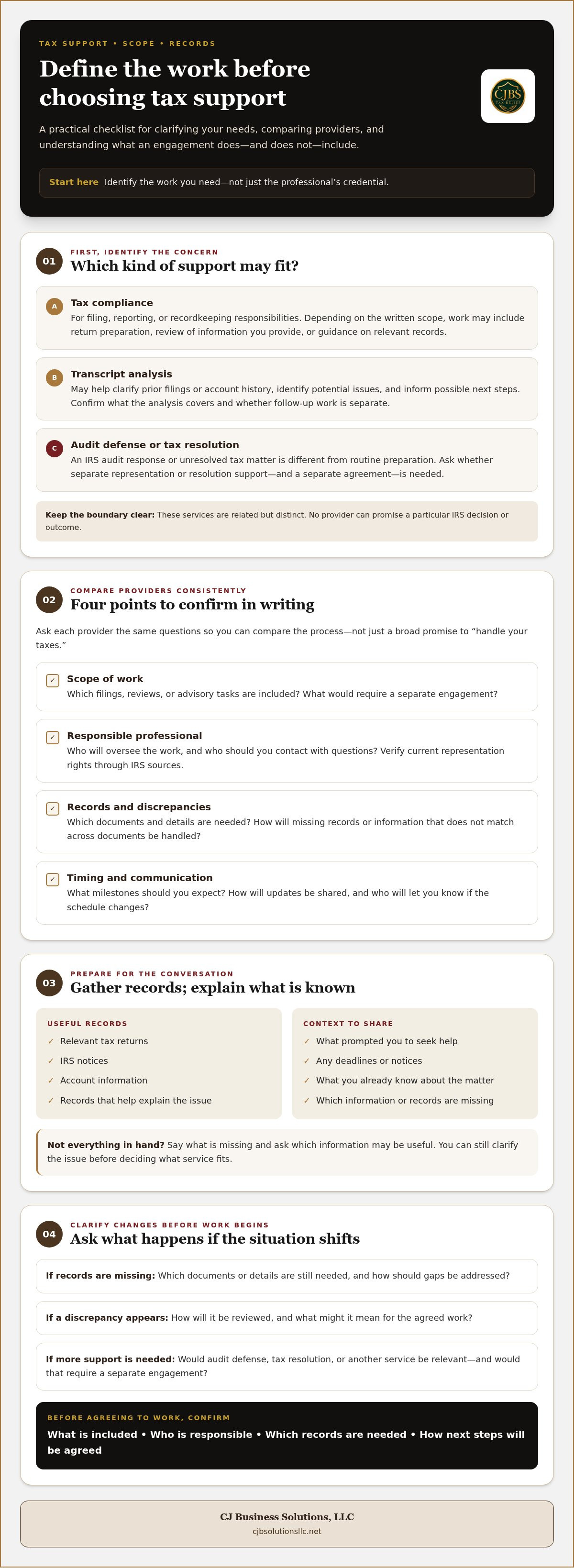
Start with the written scope rather than a broad promise to “handle your taxes.” Enrolled Agent tax compliance services can differ in the work included, the records available, and the complexity of your situation. Ask each provider the same questions so you can compare the responses:
- Scope: Which filings, reviews, or advisory tasks are included? What would require a separate engagement?
- Responsible professional: Who will oversee the work, and who should you contact with questions? The IRS explains the Enrolled Agent designation and practice information on its page about the highest credential the IRS awards.
- Records: Which documents and details are needed? Ask how the provider will address missing records or information that does not match across documents.
- Timing and communication: What milestones should you expect, how will updates be shared, and who will tell you if the schedule changes?
If earlier filings or account activity are unclear, ask whether transcript analysis could help identify potential issues and inform next steps. Confirm what the analysis covers and whether any follow-up work would be separate.
Questions to ask before engaging a tax compliance provider
Ask which specific filings, reviews, or advisory tasks the engagement includes. Then ask what happens if records are missing, a discrepancy comes to light, or the work reveals a need beyond the agreed scope. Clear answers help you understand the process and when additional support may be appropriate.
Routine preparation is not the same as responding to an IRS audit or addressing tax debt. If you have an audit notice, collection concern, or unresolved account issue, ask whether you need audit defense or tax resolution rather than compliance work alone. If transcript analysis may help clarify your tax history, learn about transcript analysis services from CJ Business Solutions.
What to expect when working with CJ Business Solutions
A focused first conversation can help establish whether your concern is preparing a return, understanding prior account activity, or responding to an IRS matter. Explain what prompted you to seek help, mention any deadlines or notices, and describe what you already know. This helps clarify the issue before you decide which service, if any, fits.
Prepare records and clarify the next step
Gather relevant tax returns, IRS notices, and account information, along with records that help explain the issue. If you do not have everything, say what is missing. You can still ask which information may be useful. CJ Business Solutions can discuss whether tax compliance, transcript analysis, or another service is relevant to your circumstances.
Transcript analysis may help identify tax issues and inform possible next steps when prior filings or account history need review. If the concern involves an audit, ask about the firm’s IRS audit strategy defense. If it involves unresolved tax matters, tax resolution may be more relevant. These services are distinct, so confirm the engagement scope before work begins.
Before proceeding, confirm what Enrolled Agent tax compliance services would include in your case, who will be responsible, which records are needed, and how the next steps will be agreed. The National Association of Enrolled Agents (NAEA) directory can also be a reference when researching Enrolled Agent professionals.
If you’d like to explore whether the firm’s tax and accounting services fit your needs, you can review CJ Business Solutions’ services and raise your questions directly. The appropriate path depends on your records and circumstances. No particular savings, resolution, or IRS decision can be promised.
Choose support that fits your tax situation
The right Enrolled Agent tax compliance services should have a clearly defined scope, a responsible professional, and a process that fits your records and needs. Before agreeing to work, clarify whether you need routine tax preparation, transcript analysis to review account history, or separate support for an audit or unresolved tax matter. These services are related, but they address different concerns.
CJ Business Solutions is led by an Enrolled Agent and offers tax and accounting services, transcript analysis, IRS audit strategy defense, and tax resolution. Which service is appropriate depends on your circumstances. Discussing your concern and confirming the engagement scope can help establish a suitable next step.
Discuss your tax compliance needs with CJ Business Solutions and ask whether its services may fit your situation. A clear conversation can help you understand the next step.
Frequently Asked Questions
What tax compliance services can an Enrolled Agent provide?
An Enrolled Agent may provide tax preparation and support with applicable filing, reporting, and recordkeeping responsibilities. The specific work depends on your situation and the engagement agreement, so confirm which returns or tasks are included. Routine compliance is distinct from IRS audit defense or tax resolution, and not every Enrolled Agent offers the same services.
Can an Enrolled Agent represent me before the IRS?
An Enrolled Agent may be able to represent taxpayers before the IRS, but confirm current IRS rules and the professional’s status before relying on that authority. Ask whether the practitioner can represent you for your specific matter and what the engagement covers. Representation can help you address an IRS issue, but it doesn’t guarantee a favorable decision.
How do I choose an Enrolled Agent for tax compliance?
Compare relevant experience, the written engagement scope, document requirements, timelines, and communication practices. Ask which filings or reviews are included and how missing records or discrepancies will be handled. Explain your concern and ask whether it calls for routine compliance, audit defense, or tax resolution so you understand the proposed next steps.
When should I seek help with tax compliance instead of tax resolution?
Tax compliance generally focuses on meeting filing and reporting responsibilities, while tax resolution addresses existing tax problems. If you’re unsure which applies, gather relevant returns, IRS notices, and account information for review. The needs can overlap, so a provider may need to examine your records and account history before recommending whether compliance support, transcript analysis, or resolution is appropriate.

Article by
Crystal R. Johnson, MBA EA
Crystal Johnson founded CJ Business Solutions to give individuals and small-business owners something often missing from the tax and accounting process: clear explanations, practical solutions, and trusted support.
With more than 27 years of accounting and financial experience, Crystal helps clients understand complicated tax matters, restore compliance, respond to IRS concerns, and make stronger business decisions. As an Enrolled Agent, she is federally authorized to represent taxpayers before the Internal Revenue Service.


