

What if the balance on your IRS notice needs a closer look before you decide what to do? A notice can be unsettling, especially when you’re unsure whether the amount is accurate or how quickly charges may grow. The fear of IRS penalties and interest is understandable, but reviewing your account can help turn uncertainty into practical next steps.
This article explains how to read an IRS balance, distinguish penalties from interest, and gather records to assess your situation. You’ll also learn how payment arrangements and penalty-relief options differ, and why relief doesn’t necessarily stop interest from accruing. A straightforward account may be manageable on your own. If the records, notices, or resolution choices are more complex, transcript analysis and Enrolled Agent representation can help you understand the account and evaluate your options.
Key Takeaways
- The fear of IRS penalties and interest can feel more manageable when you separate penalty charges from interest and use the notice and account record to guide your response.
- Review the notice, verify account activity, identify each charge, note deadlines, and gather relevant tax and payment records before deciding what to do.
- An IRS account transcript can help clarify assessments, payments, and other activity, but individual codes need to be considered in context.
- Compare possible relief and payment options carefully. An Enrolled Agent can help assess complex records and resolution decisions, without promising a particular outcome.
Fear of IRS penalties and interest: understand what the notice says
An IRS balance notice can be unsettling, particularly if you’re unsure whether the amount is correct or whether it will grow. The fear of IRS penalties and interest is understandable, but the notice and your account history are more useful than assumptions about what a balance means. Penalties are charges tied to specific tax-compliance failures. Interest is separate and can accrue on unpaid tax and penalties. Because these are distinct charges, penalty relief does not necessarily stop interest from accruing on the remaining tax debt.
A general overview of Back taxes also describes how unpaid tax can involve penalties, interest, and collection activity. To understand your own situation, start with the specific issue and response deadline shown on your notice.
Which IRS notice details should you review first?
Locate the tax period, stated balance, notice date, and response deadline. These details identify which return or account the notice concerns and how much time you have to respond. Notices can address different issues, such as unpaid tax, a proposed adjustment, or a penalty, so don’t assume every balance has the same cause.
Next, compare the notice with the return you filed for that period and your payment records. For example, if a payment doesn’t appear in the notice’s calculation, its confirmation may help explain why the balance differs from your records. Gather the relevant return, payment confirmations, and earlier IRS correspondence before deciding whether the amount is correct. If the figures still don’t align, an account transcript can add context about assessments and account activity. Treat any transcript code as a clue, not a complete explanation of the balance.
How to respond to IRS penalties and interest, step by step
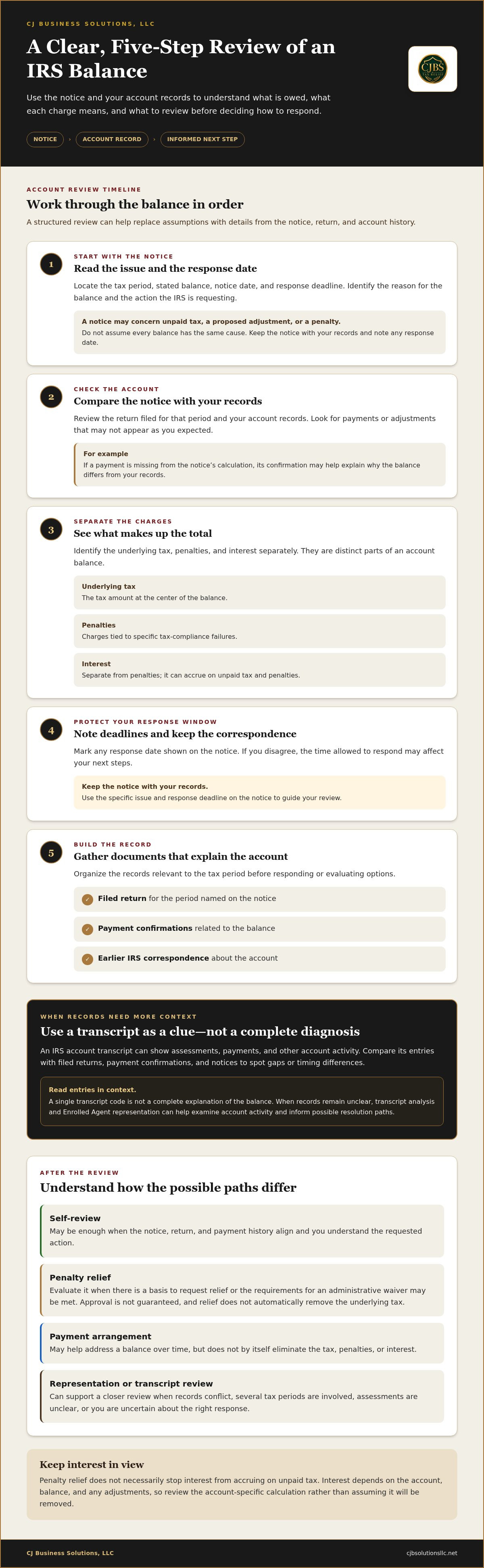
The fear of IRS penalties and interest can make it tempting to act quickly. A short review helps you base your response on the account record instead. Verify the balance against your IRS account and note the response deadline stated on the notice. The notice explains the issue and any action or response date that applies.
- Read the notice closely. Identify the tax period, the reason for the balance, and the action the IRS is requesting.
- Verify the account. Compare the amount with your return and account records. Look for payments or adjustments that may not be reflected as you expected.
- Identify each charge. Separate the underlying tax from penalties and interest so you can see what makes up the total.
- Note deadlines. Mark any response date and keep the notice with your records. If you disagree, the time allowed to respond may affect your next steps.
- Organize supporting documents. Gather filed returns, payment confirmations, and relevant IRS correspondence before responding or evaluating options.
When can transcript analysis help clarify the balance?
An IRS account transcript can show assessments, payments, and other account activity. Compare its entries with your filed returns, payment confirmations, and notices to spot gaps or timing differences. A single transcript code isn’t a complete diagnosis; the entries need to be read in context. CJ Business Solutions provides transcript analysis to identify tax issues and inform possible resolution paths.
If the records remain unclear, CJ Business Solutions’ tax resolution services can help you review the account and consider a response. If you’re assessing whether a penalty may qualify for relief, the IRS explains its criteria and procedures in its IRS Penalty Relief Options. Review the account facts first, then weigh any option against the notice and your records.
Compare IRS penalty relief and payment options
Once you understand the account, choose a path that fits the facts rather than the fear of IRS penalties and interest. If the notice matches your records and the issue is straightforward, self-review may be enough to decide what to do next. If a penalty appears incorrect or you may qualify for relief, review the IRS criteria and request process. Relief is conditional, may apply only to eligible penalties, and doesn’t automatically remove the underlying tax owed.
- Self-review: Useful when the notice, return, and payment history align and you understand the requested action.
- Penalty relief: Worth evaluating when you have a basis to request relief or meet an administrative waiver’s requirements. Approval isn’t guaranteed.
- Payment arrangement: May help address a balance over time, but it doesn’t by itself eliminate the tax, penalties, or interest.
- Representation: Can support a more involved review when records conflict or you’re uncertain about the right response.
Interest is separate from penalty relief. How it applies depends on the account, the balance, and any adjustments. Relief from a penalty doesn’t necessarily stop interest on unpaid tax. The IRS explains how interest applies and when it may be disputed in its IRS Interest on Underpayments guidance. Review the account-specific calculation rather than assuming interest will be removed.
When might an Enrolled Agent or transcript review be useful?
A closer review can be useful if records don’t agree, several tax periods are involved, assessments are unclear, or you’re unsure which response fits. CJ Business Solutions’ Enrolled Agent-led representation and transcript analysis can help examine account activity and inform possible resolution paths. To discuss support for evaluating your options, contact CJ Business Solutions.
Take the Next Step With a Clearer View of Your IRS Account
The fear of IRS penalties and interest doesn’t have to determine your next move. Start by identifying what remains uncertain and what information could help resolve it. If your account involves multiple tax periods, unclear assessments, or difficult response choices, a focused review can help you understand the issues and consider your next steps.
CJ Business Solutions is led by an Enrolled Agent and provides transcript analysis to identify tax issues and consider possible resolution paths, along with tax resolution and IRS audit defense services. The goal is to understand the circumstances and assess appropriate options, not to promise a particular result. Contact CJ Business Solutions to discuss your IRS account and tax resolution options.
Frequently Asked Questions
Can IRS penalties be removed while interest remains?
Yes, the IRS may approve relief from an eligible penalty while tax and other charges remain due. If a penalty is adjusted or removed, related interest may also be recalculated, but interest on unpaid tax generally follows the account balance and applicable IRS rules. The fear of IRS penalties and interest can ease with a careful review, but relief isn’t assured. Check how any adjustment affects your specific account.
Does filing a tax extension prevent IRS penalties and interest?
No. An extension generally gives you more time to file, not more time to pay tax due. For example, if you expect to owe but can’t pay in full, file an accurate return by the extended filing deadline and pay what you can by the applicable payment deadline. Interest and applicable penalties may still apply to an unpaid balance. Check current IRS instructions for your filing situation.
Can I dispute an IRS penalty if I believe the notice is wrong?
Yes, you can respond if you believe the penalty is incorrect, but the right process depends on the notice and your circumstances. For example, if the charge appears to overlook a payment, gather its confirmation alongside the relevant return and account records. Follow the notice’s response instructions and deadline, and explain the specific discrepancy. The IRS may review a dispute, but a reversal isn’t guaranteed.
Will an IRS payment plan stop interest from accruing?
Not necessarily. Interest may continue on an unpaid balance under current IRS rules, even while you make payments. An approved installment agreement can reduce the failure-to-pay penalty rate to 0.25% per month while the agreement applies, but it doesn’t mean interest stops. Review the plan’s terms and current IRS guidance to understand how charges and payments apply to your account.

Article by
Crystal R. Johnson, MBA EA
Crystal Johnson founded CJ Business Solutions to give individuals and small-business owners something often missing from the tax and accounting process: clear explanations, practical solutions, and trusted support.
With more than 27 years of accounting and financial experience, Crystal helps clients understand complicated tax matters, restore compliance, respond to IRS concerns, and make stronger business decisions. As an Enrolled Agent, she is federally authorized to represent taxpayers before the Internal Revenue Service.


