

Could a relief option that sounds right on paper be a poor fit for your tax situation? When it comes to IRS tax relief programs eligibility, details matter. Similar-sounding options can have very different requirements, and owing a balance alone doesn’t determine which path may be available. It’s understandable to feel uncertain about what the IRS will review or whether asking questions could complicate an unresolved account.
This guide explains how eligibility differs across installment agreements, Offers in Compromise, penalty relief, and Currently Not Collectible status. You’ll learn why filing history, income, assets, and ability to pay can matter, and which records to gather before taking action. We’ll also explain how an IRS transcript review can clarify your account history and when a professional assessment may help you evaluate possible next steps without assuming you’ll qualify for a particular option.
Key Takeaways
- IRS tax relief programs eligibility varies by option. Compare payment plans, Offers in Compromise, Currently Not Collectible status, and penalty relief with your circumstances.
- For financial relief options, consider how income, allowable expenses, assets, liabilities, and ability to pay may affect the IRS’s assessment.
- Check whether required returns and payments are current, since compliance can affect access to particular relief programs.
- Gather IRS notices and financial records, then review your account transcripts to confirm filing history, balances, and account activity before choosing a next step.
Which IRS tax relief programs may fit your situation?
More than one path may be worth considering. The appropriate option depends on the issue, your IRS account status, and your circumstances, including whether you can pay over time or whether paying would create hardship. IRS tax relief programs eligibility rules differ, so a screening result or an available application is not a promise of approval.
What does each IRS relief option address?
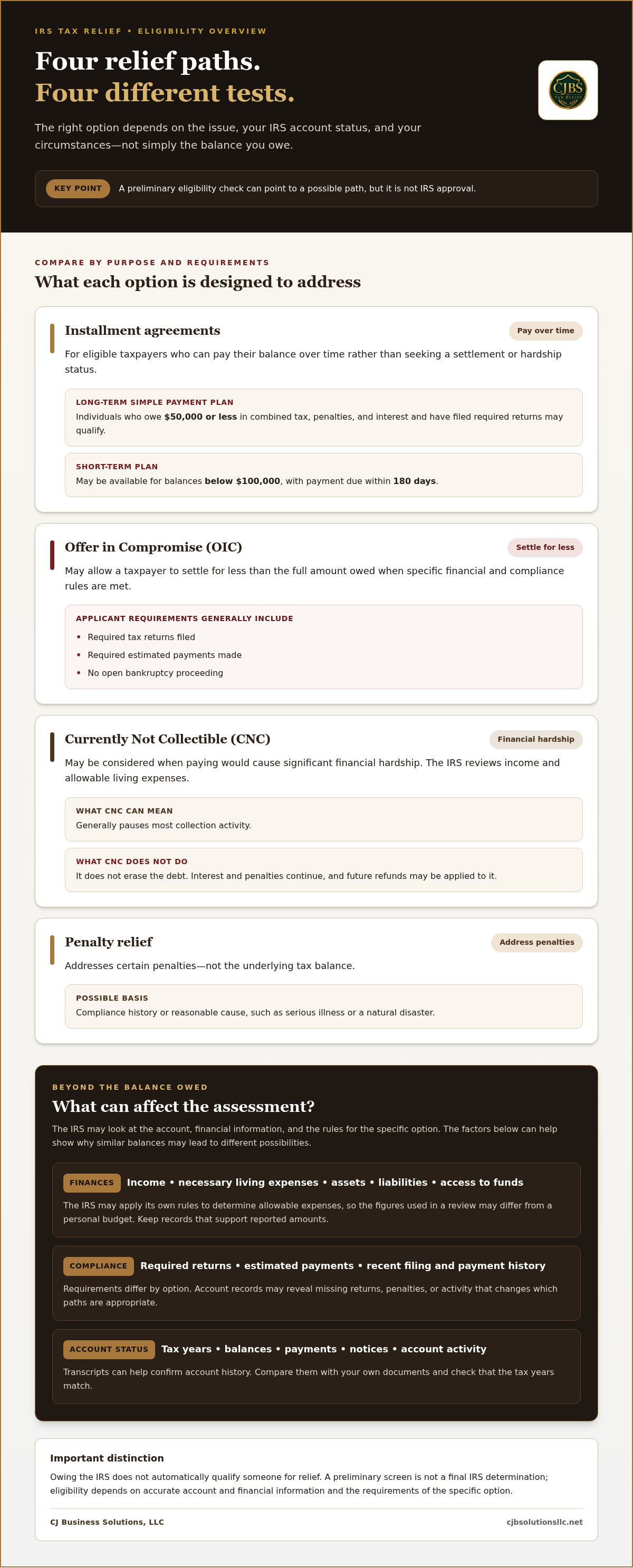
Installment agreements let eligible taxpayers pay a balance over time. For example, individuals who owe $50,000 or less in combined tax, penalties, and interest and have filed required returns may qualify for a long-term Simple Payment Plan. A short-term plan may be available for balances below $100,000, with payment due within 180 days. These options are worth comparing if you can pay the balance over time rather than seeking a settlement or hardship status.
An Offer in Compromise (OIC) may allow a taxpayer to settle for less than the full amount owed when specific financial and compliance rules are met. Applicants generally must have filed required returns, made required estimated payments, and not be in an open bankruptcy proceeding. The Offer in Compromise overview provides additional background, but the IRS decides each application based on its rules and the taxpayer’s circumstances.
Currently Not Collectible (CNC) status may be considered when paying would cause significant financial hardship. The IRS reviews income and allowable living expenses. CNC status generally pauses most collection activity, but it doesn’t erase the debt. Interest and penalties continue, and future refunds may be applied to it.
Penalty relief addresses certain penalties, not the underlying tax balance. A taxpayer may qualify based on compliance history or reasonable cause, such as serious illness or a natural disaster. If your concern is a penalty rather than the balance itself, distinguish that issue from options intended to address payment. Each option has distinct requirements, so treat an initial eligibility check as a starting point, not a final IRS determination.
What factors affect IRS tax relief program eligibility?
The IRS looks beyond the amount owed when assessing financial relief. Income and necessary living expenses help show what you can reasonably pay, while assets, liabilities, and access to available funds may also affect the assessment. The agency may apply its own rules to determine which expenses are allowable, so your personal budget may not match the figures used in a review. Keep records that support the income, expenses, assets, and liabilities you report.
Filing and payment compliance matter, too. Some options require required returns to be filed or estimated tax payments to be current; other relief paths may consider your recent filing and payment history. Account records can reveal missing returns, penalties, or activity that changes which options are appropriate. For a high-level overview of IRS options to resolve a tax debt, consult the agency’s current guidance. Requirements can differ by option and change over time, so verify the applicable criteria before relying on a general description.
Does owing the IRS automatically qualify you for relief?
No. A balance by itself doesn’t establish eligibility for a settlement or hardship status. The IRS may consider account status, financial disclosures, filing history, and the rules for the specific option. For example, the same debt may present differently for someone with funds to make regular payments than for someone whose documented income is largely used for allowable expenses.
Possible eligibility is not IRS approval. A preliminary screen can help identify a potential path, but it doesn’t replace the agency’s review of your records and application. Reviewing transcripts can help clarify account activity before you assess your circumstances. If you’d like help understanding those records, transcript analysis services may be a useful part of your preparation.
How can you check eligibility and choose a sound next step?
A careful review can make the options easier to compare. Before applying, work through these steps:
- Identify IRS notices. Note the tax years involved, response dates, and any collection or payment instructions.
- Check filing status. Confirm which required returns have been filed and whether any estimated payments may be outstanding.
- Gather financial records. Collect recent income information, monthly expenses, details about assets and liabilities, and records of payments made to the IRS.
- Compare options with your circumstances. Consider whether you can pay over time, whether paying would create hardship, or whether penalty relief may address your issue.
Next, review your IRS account information and transcripts. These records can help confirm posted returns, balances, payments, and account activity. Compare them with your own documents, and check that you’re reviewing the correct tax years. If details don’t match or a notice is unclear, resolve those questions before relying on an eligibility estimate. An IRS tax relief programs eligibility assessment depends on accurate account and financial information, as well as the rules for the option being considered.
When can transcript analysis or representation help?
Transcript analysis may be useful when account history is incomplete, a payment appears missing, or you’re unsure how the IRS calculated a balance. An Enrolled Agent-led review can help interpret account details and evaluate potential resolution paths. That guidance can inform your next steps, but it isn’t a final IRS determination and can’t guarantee approval or a particular result.
If your records or options remain unclear, you may wish to discuss tax resolution and transcript analysis with CJ Business Solutions, LLC. A measured review can help you understand your account before deciding how to proceed.
Take a Clear Next Step With Your IRS Account
IRS tax relief programs eligibility depends on more than the amount owed. The right path may turn on your filing and payment history, financial circumstances, and the details reflected in your IRS account. Reviewing notices and transcripts can help confirm balances, posted payments, and account activity before you decide how to proceed. An initial assessment can clarify potential options, but only the IRS can determine whether a specific application is approved.
If the account history or eligibility picture remains unclear, a focused review may help you prepare. CJ Business Solutions, LLC provides Enrolled Agent-led tax representation and audit defense, along with transcript analysis to help identify account issues and inform resolution planning. Discuss your IRS tax situation with CJ Business Solutions, LLC to consider a practical next step. With accurate records and a clearer understanding of your options, you can move forward with greater confidence.
Frequently Asked Questions
Can I qualify for IRS tax relief if I owe back taxes?
Owing back taxes doesn’t, by itself, establish eligibility for IRS relief. IRS tax relief programs eligibility depends on the type of relief, your account status, whether required returns and payments are current, your financial circumstances, and the applicable IRS criteria. Review notices and account transcripts to confirm balances and filing history before assuming you qualify or choosing an option.
What income qualifies for an IRS Offer in Compromise?
There is no single income figure that guarantees qualification for an Offer in Compromise. The IRS evaluates your financial circumstances under its current rules, including income, allowable expenses, assets, and ability to pay. Filing compliance and other program requirements can also apply. Check current IRS guidance and treat any estimate as a preliminary indicator, not a promise of acceptance.
Can I get IRS relief if I cannot afford to pay my tax debt?
Possibly. If you can’t afford to pay, an installment agreement or hardship option may be worth reviewing, but inability to pay doesn’t automatically qualify you for a specific program. The IRS assesses your circumstances under that option’s rules. Currently Not Collectible status doesn’t erase the balance. Interest and penalties may continue, and future refunds may be applied to the debt.
Do I have to file all required tax returns to qualify for IRS relief?
For some relief options, yes, filing all required returns is an eligibility condition, but requirements vary by program and situation. Identify any missing returns and confirm current IRS rules before applying. Gather notices and account records, including transcripts, to help distinguish unresolved filing issues from payment questions and support an informed review of which options may be available.

Article by
Crystal R. Johnson, MBA EA
Crystal Johnson founded CJ Business Solutions to give individuals and small-business owners something often missing from the tax and accounting process: clear explanations, practical solutions, and trusted support.
With more than 27 years of accounting and financial experience, Crystal helps clients understand complicated tax matters, restore compliance, respond to IRS concerns, and make stronger business decisions. As an Enrolled Agent, she is federally authorized to represent taxpayers before the Internal Revenue Service.


