

What should you do first when an IRS notice raises a question about your return or account? Before sending documents or making a payment, identify the notice type, the tax year, the issue, the action requested, and the response date. Resolving IRS tax disputes starts with understanding the specific issue, not assuming the notice tells the whole story. A rushed or incomplete response can make it harder to address the matter clearly.
This guide explains how to review a notice, gather records that may clarify the facts, and compare possible next steps. You’ll learn how transcript analysis can add context about your IRS account, when professional representation may be useful, and how to keep your response focused without assuming a particular outcome.
Key Takeaways
- Identify the notice type, tax year, issue, requested action, and response date before deciding how to respond.
- Check the facts and gather relevant returns, receipts, payment records, and prior correspondence before choosing a response.
- IRS transcript analysis may help clarify account history and identify entries that need further review.
- Compare response or review options with the complexity of your issue and its deadlines. Consider whether an Enrolled Agent or other qualified representative is appropriate.
Resolving IRS Tax Disputes Starts With Identifying the Issue
An IRS tax dispute is a disagreement or unresolved issue involving a federal tax account or determination. The term covers different situations, and each may follow a different process. A notice may request information or explain a proposed change. An audit examines reported information. A collection matter concerns a balance or collection action. An account discrepancy may involve a payment or other record that doesn’t match your documents.
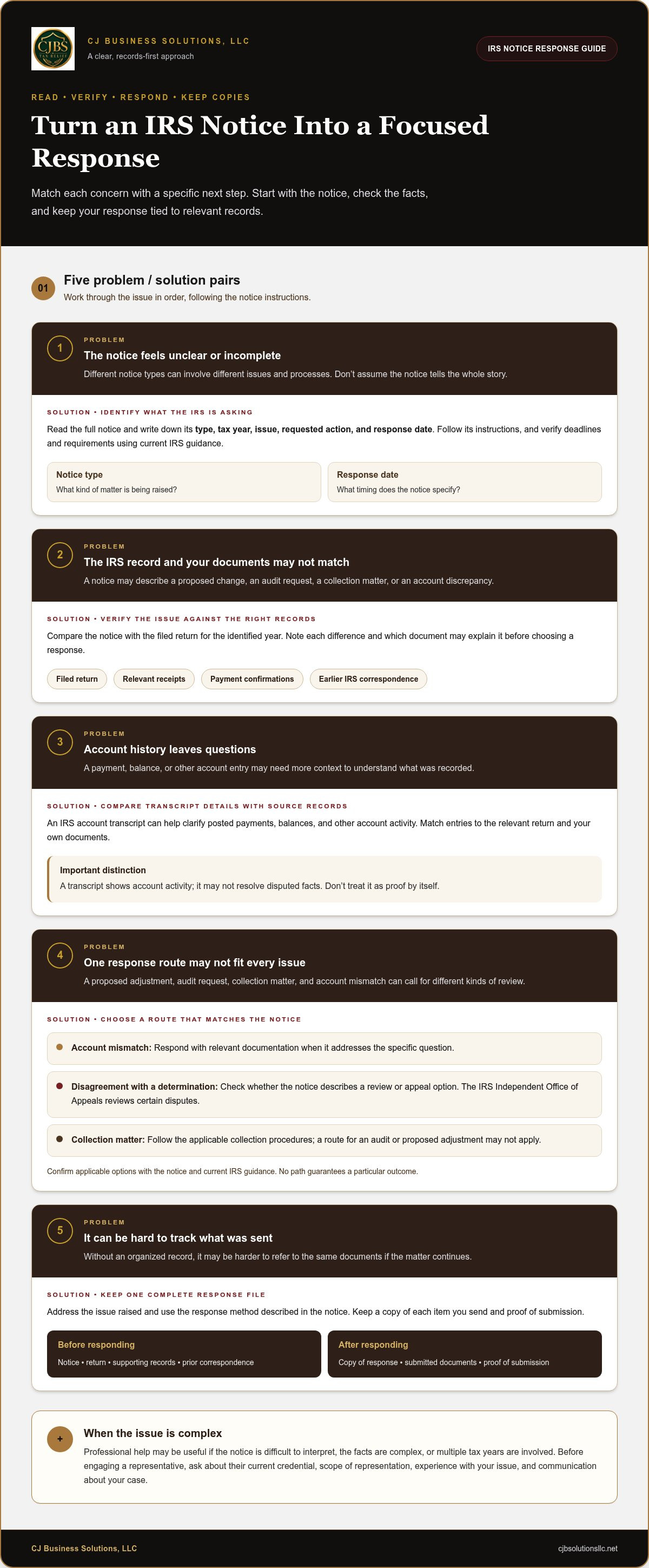
Start with the notice. Write down its type, the tax year, the issue described, the action requested, and any response date. This helps you distinguish what the IRS is asking from what you need to investigate. If you’re unsure about your account history, transcript analysis may help clarify what the IRS has recorded and identify entries to review.
What should you check on an IRS notice first?
Read the full notice and follow its instructions. Verify any response deadline using current IRS guidance, since timing and procedures depend on the notice and issue. Then compare the notice with the filed return for that year, relevant receipts or payment confirmations, and earlier IRS correspondence. Make a note of each difference and the document that may help explain it before deciding how to respond.
The notice type and stated response deadline shape the next step. A proposed adjustment, an audit request, and a collection notice call for different kinds of review. Don’t assume instructions for one apply to another. If you disagree with a determination, the Independent Office of Appeals is a separate IRS path for reviewing certain disputes. Check the notice and current IRS guidance to confirm which options apply to your situation.
How to Respond to an IRS Tax Dispute Without Losing Track
A clear process keeps your response focused on the issue instead of sending documents without context. Follow the notice instructions, and check current IRS guidance for deadlines and submission requirements. Keep a copy of each item you send so you can refer to the same records if the matter continues.
- Read the instructions: Identify what the IRS asks you to do and how to respond.
- Verify the issue: Compare the notice with the return and tax year it identifies. Note what appears inconsistent and what records could help explain the difference.
- Gather relevant records: Collect filed returns, receipts, payment confirmations, and prior IRS correspondence related to the specific question.
- Choose a response: Address the issue raised and use the response method described in the notice. If it remains unresolved, check whether another review option applies. The IRS Independent Office of Appeals provides information about the IRS appeals process.
- Keep copies: Save the notice, supporting documents, your response, and any proof of submission together for reference.
How do records and transcripts support a dispute response?
Returns and source documents help show what you reported and why. A receipt may support a claimed expense, while a payment confirmation may help investigate a balance that appears inconsistent with your records. An IRS account transcript can help clarify posted payments, balances, and other account activity. Compare transcript details with IRS guidance and your own documents.
A transcript can show account activity, but it may not resolve disputed facts. Match entries to the relevant return and source records rather than treating the transcript as proof by itself. For help understanding account history, IRS transcript analysis services may be a useful professional resource. This approach helps keep resolving IRS tax disputes organized and your response tied to verifiable information.
Which IRS Dispute Resolution Path Fits Your Situation?
The appropriate path depends on what the IRS is disputing, what your records show, and what the notice allows. A straightforward account mismatch may be addressed by responding with relevant documentation. If you disagree with a determination, the notice may describe a review or appeal option. Collection matters follow their own procedures, so a response route available for an audit or proposed adjustment may not apply.
Before choosing a path, confirm the notice instructions and applicable requirements with current IRS guidance. Consider the issue, the records supporting your position, the response deadline, and whether several tax periods or complicated facts are involved. These details can help you decide whether to prepare a response yourself, request an appropriate review, or consult a qualified representative. No path guarantees a particular outcome.
When should you consider an Enrolled Agent for IRS representation?
Professional help may be useful if the notice is difficult to interpret, the facts are complex, or multiple tax years are involved. Before engaging a representative, ask about their current credential, the scope of representation they can provide, their experience with your type of issue, and how they’ll communicate about your case. These questions can help you assess whether their support fits your needs.
CJ Business Solutions, LLC offers IRS transcript analysis to help clarify account activity and identify issues for further review, along with Enrolled Agent-led tax resolution and audit-defense services. Transcript information can inform a response, but it doesn’t determine which resolution path applies. Resolving IRS tax disputes means matching the next step to the notice, facts, and applicable procedure. You can review CJ Business Solutions' tax resolution services as one resource while considering your options.
Choose Your Next Step With Clear Information
Resolving IRS tax disputes begins with understanding what the notice concerns, which records can clarify the facts, and what response options apply. Keep the notice and supporting documents organized, and verify instructions and deadlines before acting. If the issue is complex or the right path remains unclear, professional guidance may help you assess your next step.
CJ Business Solutions, LLC is led by an Enrolled Agent and offers transcript analysis and IRS audit-defense services. These services can help clarify account activity and inform your review, without guaranteeing a particular outcome. A careful response based on the notice and relevant records can help you move forward with a clearer understanding of the issue.
Frequently Asked Questions
What should I do first when I disagree with an IRS notice?
Read the entire notice and identify the tax year, issue, requested action, and response date. Follow its instructions, then verify current requirements with IRS guidance. Compare the notice with your filed return, payment records, and related correspondence. Resolving IRS tax disputes starts with understanding what the IRS is asking, so avoid sending unrelated documents or assuming another notice’s procedures apply.
Can I resolve an IRS tax dispute without a professional?
You may be able to respond on your own when the issue is straightforward, you understand the notice’s instructions, and you can support your position with relevant records. Keep copies of what you send and verify the applicable deadline. If the facts are complicated, several tax years are involved, or the response path is unclear, consider consulting a qualified tax professional before proceeding.
How do IRS transcripts help resolve a tax dispute?
An IRS transcript can show recorded account activity, such as certain postings, payments, or balance information, and may help identify details to investigate. Compare the entries with your filed return, payment confirmations, and other source documents. A transcript reflects information recorded by the IRS, but it may not explain why an entry is disputed or establish every underlying fact.
When should I hire an Enrolled Agent for an IRS dispute?
Consider an Enrolled Agent if the notice is difficult to interpret, the facts are complex, multiple tax periods are involved, or you need help understanding the available response options. Before engaging a representative, confirm their current credential, representation scope, and experience with your issue. CJ Business Solutions, LLC is led by an Enrolled Agent and offers transcript analysis and IRS audit-defense services, without promising a particular result.
If you’d like professional input on your circumstances, request a review of your IRS tax situation.

Article by
Crystal R. Johnson, MBA EA
Crystal Johnson founded CJ Business Solutions to give individuals and small-business owners something often missing from the tax and accounting process: clear explanations, practical solutions, and trusted support.
With more than 27 years of accounting and financial experience, Crystal helps clients understand complicated tax matters, restore compliance, respond to IRS concerns, and make stronger business decisions. As an Enrolled Agent, she is federally authorized to represent taxpayers before the Internal Revenue Service.


